
Your React app ships 42 KB of JavaScript just to say “Hello World.” A Svelte app does it in 1.6 KB.
That’s not a benchmark curiosity. It’s the kind of decision that compounds across every page, every user, every Core Web Vital score — and ultimately, every conversion your frontend either wins or loses.
After building 1,700+ projects across React, Angular, Vue, Svelte, and newer entrants like Astro and Qwik, our team has learned something the benchmark tables won’t tell you: the best frontend framework is the one that matches your team, your timeline, and your product’s actual constraints. Not the one with the most GitHub stars.
This guide breaks down 12 production-relevant frontend frameworks in 2026, backed by data from the Stack Overflow 2025 Survey (49,000+ developers), State of JS 2025, npm download trends, and performance benchmarks — plus what we’ve seen work (and fail) across real enterprise deployments.
Show
- React leads with 44.7% developer usage and powers 57.2% of framework-using websites, making it the industry default — not because it’s the best, but because its ecosystem depth and hiring pool make it the lowest-risk choice for large organizations.
- Svelte ships ~1.6 KB gzipped compared to React’s ~42 KB — a 96% reduction — and holds the highest developer satisfaction at 62.4% admiration and 91% retention rate in State of JS 2025.
- In 2026, the meta-framework has become the default entry point: 78% of new React apps use Next.js, and choosing a framework increasingly means choosing its meta-framework (React → Next.js, Vue → Nuxt, Svelte → SvelteKit).
- AI coding tools like Cursor and GitHub Copilot are writing 30–60% of frontend code in many teams — and React/Next.js benefit most due to the largest training data corpus, creating a compounding advantage for these frameworks.
- Framework selection should match your team’s expertise, hiring plans, performance requirements, and timeline — not GitHub star counts; the blog’s decision matrix maps 10 distinct project situations to the right framework choice.
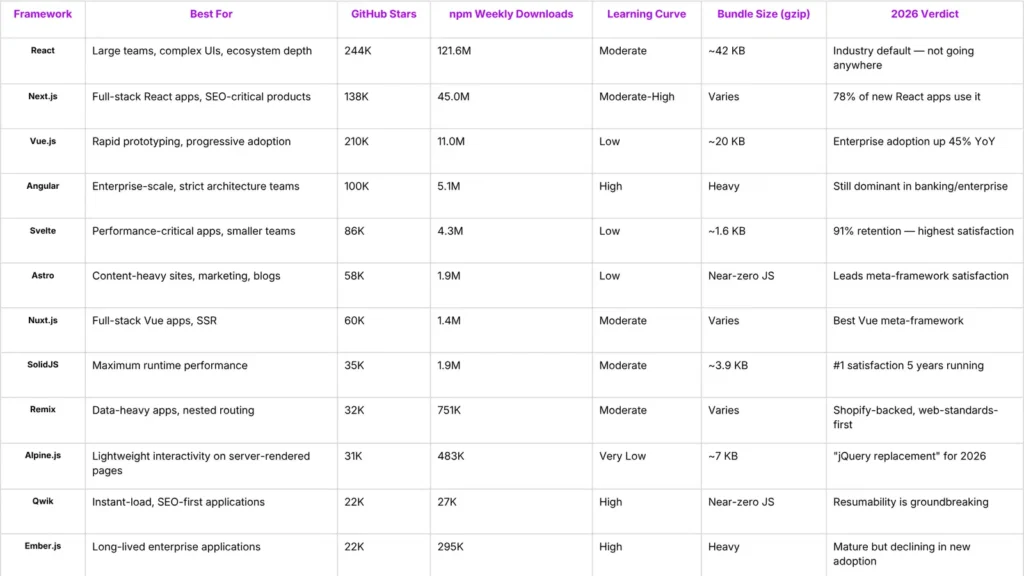
Quick Comparison: 12 Best Frontend Frameworks at a Glance (2026)
How We Evaluated These Frameworks
Most “best frameworks” lists rank by popularity. We ranked by production readiness — what actually matters when you’re shipping software that users depend on.
Our evaluation criteria, drawn from building enterprise applications across all of these frameworks:
- Ecosystem maturity — Library availability, tooling support, and third-party integration depth
- Performance at scale — Not just benchmarks, but real-world Lighthouse scores and Core Web Vitals across production deployments
- Developer experience — Hiring availability, learning curve, and how fast a team of 5-10 engineers can ship features
- Enterprise readiness — TypeScript support, testing infrastructure, security patterns, and long-term maintenance viability
- 2026 trajectory — Community momentum, corporate backing, and whether the framework is gaining or losing developer mindshare
Explore Solutions
Intuz Web Development ServicesBest Frontend Frameworks
1. React — The Industry Default That Earned Its Position
Created by: Meta (2013)
Latest: React 19
Usage: 44.7% of developers (Stack Overflow 2025)
Market share: 57.2% of framework-using websites
GitHub Stars: 244K
npm Downloads: 121.6M/week
Used by: Meta, Netflix, Airbnb, Uber, Amazon, PayPal, Tesla, Spotify, Disney+
React isn’t the best frontend framework because it’s the most popular. It’s the most popular because it solved a real problem — building complex, interactive UIs with a component model that scales — and then built the deepest ecosystem in frontend development around that solution.
With React 19, the framework introduced Server Components and Actions natively, blurring the line between frontend and backend. The concurrent rendering model means your UI stays responsive even during expensive operations.
When to use React
- Building complex, stateful applications with large engineering teams
- Projects requiring deep ecosystem support (charting, forms, animation, state management – React has a library for everything)
- Products where hiring matters — you’ll find 10 React developers for every 1 Svelte developer
- When your team already knows React (switching costs are real)
When NOT to use React
- Simple content sites where you’re shipping JavaScript that users don’t need
- Projects where bundle size directly impacts conversion (every KB counts in e-commerce)
- Small teams building MVPs who need speed over ecosystem depth — Vue or Svelte will get you there faster
Performance note
React’s ~42 KB gzipped bundle is the largest among modern frameworks. In our experience, this matters less for complex SPAs (where React’s rendering optimizations shine) and more for content-heavy sites (where you’re paying a tax for interactivity you don’t need).
Our experience
React remains the default recommendation for enterprise clients with existing React teams or complex product requirements. It’s not the fastest, lightest, or easiest to learn — but the ecosystem depth and hiring pool make it the lowest-risk choice for large organizations.
2. Next.js — Where Most New React Apps Actually Live
Created by: Vercel (2016)
Latest: Next.js 15
Usage: 59% of developers (State of JS 2025)
78% of new React apps use Next.js
GitHub Stars: 138K
npm Downloads: 45.0M/week
Used by: Vercel, TikTok, Netflix, OpenAI (ChatGPT), Nike, Starbucks, GitHub, Notion, Target
Here’s the reality most framework comparisons won’t tell you: if you’re choosing React in 2026, you’re probably choosing Next.js. It jumped from the 11th to the 4th most-used web framework between 2022 and 2026, and 78% of new React projects now start with Next.js.
Next.js gives you what React alone doesn’t — server-side rendering, static site generation, API routes, image optimization, and a deployment pipeline that works out of the box. App Router with Server Components means you can render on the server by default and send JavaScript to the client only when interactivity is required.
When to use Next.js
- SEO-critical applications where server-rendered HTML matters (e-commerce, content platforms, marketing sites)
- Full-stack applications where you want one framework for the frontend and API
- Teams that want React’s ecosystem with production-grade infrastructure included
- Projects deploying to Vercel (optimized path) or any Node.js hosting
When NOT to use Next.js
- Pure client-side SPAs where SSR adds complexity without value (admin dashboards, internal tools)
- Teams that find the abstraction layers too opaque
- Next.js makes decisions for you, and debugging those decisions takes experience
- Projects where you need full control over the server runtime (Remix may be a better fit)
Sentiment reality check
State of JS 2025 shows a split — 21% positive, 17% negative sentiment. Developers love what it enables, but sometimes fight its opinions. Astro leads meta-framework satisfaction by 39 percentage points over Next.js. Something to watch.
3. Vue.js — The Progressive Framework That Enterprises Finally Adopted
Created by: Evan You (2014)
Latest: Vue 3.5+
Usage: 17.6% of developers (Stack Overflow 2025)
Enterprise adoption: up 45% year-over-year
GitHub Stars: 210K
npm Downloads: 11.0M/week
Used by: Alibaba, Xiaomi, GitLab, Grammarly, Nintendo, Adobe (Behance), WizzAir
Vue’s pitch has always been approachability — and it works. The Composition API in Vue 3 gives you React-level power with a learning curve that new developers consistently describe as the gentlest in the ecosystem. Stack Overflow 2025 shows 50.9% admiration among users.
But the story in 2026 is enterprise adoption. Vue’s enterprise usage grew 45% year-over-year, driven by improved TypeScript support, the Vue 3 Composition API aligning with React’s patterns, and a track record of stability that risk-averse organizations value.
When to use Vue.js
- Teams with mixed experience levels — Vue’s learning curve is the lowest among full-featured frameworks
- Progressive enhancement of existing applications (Vue mounts to any DOM element)
- Projects where developer happiness directly impacts velocity — Vue consistently scores highest for developer satisfaction relative to capability
- E-commerce and content platforms where Nuxt.js provides the SSR layer
When NOT to use Vue.js
- If your hiring market is React-dominant and you can’t invest in training
- Extremely performance-sensitive applications where Svelte’s compiler advantage matters
- Projects requiring the deepest possible ecosystem — React’s library ecosystem is still 3-5x larger
4. Angular — The Enterprise Fortress That Refuses to Die
Created by: Google (2016, as Angular 2+)
Latest: Angular 19
Usage: 18.2% of developers (Stack Overflow 2025)
GitHub Stars: 100K
npm Downloads: 5.1M/week
Used by: Google (YouTube, Cloud Console), Microsoft (Office 365), Deutsche Bank, Samsung, Delta Airlines, Forbes
Angular is the framework developers love to dismiss, and enterprises refuse to abandon. There’s a reason for both.
At 44.7% admiration (Stack Overflow 2025), Angular trails React, Vue, and Svelte in developer satisfaction. The learning curve is steep — dependency injection, RxJS observables, decorators, modules — it’s a lot. But that’s the point. Angular isn’t designed for the developer who wants to get started fast. It’s designed for the organization that wants 50 engineers working on the same codebase without stepping on each other.
When to use Angular
- Enterprise applications with large, distributed teams — Angular’s opinionated architecture prevents the “every team does it differently” problem
- Projects requiring strict architectural patterns (financial services, healthcare, government)
- Teams with Java/.NET backgrounds — Angular’s dependency injection and OOP patterns feel familiar
- When you need everything built-in: routing, forms, HTTP, testing, i18n — no third-party decisions
When NOT to use Angular
- Startups or small teams where architectural overhead slows down iteration
- Projects where bundle size and initial load performance are critical
- Teams without experienced Angular developers — the learning curve is the steepest of any major framework
Our take
We still deploy Angular for banking and enterprise clients where the architectural guardrails justify the overhead. But for new projects without an existing Angular team, we increasingly recommend React or Vue instead.
5. Svelte — The Compiler That Changes the Rules
~1.6 KB gzipped bundle
Created by: Rich Harris (2016)
Latest: Svelte 5
Retention: 91% would use again (State of JS 2025)
Admiration: 62.4% — highest of any framework (Stack Overflow 2025)
GitHub Stars: 86K
npm Downloads: 4.3M/week
Used by: Apple (Podcasts), The New York Times, Spotify (Wrapped), IKEA, Cloudflare, 1Password, Bloomberg
Svelte 5 changed the conversation. aren’t theoretical — they meanwhile keep the fundamental advantage: Svelte compiles your components to vanilla JavaScript at build time, shipping zero framework runtime to the browser.
The results show. Svelte’s ~1.6 KB gzipped bundle complaints about compiler magic vs. React’s ~42 KB aren’t theoretical — they mean keep faster Time to Interactive, better Core Web Vitals, and higher Lighthouse scores in production. Apps ship 60-70% less JavaScript than equivalent React or Vue applications.
When to use Svelte
- Performance-critical consumer applications where every millisecond of load time impacts conversion
- Teams of 1-15 engineers who value developer experience and shipping speed
- Content-rich applications where minimal JavaScript is a competitive advantage
- Projects where you’re fighting Core Web Vitals issues
When NOT to use Svelte
- If hiring is your primary constraint, the developer pool is still 5-6x smaller than React’s
- Enterprise environments with 50+ developers where Angular’s architectural guardrails matter more than performance
- Projects requiring deep ecosystem integration with established React-specific tools (though this gap is closing)
Our experience
Svelte has become our recommendation for performance-sensitive consumer products and marketing platforms. The 91% retention rate isn’t hype — developers who use Svelte don’t want to go back.
6. Astro — The Content Framework That Sends Zero JavaScript by Default
Created by: Fred Schott (2021)
Latest: Astro 5
Satisfaction: #1 in interest, retention, and positivity (State of JS 2024)
Leads meta-framework satisfaction by 39 points over Next.js (State of JS 2025)
GitHub Stars: 58K
npm Downloads: 1.9M/week
Adoption: From 0% to 25% of State of JS respondents in 3 years
Astro’s thesis is simple and correct: most web pages don’t need JavaScript. A blog post, a marketing page, a documentation site — these are content. Send HTML. Send CSS. Send JavaScript only for the interactive islands that actually need it.
This “islands architecture” means Astro renders everything to static HTML at build time, then hydrates only the interactive components. You can write those interactive components in React, Vue, Svelte, or any other framework — Astro doesn’t care. The result is sites that score 100 on Lighthouse performance without trying.
When to use Astro
- Content-heavy websites: blogs, documentation, marketing sites, portfolios
- SEO-critical pages where Google’s Core Web Vitals directly impact ranking – Multi-framework teams
- Astro lets you use React, Vue, Svelte, and Solid components in the same project
- When you want the developer experience of a modern framework with the performance of static HTML
When NOT to use Astro
- Highly interactive applications (dashboards, real-time collaboration, complex SPAs)
- Applications where most pages require significant client-side state management
- Teams that need a full-stack framework with API routes (Astro has them, but Next.js and Nuxt are more mature here)
Also Read
Web Application Development Company7. Nuxt.js — Vue’s Answer to Next.js
Created by: Sébastien Chopin (2016)
Latest: Nuxt 3.15+
GitHub Stars: 60K
npm Downloads: 1.4M/week
Used by: GitLab, Upwork, Adobe, Ecosia, Decathlon
If Vue is your framework, Nuxt is your meta-framework. It provides SSR, static generation, auto-imports, file-based routing, and a server engine (Nitro) that deploys anywhere — Vercel, Netlify, Cloudflare Workers, traditional Node.js servers.
Nuxt 3 rebuilt everything on Vue 3’s Composition API, and the result is a full-stack Vue framework that matches Next.js feature-for-feature in most categories.
When to use
Vue teams building SEO-critical or server-rendered applications. When you need Universal rendering (SSR + CSR) with Vue’s developer experience.
When NOT to use
If you’re not already in the Vue ecosystem. The React hiring pool is larger, and Next.js has a bigger community.
Specifically need the React ecosystem
8. SolidJS — The Performance King Nobody Expected
Created by: Ryan Carniato (2018)
Latest: Solid 2.0
Satisfaction: #1 for 5 consecutive years (State of JS)
GitHub Stars: 35K
npm Downloads: 1.9M/week
SolidJS tops performance benchmarks consistently. It uses fine-grained reactivity without a virtual DOM — when state changes, only the exact DOM node that depends on that state updates. No diffing, no reconciliation.
The syntax looks almost identical to React (JSX, hooks-like primitives), but the mental model is different. Components run once, not on every render. This means fewer gotchas, fewer performance pitfalls, and bundle sizes under 4 KB gzipped.
When to use
Performance-critical applications where you need React-like DX with Svelte-like performance. Teams willing to trade ecosystem breadth for raw speed.
When NOT to use
Projects requiring extensive third-party library support. Teams that specifically need the React ecosystem.
9. Remix — Web Standards First, Framework Second
Shopify’s
Created by: Ryan Florence & Michael Jackson (2021)
Acquired by ShopifyGitHub Stars: 32K
npm Downloads: 751K/week
Remix takes a contrarian position: instead of inventing new patterns, lean into web standards. Forms use native HTML form behavior. Data loading uses web fetch. Nested routing maps directly to URL segments. The result is applications that work without JavaScript and progressively enhance when it loads.
Shopify’s acquisition validates the approach — Shopify’s Hydrogen e-commerce framework is built on Remix.
When to use
Data-heavy applications with complex nested layouts. Teams that value web standards and progressive enhancement. E-commerce (especially the Specifically ecosystem).
When NOT to use
Teams that prefer React Server Components (Next.js’s direction). Projects where Remix’s smaller ecosystem limits library choices.
10. Alpine.js — The jQuery Replacement for 2026
Created by: Caleb Porzio (2019)
GitHub Stars: 31K
npm Downloads: 483K/week
Alpine.js is what you reach for when you need a dropdown menu, a modal, or a tab component — and pulling in React feels absurd. At ~7 KB gzipped, it adds interactivity to server-rendered HTML with inline directives that feel like writing HTML attributes.
When to use
Server-rendered applications (Laravel, Rails, Django, WordPress) that need lightweight interactivity without a build step. When jQuery would have been the answer back then.
When NOT to use
Complex SPAs or applications requiring rich client-side state management.
11. Qwik — The Resumability Revolution
Created by: Miško Hevery / Builder.io (2021) — same creator as Angular
GitHub Stars: 22K
npm Downloads: 27K/week
Qwik’s core innovation is resumability — instead of downloading and re-executing JavaScript on the client (hydration), Qwik serializes the application state into HTML and only loads JavaScript when a user interacts with something. The result is near-instant Time to Interactive regardless of application size.
When to use
SEO-first applications where instant load is the primary goal. E-commerce sites where every 100ms of load time impacts conversion.
When NOT to use
Production applications requiring ecosystem maturity — Qwik’s library and tooling ecosystem is still in its early stages. Teams that need battle-tested solutions today.
Ember pioneered many patterns that other frameworks later adopted — CLI-driven development, convention-over-configuration, and first-class routing.
12. Ember.js — The Convention-Over-Configuration Veteran
Created by: Yehuda Katz & Tom Dale (2011)
Latest: Ember 6 (Polaris)
GitHub Stars: 22K
npm Downloads: 295K/week
Ember pioneered many patterns that other frameworks later adopted — CLI-driven development, convention-over-configuration, and first-class routing. LinkedIn was built on Ember. So were Apple Music’s web player and Heroku’s dashboard.
But in 2026, new adoption is minimal. The framework remains excellent for teams maintaining long-lived applications that benefit from Ember’s stability guarantees and upgrade paths. For new projects, the ecosystem has moved on.
When to use
Maintaining or extending existing Ember applications. Teams that value extreme stability and convention over choice.
When NOT to use
New projects. The hiring pool and ecosystem are shrinking.
The 2026 Angle Nobody Else Covers: AI-Assisted Frontend Development
Here’s what no other frontend frameworks comparison tells you: which frameworks work best with AI coding tools?
In 2026, AI tools like Cursor, Claude Code, and GitHub Copilot are writing 30-60% of frontend code in many teams. Framework choice directly impacts how effective these tools are:
- React and Next.js have the largest training data corpus. AI tools generate the most accurate React code because they’ve seen the most React code. For enterprise teams leaning into AI-assisted development, this is a real advantage.
- Vue and Svelte have smaller but highly consistent codebases in training data. AI tools produce cleaner Vue/Svelte output because the frameworks are more opinionated — less variation means fewer hallucinations.
- Astro and Qwik have limited training data. AI tools struggle with newer APIs and patterns. Expect more manual correction.
Our recommendation: if AI-assisted development velocity is a priority, React/Next.js and Vue give you the best results today. Svelte is close behind and closing fast.
Explore Solutions
AI Development Company That Build, Deploy, And ScalePerformance Benchmarks: What the Numbers Actually Say
Runtime Performance (js-framework-benchmark 2025)
When you look at raw runtime performance, not all frameworks are built the same way.
At the top sits SolidJS, delivering performance that comes closest to vanilla JavaScript. It avoids heavy abstractions and updates only what’s necessary, making it extremely efficient.
Close behind is Svelte 5, which benefits from its compiler-first approach. Instead of doing most of the work in the browser, Svelte shifts complexity to build time — resulting in faster execution at runtime.
Vue 4 lands in a strong middle position. It outperforms React in baseline scenarios while maintaining a balanced developer experience.
React 19, while still powerful, shows higher runtime costs — especially in applications with frequent updates. Its virtual DOM introduces overhead that becomes noticeable at scale.
Finally, Angular remains capable but heavier. Its abstraction layers and architecture introduce more overhead compared to newer, leaner frameworks.
Source: js-framework-benchmark (Stefan Krause)
Bundle Size Comparison (Gzipped “Hello World”)
The amount of JavaScript shipped to the browser has a direct impact on performance — especially on mobile devices and slower networks.
Svelte leads by a massive margin, with bundle sizes around ~1.6 KB — roughly 96% smaller than React. This makes it incredibly efficient for shipping lightweight applications.
SolidJS also performs exceptionally well, staying under 4 KB and maintaining a minimal footprint.
Alpine.js, while slightly larger, still remains lightweight and is ideal for progressive enhancement use cases.
Moving up, Vue.js sits in a moderate range (~20 KB), offering a balance between features and size.
React, at around ~42 KB, serves as the baseline — largely due to its runtime and ecosystem dependencies.
Angular tends to produce the largest bundles among these options, reflecting its more opinionated and feature-rich architecture.
Sources: dev.to, Quartz Devs 2026
What This Means in Production
In real-world applications, these differences translate into measurable outcomes.
Frameworks like Svelte and SolidJS often ship 60–70% less JavaScript compared to equivalent React apps. For content-heavy websites, e-commerce platforms, and marketing pages, this directly improves Core Web Vitals — leading to faster load times, better user experience, and improved search rankings.
However, performance is not one-dimensional.
In large-scale applications with complex state and hundreds of components, React’s virtual DOM and ecosystem optimizations begin to offset its initial overhead. This is why React continues to perform competitively in enterprise-grade SPAs despite larger bundle sizes.
The key takeaway:
Smaller and faster frameworks win on initial load — but architecture and ecosystem matter more as complexity grows.
Which Frontend Framework Should You Choose? A Decision Framework
Instead of asking “What’s the best frontend framework?” the better question is:
What’s the best framework for my specific use case?
Here’s how that decision typically breaks down:
For Large Enterprise Applications
If you’re working with a large team (20+ developers) building a complex SPA, React and Angular are still the safest bets.
They offer mature ecosystems, strong community support, and well-defined architectural patterns. Hiring is also significantly easier due to their widespread adoption.
For Startups and MVPs
Speed matters most at this stage.
Vue.js and Svelte shine here because of their simplicity and low learning curve. You can move from idea to production much faster without having to deal with heavy abstractions.
For SEO-Critical Products
If your product depends on discoverability — such as SaaS marketing sites or e-commerce — frameworks like Next.js and Astro are ideal.
They provide server-side rendering and static generation out of the box, ensuring better indexing and performance.
For Content-First Websites
For blogs, documentation sites, or content-heavy platforms, Astro stands out.
It ships almost zero JavaScript by default, resulting in near-perfect Lighthouse scores and exceptional load performance.
For Performance-Critical Applications
If every millisecond counts, go with Svelte or SolidJS.
Their smaller bundles and efficient runtime make them ideal for consumer-facing apps where speed directly impacts engagement and conversion.
For Lightweight Interactivity
If you’re enhancing server-rendered pages rather than building full SPAs, Alpine.js is a great fit.
It’s simple, requires no build step, and integrates seamlessly into existing HTML.
For Vue Teams Going Full-Stack
If your team already uses Vue, Nuxt.js is the natural progression.
It adds SSR, routing, and backend capabilities while staying within the Vue ecosystem.
For E-commerce Applications
Frameworks like Next.js and Remix are strong choices here.
They provide efficient data-loading patterns and are optimized for dynamic, high-performance storefronts (especially on platforms like Shopify).
For Cutting-Edge Performance
If you’re willing to adopt newer paradigms, Qwik introduces resumability — eliminating hydration costs entirely.
It’s still early, but the performance potential is significant.
For Long-Term, Convention-Driven Systems
If stability and strict architecture matter more than flexibility, Angular and Ember.js provide opinionated structures that scale well over time.
Final Takeaway
There is no universally best frontend framework.
- React wins on ecosystem and scale
- Vue balances usability and power
- Svelte and SolidJS lead in performance
- Astro dominates content-driven sites
The right choice depends on your team, product goals, and performance requirements — not trends.
3 Trends Reshaping Frontend Development in 2026
1. The Meta-Framework Becomes the Entry Point
In 2026, you don’t just pick React — you pick Next.js. You don’t just pick Vue — you pick Nuxt. The meta-framework (with SSR, routing, and data loading built in) has become the default starting point. Raw framework usage without a meta-framework is increasingly reserved for widget-level integration.
2. Server-First Is the New Default
React Server Components, Astro’s islands, Qwik’s resumability — the industry has converged on a principle: send HTML first, JavaScript only when needed. Frameworks that can’t articulate a server-rendering story are losing developer mindshare.
3. AI Changes the Build Equation
AI coding tools are accelerating development in all frameworks, but the impact is uneven. Frameworks with large, consistent codebases (React, Vue) benefit most from AI assistance today. This creates a compounding advantage: more developers use AI → better AI output → more developers adopt AI → framework ecosystem grows faster.
How Intuz Approaches Frontend Framework Selection
We don’t have a default framework. We have a default question: what does this project need to succeed?
Across 1,700+ projects, we’ve shipped production applications in React, Angular, Vue, Svelte, and Next.js for clients ranging from Fortune 500 enterprises to Series A startups. The framework decision sits at the intersection of your team’s expertise, your product’s performance requirements, your hiring plans, and your timeline.
If you’re evaluating frameworks for a new build — or questioning whether your current stack is holding you back — our engineering team has the cross-framework experience to give you an honest, data-backed recommendation. Not a sales pitch for whatever we used last.
What’s your current frontend challenge? Let’s talk about it.
FAQs
What is the most popular frontend framework in 2026?
React leads with 44.7% developer usage (Stack Overflow 2025) and 57.2% market share among framework-using websites. It powers over 11.2 million websites globally and is used by 80% of Fortune 500 companies. Next.js, the dominant React meta-framework, is used by 59% of JavaScript developers.
Which frontend framework is best for beginners?
Vue.js consistently ranks as the easiest frontend framework to learn, with the most approachable documentation and a gentle learning curve. Svelte is a close second — its syntax is closer to vanilla HTML/CSS/JavaScript. React has a moderate learning curve but the largest number of learning resources available.
Is React still the best frontend framework in 2026?
React is the most widely used, not objectively the best. It offers the deepest ecosystem, the largest hiring pool, and the most battle-tested production track record. However, Svelte (62.4% admiration) and SolidJS (#1 satisfaction for 5 years) score higher in developer satisfaction. React wins on ecosystem scale, Svelte and SolidJS win on developer experience and performance.
What is the fastest frontend framework?
SolidJS leads performance benchmarks consistently (js-framework-benchmark), followed by Svelte 5. In bundle size, Svelte ships ~1.6 KB gzipped compared to React’s ~42 KB — a 96% reduction. For production applications where load time directly impacts revenue, Svelte and SolidJS offer the most measurable performance gains.
Should I learn Angular or React in 2026?
If you are targeting enterprise/corporate roles (banking, government, large consultancies), Angular gives you access to a specific job market that values its architectural patterns. For broader career flexibility and startup environments, React offers 2-3x more job listings and a larger ecosystem. Vue.js is worth considering as a third option — enterprise adoption grew 45% year-over-year.
What is the difference between a framework and a meta-framework?
A framework (React, Vue, Svelte) handles UI rendering — building components and managing state. A meta-framework (Next.js, Nuxt, SvelteKit, Astro) adds production infrastructure on top: server-side rendering, routing, data loading, deployment optimization. In 2026, meta-frameworks are increasingly the standard entry point rather than bare frameworks.
Which frontend framework is best for SEO?
Astro and Next.js lead for SEO. Astro ships zero JavaScript by default, producing the fastest-loading pages with perfect Core Web Vitals. Next.js provides server-side rendering for React applications, ensuring Google can crawl and index content. Qwik resumability approach also offers excellent SEO characteristics by eliminating hydration delays.
Is Svelte ready for enterprise production?
Yes. Apple uses Svelte for their Podcasts web app. The New York Times uses it for interactive data graphics. IKEA rebuilt global site templates in SvelteKit. Bloomberg uses it for financial data interfaces. Svelte 5 runes system addressed the most common enterprise concern (explicit reactivity), and 91% retention in State of JS 2025 confirms it’s production-grade.
What frontend framework does Google use?
Google created Angular and uses it extensively across YouTube, Google Cloud Console, Firebase Console, and internal tools. However, Google is not a single-framework company — different teams use different frameworks including React and internal solutions.
Which frontend framework should I use for an e-commerce application?
For e-commerce, Next.js and Remix are the top choices. Next.js dominates (TikTok, Nike, Target, Starbucks use it) with server rendering, image optimization, and edge deployment. Remix is Shopify framework of choice, with its Hydrogen e-commerce framework built directly on Remix. If your priority is raw performance, Svelte/SvelteKit — IKEA and Decathlon have proven this path.