






Technological advancements have improved the lives of people manifold. They have saved time and money for companies year-on-year, and there is no reason why the coming years will be any different. As per Statista, Globally, the IT spending on enterprise software is approximately 675 billion U.S. dollars, indicating an 11 percent increase from the previous year. Naturally, app development companies have to ensure that they deploy proper frameworks to test their software apps’ efficiency and accuracy. No wonder the term “automation testing” is the latest buzzword to hit the market!
Automation testing is just what it sounds like – it tests the quality of software applications for web, desktop, mobile, and other platforms through an automated process. In other words, automated software testing tools take over repetitive tasks to free up the developers’ time so that they can do tasks that require more creative problem-solving skills and generate more revenues.
Show
- Automation testing frees up developer time by taking over repetitive testing tasks, allowing teams to focus on creative problem-solving and revenue-generating work.
- Selenium leads the market with ~45% market share and is trusted by 51% of its users from the US — making it the go-to open-source tool for web app testing.
- Codeless testing is the dominant trend, with platforms like Katalon, AccelQ, Subject7, and TestCraft enabling full automation without writing a single line of code.
- No single tool fits all needs — the right choice depends on your app type (web, mobile, API), team skill level, budget, and CI/CD requirements.
- AI and ML are reshaping testing, with tools like TestComplete using self-healing AI algorithms and AccelQ deploying a cognitive core engine for predictive analytics.
Trends in automation testing
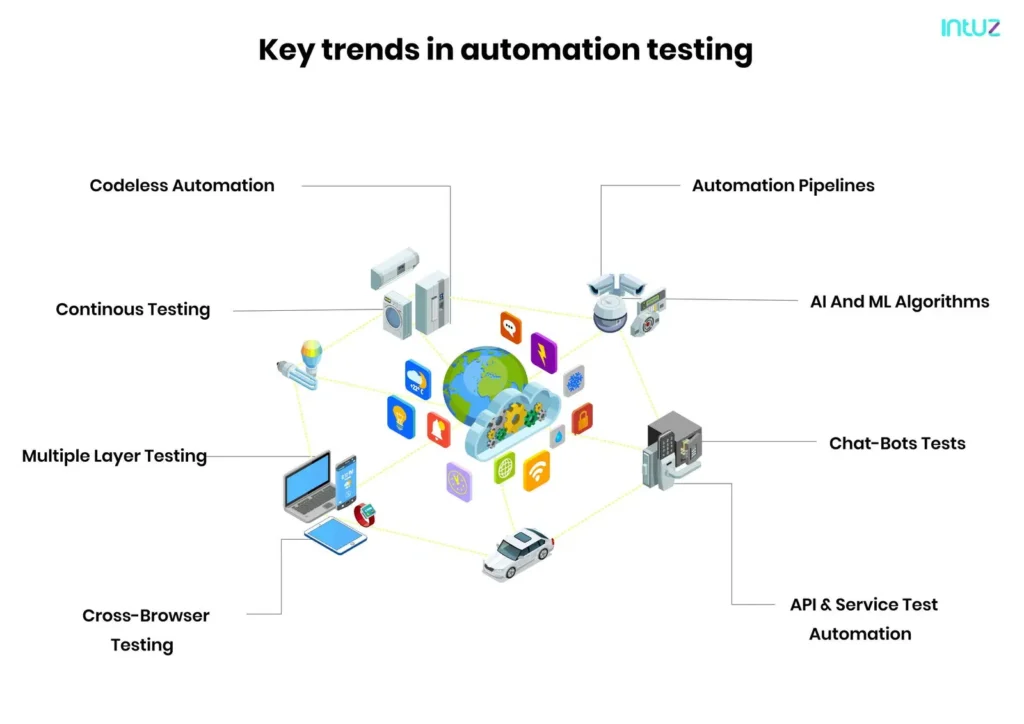
In the past few years, the concept has evolved in many ways; it has completely transformed the way the developers approach automated software testing. Here are five trends in automation testing that companies must look forward to:
- Codeless automated software testing will be in vogue as it allows the accelerated creation of test cases—imagine deploying tools that let you test an application without writing a single line of code?
- Automation testing tools that test apps at multiple layers is catching on.
- The QA team and the operations team will work together even more closely to deliver a quality application. Success and collaboration go hand-in-hand.
- With the increase in the number of devices, cross-browser testing on the cloud will soon be viewed as a viable option for its ability to include different screen sizes and form factors. This was not possible before!
- AI and ML algorithms will go mainstream with user interface testing as the UI can be broken down at a pixelated level.
Top 19 automation testing tools
The key to successfully doing automated testing in software apps is choosing the right set of automation testing tools. This can be a challenging task as there are so many platforms to choose from the platform, each with its strengths and weaknesses.
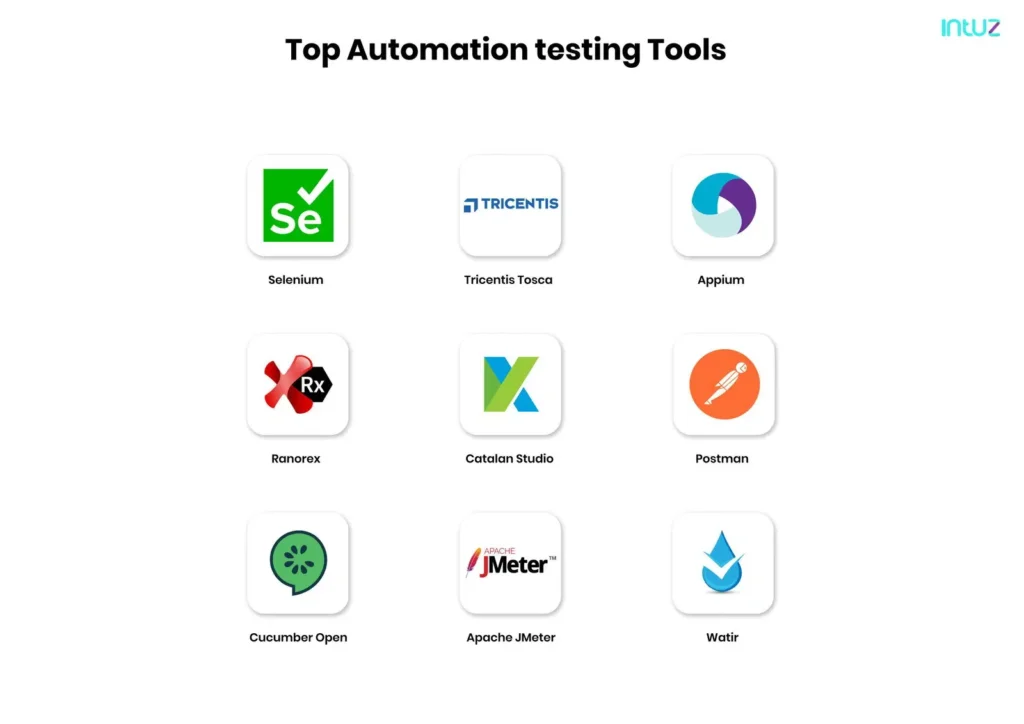
To help you identify the best automation tool for your company, we have listed the top 19 tools that have stood the test of time and showcased their potential in the market. Let us begin:
1. Selenium
Unless you have been living under a rock, you will agree that Selenium is a popular name in the list of automation testing tools. It is a portable framework for testing web apps. Selenium was launched in 2004 by an engineer at ThoughtWorks when he realized the web application he was working on required frequent testing.
Selenium tests allow developers to write test scripts in multiple programming such as Ruby, C#, Python, Groovy, and Perl, which can run on different system environments, including Windows, macOS, Linux, and browsers like Firefox, Safari, and Chrome.
Ever since the release of Selenium 4.0.0 Alpha 5 in March 2020, developers can enjoy a smoother testing experience via W3C standardization. Due to this feature, they do not have to modify codes to work with different browsers such as Safari, Chrome, Edge, and Firefox.
Features:
- To Selenium efficiently, developers must possess advanced programming skills and invest time to build automation libraries and networks that enable automation. This is perhaps the most significant disadvantage of Selenium testing.
- Fifty-one-percent of Selenium customers are from the US. As per slintel the open-source automation tool currently holds a market share of about 45.19%. Community: 42.8k users and continue growing. Developers in need can visit the Official User Group and the Slack channel to get help.
- License:Open-source
2. Tricentis Tosca
This is one of the few automation testing tools that includes comprehensive toolsets to support most testing activities, including test design, automation, reports, and analytics.
Released in 2016, Tricentis Tosca has a user-friendly interface and a rich set of features for API test management, such as dashboards, integrations, analytics, and distributed executions to support continuous integration and DevOps practices.
The tool also claims to significantly reduce regression testing down to minutes from weeks, enabling developers and testers to shorten the development cycle considerably.
Features:
- Its most recent version came out in December 2020, which includes self-healing SAP modules and provides improvements for Mail Engine 3.0 with LDAP authentication support.
- Community: Check out a growing, private community of Tricentis Tosca.
- License: Commercial—necessary to contact the sales team for information
3. Appium
If you are looking for test automation tools that do not require an SDK or recompilation of the mobile app, this open-source automated software testing tool will not disappoint. It is built with the notion that developers should apply their preferred test practices, tools, and frameworks.
Initially developed in 2011, Appium is one of the few automation testing tools primarily intended to test mobile apps. It enables automating hybrid, native, and mobile web applications developed for both Android and iOS.
Appium is one of the few test automation tools which gives full access to back-end APIs and DBs from test code. It is based on server architecture and uses vendor-provided automation frameworks to do the job.
Features:
- Setting up Appium is easy. The learning curve is easy. It is because of this reason that the open-source automation tool has gained immense popularity as the best automation testing tool in the market.
- The only disadvantage of Appium is that every time developers use the same test code for testing Android and iOS devices, they must differentiate between test automation requests through capabilities options mentioning key-value pairs such as device Name, app activity, platform name, and so on.
- Community: Appium has a vibrant contributing community. One can access Appium Discuss, their official community platform.
- License: Open-source
4. Ranorex

Ranorex has been around for a long time now and provides a comprehensive set of professional-grade features for desktop, mobile, web, and API testing. Its desktop-based test automation experience allows developers and testers advanced UI element identification, editing, and management capabilities.
Released in February 2020, it integrates multiple solutions such as Bugzilla, NeoLoad, Jenkins, TFS, Git, TestRail, and more.
Features:
- Ranorex is ideal for beginners who have just started testing software applications and want to fetch optimal results in a short amount of time. It works for iOS and Android application development and delivers robust reporting, which is considered one of the best automation testing tools.
- The newest release, Ranorex Studio 10.5.2 released on February 13, 2023, this will help users to fast automated testing through recording and editing, while also offering API flexibility for teams who prefer coding.
- Community: As of today, more than 14,000 users test with Ranorex worldwide. It has a robust community that one can access.
- License: Proprietary // A premium license is available from €2290 onwards
5. Katalon Studio

Katalon Studio is one of those tools automation testing tools that support both web and mobile app development environments. It comprises a rich feature set for testing API, web and desktop services, and mobile applications.
Released in 2015, Katalon Studio has a dual UI for creating test cases that is interchangeable—meaning, a manual view for those who are less technical users and a script view for experienced developers and testers.
The best automation testing tools allow test cases to be structured using test suites with environment variables, and test execution can be parameterized and parallelized using profiles. Katalon Studio also supports RESTful and SOAP for API and services testing.
Katalon recently won the Gartner Peer Insights Customers’ Choice award in the category’s best software automation testing tools.
Features:
- It is easy to deploy Katalon, and minimum programming skill is required from developers to use the tool. The testing capability can be enhanced with the help of plugins available at the Katalon Store to ensure in-depth views of reports.
- Community: It does not matter if you are using Katalon Studio or Katalon Studio Enterprise. You can easily ask fellow Katalon users when in doubt. Developers can be a part of its thriving community at Katalon Community.
- License: Available in three ways – Free / $759 per year / $539 per year
6. Postman

Postman is not just another automation tool—it is a complete development environment to develop and test APIs, making it popular with developers and testers for API test automation. Released in 2014, it can be installed as a browser extension or a desktop application on Linux, Windows, and Mac. That shows how versatile Postman is.
Developers can easily leverage its comprehensive set of features for designing, testing, debugging, documenting, and publishing APIs.
Features:
- Its latest version was released in February 2023 with some bug fixes and minor feature enhancements beneficial to the developers and testers.
- Community: There is a learning center by Postman, which allows developers to discover resources, watch videos, and browse the network.
- License: Available in four ways – Free // $12 per month // $29 per month // $99 per month
7. Cucumber Open

Cucumber Open is a popular automation testing tool which supports Behavior Driven Development (BDD). It offers an easy way for developers and testers to write and execute a test case, irrespective of the technical knowledge.
Cucumber Open allows expected software behaviors to be specified in a logical language that customers can understand. The execution of feature documentation is written in business-facing text. Released in 2018, it was initially written in the Ruby programming language. However, today, Cucumber Open works across multiple platforms such as Java, Scala, .NET, and JavaScript.
Features:
- It is currently used by 20% of testers and has an impressive clientele, including Canon and PayPal. The main goal of Cucumber Open is to ensure an enhanced end-user experience.
- Community: Cucumber Open has a thriving community of contributors who get paid for their valuable contributions by companies and individuals who desire their continued involvement in Cucumber Open.
- License: MIT License // Free
8. Apache JMeter
Apache JMeter is an open-source automation testing tool designed for test loading and performance measurement but is also useful for API performance and services testing.
Its most recent version was released in June 2022 and now is stacked with multiple feature enhancements such as bug fixes, an updated Groovy library, and JMeter templates for functional testing.
Features:
- JMeter can easily integrate with Selenium and run automation scripts besides completing performance or load tests. Also, JMeter may look like a browser. However, it does not perform all actions supported by browsers. Its architecture, instead, is based on plugins.
- Community: JMeter has an active community. Developers in need can join the Slack channel to get help and to contribute.
- License: Open-source
9. HPE Unified Functional Testing (UFT) One

As the prefix suggests, HPE UFT One is owned by Hewlett-Packard, although it was initially developed by Mercury Interactive in 2001 and called QuickTest Professional (QTP). Currently, it is one of the best automation tools for cross-platforms.
It brings the developers and testers under one roof, empowering them to simplify functional testing and make it cost-effective. HPE UFT One allows them to test all three layers of a program’s operations from a single console, i.e., the database layer, the service layer, and the interface.
Features:
- With HPE UFT One, it is possible to automate desktop, web, mobile, Oracle, Delphi, ActiveX, Visual Basic, PeopleSoft, Stingray, and Java relatively easily. It performs regression tests through UI, as in a web interface or a native GUI.
- Besides, it is one of the few automation testing tools to feature API feature tools for evaluating the functionality and load performance of any deployed or created APIs presented in the app being tested.
- Community: Since HPE UFT One is not an open-source automation tool, its community is not as large as ReactJS or Selenium. However, one can contribute to the Micro Focus Community, the sole community for HPE and UFT.
- License: Proprietary
10. Watir

Pronounced as ‘water,’ Watir is an excellent open-source automated software testing tool for web apps. Released in 2005, it has a rich set of APIs to assist testers with browser interaction, locating page elements, headless testing, working with alerts, and so on.
Watir supports the Internet Explorer on Windows, and Firefox and Opera after combining with WebDriver. Even though it uses Ruby as the scripting language, one can automate web apps developed in any language using Watir.
Features:
- Ruby empowers Watir to read flat files, connect with the database, and use Excel—all of which are important for data-driven testing. Many companies such as SAP, Facebook, HP, Honeywell, Yahoo!, TopTal and so on have implemented Watir. Its latest version was released in January 2023 with bug fixes and minor feature enhancements, and has caught the attention of many enterprises.
- Community: Watir has a growing community of developers and testers.
- License: Open-source
11. Worksoft Certify
Worksoft Certify is one of the popular automation testing tools for enterprise packaged apps. Developed in 1998, the tool is certified by SAP and can be used even if the SAP project is in the deployment, updation, or maintenance stage. It integrates seamlessly with other automation testing tools such as DevOps toolchains and ALM systems.
Suppose one is looking to handle the needs of large enterprises dealing with mission-critical business processes. In that case, Worksoft Certify can be effectively used across multiple applications and systems for testing. It also offers an integrated test data management tool, which helps developers save time and get done quickly.
Features:
- The latest version of Worksoft Certify was released in March 2019. Its offerings expanded to DevOps integrations and optimizations for modern cloud and web apps. It also added support for Postman and improved the Jenkins automation server with an official plugin.
- Community: Since Worksoft Certify is not open-source, its community is limited to Worksoft Community, a private group.
- License: Commercial—necessary to contact the sales team for pricing plans
12. Subject7

Subject7 is a cloud-based tool that supports end-to-end automation for desktop, mobile, web, database, security, web services, load, and accessibility testing. The learning curve for using the tool is shallow, and developers can begin work without any coding knowledge.
Often called one of the fastest automation testing tools, Subject7 is highly scalable. Anyone with basic QA knowledge can build and execute robust automation using our web interface, apt for real-time testing. Founded in 2011, it interacts with web and mobile, back-end verifications, and web service calls – all in the same testing kit.
Features:
- Subject7 uses open-source standards such as JMeter, ZAP, Appium, and Selenium. However, instead of increasing the testing costs, it reduces it. One can avail Subject7 on the cloud or the premise—by purchasing a license.
- It offers a single platform for developers and testers to use a web interface to automate. It is possible to share scripts, execute, and report on the same platform conveniently. Its clientele includes major government agencies and business enterprises of all sizes.
- Community: Subject7 has a small active community. Developers in need can visit their official group for submitting a request or to help.
- License: Contact for custom pricing
13. IBM Rational Functional Tester (RFT)
As the name suggests, RFT is a commercial automation test from IBM built primarily for automated functional testing, GUI testing, regression testing, and data-driven testing.
This is one of the leading automation testing tools, launched in 2016, that supports multiple development environments such as Adobe Flex, Siebel, SAP, PowerBuilder, Dojo Toolkit, Java, and so on.
Storyboard Testing is a unique offering by IBM RFT that enables diagram visualization for test activities and parameters using natural language and application screenshots. This means the tester can make amends to the screenshots for enhancing the script.
Features:
- Its most recent version, released in July 2020, was made available with new features and bug fixes to internally-bound and client-reported defects. It enables testers to automate tests resilient to frequent application UI changes by deploying ScriptAssure technology.
- IBM RFT includes multiple capabilities for API testing and supports several applications for the target application under test (AUT).
- Community: Since RFT is not an open-source automation tool, its community is limited to the developers and testers of the IBM community.
- License: Commercial—necessary to contact the sales team for pricing plans
14. AccelQ

AccelQ is one of the few cloud-based automation testing tools that seamlessly automate web testing and API in one unified flow. It has the flexibility and the power to handle most types of complex automation with no coding needed. Web, mobile, DB, API, and packaged apps are all supported on AccelQ.
Launched in 2014, it is developed on a cognitive core engine that empowers predictive analytics in autonomics in test automation, scenario design, and adaptive change management in traceability.
Features:
- It enables AI-based test automation for rapid app development. Testers can flexibly handle the most complicated automation techniques without writing a single line of code. AccelQ integrates seamlessly with Salesforce Test Automation and also supports Salesforce lightning and custom objects.
- Community: There is a small private community for developers and testers who can offer help and add value to the world of AccelQ.
- License: Commercial—starts at $390 per month per user // Free trial available
15. Telerik Test Studio
Telerik Test Studio is one of the best automation testing tools known for software performance testing, mobile app testing, and Web and desktop functional testing. Built as a Windows-based automated software testing tool in 2012, it follows a codeless approach and ensures an optimal app quality with the best results and addresses QA’s top challenges efficiently.
Telerik Test Studio makes application testing more stable and reliable while keeping test maintenance to a minimum. It provides cross-browser support, which is perfect for functional, load, and API testing. It creates, runs, and maintains functional tests for WPF applications as well, so developers can actually have it easy with Telerik Test Studio.
Moreover, the test tool supports automating apps such as Angular, Silverlight, MVC, PHP, Ruby, JavaScript, and HTML5, apart from Android and iOS apps. Telerik Test Studio also takes the cake for being an intuitive record and playback tool.
Features:
- It can connect with source control systems such as GUT and Team Foundation Server and execute Continuous Testing. Its most recent version brings new features such as scroll-type for RadInput, OCR Verification, and RadAsyncUpload steps.
- Community: Telerik Test Studio has an active community. Developers in need can visit their official private group for submitting their requests or to help fellow developers.
- License: Perpetual license starting from $2,500
16. TestProject
This is the world’s first community-powered free cloud-based automation testing tool that allows developers to test Web, Android, and iOS applications on all operating systems. There are no complex setup processes, and no coding knowledge is required. In fact, it is very easy for developers to develop their coding tests with its powerful SDK.
Founded in 2015, TestProject is currently used by more than 70,000 companies and users. It integrates easily with Selenium and Appium for more speed and accuracy in automated software testing. TestProject deploys advanced built-in recording capabilities and creates and uses add-ons.
Features:
- TestProject is ideal for enterprises with web applications that need automated tests that scale and evolve with their app and require little to no upkeep while offering robust and actionable insights. No wonder it is such a hit amongst developers who are still new to the game and learning the testing frameworks.
- Community: It has a small private community of TestProject developers and testers.
- License: Free
17. SoapUI
Designed by Gartner-owned Smartbear, Soap UI is an open-source automation tool, especially for API testing. Initially released in 2005, it provides API Test Automation Framework for Service-Oriented Architectures (SOAP) and Representational State Transfers (REST).
SoapUI enables testers and developers to automate and fit API testing into the continuous delivery pipeline with the next-generation test tool built to validate GraphQL, microservices, and other back-end services.
Features
- There are two versions of SoapUI—open-source and pro version. The latter has a user-friendly interface and a string of advanced features such as form editor, SQL query, and assertion wizard among other things. One can also debug API’s responses instantly in the pro version. This is an added benefit for developers as they get to cover all bases in testing.
- SoapUI also offers new features that improve testing efficiencies, streamline the testing process, and provide high-quality results in a reduced timeframe. It supports smart object detection and image-based object detection and correction—another win for testers!
- Community: SoapUI has a thriving community of developers and testers who can use resources present on the website.
- License: Open-source // premium license available from $895 per year onward
18. TestCraft
This is the best codeless automation testing platform with unique AI capabilities and visual modeling for faster test creation. Testers can create fully automated test scenarios and integrate the tool with their CI/CD workflows on TestCraft.
There is an easy learning curve, and setting up TestCraft is not complicated at all! One can leverage manual tester’s knowledge and create automated test scenarios relatively easily. This also helps them root out any bugs much faster.
Features:
- It is possible to quickly integrate modules developed by the developer community, and run simultaneous tests across environments and platforms.
- TestCraft enables developers to integrate and leverage modules built by the community quickly. It provides immediate value without wasting any time. CIOs, CTOs, architects, analysts, and consultants—all will love creating fully automated test scenarios without coding on TestCraft.
- Community: It has a fast-growing community that offers assistance to amateur developers and testers. TestCraft also has a dynamic resource library.
- License: Commercial—necessary to contact the sales team to know about the pricing plans
19. TestComplete
Another offering by Smartbear, TestComplete, is one of the leading automation testing tools ideal for testing web, mobile, and desktop apps—initially developed in 1999.
It supports many programming languages such as Python, C#, JavaScript, and VBScript. It uses multiple testing tactics such as data-driven testing, distributed testing, keyword-driven testing, and regression testing.
Features
- Like UFT One, TestComplete can accurately detect dynamic user interface elements by using an object recognition engine. This is especially in managing interfaces that are dynamic and frequently changing.
- The software validates dynamic data with multiple verification points and supports regular expression pattern matching with its spreadsheet-like data editor.
- TestComplete’s most recent version, rolled out in September 2020, includes small improvements in the installer that streamlines the product installation process. Its self-healing functionality finds a replacement object by image by leveraging improved AI-based algorithms.
- Community: There is a thriving private community for developers and testers who can offer help and add value to the world of TestCompete.
- License: Testing complete Base—starting from $3.655 per year
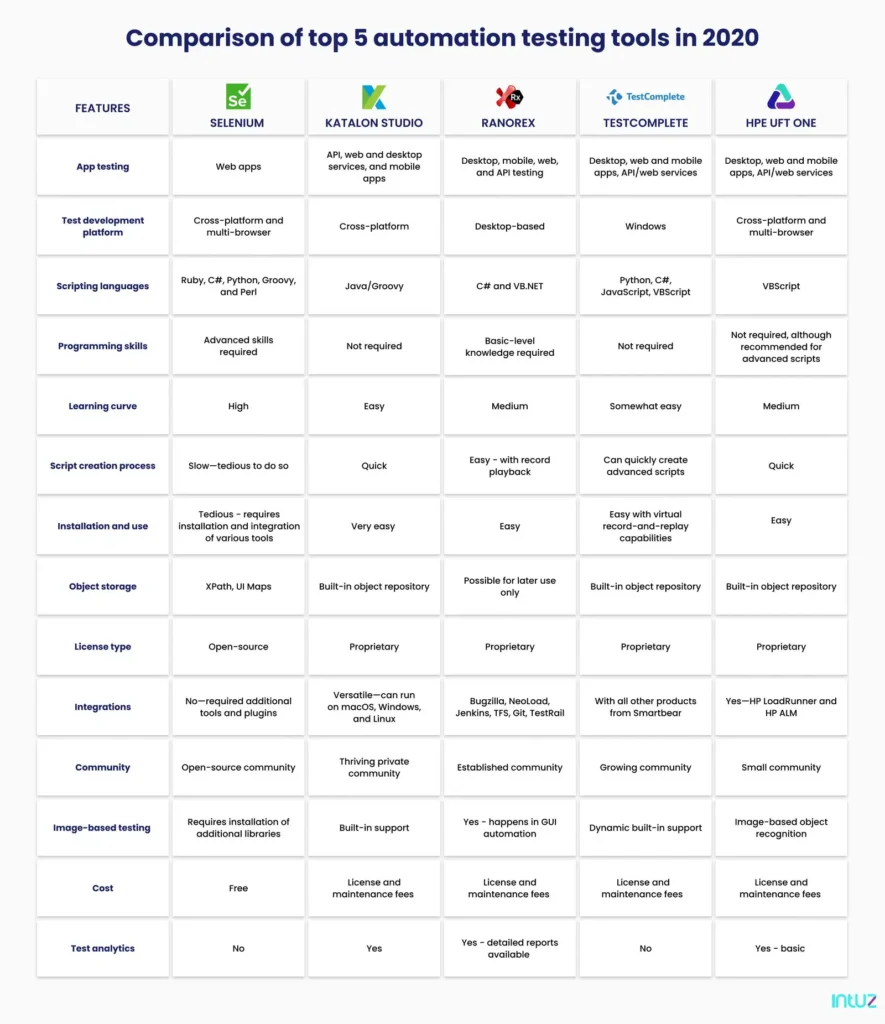
Comparison of top 5 automation testing tools
Wrapping it up
According to Gartner, global IT spending is projected to total $4.1 trillion in 2021, an increase of a 8.4% from 2020. Experts say it has got to do with the pandemic that has compelled more and more businesses to go digital to survive the outbreak. The demand from customers is also at an all-time high.
Do not be surprised when you see more websites and mobile apps getting added to the mix. It is what the market demands right now. The future of quality software development is bright, and the use of the right automation testing tools can ensure lower costs, optimal results, and more profits for the enterprises.
If you are struggling to develop a software or test it or just want to understand the process a bit better, we are someone you can rely on. book a free consultation today! Our competent team will sort out all your business requirements.
FAQs
What is automation testing and why does it matter?
Automation testing uses tools and scripts to test software with minimal human intervention. It supports regression and functional testing, runs faster than manual testing, and can even be scheduled at specific times — helping teams catch bugs early, save time, and deliver more reliable applications.
What are the top automation testing tools available today?
The top automation testing tools include Selenium, Appium, Katalon Studio, Ranorex, and Postman. Each tool has distinct strengths — from web and mobile testing to API validation — making it important to choose based on your project type, team skill level, and budget.
How do I choose between Katalon Studio and Selenium for my team?
Choose Selenium if your team has strong programming skills, needs broad customization, and is already managing CI/CD pipelines with Jenkins or Docker. Choose Katalon Studio if you want a faster setup, need both manual and scripted test views, or have mixed-skill teams that include less-technical testers. Katalon won the Gartner Peer Insights Customers’ Choice award and offers a free plan, while Selenium is fully open-source but requires more upfront investment in framework setup and library management.
Is codeless automation testing reliable enough for production-grade apps?
Yes, for most use cases. Tools like Subject7, AccelQ, TestCraft, and Telerik Test Studio demonstrate that codeless automation can handle end-to-end testing across web, mobile, API, database, and security layers without writing code. Subject7 is actively used by major government agencies, and AccelQ runs on a cognitive core engine built for complex automation. The trade-off is customisation flexibility — codeless tools are highly capable out of the box but may hit limits when dealing with deeply custom or legacy application architectures.
How do I choose the right automation testing tool for my project?
Choosing the right tool depends on your application type (web, mobile, API), team’s technical expertise, budget, and testing goals. Open-source tools like Selenium suit experienced developers, while platforms like Katalon or Ranorex work well for teams that prefer low-code or GUI-driven testing.
How do automation testing tools fit into a CI/CD pipeline?
Most modern automation testing tools are built for CI/CD integration. Selenium integrates natively with Jenkins, Maven, and Docker. Katalon Studio supports pipeline execution with parameterized and parallelized test runs. Apache JMeter can run load and performance tests as part of automated builds. Tricentis Tosca and Worksoft Certify include native DevOps toolchain integrations. The typical setup triggers automated test suites on every code commit or pull request, flagging failures before deployment — reducing the cost of catching bugs at the production stage.
Work with Intuz
Find the Right Testing Tool for Your App
Get a expert recommendation based on your stack and team size.
Let's Get Started
Share this article