






Developing and maintaining a website is a complicated process. The end result needs to be dynamic, blazing-fast, and robust. It must stand the test of time.
In this digital age, ensuring high performance is at the forefront of efficient web development and the key to creating an engaging user experience.
But to build swift, visually appealing websites minus the restraints that plagued developers in the past requires you to wisely choose a hassle-free web development method that delivers impressive results.
Show
- Static websites consist of individual HTML files per page, offering faster loading times, easier caching, and a more robust, secure environment compared to dynamic sites.
- A static site generator automates the creation of HTML pages from templates and raw data, eliminating the need to manually code each page individually. Next.js, Hugo, and Gatsby dominate as the top three generators by GitHub community ratings (68K, 52.1K, and 50.4K respectively), making them the most battle-tested options for 2026.
- Framework choice is tied to language preference — React developers lean toward Next.js/Gatsby/React Static, Vue developers toward Nuxt.js/VuePress/Gridsome, Python devs toward Pelican, PHP devs toward Sculpin, and Go developers toward Hugo.
- Community size and documentation quality vary significantly across generators — tools like Next.js, Hugo, Gatsby, and Docusaurus have strong ecosystems, while newer options like Scully, Sapper, and React Static are still maturing.
Solution: Build a static website
Static websites, for instance, are fixed and display the same content for every visitor. They comprise a series of HTML files, each one representing a physical web page. That means every web page is a separate HTML file.
There are certain benefits of having a static website, such as:
- Faster loading times
- Easier caching
- Robust and safe environments
What is a static page generator?
Although traditionally speaking, static websites were maintained manually, which was obviously painstaking. Over time, a system has been developed which lets the developers use certain code sections easily and repeatedly. It is called a static site generator.
This tool generates an entire static HTML site based on a defined set of templates and unpolished data. A static site generator automates coding individual HTML pages and ensures they are ready for users to access ahead of time.
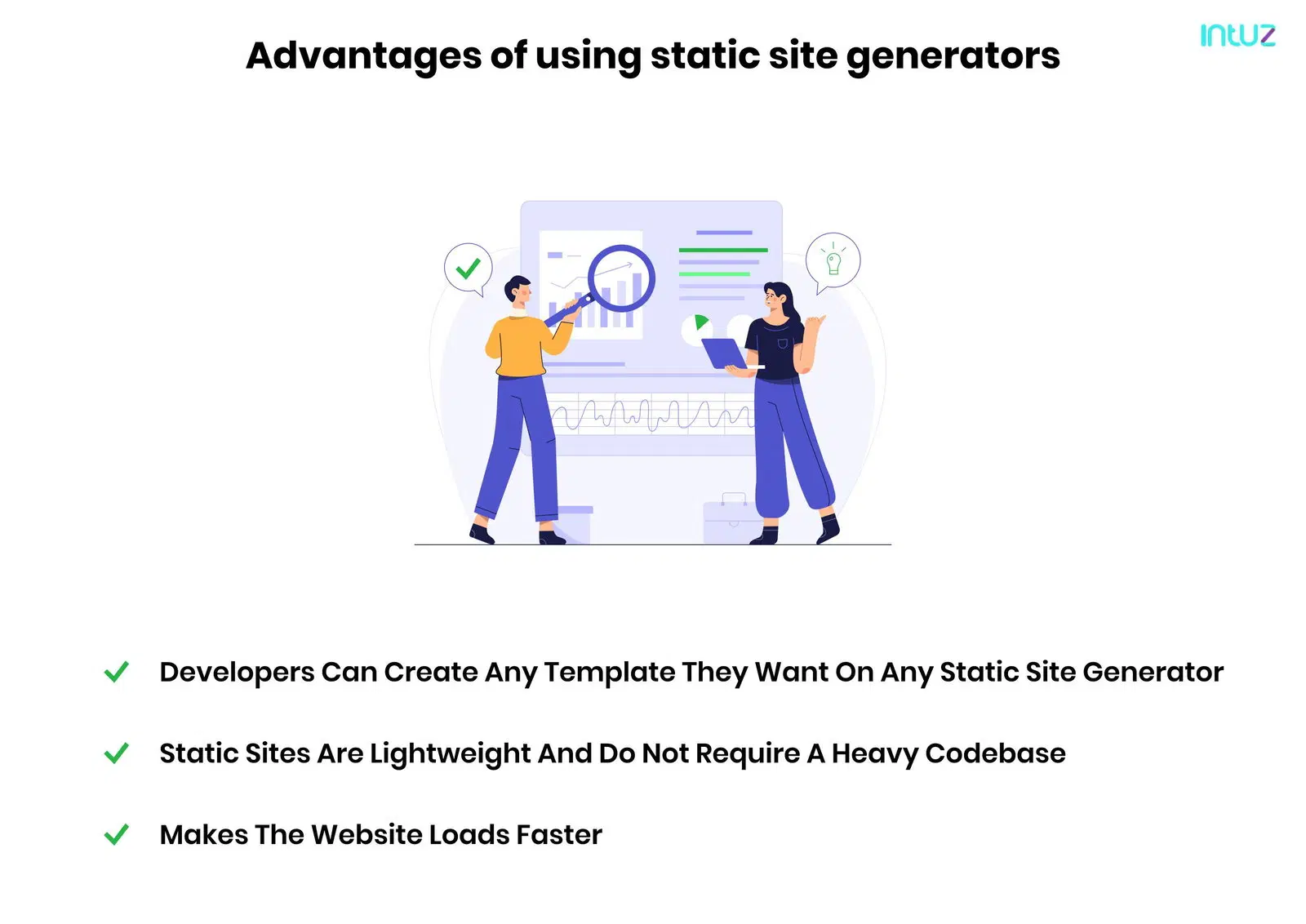
Here are a few advantages of using a static site generator:
Top 20 static site generators
If you are convinced you want to create a static website for your business, you are in luck. There is no shortage of options in the market when it comes to static site generators. But sifting through all of them is time-consuming and head-ache-inducing.
That is why we have listed the best 20 options for you in the next section. Have a look:
1. Next.js

Next.js is a static generator built on React. It can be used to create Progressive Web Apps, server-rendered apps, and static websites.
Next.js lets you define server-less functions as API endpoints and gives developers control over how they build and deploy their applications. Moreover, it helps simplify the web development process with a smooth and clutter-free experience.
Next.js has multiple community forums online that actively contribute to the advancement of this static site generator.
GitHub rating: 68k
2. Hugo

Hugo is a popular static site generator built using the Go programming language. It comes with an ultra-fast build process and hence, makes the creation of static websites simple. As a result, Hugo is often known as the fastest static site generator.
It has an active community on the Discourse platform to share your concerns and contributions related to Hugo.
GitHub rating: 52.1K
3. Gatsby

Gatsby is a static site generator based on React and uses GraphQL to glean data from various sources. Since it is compatible with many CMS platforms, it can help you get any static site or app up and running swiftly and efficiently.
GitHub rating: 50.4K
4. Nuxt.js

Nuxt.js is an open-source Vue.js framework used for building simple and powerful static websites. Since it is based on a modular web architecture, you do not have to reinvent the wheel to avail of the PWA benefits. Fine-tune your website using the bundle analyzer provided by Nuxt.js.
Nuxt.js has a small community with limited resources. Its product documentation has also not been updated in a long time.
GitHub rating: 34K
5. Jekyll

Launched in 2008, Jekyll is a popular static site generator, which is simple to use and has a low barrier to entry. Jekyll creates static websites and blog posts from plain text. You can typically work on the content in Markdown, a lightweight markup language for text formatting.
Jekyll has a small community with limited support available on the website and GitHub.
GitHub rating: 42K
6. Hexo

Hexo is a clean and straightforward static site generator powered by Node.js. It is most commonly used for general blog site building purposes and supports using templates from different engines, making the development process a breeze for JS developers.
Hexo has a large community, but one can access the limited tutorials online to learn the functions of the static site generator.
GitHub rating: 32.8K
7. Docusaurus

Docusaurus is an optimized site generator built using React. It is designed to save you time and enables the quick creation, deployment, and maintenance of open-source project sites.
Plus, it allows users to submit simple blog posts and docs with Markdown, which Docusaurus publishes in static HTML files.
Docusaurus has a thriving community on Reddit, Stack Overflow, and GitHub. It also offers access to detailed documentation on the website.
GitHub rating: 23.7K
8. VuePress

As the name suggests, VuePress is a static site generator powered by Vue. It emphasizes writing code and keeping the site setup-hassle to the minimum with a markdown-centered project structure. In addition, Vuepress supports the documentation needs of Vue’s sub-projects.
For every page, VuePress generates pre-rendered static HTML and executes it as a Single Page Application. That is why it is favored by many developers.
The community is niche and small, with limited documentation accessible from the official website.
GitHub rating: 18.9K
9. React Static

As the name suggests, React Static is a progressive static site generator for React. There is no syntax to get used to, no schema to learn. React developers can get started with the development process fairly easily as long as they understand the language. That is what makes working on React Static highly user-friendly.
Both React Static community and documentation are not that advanced but are swiftly evolving.
GitHub rating: 9.6K
10. Eleventy

Eleventy is a comparatively new static site generator in the market. If you are looking to convert featured content into static HTML files, opt for this framework. Also stylized as 11ty, it is effortless to use and quite progressive. It is written in JavaScript and uses flexible templating language such as Nunjunks, JS, and Markdown.
The Eleventy community is small and bootstrapped, so the level of support and guidance offered is also limited.
GitHub rating: 9.4K
11. Metalsmith

Metalsmith is an easy-to-use static site generator. It has different kinds of user-defined plugins which you can use to create anything. You can build web apps, documentation, or blogs using Metalsmith. It is also ideal for generating eBooks, documents, and PDFs.
It has a reasonably small community compared to other popular static site generators like Docusaurus and Hugo. Finding learning resources from other contributors can be an issue. However, a Slack group has recently started to curb the problem.
GitHub rating: 7.6K
12. Pelican

A Python-powered static site generator, Pelican, builds static sites with a lot of potential for scalability in any direction you want to move with a little extra programming.
It can be used to develop a complete site, one that is not limited to blogging only. It uses Jinja2 as its templating language. Pelican is a good starting point if you have some experience as a Python developer.
It has an active community that fixes bugs, adds features, and creates new themes regularly. Pelican documentation is comprehensive and helpful.
GitHub rating: 10.4K
13. Sapper

Sapper is a Svelte framework that is used for creating high-performance web applications. From building server-rendered pages to defining API endpoints, Sapper is equipped to perform many versatile functions in the web development process.
Since it is a new framework in the market, its documentation is still in the initial stages, and it has a small but fast-growing community on Discourse.
GitHub rating: 7.1K
14. Brunch

Brunch is a programming language-agnostic assembler of HTML5 apps. It collates templates, scripts, and style sheets in a single JavaScript module, giving you a leaner package to work with. For example, with Brunch, you can easily create a website skeleton for a swift launch.
Its contributors are active on GitHub and Stack Overflow. It offers guidance on designing plugins on the website.
GitHub rating: 6.8K
15. Middleman

If you are looking to leverage all shortcuts and web development tools helpful in building a website, then Middleman is apt for you. It is a command-line tool perfect for building static websites used by major brands like DigitalOcean, Dockbit, and Bivee.
A group of the core team and contributors actively contribute to the evolution of Middleman on GitHub.
GitHub rating: 6.8K
16. Harp

Harp is a static web service that allows you to reuse common elements and partials to maintain consistency across the website design and layouts. It preprocesses the codebase automatically, giving you time to focus on writing the actual code. It builds JavaScript, HTML, and CSS sites.
They have a small community on IRC and GitHub. Detailed documentation can be found on the website.
GitHub rating: 4.9K
17. Roots

Roots is a static site generator built using Node.js. It is used for creating static HTML, JavaScript, and CSS files. If you are a freelancer or agency looking to develop a high variable website, Roots is an ideal option for you to develop your project.
It has a tiny community with limited learning resources.
GitHub rating: 11K
18. Gridsome

Gridsome offers the fastest and the most optimal way to build static websites. It is a JAMstack framework powered by Vue.js. You can use web tech tools such as GraphQL and Webpack to create a website using this static site generator.
It has a massive community of developers and editors, most active on Discord, GitHub, and Twitter.
GitHub rating: 7.6K
19. Scully

Scully is the first static site generator built on Angular. It was released in 2019 and positively supports Angular v9 and v10 with Node.js 12 or higher. With just a single command, Scully can be integrated with any existing Angular project. It also makes it possible to use Markdown files quickly and pre-render your web apps.
Scully does not have an immense community support like many other static site generators.
GitHub rating: 2.2K
20. Sculpin

Sculpin is a static site generator powered by PHP. It converts Twig templates, Markdown files, and standard HTML into static web pages. It uses Symfony components and comes integrated with the Composer.
It has a great community, active on IRL and Twitter. One can access the documentation on the website.
GitHub rating: 1.4K
In conclusion
A website’s success lies in its foundation, well, the majority of it. So if you are keen to build a rock-solid website, you must choose a platform that supports your end goal.
Are you looking to build a static site generator but do not have the expertise in-house? No worries — share your requirements with us, and our expert team will come up with the most suitable business solution for you pronto.
FAQs
What is a static site generator and how is it different from a CMS like WordPress?
A static site generator (SSG) takes raw content — usually Markdown files and templates — and compiles them into plain HTML, CSS, and JavaScript files before deployment. Unlike WordPress or other CMS platforms, there’s no database or server-side processing at request time. This makes static sites significantly faster, more secure (no attack surface from database queries), and cheaper to host. The tradeoff is that real-time content updates require a rebuild-and-redeploy cycle, which can add friction for non-technical editors. For content-heavy but infrequently updated sites — documentation, portfolios, marketing pages — SSGs are often the smarter architectural choice.
Which static site generator is fastest to build with?
Hugo is widely considered the fastest SSG available — it’s built in Go and can generate thousands of pages in under a second. For large documentation sites or content-heavy projects where build times matter, Hugo consistently outperforms React-based alternatives like Gatsby or Next.js. That said, if your team is already working in JavaScript, the build-time difference rarely matters enough to justify switching ecosystems. React developers typically start with Next.js or Gatsby; Vue developers default to Nuxt.js or Gridsome. The right choice is usually the one your team can ship fastest with.
Is Next.js a static site generator or a full-stack framework?
Next.js is both — and that flexibility is why it has over 68K GitHub stars. It supports Static Site Generation (SSG), Server-Side Rendering (SSR), and Incremental Static Regeneration (ISR) within the same project. For fully static deployments, you can export a Next.js app as pure HTML/CSS/JS using its static export mode. For teams that anticipate needing dynamic pages, API routes, or server logic down the line, Next.js is often the safer long-term bet compared to Gatsby or React Static, which are designed primarily for static output.
When should I choose Gatsby over Next.js for a static project?
Gatsby is the stronger choice when your content lives across multiple sources — a headless CMS, a REST API, a Markdown folder, and a database simultaneously. Its GraphQL data layer was built specifically to unify heterogeneous data sources into a single query interface. Next.js handles data fetching differently, requiring more manual coordination across sources. That said, Gatsby’s build times increase noticeably for large sites (thousands of pages), and its frequent dependency updates can create maintenance overhead. If your content sources are straightforward and your team is comfortable with React, Next.js is often simpler to operate long-term.
Can static site generators handle e-commerce or user authentication?
Static sites can support both, but through APIs and third-party services rather than built-in server logic. For e-commerce, tools like Shopify’s Storefront API, Snipcart, or Stripe Checkout are commonly paired with SSGs. For authentication, services like Auth0, Firebase Auth, or Clerk handle the logic client-side or via serverless functions. Gatsby and Next.js both have mature ecosystems for these integrations. The JAMstack architecture — JavaScript, APIs, and Markup — was designed precisely for this model. It’s a more complex setup than a monolithic CMS, but the performance and scalability benefits often justify the architecture for mid-to-large-scale projects.
Which static site generator should a Python developer use?
Pelican is the most established Python-powered SSG. It supports Markdown and reStructuredText, uses Jinja2 for templating, and has an active community that regularly adds themes and fixes bugs. It’s a practical choice for developers who want to stay in the Python ecosystem and aren’t building React or Vue frontends. For data-heavy documentation sites, MkDocs is another Python-based option worth evaluating — though it wasn’t covered in the top 20 list above. If your team is Python-first and the site scope is primarily content or documentation, Pelican is the lowest-friction place to start.