



Curious about the difference between Generative AI and Predictive AI? This guide breaks it down in simple terms, showing how one creates entirely new content while the other predicts future trends. Learn where each technology shines, the real-world problems it solves, and how they can transform your business. Whether you’re exploring key differences, use cases, benefits, or which technology is best for your business, an experienced custom AI development can help you choose the right path.
Over the last few years, AI has established itself as a non-negotiable if you want to streamline your business processes and costs. It can be expensive, however, so you want to make sure you’re using the right kind of AI for your SME.
As you browse custom AI solutions, you’re likely to encounter two main options—Generative AI and predictive AI. Each has its own pros and cons, and it’s important to understand exactly what each can do for your business goals before investing. This guide will help you do just that.
$644B Global GenAI spending in 2025 — up 76.4% from 2024 – Source: Gartner, March 2025
$18.9B Predictive analytics market in 2024, projected to reach $82.35B by 2030 – Source: Grand View Research, 2025
Show
- Generative AI creates new content (text, images, code); Predictive AI forecasts future outcomes from historical data.
- Generative AI uses models like GPT, GANs, and diffusion models; Predictive AI relies on regression, decision trees, and XGBoost.
- Generative AI excels in marketing, content, and customer support; Predictive AI dominates in finance, healthcare, and logistics.
- Both AI types can work together — predictive AI identifies who to target, generative AI creates the message. Choosing between the two comes down to your goal: create (generative) or forecast (predictive).
Generative AI vs Predictive AI
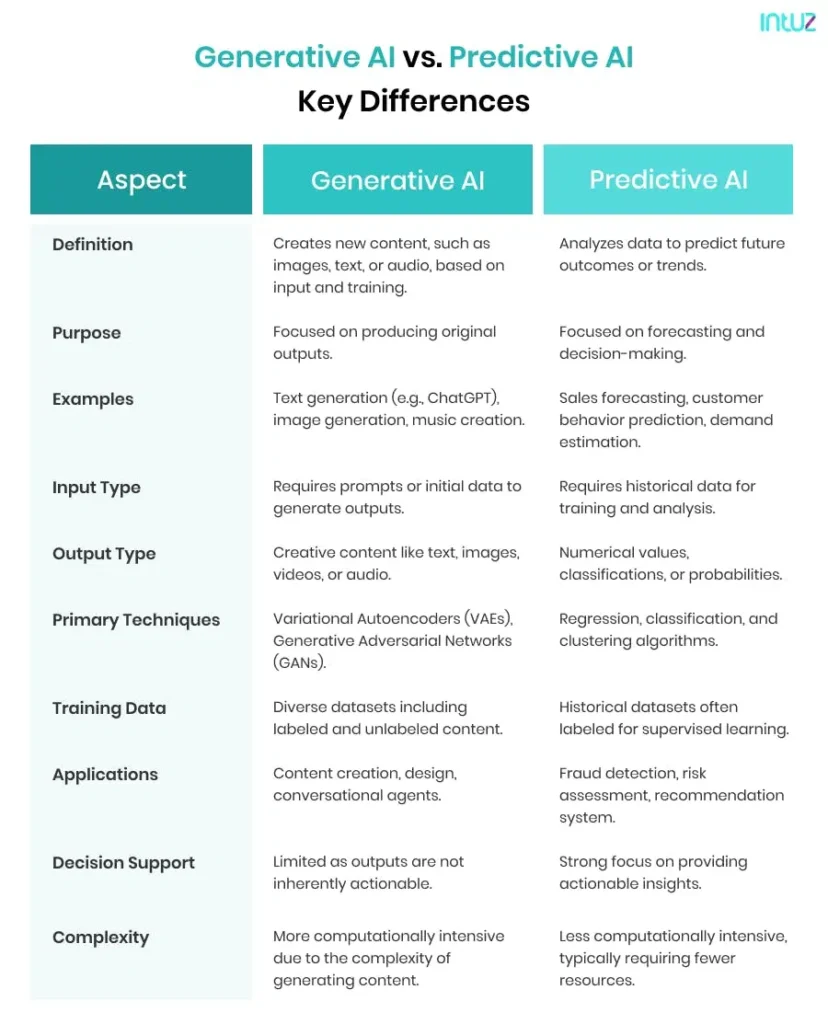
Generative AI creates brand-new content — text, images, code, or audio — by learning patterns from existing data. Predictive AI uses historical data and statistical models to forecast future outcomes, such as customer churn, equipment failure, or sales demand. The core distinction: generative AI produces something new; predictive AI forecasts something that hasn’t happened yet. Both types are powered by machine learning, but they serve fundamentally different business goals — one for innovation and automation, the other for informed decision-making.
| Dimension | Generative AI | Predictive AI |
|---|---|---|
| Primary output | New content — text, images, code, audio, video | A forecast, probability, or classification |
| Core question it answers | “What should we create?” | “What is likely to happen next?” |
| Training data | Large, unstructured datasets (text corpora, image libraries) | Structured historical data (transactions, logs, records) |
| Common models | GPT (LLMs), GANs, diffusion models, VAEs | XGBoost, LSTM, regression, decision trees |
| Key use case | Content creation, chatbots, code generation | Demand forecasting, fraud detection, churn prediction |
| Top industries | Marketing, eCommerce, legal, education | Finance, healthcare, manufacturing, logistics |
| Decision type | Creative / automation | Analytical / strategic |
| Real-world example | ChatGPT, Midjourney, GitHub Copilot | Salesforce Einstein, IBM Watson, Google Vertex AI |
| Ideal for SMEs when… | You need to produce content or automate interactions at scale | You need data-driven insights to reduce risk or improve planning |
What is Generative AI, and How Does It Work?
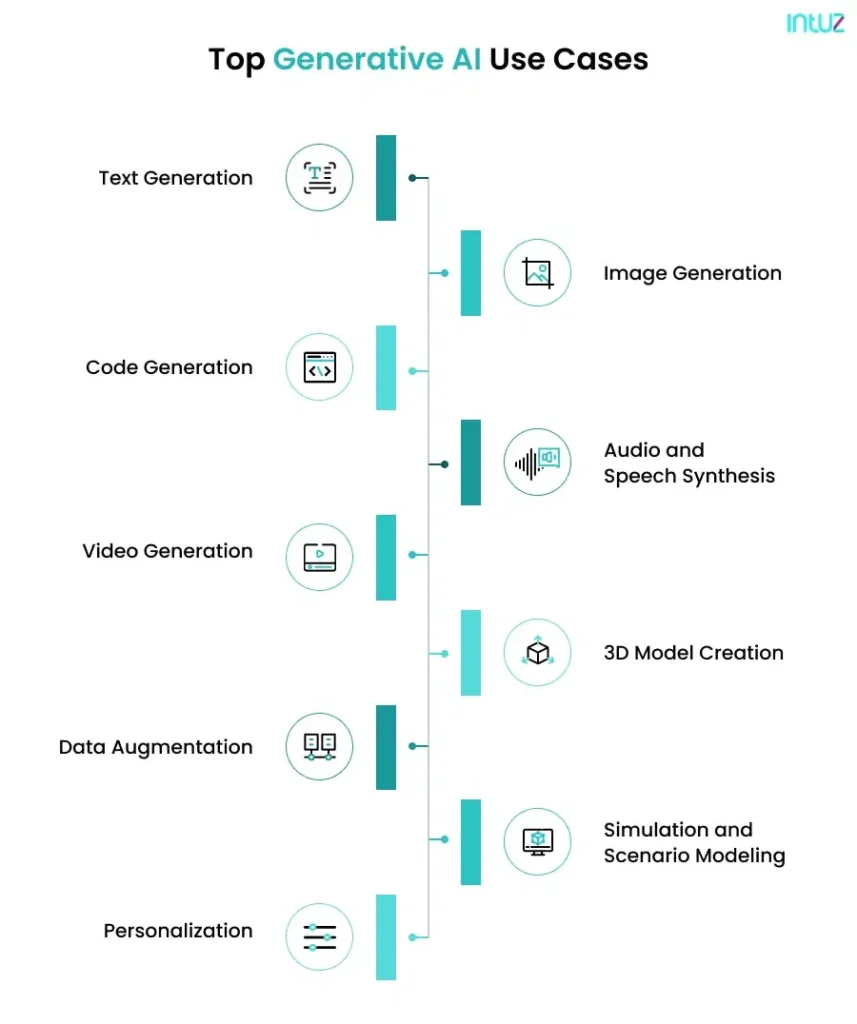
Generative AI is a category of artificial intelligence that learns patterns from existing data and uses them to create entirely new content. Unlike traditional AI that classifies or retrieves information, generative AI synthesizes original outputs — whether that’s a product description, a marketing image, a block of code, or a conversational response. It does not retrieve; it generates.
At its simplest, Generative AI studies existing datasets, identifies patterns in them, and creates new content based on those patterns.
This could include textual content such as blogs or whitepapers, visual content such as ads or videos, lines of code, product mockups, or conversational AI chatbots.
Generative AI may use various learning models, such as large language models (LLMs), neural networks, diffusion models, and GANs.
What is Predictive AI, and How Does It Work?
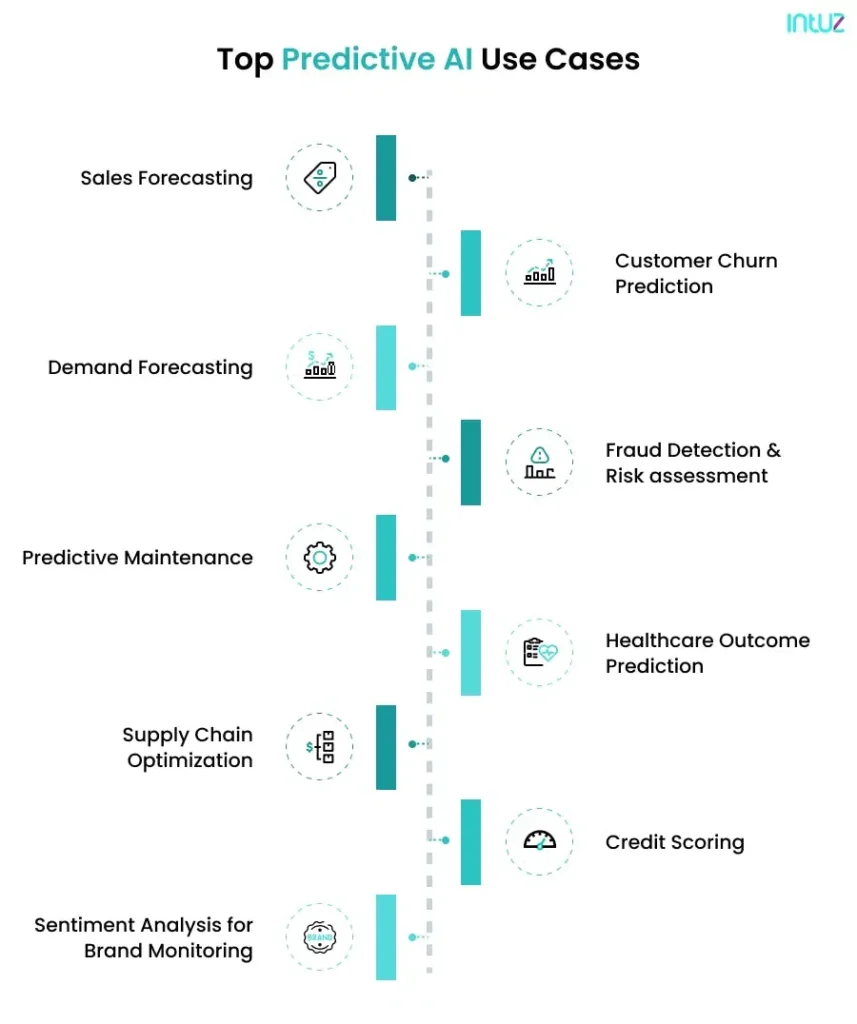
Predictive AI is a branch of artificial intelligence that uses historical data, statistical algorithms, and machine learning to forecast future events or behaviors. Rather than creating something new, predictive AI analyzes patterns in what has already happened to estimate what is likely to happen next — with a quantifiable degree of confidence. It is the engine behind demand forecasting, customer churn models, fraud detection systems, and clinical risk scoring.
A Generative AI development company will train the model on your historical data so that it can give you customer insights, sales forecasts, financial risk assessments, or whatever else you need help with.
Use Cases of Generative AI Across Major Industries
Customer support
- It pre-loads chatbots and virtual assistants with automated responses for frequently asked questions and customer complaints.
- It suggests personalized responses or escalations based on sentiment analysis in customer conversations.
- It prepares automated email threads and ticket resolution pipelines for faster problem-solving.
AI is already transforming customer operations at scale. AI customer service tools reduce operational costs by up to 30%, and AI is projected to handle 95% of all customer interactions by 2025. (Fullview AI Statistics Roundup, 2025)
Retail and eCommerce
- It generates enhanced images and product close-ups/3D mockups.
- It offers personalized recommendations based on shopping behaviour.
- It crafts engaging and SEO-friendly product descriptions for the inventory.
Finance
- It drafts tailored investment strategies based on market patterns.
- It automatically distils financial insights into reports for stakeholders.
- It identifies fraudulent behaviour based on past transactions and prepares risk assessments.
Healthcare
- It summarizes the contents of medical reports for easy skimming.
- It automates patient communications such as appointment reminders or payment notifications.
- It summarizes research and speeds up the process of discovering new opportunities for drug development.
Marketing
- Generative AI in digital marketing tailors ad and email copy to different customer groups.
- It generates marketing copy, blog posts, and ad visuals at scale.
- It tailors social media copy to suit the specifications of different platforms.
Education
- It crafts custom video lesson plans for different curricula.
- It assists students with structuring their submissions and presenting logical arguments.
- It generates student assessments based on their past performance and learning patterns.
Legal
- It automates the drafting and review of contracts.
- It interprets laws and policies to ensure compliance.
- It summarizes relevant laws and legal precedents for easy reference.
Use Cases of Predictive AI Across Major Industries
Healthcare
- It identifies early signs of various diseases based on past patient data.
- It predicts patient outcomes for different treatment options.
- It detects anomalies in test results or medical images.
Retail and eCommerce
- It adjusts prices dynamically with demand or competitor pricing.
- It predicts inventory requirements based on demand patterns.
- It identifies indicators of customer churn.
Financial services
- It conducts credit risk assessments based on customer profiles.
- It flags suspicious transactions and indicates potential fraud.
- It predicts stock movements based on market trends.
Manufacturing
- It detects equipment wear and tear and schedules maintenance in advance.
- It identifies opportunities for energy efficiency.
- It detects product defects while in production.
Legal
- It predicts legal risks based on reviews of contracts.
- It predicts the potential legal ramifications of any action.
- It predicts the probability of success in any legal case by analysing past cases of that type.
Transportation and logistics
- It optimizes delivery routes based on traffic and weather predictions.
- It predicts peak times and allocates vehicles for ride-sharing services.
- It predicts supply chain disruptions based on real-time global events.
Predictive AI is delivering measurable ROI across industries. 77% of financial institutions now rely on predictive analytics, up from 37% the previous year. In fraud prevention alone, advanced predictive AI has increased fraud-detection accuracy by 60%, saving the financial sector an estimated $15 billion annually – (ElectroIQ Predictive AI Statistics, 2025)
Benefits of Generative AI for SMEs
1. Easy content creation
With GenAI tools, you can prepare blog posts, marketing brochures, product descriptions, and online ad copy at scale, allowing you to plan your marketing calendar with much greater efficiency.
2. Automated tasks
Generative AI handles all the repetitive daily tasks like sending email nudges, summarising reports, processing expense claims, and entering daily activity logs so you don’t have to.
3. Efficient customer support
GenAI-powered chatbots handle customer conversations seamlessly 24×7, with quick responses to common questions and personalized responses based on chat history and purchase behaviour. This lets you be there for your customer more effectively without the cost burden of a bigger support team.
4. Globalization support
Generative AI makes it easier to establish a presence in global markets by helping you translate content to different languages, adapt it to local cultural nuances, and include modifications based on local preferences and market aspirations.
5. Innovation at scale
By studying your current data and market performance patterns, Generative AI models can come up with new ideas for products and quickly generate mockups for them. This helps you test and validate new concepts sooner so that you can get them to market.
Benefits of Predictive AI for SMEs
1. Smarter decision-making
Whether you’re using predictive AI in eCommerce, healthcare, legal or retail, you get the advantage of data-driven insights on all your business decisions, reducing the amount of guesswork at any stage.
2. Efficient cost planning
AI can predict demand patterns and suggest how and when to stock inventory to avoid wastage. It can also predict when maintenance or repairs might be required for production machinery, thus minimising unexpected downtime.
3. Improved customer retention
Predictive AI can offer insights on customer behaviours that indicate churn risk so that you can proactively take steps to retain them, such as with a personalised discount. This is a particularly important function of predictive AI in e-commerce.
4. Better risk management
Predictive AI studies customer profiles and transaction histories to identify anomalies or indicators of fraudulent behaviour, thus minimising your risk of losses from bad debts.
5. Optimized marketing campaigns
AI can study your past marketing campaigns and customer interactions to give you insights on which marketing strategies will be the most lucrative, letting you budget effectively.
Can Generative AI and Predictive AI Work Together?
Yes — and the most sophisticated business AI systems today combine both. Rather than treating generative and predictive AI as competing choices, leading organizations are integrating them in sequence: predictive AI identifies the who, when, and what, while generative AI delivers the message or action.
Real-world example — eCommerce personalization:
A retail platform uses predictive AI to identify which customers are at risk of churning and which products they’re most likely to buy next. It then uses generative AI to automatically draft personalized discount emails, product recommendations, and push notifications — tailored in tone and content for each individual customer segment.
Real-world example — Healthcare
Predictive AI flags a patient as high-risk for readmission within 30 days. Generative AI then drafts a personalized post-discharge care summary and follow-up message for the care team to review and send.
How to Choose Between Generative AI and Predictive AI
As is no doubt clear from this discussion, both types of AI have a lot to offer. Choosing between predictive AI and Generative AI development models thus comes down to a matter of what you’re using the AI for, and what resources you have to spare.
Use Generative AI if:
- You’re comfortable with upfront costs for model integration
- You’re looking for a no-code or low-code option that your whole team can use
- You have sufficiently diverse datasets for the Generative AI model to learn from
- You want to generate content in multiple formats or streamline customer interactions at scale
- You work in a content-heavy industry with the end goal of automated tasks and minimal human intervention
Use predictive AI if:
- You have the computing power to support further data being fed into the system
- You’re comfortable with a sizeable investment in analytics tools and data collection
- You have enough structured historical data to train the model on pattern analysis
- You have the data analytics expertise to interpret the results and optimise the model
- You need data-driven insights on customer behaviour, financial risk, or market demand
Explore Solutions
How Intuz Can Empower Your Business with AI
When it comes to leveraging AI for maximum growth, we at Intuz believe that you shouldn’t have to pick. That’s why our AI models combine the best of both Generative and predictive AI to help you reach your specific business goals.
And designing the solution is just the first step.
From the ideation stage to deploying the solution to providing on-the-go support, our custom AI solutions pride themselves on helping AI become a seamless part of your systems, whatever they might look like.
We also train your team on how to use the model effectively and guide them through optimising it to suit their own needs. As your business grows, our cloud-based models help you scale up fluidly while keeping all your data safe and compliant with industry regulations.
Book a free consultation with us today.
FAQs
What is the key difference between generative AI and predictive AI?
Generative AI creates new content—like images, text, or code—while predictive AI forecasts outcomes using historical data. Businesses use generative AI for content automation, while predictive AI helps in decision-making, demand forecasting, and churn analysis.
Which industries benefit most from generative AI versus predictive AI?
Generative AI is widely used in marketing, eCommerce, and product design for content creation and personalization. Predictive AI thrives in finance, healthcare, and logistics for forecasting, risk analysis, and operational efficiency. Each supports different stages of the business workflow.
Can generative AI and predictive AI be combined in real-world applications?
Yes, businesses often combine both. For example, eCommerce platforms use predictive AI to analyze customer behavior and generative AI to create personalized product descriptions or emails—boosting conversions through intelligent automation.
What are common machine learning models used in generative vs predictive AI?
Generative AI commonly uses models like GANs, VAEs, and transformers (e.g., GPT). Predictive AI relies on regression models, decision trees, time-series models, and ensemble methods like XGBoost—each optimized for different use cases like generation or forecasting.
Is generative AI the same as ChatGPT?
ChatGPT is one application of generative AI, but generative AI is a much broader category. It includes image generators like Midjourney, code assistants like GitHub Copilot, video synthesis tools, and music generation systems. ChatGPT is a consumer-facing product built on GPT, which is itself a type of large language model (LLM) — one architecture within the generative AI family.
How much does it cost to implement generative AI or predictive AI for an SME?
Costs vary significantly based on approach. Off-the-shelf generative AI tools (e.g., ChatGPT API, Jasper, Copy.ai) can cost $50–$500/month for SMEs. Custom generative AI model development typically ranges from $20,000 to $150,000+, depending on complexity. Predictive AI implementations generally require more upfront data infrastructure investment, with projects typically ranging from $15,000 to $100,000+. An AI development partner like Intuz can help scope the right solution for your budget and use case.
Work with Intuz
Not Sure Which AI Your Business Needs?
Get a free expert assessment on the right AI fit for you.
Let's Get Started
Share this article