




Learn how to set goals, prepare data, choose the right tools, and build reliable models. This guide shows you how to integrate predictive AI into healthcare systems, improving patient care and outcomes. Transform the future of healthcare by developing AI-Powered application providing actionable insights and innovative solutions!
While the healthcare industry is making strides with new innovations, you’re likely to still face several challenges. Rising patient demands coupled with shortages in medical resources create noticeable care gaps.
On top of that, predicting healthcare risks and outcomes can feel like navigating through certainty. It’s no surprise professionals like you are seeking ways to make decisions faster and more accurately.
That’s where predictive analytics comes in. By analyzing vast volumes of data, this technology helps you spot trends in illnesses and recovery, forecast outcomes before they happen, and allocate resources more efficiently.
It offers a more practical way to serve more patients effectively while staying on top of your budget. No wonder AI predictive analytics apps have the potential to save $360 billion annually in the US alone!
In this AI in healthcare guide, we’ll explore how you can start using predictive analytics for a more proactive approach. Let’s get started.
Show
- AI predictive analytics has the potential to save $360 billion annually in the US healthcare sector alone by improving decision-making and resource allocation.
- A phased implementation approach — starting with a pilot in a single department — is recommended to minimize workflow disruptions and build team confidence before scaling.
- Data quality is foundational: healthcare data from EHRs, lab results, wearables, and imaging must be normalized, tagged, and cleaned before feeding into predictive models.
- Different model types serve different goals — classification models for high-risk patients, clustering models for patient grouping, and regression models for predicting recovery timelines.
- Seamless integration requires user-friendly dashboards, clear communication that AI supplements (not replaces) clinical judgment, and strict HIPAA-compliant security controls.
7 Steps to Implement AI Predictive Analytics in Healthcare
1. Set clear goals for your predictive analytics application
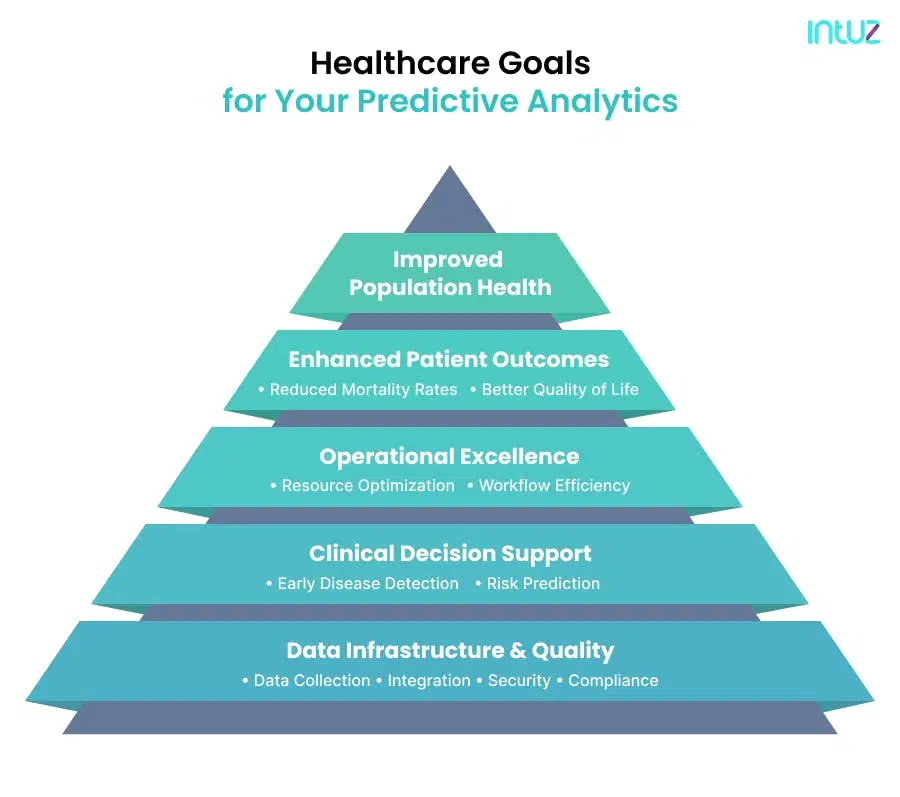
To help all stakeholders stay aligned without ambiguity, start by setting specific goals around the on-site and remote healthcare service challenges you want to solve with predictive analytics.
Ask yourself:
- Are you trying to reduce the number of hospital readmissions?
- Are you aiming to improve early diagnosis rates for diabetes or cancer?
- Do you need better staff schedules to avoid overwork while ensuring patients get timely care?
Remember to make each goal quantifiable—such as reducing hospital readmission by 30% over 12 months or detecting early-stage cancer with 95% accuracy. You should also define KPIs to track the progress for each goal, such as cost savings or patient outcome improvements.
Ready to Improve Healthcare with AI?
2. Collect and prepare healthcare data for analysis
Your predictive analytics project will only be as good as the data you use.
Therefore, choose reliable sources to gain insights into patient health data and outcomes. Lab results, patient demographics, claims information, imaging reports, and even data from wearable devices can be useful in this context.
It’s also important to remember that much of this data is messy, spread across multiple locations, or irrelevant. Sifting through it all can be incredibly time-consuming. That’s why we recommend working with an AI development company for this job.
Intuz’s AI developers, for instance, can normalize the data to meet standard formats (such as date and time), assign suitable tags to data points to help the AI model understand relationships, and identify and remove anything extraneous.
Starting with clean, well-prepared data ensures that your AI insights are as meaningful as possible from the get-go.
3. Select the right AI tools and technologies
Several AI tools and frameworks can power your predictive analytics project. TensorFlow and PyTorch have highly robust capabilities and can be customized as per your application requirements, especially when paired with PyTorch or Tensorflow development services. You can also opt for industry-specific AI solutions like IBM Watson Health or Google Cloud Healthcare AI.
Cloud platforms like Microsoft Azure or AWS Healthlake are helpful in deploying custom AI solutions. When choosing your AI tools, consider their scalability, compliance with regulatory standards, and integration with the rest of your tech stack.
It might be worth exploring working with Intuz. We can bring expertise in tool selection, personalization, and deployment, ensuring your predictive analytics app runs smoothly. Find the right ways to select your AI partner in this blog.
4. Build AI models to predict healthcare outcomes
Now it’s time to create the predictive models.
The type of model you build will depend on your goals:
- Use classification models to identify high-risk patients
- Try clustering models to group patients with similar needs
- Go for regression models if you need to predict outcomes like recovery time
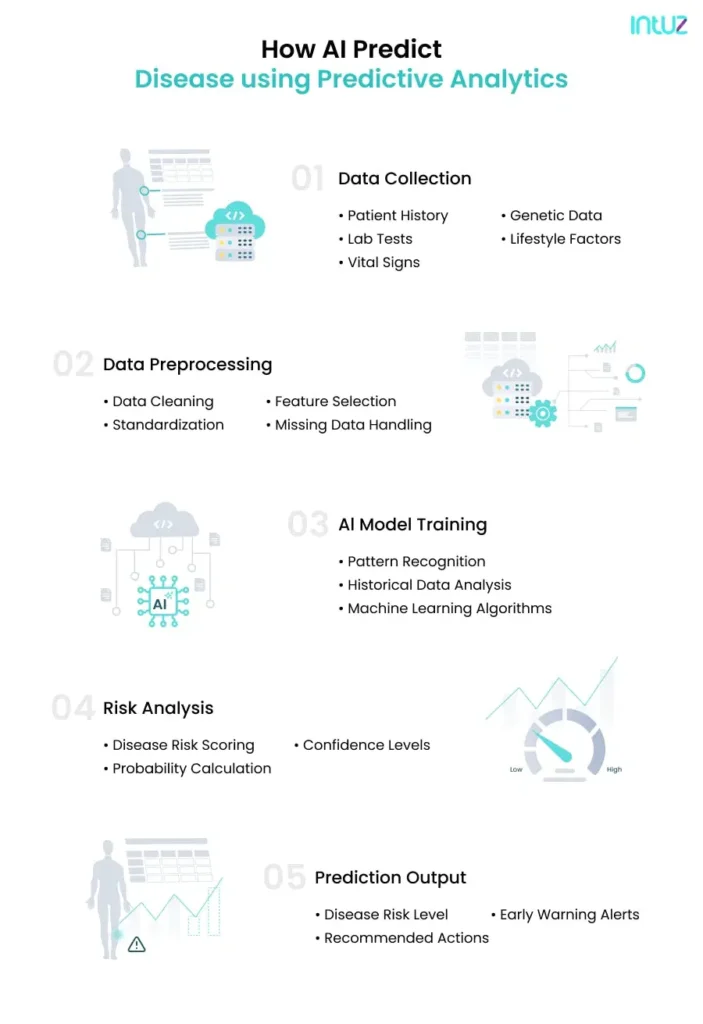
These models use machine learning to identify and predict outcomes or deep learning for more complex tasks like image analysis. To develop them, select the right algorithm (e.g., logistic regression or neural networks) for the type of health prediction you want to make.
Then, move on to feature engineering, extracting meaningful variables like age, BMI, or diet to predict outcomes. Finally, train the model using historical data and test its performance ability.
You can use such predictive models to manage various outcomes, such as identifying high-risk patients for heart attacks or early signs of chronic illnesses like dementia, enabling your healthcare staff to prioritize timely patient care.
5. Test predictive models for accuracy and reliability
You’ll need to test your predictive models rigorously to ensure their suitability for real-world applications and resistance to failure.
Cross-validation is a popular method involving training the model based on certain subsets of your data and testing it on other subsets (such as validating its diagnostic accuracy across different demographics).
There’s also A/B testing, wherein you compare outcomes from your predictive model against outcomes from a traditional method.
To maximize the model’s predictive accuracy, monitor metrics like precision (the proportion of correctly identified positive cases against predicted positives), recall (the proportion of the actual number of positive cases identified), and F-1 (a measure combining recall and precision).
Remember, testing doesn’t stop here. As new data becomes available, retrain your model regularly to keep it accurate and reliable.
6. Integrate into your healthcare systems
Your predictive model must integrate smoothly into your existing healthcare IT systems. This could involve leveraging existing IT infrastructure or setting up custom dashboards, typically a job best done in collaboration with companies offering AI development services.
It’s equally important to ensure that your healthcare professionals are aligned with the change from the start so that they feel their perspectives and experiences are part of the journey.
For instance, emphasize that the predictive insights from your AI model supplement their diagnostic judgment, not replace it.
A big part of garnering their support is setting up user-friendly interfaces that even non-technical users can comfortably access for the insights they need, such as visual dashboards and contextual explanations wherever relevant.
Last but not least, remember to include security measures and data access controls that prioritize patient privacy and compliance eg. HIPPA with all legal/ethical standards.
7. Pilot the project and then roll it out in stages
Implementing predictive analytics into your healthcare practice is a major change, so we recommend doing it in phases for the best long-term results.
Start with a pilot in one specific department or patient cohort (for example, improving hospital readmissions in one specific ward) to test the model’s real-world efficacy.
Document any bugs and gather feedback from the healthcare professionals who will actually use the AI enabled system in their daily workflows. For instance, if they note that the insights are presented in an unclear fashion, you can adjust the model to use simpler or more intuitive methods for presenting data results.
Once the pilot is completed, roll it out to other departments, continue testing, and incorporate feedback while simultaneously training all your team members on using the AI model for their benefit.
Continue to collect their feedback on the model through open surveys and one-on-one communication, and remember to keep training your model with relevant, up-to-date data. Consistency is key to long-term success.
Plus, this piloted approach will allow you to win over your team’s confidence from the start and minimize the risk of workflow mismatches later on.
Also Read
Agentic AI in Healthcare: A CXO’s GuideIn Conclusion
Proactive healthcare is the future, as more patients demand care that is personalized to their needs and administered on time. Using AI predictive analytics in healthcare can improve your healthcare firm’s decision-making, enhance patient outcomes, and keep costs under control.
Be sure to have a structured plan, start small, invest in the right tools, and continue iterating along the way based on results and stakeholder feedback. You’ll see the results very soon and be known as a healthcare expert who truly cares.
With various phenomenal AI predictive analytics use cases, the technology is ready to change how the healthcare industry works. Are you ready to revolutionize your processes, products, and research?
Book your free 60-minute consultation with our AI experts today!
During this personalized session, our team will:
- Create a predictive analytics proof-of-concept customized for your business
- Design a top-level implementation strategy for your healthcare organization
- Provide strategies for integrating predictive analytics into areas like diagnostics, patient care, and medical research
So, what are you waiting for? Get in touch and change the way you deliver care.
FAQs
How much does it cost to implement AI predictive analytics in a healthcare organization?
Costs vary significantly based on scope, but most healthcare organizations should budget $50,000–$250,000+ for an end-to-end custom implementation. A focused pilot — say, a readmission prediction model for one department — typically starts around $30,000–$60,000. Broader deployments covering diagnostics, staffing optimization, and EHR integration push well beyond six figures. Key cost drivers include data preparation (often 30–40% of total effort), model complexity, cloud infrastructure, and compliance requirements like HIPAA. Ongoing maintenance and model retraining add 15–20% annually. Working with a specialized AI development partner like Intuz helps avoid costly scope creep by defining the right starting point.
How long does it take to implement AI predictive analytics?
A scoped pilot — covering one use case like hospital readmission prediction — typically takes 10–16 weeks from kickoff to production deployment. This includes 2–3 weeks for data audit and preparation, 4–6 weeks for model development and training, 2–3 weeks for testing and clinical validation, and 2–3 weeks for integration and staff onboarding. Full enterprise-wide rollout across multiple departments can take 9–18 months. The biggest timeline risks are poor data quality and delayed stakeholder alignment — both of which can be mitigated significantly with a clear discovery phase before development begins.
What tech stack is typically used to build AI predictive analytics?
The most common stack includes TensorFlow or PyTorch for model development, Python (scikit-learn, Pandas, NumPy) for data processing, and FHIR-compliant APIs for EHR integration. Cloud infrastructure is typically AWS HealthLake, Microsoft Azure Health Data Services, or Google Cloud Healthcare API — all of which offer HIPAA-compliant environments. For visualization and clinical dashboards, Power BI, Tableau, or custom React-based interfaces are standard. MLflow or Kubeflow handle model versioning and pipeline orchestration. The specific stack should align with your existing EMR vendor (Epic, Cerner, Meditech) to minimize integration friction and ensure data continuity.
Do we need to replace our existing EHR system to implement AI predictive analytics?
No — AI predictive analytics is designed to work alongside your existing EHR, not replace it. Solutions integrate via HL7 FHIR or API connectors that pull structured data from Epic, Cerner, Meditech, or similar platforms without disrupting day-to-day workflows. The AI layer sits on top of your current infrastructure, processing data in real time or batch mode and surfacing insights directly within clinical dashboards your staff already use. What you will need is a data audit to assess completeness and quality across your existing records — gaps in historical data are the most common barrier to model accuracy, not the EHR system itself.
How do you ensure HIPAA compliance when building AI predictive analytics for healthcare?
Compliance needs to be built in from the architecture stage — not added afterward. This means using HIPAA-compliant cloud environments (AWS, Azure, or GCP all offer BAA-eligible services), encrypting patient data at rest and in transit (AES-256 and TLS 1.2+ as minimums), and implementing role-based access controls so only authorized personnel can access identifiable records. On the AI side, models should be trained on de-identified or anonymized datasets wherever possible. Regular security audits, audit trail logging, and third-party penetration testing are also required for most covered entities. An experienced AI development partner should carry HIPAA compliance documentation and be willing to sign a Business Associate Agreement before work begins.
What types of predictions can AI analytics actually make in a clinical setting?
Mature production use cases include 30-day hospital readmission risk scoring, early sepsis detection (often 4–6 hours before clinical symptoms), ICU deterioration alerts, chronic disease progression forecasting (diabetes, COPD, heart failure), and surgical complication risk stratification. Beyond patient-level predictions, AI models are also used operationally — forecasting ED patient volumes for staffing, predicting equipment maintenance needs, and optimizing bed allocation. The right use case to start with depends on where your organization carries the most cost risk or care gap. High-volume, high-cost conditions with abundant historical data (like readmissions or chronic disease management) typically yield the fastest, most measurable ROI.
Work with Intuz
Ready to Integrate Predictive Analytics in Your Healthcare System?
Book 45-minute free consultation to discuss next steps.
Let's Get Started
Share this article