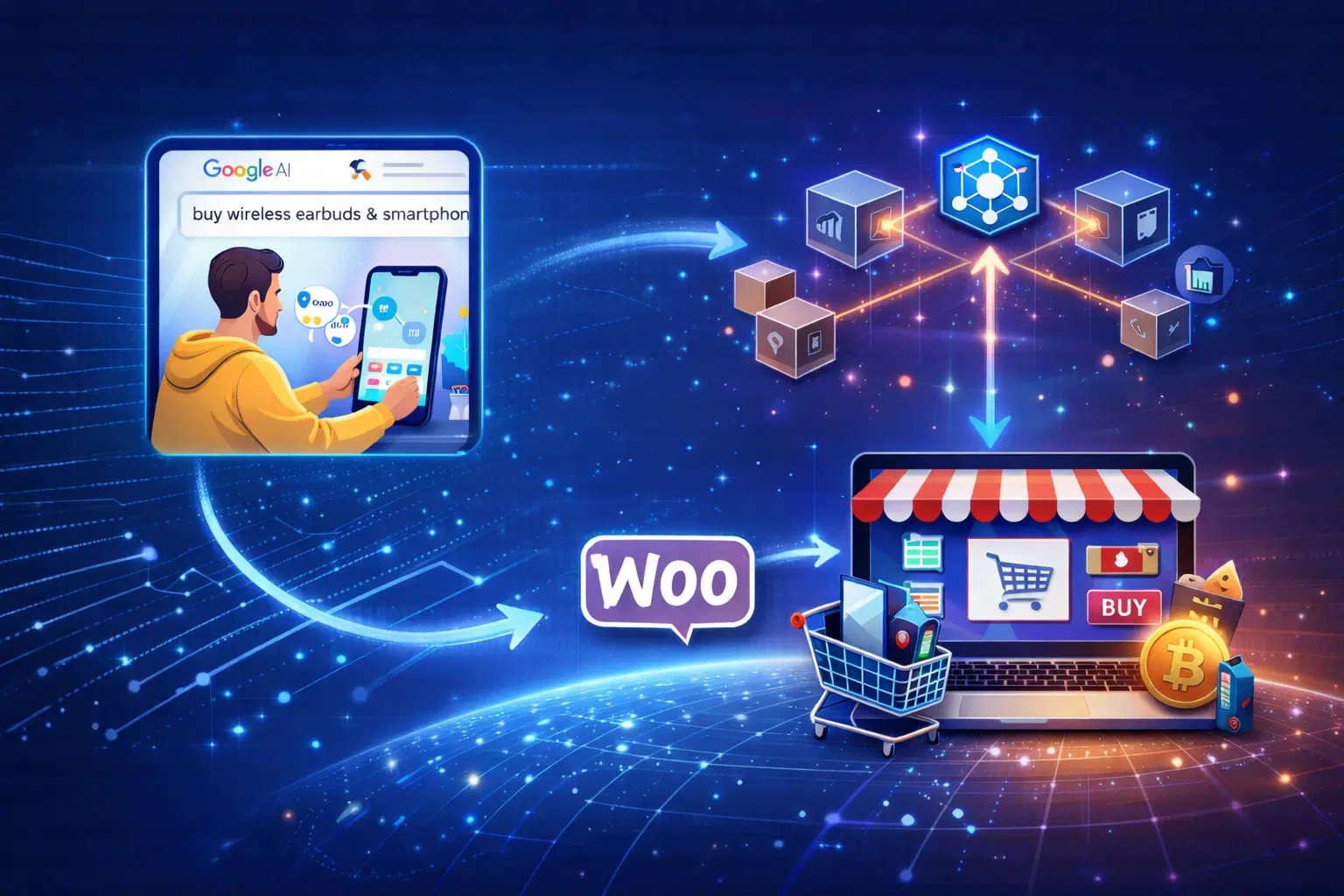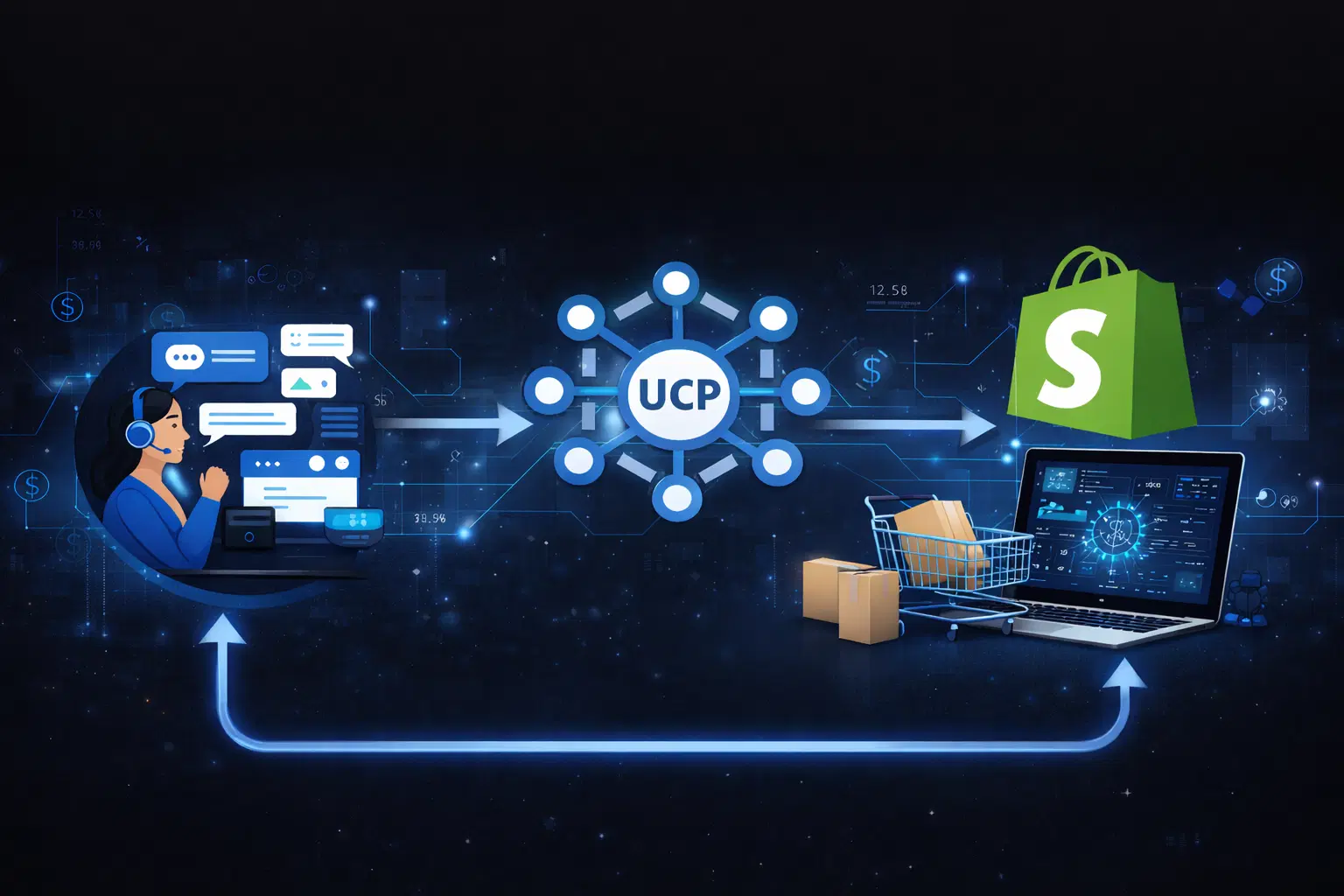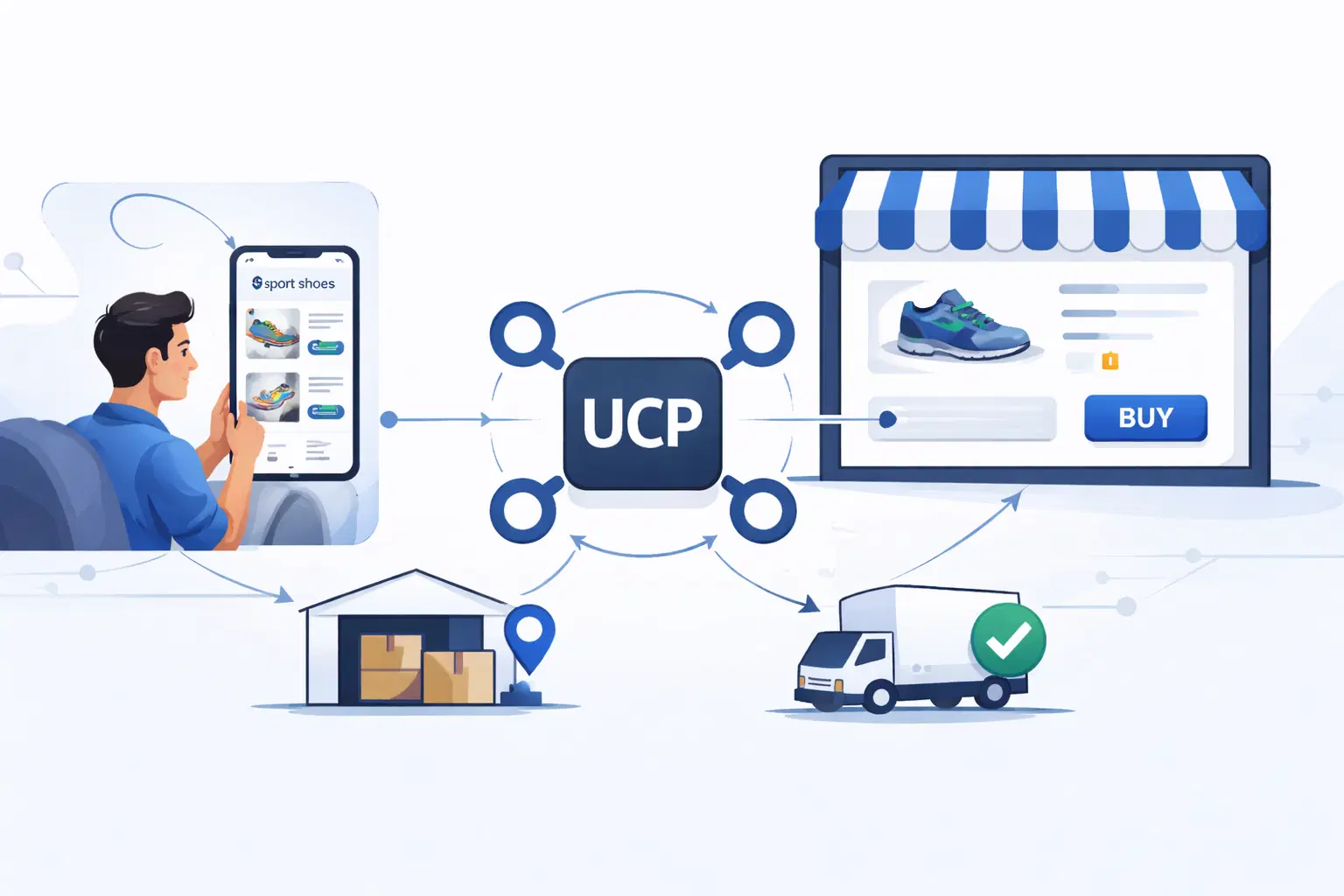

In this guide, we’ll explain what UCP is, how it works, what changes in your tech stack, and how it’s set to alter discovery, checkout, loyalty, support, and cross-channel selling for your eCommerce company. Let’s get started by first exploring the fundamentals of UCP.
Online shopping became mainstream with the rise of the World Wide Web in the mid-1990s. Conventionally, a person would arrive at an eCommerce store, browse multiple pages, add items to the cart, and complete a form-heavy checkout.
But now, all of that’s about to change. On January 11, 2026, Google unveiled the Universal Commerce Protocol (UCP), an open standard that will enable AI agents to make purchases on your behalf without ever visiting your store!
Show
- Universal Commerce Protocol (UCP) enables AI agents to discover products, create checkout sessions, process payments, and manage post-purchase actions without users visiting a storefront.
- UCP transforms eCommerce from page-based shopping to machine-readable, agent-driven commerce using structured product, pricing, inventory, and checkout data.
- AI-powered checkout reduces friction by eliminating manual forms, browser sessions, and repetitive checkout steps that commonly cause cart abandonment.
- UCP allows merchants to automate loyalty programs, discounts, bulk pricing, and shipping incentives through real-time transaction rules.
- Post-purchase workflows such as order tracking, cancellations, returns, and address changes can be executed directly by AI agents through standardized commerce actions.
What Is the Universal Commerce Protocol (UCP)?
Universal Commerce Protocol (UCP) is an open, standardized language (or communication protocol) that specifies how an AI agent (a software program that performs tasks for users) discovers a merchant’s products and capabilities, retrieves product, price, and availability data, creates and updates a checkout session, applies incentives, and executes payment through supported handlers.
Basically, it’s built to work with existing retail infrastructure, executing pre- and post-purchase actions for each order. UCP is compatible with Agent Payments Protocol (AP2), Agent2Agent (A2A), and the Model Context Protocol (MCP).
UCP was co-developed with industry leaders, including Shopify, Etsy, Wayfair, Target, and Walmart, and endorsed by 20+ others across the ecosystem, like American Express, Best Buy, Flipkart, Macy’s Inc., Mastercard, Stripe, Visa, and The Home Depot.
Let’s understand this with an example.
A customer begins the process by asking an AI system, “Find a lightweight carry-on suitcase under $200 that fits international cabin limits.”
The AI then reaches out to merchants A, B, and C, whose stores expose UCP endpoints.
Each merchant retrieves the following information:
- Matching products
- Current prices
- Stock availability
- Purchase constraints (like payment methods and delivery deadlines)
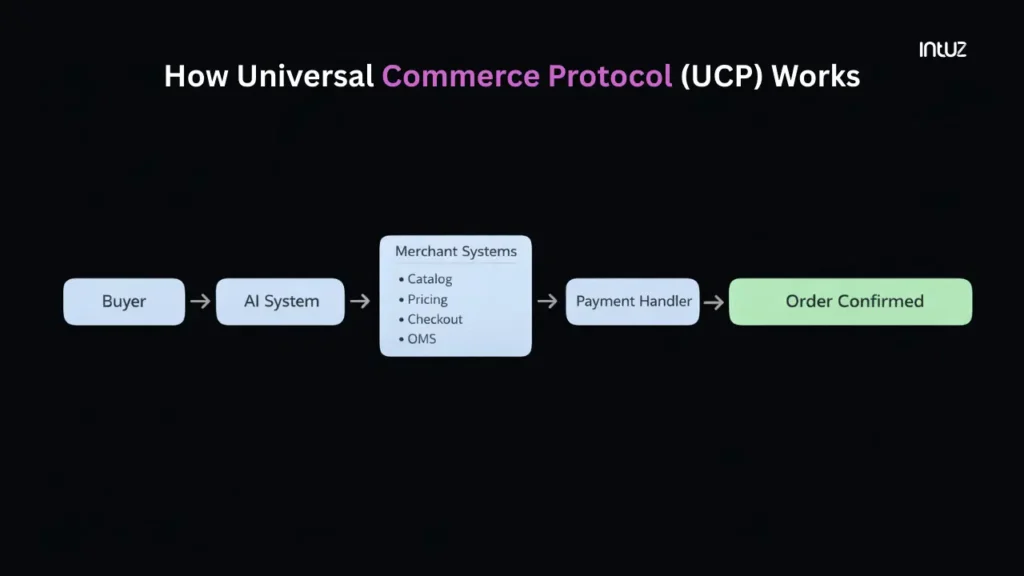
The AI system evaluates and compiles the responses and presents a short list to the customer, who, in turn, selects one item from Merchant B. This prompts the AI to create a UCP checkout session. The request is sent directly to Merchant B’s checkout capability. It returns:
- Final price
- Taxes
- Shipping options
- Payment requirements
The AI completes payment using an existing wallet. The order is confirmed, and the same interface remains available for order tracking, cancellations, and changing addresses.
Traditional eCommerce vs UCP-Based Commerce: What Changes
| Dimension | Traditional eCommerce | UCP-Based Commerce |
|---|---|---|
| Entry point | Browser request to a URL | Capability request from an agent |
| Discovery mechanism | Keyword indexing of pages | Programmatic product queries |
| Product representation | HTML optimized for rendering | Typed data returned through a standard schema |
| Decision context | User navigates and evaluates manually | Agent evaluates constraints and options |
| Checkout initiation | User submits a form | Agent creates a checkout session |
| Checkout state | Bound to a browser session | Bound to an addressable transaction object |
| Pricing logic | Applied during page or cart render | Evaluated per request through defined rules |
| Incentives | Entered manually or attached to campaigns | Applied programmatically during transaction creation |
| Identity | Local to a site or account | Linked across agents through protocol-level identity |
| Post-purchase actions | Ticket or portal based | Direct actions on order state |
| Channel expansion | New surface requires new integration | Any compliant agent can transact |
| Failure handling | Page errors and retries | Typed error states and idempotent requests |
4 Key Use Cases of Universal Commerce Protocol for Ecommerce Companies
1. Instant product discovery for higher conversions
Today, discovery depends on pages, rankings, and clicks. You compete for attention in crowded layouts, pay for traffic, and accept that most visitors will leave without buying.
With UCP, discovery becomes a direct system interaction. Here, the primary customer is the AI agent. It arrives through Google AI Mode, the Gemini app, and enterprise assistants that shop for customers.
Your catalog is exposed as structured data. Inventory, pricing, and constraints become machine-readable. An agent can issue a bounded request, and your system replies with only items that meet the customer’s criteria.
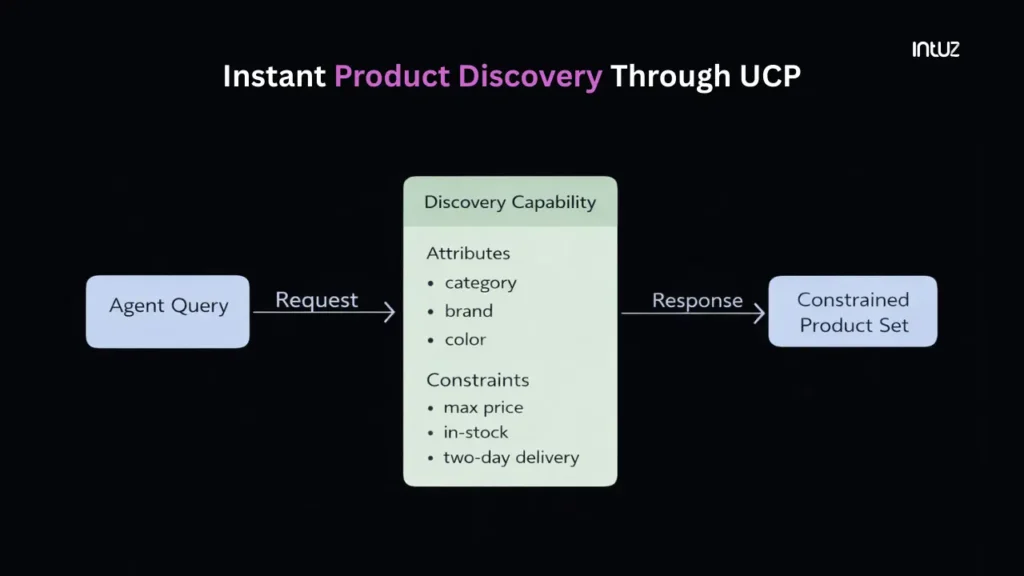
Every request is high-intent. There’s no wandering or casual browsing. Discovery is no longer “traffic” but “qualified demand.” Instead of hoping for visits, your products become accessible for software queries.
Example: A mid-sized luggage brand currently spends to attract 50,000 monthly visitors. Roughly 1.5% convert, which yields ~750 orders.
In a UCP-driven flow, the brand receives 1,200 agent queries like:
“Carry-on suitcase under $200, under 7 kg, deliverable in 3 days.”
Every request already satisfies price, size, and logistics constraints. If even 25–30% of those queries convert, the same brand closes 300–360 orders from a fraction of the interaction volume, with no ad spend and no page-level persuasion.
2. Streamlined checkout without friction
You won’t believe this, but despite eCommerce companies investing significantly in “first in mind” strategies, Pay-Per-Click campaigns, beautifully-crafted homepage UX, and faceted search logic, the average cart abandonment rate globally sits at 80%!
In fact, you’d safely assume that most people browsing your store are just “window shopping.” But UCP converts checkout into a callable transaction capability. An AI agent can send a complete order request straight to your eCommerce store from its own interface.
It can create a session, update items, change quantities or delivery terms, apply conditions, and safely retry failed steps without losing state.
Each request either satisfies your rules or it doesn’t. There are no intermediate screens to abandon, so drop-off disappears. Conversion speeds up, form fatigue vanishes, and order value rises as agents negotiate quantities, bundles, and delivery terms in line.
Example: A consumer electronics retailer currently loses 65% of customers between “Add to Cart” and “Order Confirmed.”
The drop-off comes from:
- Account creation
- Address entry
- Payment failures
- Redirects to third-party gateways
- Mobile form friction
With UCP, a customer says:
“Buy the 14-inch laptop with 32GB RAM. Deliver in three days. Use my business card.”
The agent submits a complete transaction request:
- SKU
- Quantity
- Shipping preference
- Payment handler
- Billing identity
Your system validates it in one call.
If a rule fails (for example, the delivery window is unavailable), the agent adjusts and retries: “Deliver in five days instead.” There are no page reloads, form resets, or lost states to recover. The order completes in a single, continuous exchange.
3. Automate loyalty and incentives
Research shows that eCommerce discounts don’t always correlate with stronger purchase intent or higher profitability. This isn’t surprising as they’re mostly campaign-driven, surface-specific, and loosely enforced. Plus, rules fragment across channels.
The same customer may receive different treatment depending on where they enter. UCP changes where and how discounts happen. Incentives now become part of the actual purchase transaction. Your store decides in real time who qualifies for an offer, under what conditions, and how it affects the final price.
So instead of saying:
“Everyone gets 10% off this week,” you can say:
- “Give free shipping only to repeat buyers”
- “Apply bulk pricing only above 100 units”
- “Offer a discount only if this customer hasn’t ordered in 90 days”
Those rules can get enforced everywhere – in search assistants, chat agents, and enterprise procurement tools – whenever a checkout session is set up.
Example: A returning business customer says to their AI assistant:
“Reorder the same printer cartridges we bought last month. We need 80 units.”
The shopping assistant sends a UCP checkout request with the buyer’s identity, order history, and quantity. The merchant’s system evaluates its incentive rules in real time:
- Buyer has placed 3 orders in the last 60 days
- Order value exceeds the loyalty threshold
- Quantity is above the bulk tier
Based on those conditions, the system applies a 6% loyalty discount, tiered bulk pricing, and free expedited shipping. The response sent back to the agent includes the base price, the loyalty-adjusted bulk price, free shipping, and the delivery date.
The assistant replies:
“You qualify for loyalty pricing and bulk rates. Total is $1,420 with free next-day delivery. Should I place the order?”
The discount appears because the rules say it should, at the moment of purchase.
4. Autonomous post-purchase service
After an order is placed, the most support volume comes from predictable things, like:
- “Where is my order?”
- “Can I change the address?”
- “I need to cancel.”
- “I want to return this.”
These problems aren’t hard to fix. They’re simply repetitive: creating tickets, hitting chat queues, and introducing delays and inconsistency into order fulfillment.
In the UCP world, your eCommerce store decides how to fetch order status, when cancellation is allowed, and how to initiate returns.
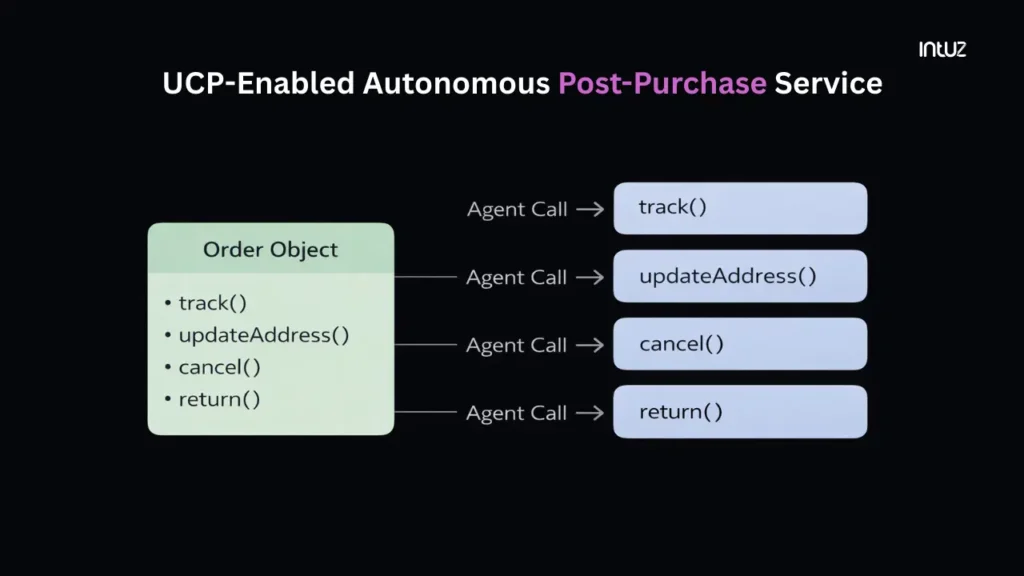
Each customer request (via agents) is validated against your actual order system. If the action is allowed, it happens. If it’s not, the AI gets a clear reason. Your team only handles exceptions.
Example: A customer tells their AI assistant:
“Cancel my coffee machine order and reorder it with the extended warranty.”
The assistant sends a UCP request to cancel the order.
The store checks its fulfillment rules. The package hasn’t shipped yet. Cancellation is allowed. The order is canceled.
But if the original order had already shipped, the store would respond:
“Cancellation is no longer possible. Shipment has entered carrier transit.”
The assistant would relay that and offer the next valid action: “I can initiate a return once it’s delivered. Would you like me to set that up?” Post-purchase service becomes a sequence of valid system actions, executed or declined by rule.
How Intuz Helps You Implement Universal Commerce Protocol
UCP is a new technology, one that will need to be adapted quickly by eCommerce companies. The good news is, we can help you become future-ready.
We’ll build task-specific AI agents that operate directly against your UCP interface. These include buying agents for discovery and checkout, negotiation agents for quantity, pricing, and delivery terms, and support agents for tracking, changes, and returns.
Each agent can be configured to consume your UCP capabilities, enforce your business rules, and operate within your security and policy boundaries. For Google integration, we’ll connect your Merchant Center feeds to UCP and implement the required capability mappings.
Intuz can implement UCP workflows using tools like n8n or LangChain, which orchestrate discovery, checkout, and post-purchase actions, handle exceptions and retries, integrate with CRM, ERP, and support systems, and trigger event-driven flows for order updates and fulfillment.
All workflows will run in your environment and remain fully observable and auditable. If you want to participate in agent-led commerce, your stack has to become callable. Schedule a 45-minute demo with Intuz for a UCP readiness audit.
We’ll assess your current commerce stack, identify which capabilities can be exposed immediately, map gaps in discovery, checkout, and order APIs, evaluate security and compliance requirements, and produce a clear migration roadmap to UCP compliance.
You’ll receive a concrete implementation plan, not a concept document. Talk soon!
FAQs
What is Universal Commerce Protocol (UCP)?
UCP is an open-source standard launched by Google in January 2026 under Apache 2.0 license. It provides a common language for AI agents, platforms, and merchants to complete full commerce journeys—from product discovery and checkout to order management—without custom integrations. Merchants link via Google Merchant Center feeds for AI-driven sales on Search and Gemini.
How does UCP work for ecommerce?
UCP standardizes commerce via REST endpoints for capabilities like inventory checks, cart creation, and tokenized payments (OAuth 2.0, AP2). AI agents discover merchant services, negotiate terms, and execute buys in conversational flows. Merchants remain the seller of record, syncing data securely while agents handle frictionless experiences across Google AI surfaces. (52 words)
What are the benefits of UCP for merchants?
UCP cuts integration costs with one-time setup for multiple AI platforms, boosts conversions via in-chat checkouts, and expands reach to high-intent Google traffic. Merchants retain data control, pricing, and customer relationships as Merchant of Record. It reduces abandonment by 30-50% through seamless, secure flows without becoming a marketplace.
How do I integrate UCP into my store?
Prepare Merchant Center feeds, join Google’s waitlist for approval, implement core REST endpoints for checkout sessions, and publish your business profile with public keys. Support guest or OAuth-linked checkouts; sync orders via webhooks. Platforms like Shopify offer apps—start with inventory sync and test AI agent flows.
Is UCP the future of ecommerce?
Yes, UCP powers agentic commerce, shifting to AI-led, invisible transactions by 2030 (25% e-commerce volume). Future includes agent-to-agent negotiations, autonomous supply chains, and multi-platform interoperability. Early US adopters gain SEO/AI visibility edge, non-ready sellers risk losing traffic as shopping moves conversational.