

Generative AI Chatbots for Ecommerce Customer Support: Complete 2026 Guide
Updated 11 Mar 2026

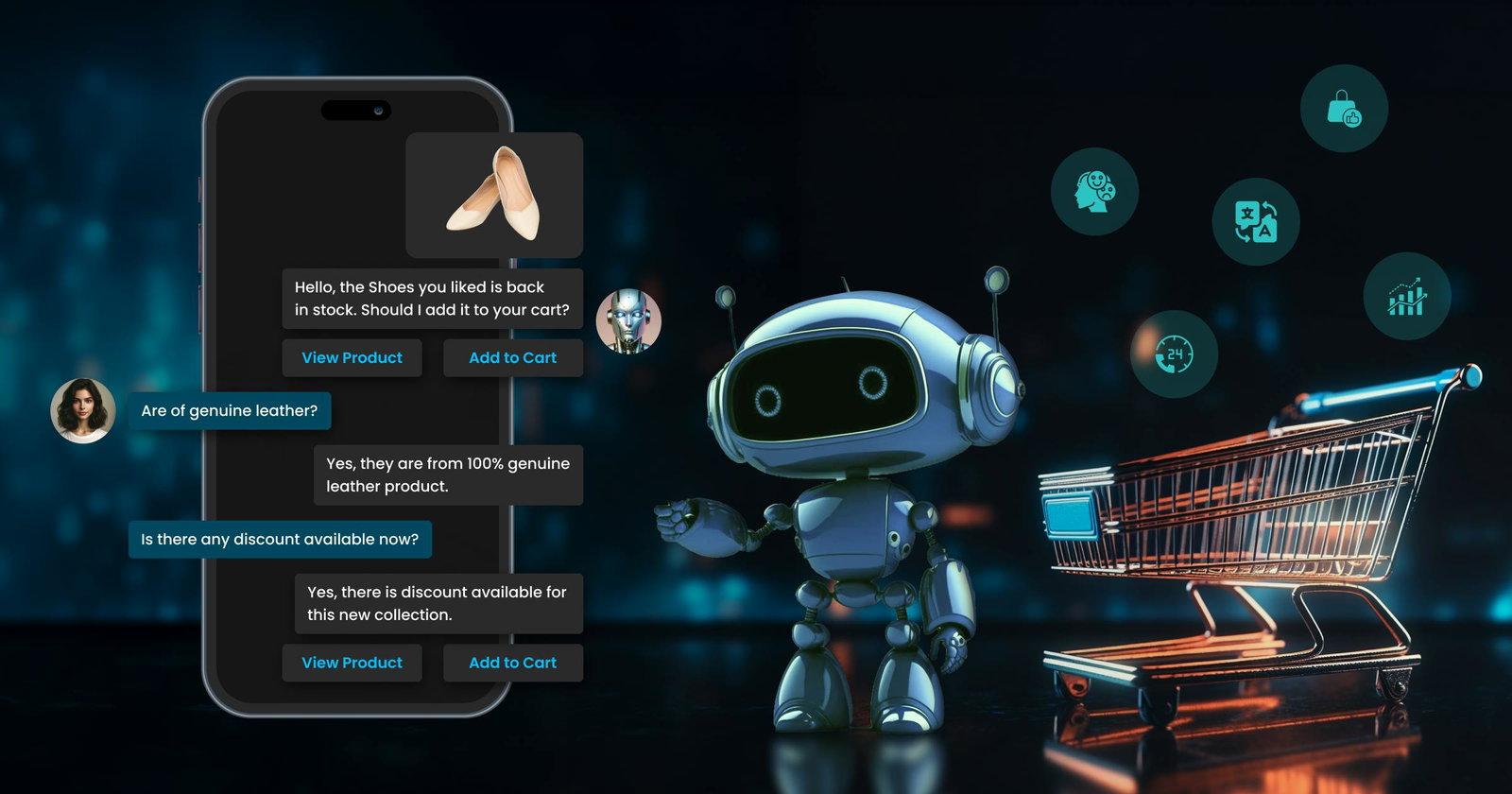
In this blog post, we will study what a Generative AI chatbot is, how it is disrupting eCommerce retail, and what it can do to enhance customer experience—with support from an experienced AI development company.
According to a McKinsey report, nearly a quarter of all global sales will be online in 2025, translating to 2.71 billion online shoppers. Keeping that in mind and the fact that 71% of consumers make buying decisions based on the quality of support, it has become imperative for eCommerce businesses to provide efficient customer service - and what is better than using chatbots?
Quick responses, personalized interactions, and round-the-clock availability interactions are a few massive benefits of chatbots. They are cost-effective, too. If the alternative were to wait 10 minutes for a live agent to resolve concerns, 62% of consumers would rather converse with a chatbot. They save time and find what they want.
Given how seamlessly chatbots initiate a conversation between businesses and the ever-connected consumers, it is fair to say they are rewriting the customer support playbook, especially in the world of eCommerce. However, traditional chatbots are limited to scripted responses and may not reply appropriately to complex human language. That is where Generative AI is poised to have far-reaching implications for the global e-commerce sector.
What are Generative AI chatbots?
Generative AI is an advanced subset of Artificial Intelligence (AI) that makes use of Natural Language Processing (NLP) for interpreting user queries and Machine Learning (ML) and creating new content in the form of text, images, and music or even predicting future data points.
More specifically, Generative AI chatbots generate original output in contextually relevant, human-like language instead of pre-written responses like traditional chatbots, keeping the conversation natural and increasing customer satisfaction. And if you're exploring how to create an AI chatbotfor your business, understanding the capabilities of Generative AI is a crucial first step.
Key benefits of AI in eCommerce customer support
1. Humanized customer interactions
Generative AI-powered chatbots are trained using large data sets and algorithms to understand customer preferences, analyze purchase history, and identify patterns. They use the information to create responses tailored to each customer, even when resolving similar queries. These custom interactions make customers feel heard and understood.
2. Personalized product recommendations
The technology enables eCommerce businesses to deploy superior recommendation systems that deliver customized product suggestions based on individual behaviors. This level of personalization enhances the overall shopping experience, increasing the likelihood of customers discovering products they want to buy.
![[]](/_next/image?url=https%3A%2F%2Fintuz-site-uat.b-cdn.net%2FKey_Benefits_of_Generative_AI_in_E-Commerce_Customer_Support.png&w=1920&q=75)
3. 24/7 availability and instant responses
The around-the-clock accessibility of AI-powered chatbots ensures that customers can seek help or information anytime, which enhances their convenience. The instantaneous nature of responses addresses customer inquiries promptly and contributes to heightened satisfaction as users receive quick and accurate information.
4. Handling multiple and complex user queries
Traditional customer support chatbots only successfully respond to limited customer queries. However, consumers often have to wait for human intervention for complex queries, leading to delays and longer response times.
For instance, a customer might ask several questions in one message, each about a different product or service aspect. The chatbot would have to parse each question, understand the context, and give accurate responses for every query, which might not be possible in a traditional setup.
Generative AI models are designed to produce content based on the input they receive, so they thoroughly analyze the customer’s question to understand its context and intent and then answer accordingly. That is how AI chatbots can handle complex queries simultaneously.
How Generative AI Virtual Try-On Is Transforming Fashion eCommerce
Integration of Generative AI-powered chatbots with CRM systems
By merging the capabilities of this advanced AI technology with the comprehensive data management features of CRM platforms, eCommerce businesses can build a smart customer service ecosystem. Here is how:
1. Seamless data flow for a holistic customer experience
This integration enables chatbots to access comprehensive customer profiles, interaction histories, and preferences stored in CRM platforms. For example, a customer who previously bought a product and had support interactions will be instantly recognized on the system when they contact again. Using the CRM data, the chatbot can provide personalized recommendations, promotions, and responses.
![[]](/_next/image?url=https%3A%2F%2Fintuz-site-uat.b-cdn.net%2FIntegration_of_Generative_AI-powered_Chatbots_with_CRM_Systems.png&w=1920&q=75)
2. Data continuity for better customer understanding
This means all interactions, whether manual or automated, are a part of a unified customer profile. This ongoing data collection and analysis lead to a deeper understanding of customer requirements, preferences, and behavior patterns.
The AI-powered chatbot can analyze customer behavior and engagement history intelligently to ensure that future interactions are contextually relevant and aligned with individual preferences. The integration enables eCommerce businesses to make data-driven decisions, improve products/services, and meet unique customer segments through targeted marketing efforts.
3. Collaboration between AI and human agents
When a chatbot and a human agent work together, the former quickly escalates complex queries to the latter, ensuring a smooth customer experience. Chatbots can also pass on other relevant info, such as customer mood and intent, speeding up resolution times. For example, if you run an online wedding clothing store, the chatbot can assist customers with general inquiries about bridal wear collections and pricing. But for chalking out custom tailoring details, it can smoothly transfer the query to a human agent, who accesses the conversation history from the CRM for a seamless continuation of a conversation.
Future trends and innovations of Generative AI in e-commerce
As AI technology continues to evolve, several exciting developments on the horizon will shape the use of AI technology in providing customer service in eCommerce, including:
1. Voice assistance
With the growing popularity of voice assistants like Google Home and Amazon’s Alexa, we can expect to see their integration with AI chatbots. Voice-enabled chatbots will provide a more natural and efficient way for customers to interact with their preferred eCommerce brands, further enhancing the shopping experience.
2. Emotional intelligence
Emotional intelligence in AI chatbots is a transformative feature that has the power to take an interaction experience to a more empathetic level. AI-powered chatbots are designed to understand and reply to customer queries based on customer sentiment analysis, which involves studying their emotions and moods. By reviewing text for emotional cues, such as word choice, tone, and sentence structure, chatbots can gauge feelings like frustration, happiness, or sadness in the customers. As this technology evolves, it could enhance the personalization of interactions and create more meaningful connections simply through this type of text inflection.
3. Multilingual capabilities
As eCommerce businesses expand globally, AI-powered chatbots must accurately translate, interpret, and respond to queries in multiple languages. Eliminating language barriers will help support, gather feedback, and engage with a broader audience without language constraints.
![[]](/_next/image?url=https%3A%2F%2Fintuz-site-uat.b-cdn.net%2FFuture_Trends_Innovations_of_Generative_AI_in_E-Commerce.png&w=1920&q=75)
4. Enhanced NLP, ML, and NLU capabilities
The application of these models will help chatbots find relevant information faster during a live call to resolve customer problems. Using Natural Language Understanding (NLU), they can find the intent behind a query and drive natural language conversation with humans. This model will build semantic intelligence to decipher the meanings of phrases and accurately interpret customer needs
5. Predictive analysis for interaction customization
Predictive analytics represents a major leap in the evolution of chatbots. This model leverages historical data, statistical algorithms, and ML techniques to foresee potential issues or questions a user might have, enabling them to offer help or solutions proactively. For example, if a customer named Lauren visits the website looking for a new handbag, the chatbot, having access to her previous buying history and browsing patterns via predictive analytics, can initiate a conversation:
*“Hey, Lauren! Our new Barbie pink handbag collection is here. Would you like to check it out?”*
The goal is to drive more sales, and in this scenario, the chatbot attempts to boost the chances with an insightful suggestion.
How to evaluate and choose the correct Generative AI solution for your eCommerce business
According toHubspot, 48% of customer service pros believe Generative AI chatbots understand and respond to customer queries accurately. While 46% agree that AI helps provide personalized recommendations, 84% think it improves overall CX. But not all chatbots are created equal. Choosing the right Generative AI solution for your specific eCommerce needs is essential for a successful implementation.
Here are some key factors to consider:
 Identify how well the AI solution integrates with your current eCommerce platform and other tech stacks, such as CRM platforms, product databases, and data analytics tools. For example, if you host your eCommerce website on Magento, ensure your AI solution offers compatible APIs and plugins.
- Review the quality of content that AI produces. It should be grammatically correct and align with your business tone of voice and style. Before purchasing the solution, check if you can try it for free.
- AI for the retail industry must be customizable so that you can add industry-specific terminology. See if the solution can be personalized for specific tasks, such as customer service chatbots, custom product recommendations, or content generation, or whether it can handle heavy volumes of interactions and data.
- AI algorithms require continuous training and fine-tuning to improve their performance. The chosen AI solution should offer easy-to-use tools and use customer interaction data for AI model training.
- The AI solution should offer robust analytics and reporting to monitor specific metrics regarding its performance, such as engagement rates, conversion ratio, customer satisfaction scores, and so on.
How to Increase E-commerce Sales Conversions and Revenue with Generative AI
In conclusion
The transformative impact of Generative AI in customer support lies in the ability to revolutionize the shopping experience, streamline operations, and drive unprecedented personalization.
Additionally, the technology’s adaptability and continuous learning capabilities empower eCommerce businesses to stay agile, fostering customer loyalty and encouraging repeat business.
If you are keen to change how you engage with your customers, transform your online retail customer support with the help of a Generative AI-powered chatbot built for you. Consult our AI app development experts to get started.
How do generative AI-powered chatbots improve customer support in eCommerce compared to traditional chatbots?
Can AI chatbots handle complex or multi-part customer queries, such as order issues, returns, or product troubleshooting?
What are the main benefits of using generative AI chatbots for 24/7 customer support in eCommerce?
How do generative AI chatbots deliver personalized product recommendations and enhance the shopping experience?
What are the challenges or limitations of implementing generative AI-powered chatbots in eCommerce customer support?
Read more about latest updates in Artificial Intelligence!
Read our articles on the latest AI technology to gain a deeper insight.


Trusted by


WORK WITH US
Tell us what
cant'fail
We respond within 24 hours with a clear point of view, not a sales pitch.
GET IN TOUCH
or email getstarted@intuz.comResponse within 24 hours — no junior reps
NDA on every engagement — standard, not optional
GDPR · HIPAA · DPA — compliance frameworks are standard, not custom-added
No retainers. No lock-in. Your IP, always.