

AI Agent Development Services
that ship work, not demos.
Intuz is an AI agent development company that designs, builds, and operates production AI agents
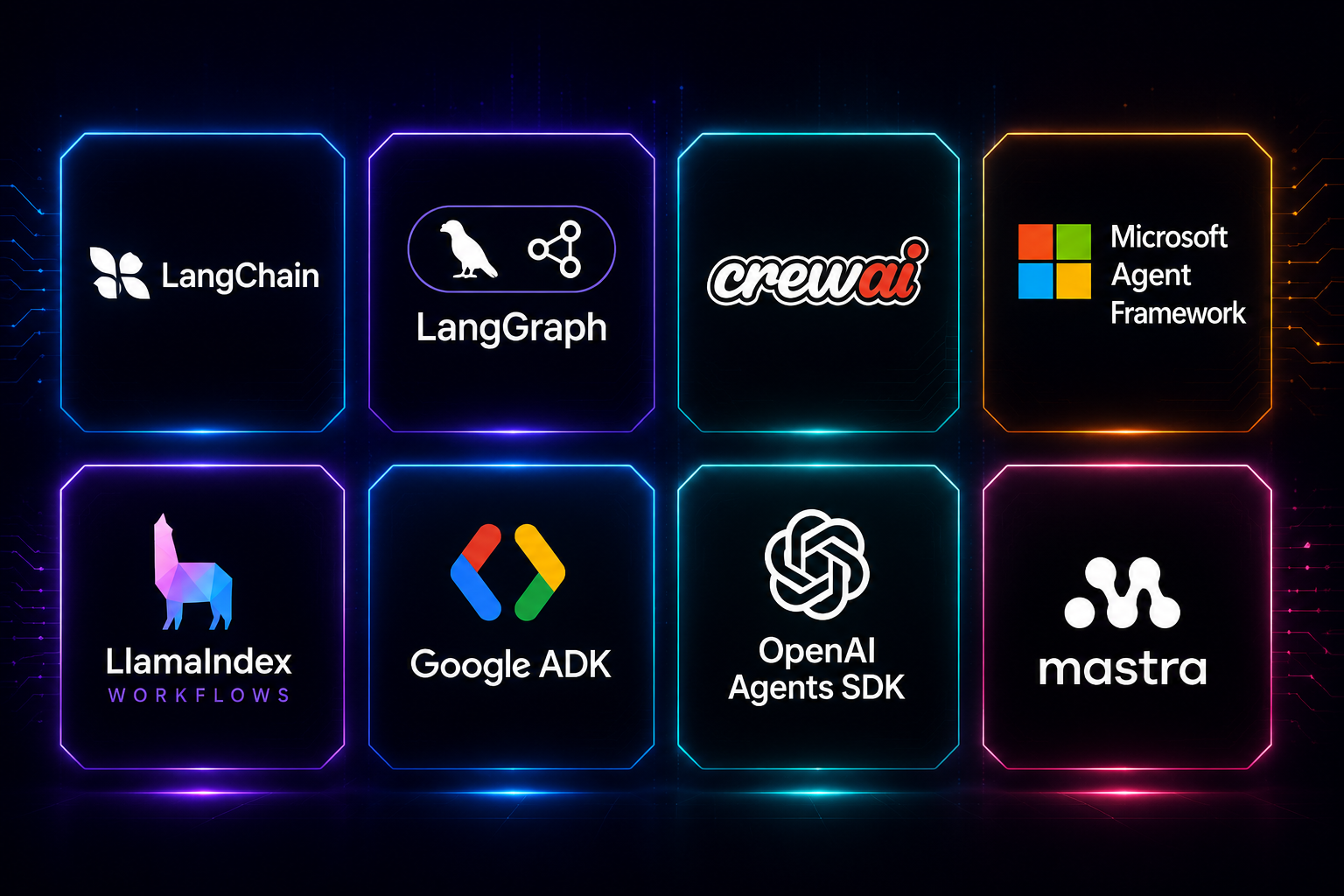
on LangGraph, CrewAI, AutoGen, and n8n. Custom multi-agent systems with the guardrails, observability, and
integration patterns that enterprise ops teams actually ask for, sitting inside your stack and owning a workflow end-to-end.
12
Agents in Production
Our strongest agent proof
Production-grade.
Not proof-of-concept.
Most agent projects die after the demo. Ours don’t. Every agent we ship
carries guardrails, observability, and deep integration with the CRM, ERP,
helpdesk, or data warehouse the client already runs on. We count what’s
operating — not what was prototyped.
4
Frameworks
LangGraph · CrewAI · AutoGen · n8n
40
Integrations
CRMs · ERPs · helpdesks · DBs
80
Retention
Clients 3+ years in, by choice
Trusted by


















Find the engagement
that matches your stage.
Four ways to work with us, from a first strategy call to an agent running in production. Use this to
identify where your team is before you reach out.
STAGE
WHAT YOU NEED
OUR SERVICE
TIMELINE
INVESTMENT RANGE
Exploration
“Should we build an AI agent, and which one first?”
Strategic AI Agent Consultation
2–3 weeks
$5k-$10k
Prototype
“Build a working agent on our real data.”
Bespoke AI Agent Design & Development
6–10 weeks
$15k-$40k
Production
“Integrate the agent with our CRM, ERP, and stack.”
AI Agent System Integration
8–12 weeks
$40k-$150k
Scale
“Keep it tuned, observed, and improving in production.”
Ongoing Optimization, Training & Support
Continuous
$8k-$25k/month
AI Agent Development Services
We design agents that ship.
Then we keep them shipping.
What we do. From the first conversation about which workflow is costing you hours, to the agent
running in the production with observability and guardrails — four services, one senior team from kickoff
to year-three optimization.
Strategic AI Agent Consultation
We start with the workflow, not the model. Where are the hours leaking — missed follow-ups, manual data entry, support triage? We map which agents to build, in what order, and what ROI to expect before a line of code.
Bespoke Agent Design & Development
Custom-built from the architecture up — how the agent thinks, which tools it uses, how it handles errors. Multi-step reasoning, tool-use, and multi-agent orchestration designed for the real task, not a demo.
Agent System Integration
Agents slide into the stack you already run — CRMs, helpdesks, ERPs, project tools, calendars, data warehouses. Auth, permissions, audit trails, and rate limits handled up front so nothing breaks when the agent goes live.
Ongoing Optimization, Training & Support
Agents drift. Workflows change. We stay on — performance reviews, prompt tuning, retraining on new data, error logging, and cost drift monitoring. Available around the clock when the agent is the one running production.
Plus 8 supporting Agent capabilities
Coordinated agent crews that hand off tasks, share context, and reach goals no single agent can.
Permission boundaries, human approval checkpoints, and kill-switches — agents treated as privileged users.
Task-level tracing, tool-call logs, hallucination detection, and cost-per-task dashboards from day one.
Connect agents to private documents, APIs, and internal systems via MCP and function-calling patterns.
Visual, auditable workflows that orchestrate agents, human reviewers, and legacy systems in one flow.
The right model per task — GPT-5, Claude Sonnet 4.6, Gemini 2.0 — with fine-tuning where it pays off.
A working agent on your real data in 4–6 weeks. Validates ROI before a full-scale build commitment.
Approval queues, review UIs, and escalation flows — so the agent has the last word only when it should.
Built to enterprise standards.
By design.
We meet the frameworks your legal, security, and procurement teams will ask about — before they ask. Your data
is protected, your contracts are clean, and your risk is managed from day one.
GDPR
General Data Protection Regulation
We implement lawful, transparent, and secure processing of personal data — ensuring any product we build for you is compliance ready with European data privacy law from the first line of code.

Your users’ data stays protected, wherever they are.
HIPAA
Health Insurance Portability & Accountability Act
We implement the safeguards required to protect sensitive health information, enabling healthcare organisations to build and deploy AI solutions without compromising patient privacy.
Build healthcare AI without compliance risk.
NDA
Standard NDA on Every Engagement
Every client relationship begins with a mutual NDA — your IP, roadmap, and business logic are legally protected from day one, not as an afterthought when the project is already live.
Your IP and roadmap are protected before kickoff.
DPA
Data Processing Agreements Included
We provide GDPR-compliant Data Processing Agreements as standard — giving your legal team a clear, enforceable record of how your data is processed, stored, and managed throughout the engagement.
Clean contracts your legal team won’t need to rewrite.
One framework
fluency.
Six disciplines
agents need.
How we build. Agents stand up fast. Agents that
survive contact with production are a different
animal. These are the disciplines we reach for when
the stakes are a workflow your ops team depends on.
4+
Agent frameworks in production
Agent Frameworks
Multi-step reasoning, planning, and tool-use — built on the frameworks the industry actually ships on in 2026. One chosen per task, not one for all.
LLM Selection & Fine- Tuning
Frontier models evaluated per task — reasoning vs throughput vs cost. Fine-tuning on proprietary data where domain accuracy earns its budget.
Tool-Use & RAG
Agents that read your docs, query your databases, and call your APIs. MCP and function-calling patterns that scale without prompt-engineering every new tool.
Enterprise Integration
Auth, permissions, rate limits, and audit trails for agents that operate inside CRMs, ERPs, helpdesks, and data warehouses. Not adapters — real integration.
Guardrails & Governance
Permission boundaries, human approval checkpoints, kill- switches, and policy-based access control. Agents treated as privileged users — monitored like one.
Observability & LLMOps
Task-level tracing, tool-call logs, hallucination detection, cost-per-task dashboards. Everything you’d instrument for a microservice, because that’s what an agent is now.
Six steps from
workflow to production.
Most agent projects die in the gap between demo and deployment. Our process is built around closing that gap — integration, guardrails, and observability are first-sprint concerns, not last-sprint
ones.
week 1
Map the Workflow
We start with the process
losing hours, not the model. Which steps are automatable, which need a human, where’s the agent’s surface area.
Weeks 2–3
Pick the Framework
LangGraph, CrewAI,
AutoGen, or n8n — chosen per task, not per preference. Model selected on reasoning, latency, and cost fit.
Weeks 3–6
Prototype on Real
Data
A working agent inside the
real workflow in 4–6 weeks
— touching your data, calling your tools. Validates the use case before full build.
Weeks 6–10
Integrate the Stack
Auth, permissions, rate
limits, and audit trails into
CRMs, ERPs, helpdesks, and data warehouses. Not adapters — real integration.
Week 10–12
Guardrails &
Observability
Permission boundaries,
human approval checkpoints, kill-switches, cost-per-task tracking, hallucination detection. Your security team is in the room.
Ongoing
Ship & Tune
Agent goes live. Weekly KPI
reviews, prompt tuning, retraining on new data, cost drift monitoring. Treated as a privileged digital employee.
Proof in the field
Work that speaks for itself
Real problems. Shipped solutions. Three industries, one standard of delivery.



What we’ve learned from 700 projects
From the workflow in your head to an agent in production in
4–6 weeks.
Senior engineers only. NDA in place before the first conversation. Response within 24 hours
with a technical point of view, not a sales pitch.
54
+
AI solutions in production
40
+
Countries served
On AI strategy
AI isn’t a trend to chase — it’s a lever. When
applied right, it cuts costs, removes friction,
and gives your team back the hours that
matter.
Nilay Dhamsania
Director & COO, Intuz
On architecture
The best architecture is the one nobody
notices — it just works, scales, and never
lets you down when it matters most.
Jitesh Jani
Chief Technology Officer, Intuz
what our clients say
Real words, not badges
Feedback from CTOs, founders, and engineering leaders — across every discipline we work in.
I really enjoyed working with the Intuz team they offered me great expertise and very good advises on all of my current and future projects.

Patrick Mimran
Founder – Ransoft Srl,
Switzerland
Gen AI-powered marketplace platform
I really appreciated their designs, because they showcased our company’s image in an excellent way.

Matthew Freeman
Founder – Live 4 It Locations,
United Kingdom
Sports & entertainment discovery platform
Working with INTUZ was a relatively smooth and stress-free process. The team did really well in communicating and staying on track with the project.

Jason Horstman
Founder – Adventurocity,
United States
Location-based social app
Where agents run
Seven industries.
Agents live in two.
The sectors we’ve shipped agents into — built around the data realities, regulations, and integration
patterns each one actually has.
Healthcare & Pharmaceuticals
LiveHIPAA-grade clinical and research agents. Audit trails, citation traceability, human approval on anything that touches a patient record. See DrugVista AI above.
E-commerce & Retail
Support-triage, product-lookup, and inventory agents that connect to storefronts, warehouses, and CRMs without custom glue.
Transportation & Logistics
LiveDispatch, route, and exception-handling agents that reason over telematics feeds, carrier APIs, and operational data. See TransIQ & QuickShift above.
Legal
Contract review, compliance-flagging, and case-summary agents — with citation tracking and human approval before any filed action.
Manufacturing & Supply Chain
Production-monitoring, demand-forecasting, and autonomous sourcing agents that pull from SCADA, ERPs, and sensor data. Includes machine-customer and machine-seller agent patterns for industrial automation.
Hospitality
Guest-service and room-management agents that escalate to humans the moment the request leaves the autopilot envelope.
Travel & Tourism
Itinerary, booking, and real-time support agents — 24/7 availability without the 24/7 staffing overhead.
marks sectors with AI systems currently in production — see the case studies above.
Intuz is a US-headquartered AI agent development company with offices in San Francisco and San Ramon, California, plus an
engineering center in Ahmedabad, India. We deliver enterprise AI agent development services across the United States,
Canada, UK, EU, and globally — with on-shore engagement leads and a senior delivery bench.
Which AI agent use case fits your industry?
INDUSTRY
STRONGEST FIRST AI AGENT USE CASE
WHERE THE VALUE LANDS
COMPLIANCE TO PLAN FOR
Healthcare
Clinical documentation assistant; patient intake and triage
Less time on admin
HIPAA, data sovereignty
Fintech
Fraud-pattern detection; compliance monitoring; support automation
Less manual review
SOC 2, PCI-DSS
eCommerce & Retail
Product recommendation; customer service; inventory optimization
Higher conversion
GDPR, CCPA
Logistics
Route optimization; dispatch automation; predictive maintenance
Faster decisions
Standard
Manufacturing
Predictive maintenance; quality control; supply-chain coordination
Less downtime
Industrial data security
Legal
Document review; contract analysis; compliance monitoring
Faster document review
Privilege, data sovereignty
AI Agent Development Solutions · The agents we build
Not chatbots. Not scripts.
Agents that own a workflow.
What it becomes in the field. Six AI agent development solutions we’ve shipped into production —
each one replacing a workflow, not sitting beside it. No generic assistants. No demos-dressed-as-
products.
Support-triage agents
Classify, route, and resolve tier-1 tickets end-to-
end — with human handoff on anything outside
the autopilot envelope.
Lead-qualification agents
Enrich, score, and schedule inbound leads in
CRMs — before the sales team opens Salesforce
for the day.
Operations agents
Dispatch, exception-handling, and workflow
orchestration agents that reason over
operational data, not just trigger rules.
Research agents
Multi-source retrieval and reasoning over
proprietary documents — citations, tracebacks,
and hallucination guards built in.
Analytics agents
Conversational analytics over your data
warehouse — ask a question, get a chart, see
the SQL it ran, audit every step.
Multi-agent systems
Coordinated agent crews that hand off tasks,
share context, and solve problems a single
agent can’t — orchestrated and observable.
Tools & technologies
The stack powering
our agent development.
Frameworks, LLMs, integrations, and guardrails — matched per task, not per preference. What we
reach for when the stakes are an agent running in production.
AI agent engineering
at Intuz.
Intuz has spent 16 years building technology that has to run in production, not demo well in a meeting. Our
artificial intelligence practice brings that same standard to agentic systems: a senior engineering bench that
has shipped AI into healthcare, fintech, logistics, manufacturing, and retail environments where downtime is not
an option.
We work across LangGraph, CrewAI, AutoGen, and n8n, and our custom AI development services bench goes deep on retrieval quality, tool design, and evaluation. For teams comparing frameworks first, our guide to the top AI agent frameworks and our library of n8n workflow templates are a useful starting point. Every engagement is led by senior engineers from kickoff through year-three optimization. When an agent reaches production, the team that built it is the team that keeps it running.
16+
Years in production engineering
100+
Enterprise AI deployments
40+
Countries served
700+
Products shipped
FAQs
Why do most AI agent projects fail after proof-of-concept?
Most agents die in the gap between demo and deployment. The common failure modes are under-scoped integration with legacy systems, no guardrails on tool use, no observability once the agent is loose on real data, and unclear business KPIs. We design agents for production on day one — integration surfaces, permission boundaries, audit logging, and human-in-the-loop checkpoints are first-sprint concerns, not last-sprint ones.
What’s the difference between an AI agent and a traditional chatbot?
A chatbot reacts. It answers user queries using scripted rules or intent matching. An AI agent plans, uses tools, and completes multi-step goals without constant prompting. A chatbot answers “what’s my order status?” An agent detects the delayed shipment, notifies the customer, initiates a replacement, and updates the CRM — in one autonomous flow, with the right guardrails.
How much does AI agent development cost?
A focused single-workflow agent (lead qualification, document processing, support triage) typically ranges $15K–$40K. Multi-agent systems with custom integrations and enterprise-grade guardrails range $40K–$150K+. We offer a phased engagement model — a proof-of-concept sprint validates ROI before committing to full-scale development, so you don’t underwrite a year of build before you know it works.
How long does it take to develop and deploy an AI agent?
A working PoC on real data in 4–6 weeks. Production deployment with integrations and guardrails in 8–12 weeks. Enterprise rollouts — with HIPAA, GDPR, internal security reviews, and multi-system integrations — in 3–6 months. We publish the timeline in week one and report against it every week.
Can AI agents safely integrate with legacy enterprise software?
Yes — but the complexity is routinely underestimated. Older ERP and CRM environments contain undocumented workflows, inconsistent data definitions, and legacy auth patterns. We use middleware orchestration, data normalization layers, and staged rollout strategies to avoid workflow failures. Task-specific agents with human oversight typically reach production faster than open-ended agents in legacy ecosystems.
How do we ensure agents don’t take unsafe or unauthorized actions?
Modern deployments use layered guardrails: permission boundaries, human approval checkpoints, audit logging, kill-switches, and policy-based access control. Since agents interact with emails, databases, and APIs autonomously, we treat them as privileged users and monitor them as such. Explainability dashboards and policy-violation alerts catch abnormal patterns before they become incidents.
How do we measure whether an agent actually delivers ROI?
Track outcome-based metrics, not model accuracy. The ones that matter: cost per completed task, automation success rate, reduction in manual hours, escalation frequency, and operational turnaround time. We instrument these from the first sprint, so you have live data by the time the agent is in production — not a retrospective six months later.
How much ongoing maintenance do AI agents require after deployment?
AI agents require continuous tuning, not one-time delivery. We monitor hallucinations, tool failures, cost drift, and workflow changes. Regular retraining, prompt updates, and performance audits keep reliability steady. Treat agents like privileged digital employees — they need supervision, optimization cycles, and KPI reviews.
Which agent framework should we use — LangGraph, CrewAI, AutoGen, or n8n?
One per task, not one for all. LangGraph for stateful multi-step reasoning (research, analytics). CrewAI for multi-agent coordination (operations, handoffs). AutoGen for conversational agent systems (support, copilots). n8n for visual workflow orchestration when the agent needs to live alongside humans and legacy systems. We recommend per engagement, not per preference.
How should we evaluate an AI agent development company?
Evaluate on what’s shipped. Ask for production references — agents live today, under SLA, with named clients. Ask for integration depth — engagements that touched real CRMs, ERPs, and helpdesks, not just demo stacks. Ask for governance — guardrails, observability, human-approval patterns. For context on us: 16+ years of enterprise software delivery, Fortune 500 trusted, AWS Consulting Partner, and an 80%+ client retention rate at 3+ years. Slide decks are cheap; running agents aren’t.
What is the difference between an AI agent and an AI workflow?
An AI workflow follows a predefined sequence: input moves through fixed steps and produces an output. An AI agent decides which steps to take, in what order, using which tools. Workflows are deterministic and predictable; agents are autonomous and adaptive. For complex business tasks where the right path depends on the input, agents outperform workflows. For repeatable, fixed processes, a workflow is simpler and more reliable.
Can AI agents replace existing software like CRMs and ERPs?
No, and they should not try to. AI agents work best when they sit on top of existing systems as an intelligent layer that reads data via APIs and triggers actions in CRMs and ERPs, without replacing them. The most successful enterprise AI agents we build are integration multipliers, not replacements.
![AI Agent Workflows: Top 5 Use Cases, Examples & Implementation Guide [2026]](https://www.intuz.com/wp-content/uploads/2026/04/AI-Agent-Workflows-Top-5-Use-Cases-Examples-Implementation.webp)