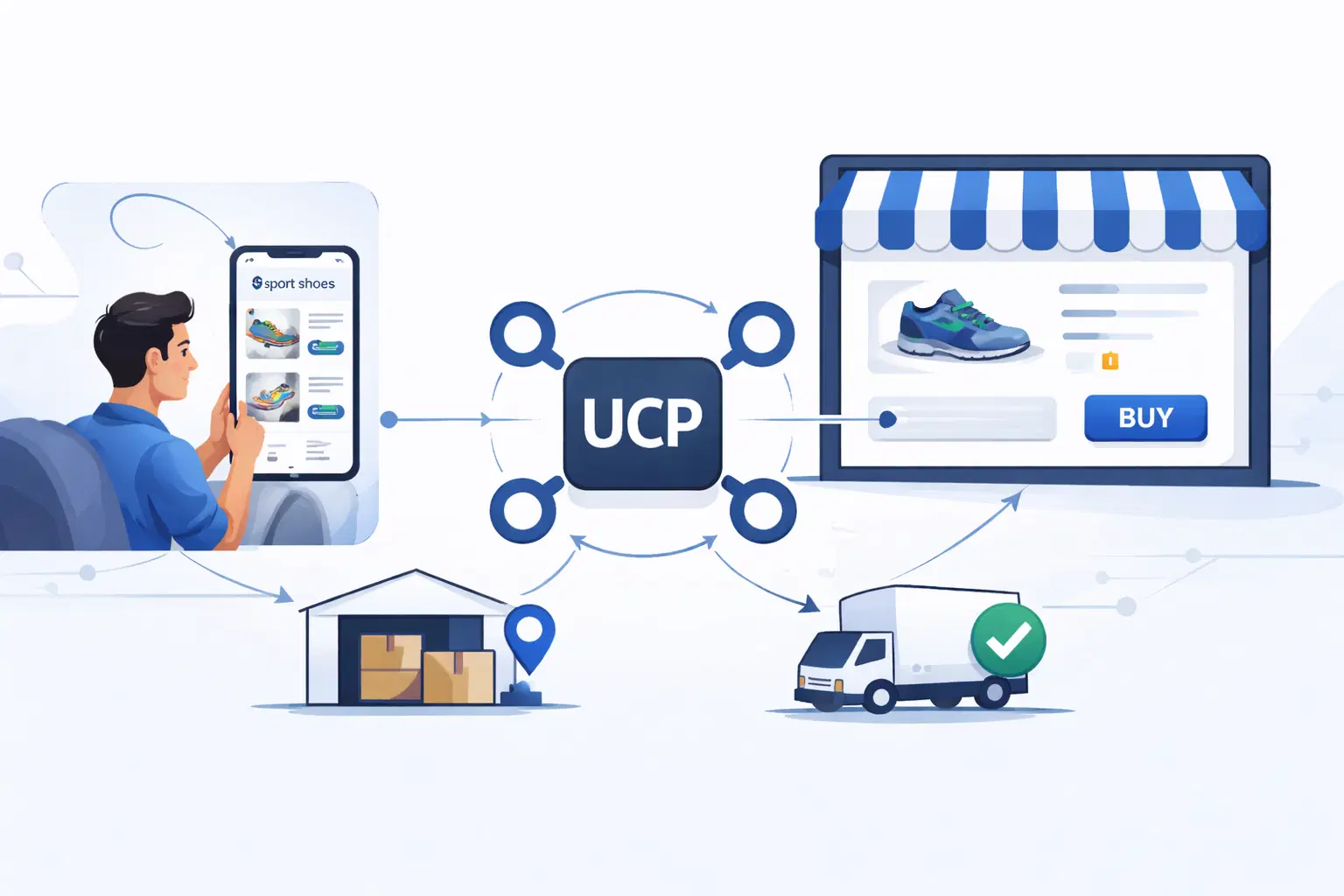
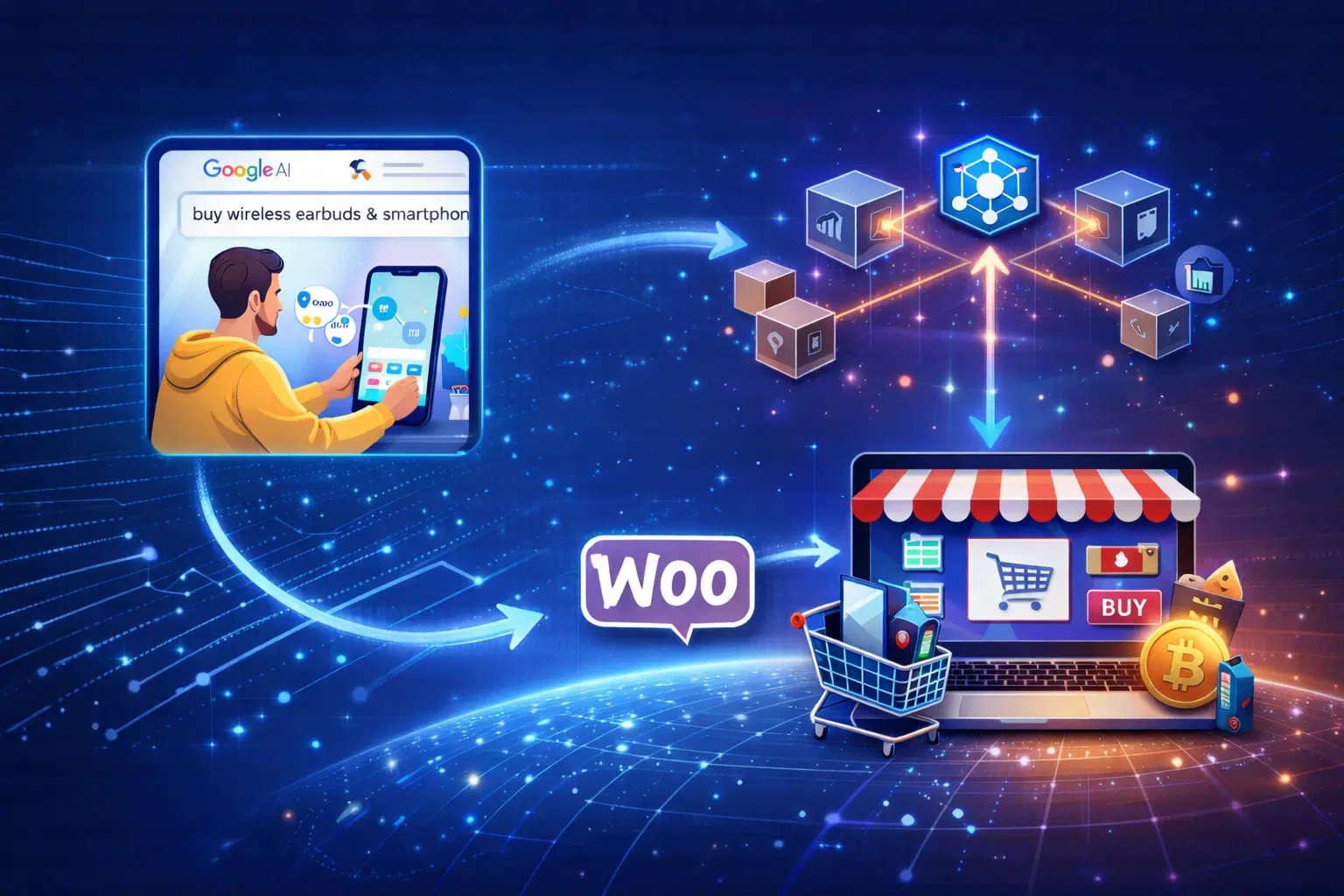
Imagine if AI assistants could browse products, add them to a cart, and pay for them, completing the transaction end to end. As a buyer, you give them specific shopping instructions, and they handle the rest without manual browsing or clicks.
This change is enabled by Google’s Universal Commerce Protocol (UCP), which allows AI to purchase directly from merchant systems.
WooCommerce currently powers over 4.4 million live stores. If you run one of them, your store must support the new AI-driven mode of buying without breaking pricing, inventory, tax, or fulfillment rules you already rely on.
This article explains what UCP is, how it works with WooCommerce, and what you need to prepare before adopting it. It also explores how Intuz can help you implement the technology.
Show
- UCP enables end-to-end AI purchasing — Google’s Universal Commerce Protocol allows AI assistants to discover products, validate pricing/inventory, and complete checkout entirely without human browser interaction, using WooCommerce’s existing order and payment logic.
- WooCommerce stays the execution authority — UCP adds a validation and control layer above WooCommerce, but all actual order creation, tax calculation, payment processing, and fulfillment are handled by WooCommerce’s own REST APIs and hooks, exactly as they are for human buyers.
- Five critical merchant readiness steps are required — Stores must normalize product modeling, ensure WooCommerce is the single source of truth for pricing/inventory, encode policies as machine-readable rules, eliminate browser-dependent checkout logic, and audit upstream content for conflicting eligibility constraints.
- Three implementation tiers exist — Plugin-based integration suits basic experimentation; custom UCP middleware offers strong control for serious stores; an AI-Commerce Orchestration Layer is best suited for high-volume marketplaces and multi-agent automation at scale.
- Intuz provides end-to-end UCP readiness — From architecture strategy and WooCommerce API orchestration to AI agent integration and security design, Intuz offers a governed path from current WooCommerce setup to fully AI-ready commerce with a free 45-minute consultation.
How UCP Works With WooCommerce
Let’s say you sell running shoes on the WooCommerce platform. A buyer tells their AI assistant: “Buy black running shoes, size 11, under $200, delivered this week.”
Before AI can go to the store and place an order, it needs to check:
- Which products match
- Whether they’re in stock
- What the final price is
- Whether delivery and returns are acceptable
- Whether it can place the order
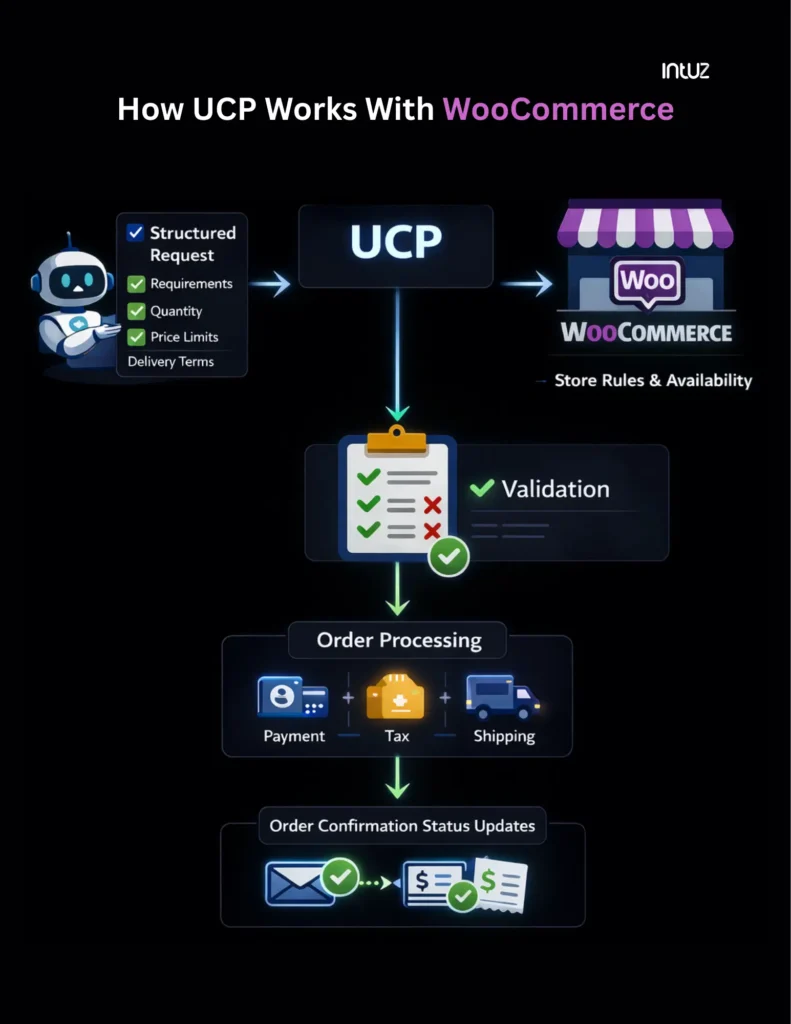
With UCP, the flow looks like this:
- The AI sends a structured request to UCP that includes product requirements, quantities, price limits, and delivery conditions
- UCP interprets the request and queries your WooCommerce setup
- WooCommerce returns current store data based on your configuration and rules, including what’s available and permitted
- UCP validates that data against the original request; if there are conflicts or disallowed conditions, the order doesn’t proceed
- If validation passes, UCP triggers the standard WooCommerce order flow, with payment, tax, and shipping handled exactly as they are today
- The AI receives order confirmation and status updates in a structured format
Core Capabilities of Universal Commerce Protocol for WooCommerce Stores
1. AI-readable product discovery
UCP exposes your WooCommerce product catalog in a machine-readable format. Product identifiers, attributes, variations, availability, and constraints are made explicit and queryable. The AI system can identify what you sell based on defined data.
2. Real-time pricing and inventory sync
All pricing, inventory, and eligibility data are retrieved directly from your active WooCommerce configuration at the time of the request. The AI system sees the same prices, stock levels, and conditions as human buyers. Any change you make in WooCommerce is reflected immediately.
3. AI-initiated checkout
UCP allows checkout to be initiated via verified AI requests rather than browser interactions. Order creation, tax calculation, payment authorization, and shipping selection use WooCommerce’s standard checkout logic.
Automation operates within the constraints you already define. Requests that violate your rules are rejected before an order is created.
4. Unified AI integration layer
UCP provides a single interface for handling requests from different AI assistants and buyer applications. You don’t need separate integrations for each system. All requests are evaluated and executed through the same controlled process, keeping commerce logic centralized and predictable.
5. Post-purchase AI workflows
After an order is placed, AI systems can interact with the order lifecycle through structured requests. This includes checking order status, viewing shipment updates, checking refund eligibility, and initiating a return.
UCP Technical Architecture for WooCommerce
The flowchart below represents the technical path of an AI-driven purchase, organized around where:
- Intent is interpreted
- Control is enforced
- Execution is allowed
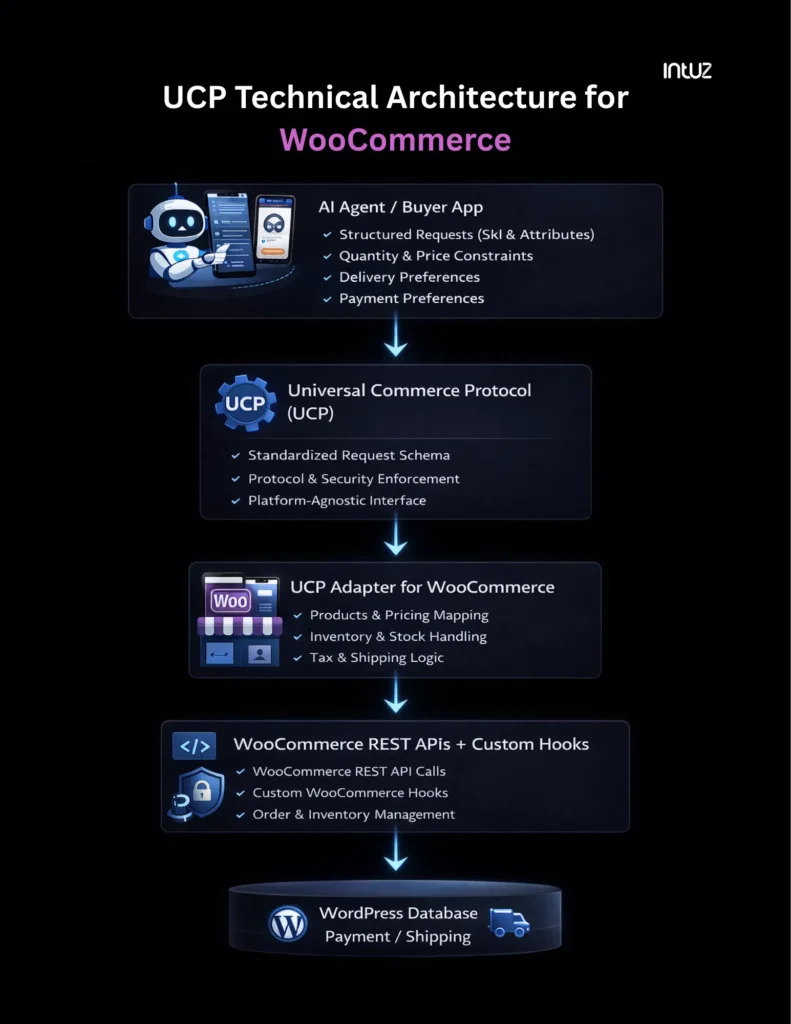
The upper layers form the intent and control layer, where AI requests are normalized, validated, and constrained without any ability to alter store state. These layers exist to ensure that only well-formed, permitted actions ever reach WooCommerce.
The transition point in the diagram marks the boundary of the commerce mutation. Above this boundary, requests can be evaluated and rejected, but cannot create orders, reserve inventory, or trigger payments.
Below it, WooCommerce becomes the execution authority, processing validated requests through its REST APIs and hooks using its existing pricing, inventory, tax, and checkout logic.
Final order creation, payment processing, and fulfillment are handled by WordPress and the configured provider systems, exactly as they are for human-initiated purchases.
What WooCommerce Merchants Should Prepare Before Adopting UCP
1. Normalize product modeling across the catalog
An AI system selects products through identifiers, attributes, and constraints rather than descriptive copy. For instance, if “Size 11” is represented as a variation in one product, a custom attribute in another, and free-text in a third, AI can’t reliably choose correctly.
Therefore, the first step is to clean the product data:
What to verify and fix:
Make sure every sellable product and variation has a stable SKU or product ID that never changes once publishedReview your global attributes and remove duplicates; if you have both Size and Shoe Size, consolidate them into oneConfirm that availability is represented through stock status or inventory rules, not implied through descriptions like “limited stock” or “usually ships fast”
2. Make WooCommerce the single source of truth for price and inventory
UCP assumes that your WooCommerce store reflects the final, enforceable pricing and inventory at the time of the request. That’s why eliminate delays or overrides that can cause mismatches during order creation.
What to verify and fix:
Trace where inventory updates originate and confirm they reach WooCommerce immediately after a sale, return, or adjustmentTest a price change and confirm the same price appears in product pages, checkout, and order creation without delayReview caching layers and confirm they don’t serve stale prices or stock during checkout
3. Machine-Readable Policies (Returns, Shipping, Taxes)
Shipping eligibility, tax application, and return constraints must be decidable by your WooCommerce store’s rules and data. An AI system doesn’t interpret policy text.
For example, if a return policy that says “Returns accepted within 30 days for unused items” isn’t enforceable by the AI system, the 30-day window must be represented in order metadata or rule logic, not only on a policy page.
What to verify and fix:
Confirm tax calculation is handled by WooCommerce rules or tax services based on address and product typeReview your return and refund rules and make sure time limits or eligibility conditions can be determined from order dataIf a rule affects whether an order or refund is allowed, ensure WooCommerce can evaluate it without reading policy pages
4. Eliminate checkout logic that depends on browser state
AI-initiated orders don’t involve sessions, cookies, or front-end interactions. You must ensure your checkout flow can execute entirely through WooCommerce’s server-side order and payment mechanisms.
What to verify and fix:
Attempt to create and pay for an order using WooCommerce APIs or headless checkout flowsIdentify any checkout step that requires a click, modal confirmation, or front-end JavaScript eventMove required confirmations, validations, or flags into server-side logic or order metadata
5. Audit content that influences buying constraints upstream
Purchase constraints are often formed before a request reaches checkout. You need to identify the limits and eligibility conditions for product definitions so the AI system can always generate valid requests.
What to verify and fix:
Confirm region restrictions, license limits, or compatibility rules appear consistently across product and category pagesCheck FAQs for eligibility statements and make sure they do not contradict product-level rulesRemove or update content that suggests exceptions your store cannot enforce programmatically
Build vs Buy: UCP Implementation Approaches for WooCommerce
| Dimension | Plugin-based Integration | Custom UCP Middleware | AI-Commerce Orchestration Layer |
|---|---|---|---|
| Integration Surface | WooCommerce hooks, front-end events, checkout plugins | Explicit API layer between UCP and WooCommerce | Dedicated control plane coordinating multiple systems |
| Policy Enforcement | Indirect. Often inferred from UI flows and plugin logic | Explicit. Enforced before order creation | Centralized and protocol-driven |
| Mutation Control | Weak; orders may be created before all constraints are evaluated | Strong; mutation occurs only after validation | Very strong; mutation isolated behind orchestration rules |
| AI Request Handling | Limited. Assumes human-like checkout behavior | Designed for structured, non-interactive requests | Designed for high-volume, multi-agent automation |
| Failure Modes | Breaks on edge cases, concurrency, or non-UI flows | Fails only if API contracts are violated | Fails primarily at specification or design time |
| Time to Production | Short | Medium | Long |
| Long-term Fit | Poor beyond basic experimentation | Good for most serious stores | Best for marketplaces and large-scale automation |
How an AI Development Partner like Intuz Helps You Go UCP-Ready
At this point, you understand what UCP enables and what your WooCommerce store needs to support it. The remaining question is execution. This is where most merchants slow down because the path from the current setup to AI-ready commerce is fragmented.
That is the gap Intuz is built to close.
Our AI development company starts by creating your UCP strategy and architecture. You’re not pushed into a plugin, a rebuild, or a predefined stack. Your current WooCommerce setup is reviewed to identify where AI-led purchasing will succeed and where it will break.
You get a clear architectural plan that shows how UCP should interact with your store, which responsibilities stay in WooCommerce, and which ones need a controlled middleware or orchestration layer.
Once the architecture is defined, Intuz handles orchestration of the WooCommerce API. This includes mapping your products, pricing logic, inventory behavior, policies, and checkout flow into deterministic, machine-readable actions.
AI agent integration is handled with the same discipline. We integrate UCP so that multiple AI systems can interact with your store through a single, governed interface. This keeps control centralized and prevents fragmented logic as new AI channels emerge.
Security and scaling are treated as first-order concerns, and we design UCP access around explicit permissions, validation boundaries, and failure handling.
If you’re serious about preparing your WooCommerce store for AI-led purchasing, this is the fastest way to move from concept to clarity.
Book a 45-minute free consultation with Intuz and get your UCP readiness roadmap today.
FAQs
What is UCP?
UCP is Google’s open standard for AI agents to discover products, check stock, build carts, and checkout seamlessly on your Woo store—no custom coding per agent. It uses standardized REST APIs for the full shopping journey. WooCommerce plugins make it plug-and-play.
How to Set Up UCP on WooCommerce?
Grab the UCP Connect or UCP Adapter – plugin from WordPress.org. Install, activate, head to WooCommerce > Settings > UCP tab, configure API keys (auto-fills mostly), and save. It auto-creates your /.well-known/ucp profile and agent endpoints. Test at ucptools.dev—done in minutes!
Do I Need a Plugin or Custom Code?
Plugin first—like UCP Connect—for 90% of stores; it’s free, handles APIs, auth, and schemas out-of-box. Go custom only for advanced stuff like subscriptions or bundles via Woo hooks. Plugins cut dev time from weeks to clicks, perfect for US SMBs scaling fast.
What are the Benefits of Integrating UCP for My WooCommerce Store?
UCP makes your Woo products visible to Google Gemini, ChatGPT agents—boosting discovery and sales by 15-30% as AI shopping hits mainstream. Real-time inventory prevents oversells; secure checkouts build trust. Early adopters win SEO/AI traffic before competitors catch up.
What are the Common UCP Setup Issues and Fixes?
Watch for missing SKUs/GTINs causing discovery fails—fix via bulk edit. API rate limits? Upgrade hosting. Plugin conflicts? Deactivate others. Validate endpoints at ucptools.dev, optimize products with structured data. Most issues resolve with clean inventory sync and Woo updates.