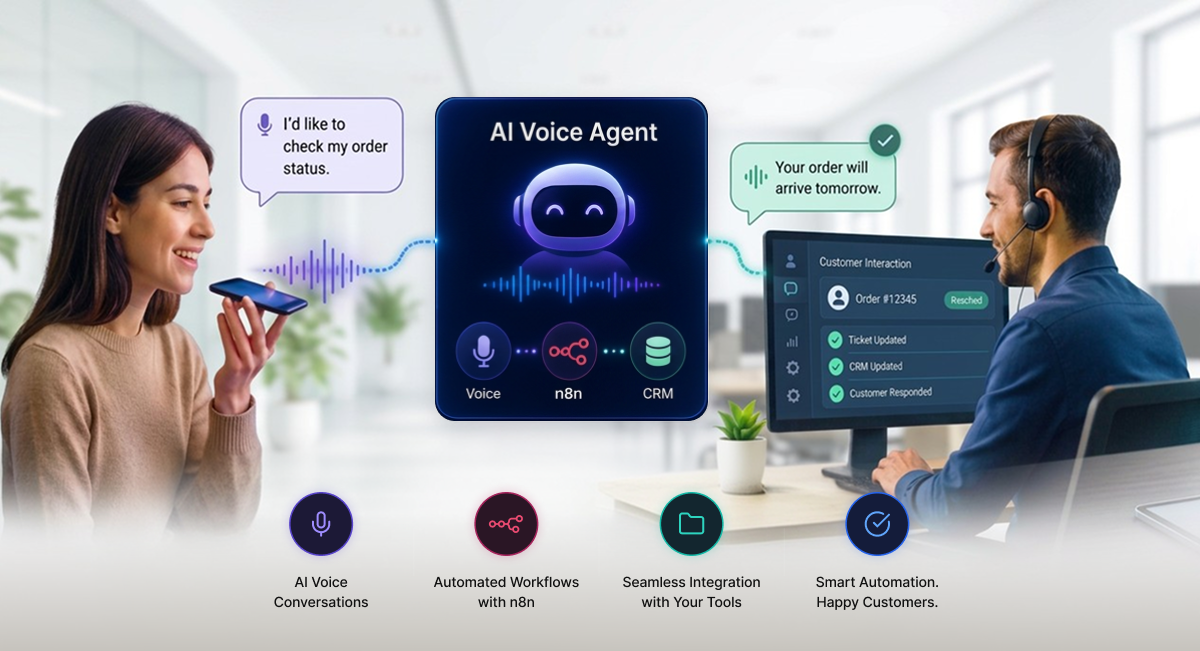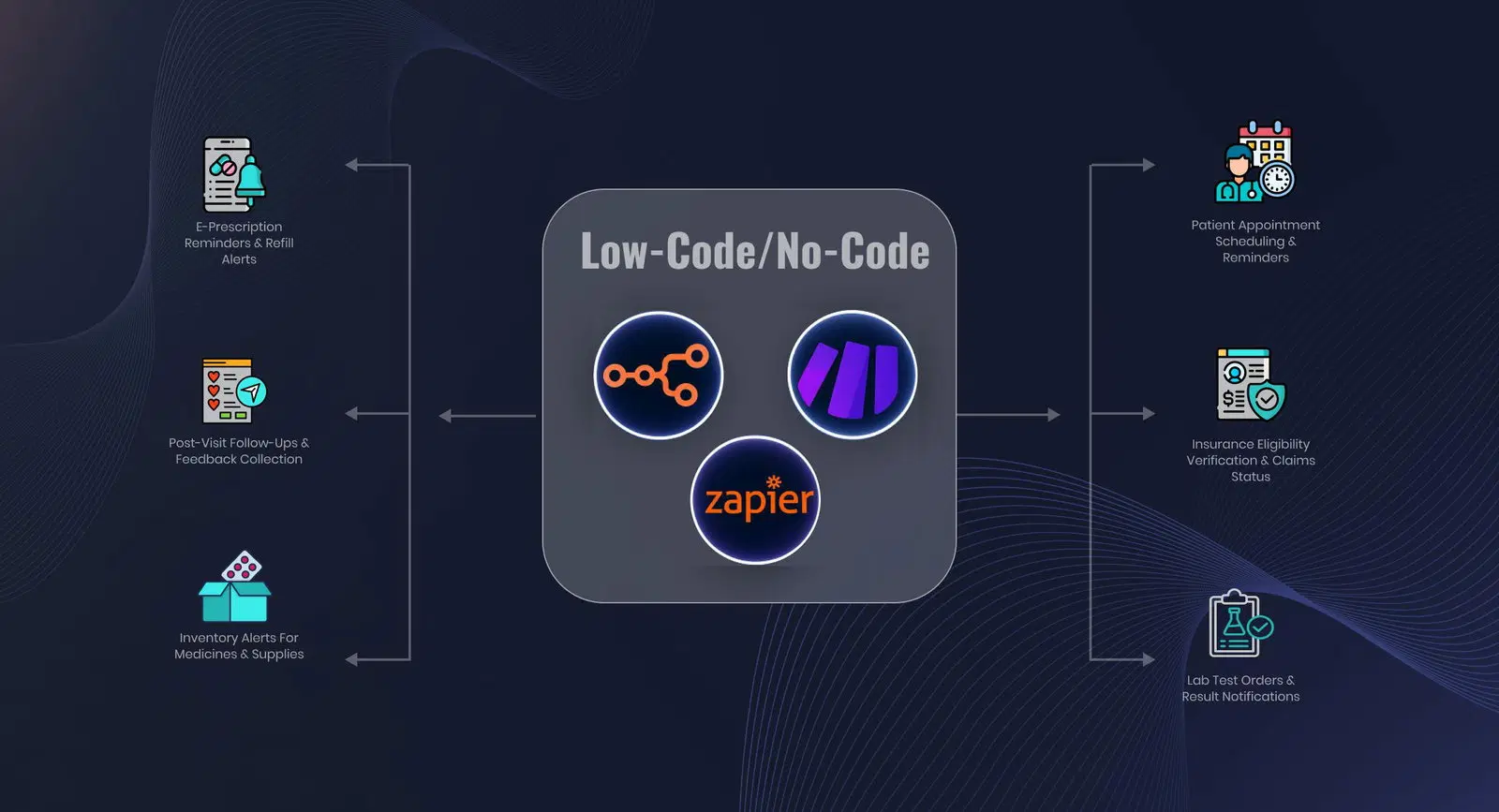





Healthcare organizations are increasingly using AI voice agents to handle patient calls, schedule appointments, collect intake information, manage referrals, answer routine questions, send reminders, and route calls to the right person or workflow. But choosing a healthcare AI voice agent is not simply about finding the platform with the most natural-sounding voice.
The more important question is: How much real healthcare work can the AI safely complete after the conversation starts? An agent that answers a call but still leaves staff to enter information into an EHR, schedule the appointment, verify the request, or follow up on missing information may improve the caller experience without significantly reducing operational work.
A production healthcare voice AI system should connect the conversation to the underlying workflow. This guide explains what healthcare AI voice agents can automate, how they compare with traditional IVR and AI receptionists, which platforms are worth evaluating, how EHR integration works, what HIPAA and security questions to ask, how healthcare voice AI is priced, how to calculate ROI, and when to buy a platform versus build a custom solution.
Show
- Healthcare AI voice agents are more than automated phone answering. The strongest implementations connect conversations to scheduling, intake, referrals, reminders, patient communication, and other operational workflows.
- There is no single best healthcare voice AI platform. A developer platform, an AI medical receptionist, and an enterprise healthcare automation platform solve different problems.
- EHR/PMS integration is a major differentiator. The ability to complete an action in the system is generally more valuable than simply capturing information from a call.
- HIPAA should be evaluated across the entire data flow. Review the BAA, PHI handling, recordings, transcripts, model providers, retention, access controls, integrations, auditability, and human escalation.
- The best first automation is usually narrow and measurable. High-volume, repetitive, predictable administrative workflows are generally stronger candidates than complex clinical interactions.
- AI and human staff should work together. AI can handle defined, repetitive interactions while humans handle exceptions, sensitive situations, clinical judgment, and complex requests.
- Healthcare voice AI costs are not limited to the per-minute platform price. Telephony, AI models, integrations, implementation, security, monitoring, and human escalation can materially affect total cost.
- Build vs. buy depends on workflow complexity. A packaged product can be faster for standard patient-access use cases, while custom development becomes more attractive when workflows span multiple systems or require organization-specific rules.
What Is an AI Voice Agent for Healthcare?
A healthcare AI voice agent is an AI-powered system that can understand spoken conversations, determine the caller’s intent, respond naturally, and execute defined actions within an approved healthcare workflow.
For example, a patient might say:
“I need to move my appointment from Thursday to next week.”
A basic voicebot may understand the request and transfer the patient.
A workflow-connected voice agent can potentially:
- Identify the patient.
- Determine the appointment.
- Check available slots.
- Offer appropriate alternatives.
- Update the scheduling system.
- Confirm the new appointment.
- Log the interaction.
That difference is important.
Healthcare voice AI has three layers
Conversation
The system listens, understands intent and context, and generates a response.
Workflow
Business rules determine what the agent is allowed to do and when it must escalate.
System action
The agent connects to an EHR, PMS, CRM, scheduling system, referral platform, payer workflow, or another approved system to complete the task.
The third layer is where healthcare voice AI starts moving from call automation to workflow automation.
How Does Healthcare Voice AI Work?
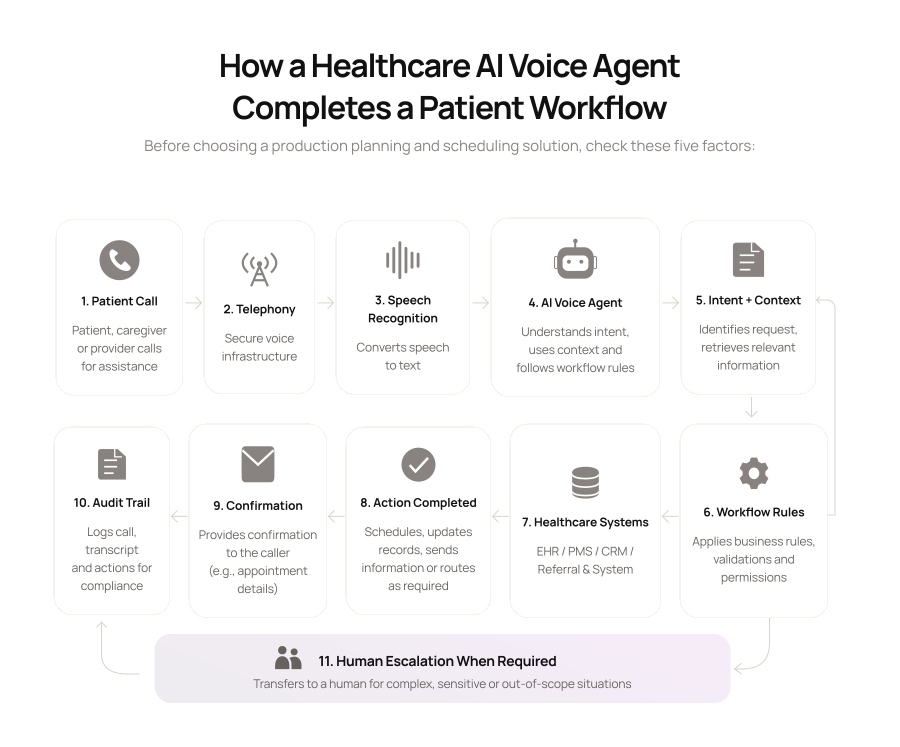
A typical architecture looks like:
Phone call → Telephony → Speech recognition → Conversational AI → Workflow orchestration → EHR/PMS/API → Action → Confirmation → Audit
A production implementation may also include:
- Patient identity verification
- Knowledge bases
- Scheduling engines
- CRM systems
- Referral platforms
- Payer systems
- Human-agent escalation
- Transcription
- Analytics
- Audit logging
- Monitoring
- Exception handling
The architecture does not have to give an LLM unrestricted control over healthcare operations. In fact, a safer design is often hybrid.
The AI can understand a request such as:
“Wednesday morning would work better for me.”
while deterministic workflow rules control whether the system is actually allowed to change the appointment.
This allows conversational flexibility while keeping sensitive actions within defined boundaries.
AI Voice Agent vs. AI Receptionist vs. IVR vs. Chatbot
These terms are frequently used interchangeably, but they describe different levels of automation.
| Technology | What it primarily does | Typical limitation |
|---|---|---|
| Traditional IVR | Menu-based routing | Rigid interaction |
| AI IVR | Natural-language routing | May have limited workflow execution |
| AI receptionist | Handles common front-desk requests | Integration depth varies |
| AI voice agent | Converses and executes defined tasks | Requires workflow controls and integrations |
| Healthcare voice automation platform | Voice + workflow + healthcare integrations | More complex implementation |
| Human receptionist | Handles broad interactions and exceptions | Capacity and labor constraints |
The important comparison is therefore not simply AI vs. human. It is:
Which interactions should AI complete, and which should remain human-led?
What Can Healthcare AI Voice Agents Automate?
The strongest healthcare use cases tend to be repetitive administrative workflows with clearly defined outcomes.
1. Appointment Scheduling
AI voice agents can potentially:
- Identify appointment intent
- Collect required information
- Check availability
- Offer available slots
- Schedule appointments
- Reschedule appointments
- Cancel appointments
- Confirm appointments
- Send follow-up notifications
The critical distinction is whether the system is actually connected to the organization’s scheduling infrastructure.
An agent that records “The patient wants an appointment” is still leaving work for staff. A connected agent can potentially complete the transaction.
2. Patient Intake
Voice AI can collect structured administrative information before a visit, such as:
- Demographic information
- Reason for the visit
- Appointment preferences
- Insurance information
- Referral information
- Administrative history
- Required documentation
The information can then enter the appropriate workflow instead of requiring staff to manually transcribe the conversation.
3. Referral Intake
Referral processing is another strong candidate for automation, particularly when organizations receive large numbers of repetitive calls.
A voice workflow can:
- Identify the referral request.
- Collect required information.
- Identify missing fields.
- Capture the missing information.
- Route the referral.
- Create or update the relevant record.
- Notify staff when human review is required.
For home health agencies, voice can become the front end of a broader referral workflow involving fax, referral platforms, eligibility verification, scheduling, and staff review.
4. Appointment Reminders and Outbound Calls
Voice AI can initiate calls rather than simply answer them.
- Appointment reminders
- Appointment confirmations
- Missing-information follow-ups
- Referral-status communication
- Physician-signature follow-ups
- Administrative outreach
Outbound healthcare calling requires its own review of consent, opt-out handling, organizational policies, and applicable calling regulations.
5. Refill and Provider Message Requests
A voice agent can collect structured requests and route them into an approved workflow.
There is an important distinction between capturing and routing a refill request and making an independent clinical decision about medication. The first can be appropriate for automation under defined rules. The second requires appropriate clinical oversight.
6. Frequently Asked Questions
Voice AI can handle routine administrative questions such as:
- Office hours
- Locations
- Parking
- Appointment preparation
- Accepted insurance
- Directions
- Administrative policies
- Department routing
The underlying knowledge should come from approved organizational information rather than unrestricted model generation.
7. After-Hours and Overflow Calls
Voice AI can provide additional coverage during evenings, weekends, holidays, peak call periods, staff shortages, and overflow situations.
The objective does not have to be eliminating human coverage. It can simply be preventing predictable administrative calls from consuming the same capacity required for complex interactions.
Which Healthcare Workflows Should You Automate First?
Not every healthcare call is a good candidate for AI.
A practical prioritization model is:
Automation priority = Volume × Repetition × Predictability × Business Impact ÷ Risk and Integration Complexity
The strongest first candidates typically have high volume, repetitive conversations, predictable outcomes, clear business rules, measurable financial or operational impact, low clinical ambiguity, and manageable integration requirements.
| Workflow | Typical automation potential |
|---|---|
| Appointment scheduling | Very high |
| Appointment confirmation | Very high |
| Rescheduling | High |
| Administrative FAQs | Very high |
| Missed-call recovery | High |
| Patient registration | High |
| Referral intake | High |
| Refill request capture | High |
| Provider-message capture | High |
| Eligibility workflows | Medium–high |
| Clinical triage | Requires stronger safeguards |
| Clinical decision-making | Human-led |
The best pilot is usually narrow. Automate appointment scheduling and rescheduling calls is a much more useful starting point than replace the entire front desk with AI.
Best AI Voice Agents for Healthcare
There is no universal “best” healthcare AI voice platform.
The market includes healthcare-specific AI receptionists, enterprise patient-access platforms, voice AI infrastructure, developer platforms, payer/provider calling automation, and custom healthcare workflow solutions.
These should not be evaluated as if they are identical products.
How We Evaluate Healthcare Voice AI
| Criterion | Weight |
|---|---|
| Workflow execution depth | 20% |
| EHR/PMS integration | 20% |
| Healthcare safety and escalation | 15% |
| Security and compliance architecture | 15% |
| Voice/conversation quality | 10% |
| Customization | 10% |
| Pricing transparency | 5% |
| Deployment and scalability | 5% |
Retell AI — Custom, High-Volume Voice Agents
Retell is primarily a voice AI platform for organizations building and deploying custom agents. It is particularly relevant when a healthcare organization or implementation partner needs control over the voice and workflow stack.
Best fit: Organizations or implementation teams that need a flexible voice-agent platform rather than a completely packaged healthcare application.
Watch for: Total cost depends on model, voice, telephony, add-ons, integrations, and implementation—not just the headline per-minute rate.
Hyro — Enterprise Patient Access
Hyro is particularly relevant for health systems with complex patient-access operations and Epic environments. Its published integrations cover workflows including patient verification, scheduling, prescription support and other patient-access functions.
Best fit: Hospitals and health systems looking for enterprise-level patient-access automation.
S10.AI — AI Medical Receptionist
S10.AI positions its BRAVO product around AI receptionist capabilities including phone answering, appointment scheduling, intake, refill requests and other front-office workflows.
Best fit: Medical practices looking for a healthcare-specific AI receptionist and broader clinical automation capabilities.
Talkie.ai — Healthcare Conversational Automation
Talkie.ai positions itself around healthcare AI agents across voice, chat and SMS, with healthcare-specific security and workflow capabilities.
Best fit: Healthcare organizations looking for a healthcare-focused conversational automation platform.
Infinitus — Complex Healthcare Administrative Calls
Infinitus represents a different category from a traditional AI receptionist. Its platform focuses on complex healthcare administrative conversations, including payer and provider workflows.
Best fit: Organizations automating complex administrative conversations rather than basic front-desk calls.
Other Platforms Worth Evaluating
Depending on the workflow, organizations may also evaluate:
- Assort Health
- Luma Health
- Vapi
- Telnyx
- Hippocratic AI
- Vocca AI
- Voiceoc
- Sully AI
The important point is not to rank these products based solely on voice quality.
The right platform is the one that can safely complete the workflow you actually need to automate.
How Do AI Voice Agents Integrate With EHRs?
EHR integration is one of the biggest differences between a voice demo and a production healthcare deployment.
Ask: Can the AI actually complete the transaction in our system?
Level 1: Information Retrieval
The agent retrieves approved information.
Level 2: Data Capture
The agent collects information and sends structured data to another system.
Level 3: Workflow Execution
The agent performs an action such as scheduling or updating a record.
Level 4: Multi-System Orchestration
The agent coordinates multiple systems within a single workflow.
For example:
Patient call → identity verification → EHR lookup → scheduling system → appointment update → confirmation → audit log
Integration may involve REST APIs, FHIR, HL7, webhooks, scheduling APIs, PMS integrations, CRM integrations, secure middleware, and workflow automation platforms.
The implementation should also define what the AI is allowed to read, what it is allowed to write, and which actions require human approval.
Are AI Voice Agents HIPAA Compliant?
This question needs more nuance than a simple yes or no.
A vendor saying that its platform is “HIPAA compliant” does not automatically mean your complete workflow meets your organization’s requirements for Healthcare AI security and compliance.
Evaluate the entire PHI lifecycle.
| Area | Questions to ask |
|---|---|
| BAA | Will the vendor sign a Business Associate Agreement? |
| Audio | Where are recordings stored? |
| Transcripts | Are transcripts generated and retained? |
| AI models | Does PHI reach another model provider? |
| Training | Is customer data used for model training? |
| Retention | How long is data retained? |
| Encryption | Is data encrypted in transit and at rest? |
| Access | Are RBAC and authentication controls available? |
| Audit | Are sensitive actions logged? |
| Integrations | How are EHR credentials and permissions protected? |
| Deletion | Can recordings and transcripts be deleted according to policy? |
| Escalation | How are sensitive calls transferred to humans? |
| Outbound calls | How are consent and opt-out requirements handled? |
| Incident response | What happens when a security incident occurs? |
The critical concept is the PHI chain.
If a call passes through:
Telephony → speech processing → voice AI → LLM → transcription → storage → EHR
then each relevant component and data transfer needs to be understood.
A BAA with one vendor does not automatically answer what happens to PHI in the rest of the chain.
How Much Does Healthcare Voice AI Cost?
Healthcare voice AI pricing varies substantially because vendors use different commercial models.
Common Pricing Models
1. Usage-Based Pricing
The organization pays according to voice usage.
2. Per-User or Per-Provider Pricing
Some healthcare products price according to the number of providers, locations or users.
3. Monthly Platform Subscription
A fixed monthly fee may include a defined amount of usage.
4. Enterprise Pricing
Larger deployments may receive custom pricing based on call volume, concurrency, locations, integrations, support, security requirements, and deployment architecture.
5. Custom Implementation
A custom healthcare deployment can add workflow discovery, architecture, telephony, AI configuration, EHR/PMS integration, security controls, testing, monitoring, deployment, and ongoing optimization.
Therefore, comparing platforms purely on cost per minute can be misleading.
Total Cost of Ownership
Total cost = platform + AI/voice usage + telephony + integrations + implementation + security/operations + human escalation
How to Calculate Healthcare Voice AI ROI
ROI should be calculated against the workflow being automated.
- Call volume: How many calls does the workflow generate each month?
- Average handling time: How much staff time does each call consume?
- Fully loaded labor cost: What does that staff capacity cost?
- Missed calls: How many calls currently go unanswered or abandoned?
- Business value: What is the value of a completed appointment, referral, intake, or follow-up?
Monthly labor savings = automated calls × average handling time × labor cost per minute
Then consider recovered appointments, fewer missed referrals, reduced overtime, after-hours coverage, faster referral processing, and increased scheduling capacity.
Finally subtract platform costs, telephony, integration, implementation, monitoring, and human escalation.
AI Voice Agent vs. Human Receptionist
AI should not be evaluated solely as a replacement for human receptionists.
AI is particularly well suited to:
- Repetitive questions
- Appointment scheduling
- Confirmations
- Information capture
- Routing
- Reminders
- Overflow calls
- After-hours coverage
Humans remain essential for:
- Clinical judgment
- Emotionally sensitive situations
- Complex exceptions
- Complaints
- Ambiguous requests
- Unusual insurance situations
- Escalations
- Situations requiring empathy or discretion
AI handles predictable volume → humans handle exceptions and judgment.
The handoff also matters. A good healthcare voice agent should transfer relevant context to the human rather than forcing the patient to start the conversation again.
Should You Buy or Build a Healthcare Voice AI Solution?
Buy
A packaged platform makes sense when the workflow is standard, the vendor already supports your systems, you need faster deployment, and customization requirements are limited.
Build
Custom development becomes more attractive when workflows are unique, several systems need to interact, your organization has proprietary business rules, existing platforms cannot support the workflow, or voice is only one component of a larger automation system.
Hybrid
A hybrid architecture uses existing voice infrastructure while building the healthcare-specific workflow layer.
Voice platform + LLM + telephony + workflow orchestration + EHR/PMS integrations + business rules + human review
AI Voice Agents for Home Health Agencies
Home health AI Automation is a particularly interesting use case because voice can become the front end of a much larger operational workflow.
Home health agencies may receive calls involving new patient referrals, referral status, patient scheduling, caregiver coordination, physician orders, insurance and eligibility, visit coordination, missed visits, physician signature follow-ups, billing questions, authorization status, and patient/caregiver communication.
A voice agent can capture and initiate these workflows while downstream automation handles the operational work.
Referral call → information captured → missing data identified → eligibility workflow → referral record → staff review → scheduling → patient/caregiver follow-up
That is fundamentally different from a healthcare AI receptionist that simply answers the phone.
“How do we turn phone conversations into completed operational workflows?”
How to Implement Healthcare Voice AI
Step 1: Select One Workflow
Start with one measurable process such as appointment scheduling, referral intake, missed-call recovery, or appointment reminders.
Step 2: Map the Workflow
Document the normal path, required information, business rules, exceptions, escalation conditions, system actions, and approval points.
Step 3: Design the Architecture
Define telephony, speech recognition, AI model, voice synthesis, workflow engine, EHR/PMS integrations, authentication, logging, monitoring, and human handoff.
Step 4: Define AI Permissions
- AI can execute automatically
- AI requires human approval
- AI must immediately escalate
Step 5: Test Real Scenarios
Test incomplete information, unusual phrasing, interruptions, background noise, frustrated callers, duplicate records, unavailable appointments, ambiguous requests, API failures, system downtime, and escalation scenarios.
Step 6: Launch With Controlled Coverage
Start with one workflow, selected call types, defined operating hours, human fallback, and measurable KPIs.
Step 7: Expand
Once the workflow demonstrates acceptable performance, safety and ROI, expand into adjacent workflows.
Common Healthcare Voice AI Implementation Mistakes
1. Choosing Based Only on Voice Quality
A natural voice does not guarantee workflow accuracy.
2. Automating Before Mapping the Process
AI can automate a broken process just as efficiently as a good one.
3. Treating HIPAA as a Checkbox
The organization needs to understand the complete PHI data flow.
4. Giving the AI Too Much Authority
Sensitive actions should have explicit permissions and escalation rules.
5. Ignoring System Failures
A production system needs a defined response when an EHR, API or scheduling system is unavailable.
6. Measuring Containment Instead of Outcomes
“AI handled 80% of calls” is not necessarily a successful outcome.
Measure task completion, scheduling accuracy, escalation quality, missed-call recovery, staff time saved, downstream errors, and patient experience.
7. Trying to Automate Everything at Once
A focused pilot usually produces better operational learning than a broad, uncontrolled deployment.
What Does a Production Healthcare Voice AI Architecture Look Like?
Patient → Telephony / Voice Interface → Speech Recognition + Conversational AI → Workflow Orchestration → Business Rules + Permissions → EHR / PMS / CRM / Referral / Payer Systems → Action + Confirmation → Audit Trail + Monitoring → Human Escalation When Required
This architecture also allows organizations to replace individual AI components as technology evolves without rebuilding the entire healthcare workflow.
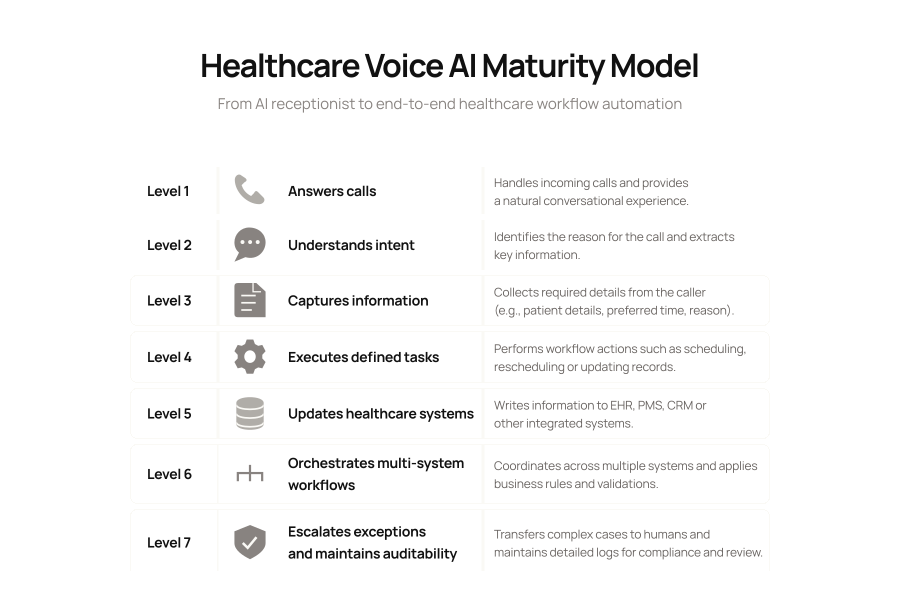
When Does Custom Healthcare Voice AI Make Sense?
Custom implementation becomes particularly valuable when the voice agent needs to do more than answer calls.
“When a referral arrives, call the patient, collect missing information, verify eligibility, schedule the appropriate visit, update the system, notify the care team, and escalate exceptions.”
That is no longer simply a voice-agent problem. It is a healthcare workflow automation problem with voice as the interface.
The voice layer may be supplied by a specialized platform. The real engineering work may be in workflow orchestration, EHR integration, business rules, authentication, exception handling, human review, auditability, monitoring, and operational rollout.
Over to you
Healthcare voice AI is moving beyond automated phone answering.
The most valuable systems are becoming workflow execution systems that use voice as their interface.
Don’t ask only:
“How human does the AI sound?”
Ask:
“What healthcare work can the AI safely complete from beginning to end?”
The evaluation should therefore follow the complete chain:
Conversation → understanding → workflow → system action → confirmation → audit → human escalation
For a small medical practice, that may mean starting with appointment scheduling and missed-call recovery.
For a health system, it may mean integrating voice AI with EHR, patient-access and contact-center workflows.
For a home health agency, it may mean connecting referral intake, scheduling, eligibility, physician orders and follow-up into a broader automation flow.
If you’re unsure where voice AI can deliver the most value in your healthcare workflow, Talk to an AI Healthcare Expert to identify practical automation opportunities and the right implementation approach.
The right starting point is not the most impressive voice demo. It is the workflow where automation can produce a measurable operational outcome with an acceptable level of risk.
FAQs
What is a healthcare AI voice agent?
A healthcare AI voice agent is an AI-powered system that conducts phone conversations with patients, providers, caregivers or other stakeholders and can execute defined administrative healthcare workflows such as scheduling, intake, reminders, routing and follow-up.
What can AI voice agents automate in healthcare?
Healthcare AI voice agents can automate repetitive administrative workflows such as appointment scheduling and rescheduling, appointment reminders, patient intake, referral intake, administrative FAQs, call routing, missed-call recovery, provider-message capture, and selected insurance or eligibility workflows. The level of automation depends on the organization’s workflow rules, system integrations, security requirements, and the actions the AI is permitted to perform.
Can AI voice agents schedule medical appointments?
Yes, provided the platform has the necessary scheduling integration and permissions. More advanced implementations can check availability, schedule or reschedule appointments, update the relevant system and confirm the outcome with the caller.
Are AI voice agents HIPAA compliant?
Some platforms support HIPAA-regulated deployments and offer BAAs. However, healthcare organizations should evaluate the complete workflow—including telephony, speech processing, AI models, transcription, storage, integrations, access controls and retention—rather than relying solely on a vendor’s HIPAA claim.
How much does healthcare voice AI cost?
Pricing varies by vendor and deployment. Some platforms use per-minute pricing, while healthcare applications may use subscription, provider-based or enterprise pricing. Custom implementations add integration, workflow, security and deployment costs.
Can AI voice agents replace medical receptionists?
They can automate a significant portion of repetitive administrative work, but replacing the entire front desk is generally not the best objective. A hybrid model allows AI to handle predictable volume while human staff handle exceptions and judgment-heavy interactions.
Can healthcare voice AI integrate with EHR systems?
Yes. Depending on the EHR and platform, integrations can use APIs, FHIR, HL7, webhooks or other interfaces. Integration depth varies significantly between vendors.
Can AI voice agents handle home health calls?
Yes. Home health is a strong use case for voice automation, particularly for referral intake, scheduling, patient and caregiver communication, physician follow-ups, eligibility workflows and after-hours calls.
Should a healthcare organization build or buy an AI voice agent?
Buy when the workflow is relatively standard and a suitable platform already integrates with your systems. Build when workflows are highly customized, span multiple systems, or require organization-specific business rules. A hybrid approach is often appropriate for complex healthcare environments.
Work with Intuz
Build AI-Powered Voice Agent to Automate Front Desk Task.
Book 45-minute free consultation call with our workflow automation experts.
Let's Get Started
Share this article