



Looking for the right AI solution that fits your business needs without stretching your budget? In this guide, we break down the 10 best small language models of 2026 that are changing the game. These models deliver powerful results in a compact, cost-effective way—perfect for SMBs ready to adopt AI. Whether it’s choosing the right model, finding the best use cases, or handling integration and deployment, Intuz’s AI experts are here to help you build smart, AI-powered solutions.
Large Language Models (LLMs) have opened the door to powerful AI apps, from advanced content generation to natural conversations. However, running these models for many small and mid-sized businesses (SMBs) comes with a heavy price.
For starters, infrastructure costs alone can be significant. Fine-tuning or hosting models like GPT-4 or Claude 3 demand robust cloud environments, large graphics processing units (GPUs) memory, and constant optimization.
In addition, the cost of APIs, latency during inference, data privacy concerns, and LLMs can make SMBs feel out of reach. That’s where Small Language Models (SLMs) can make a massive difference. They offer:
- Faster inference speeds, ideal for real-time user interactions
- Lower cost of deployment (especially on-prem or edge devices)
- Improved data control and privacy, with many models running locally
- Simpler integration, especially for AI features inside SaaS, web, or mobile products
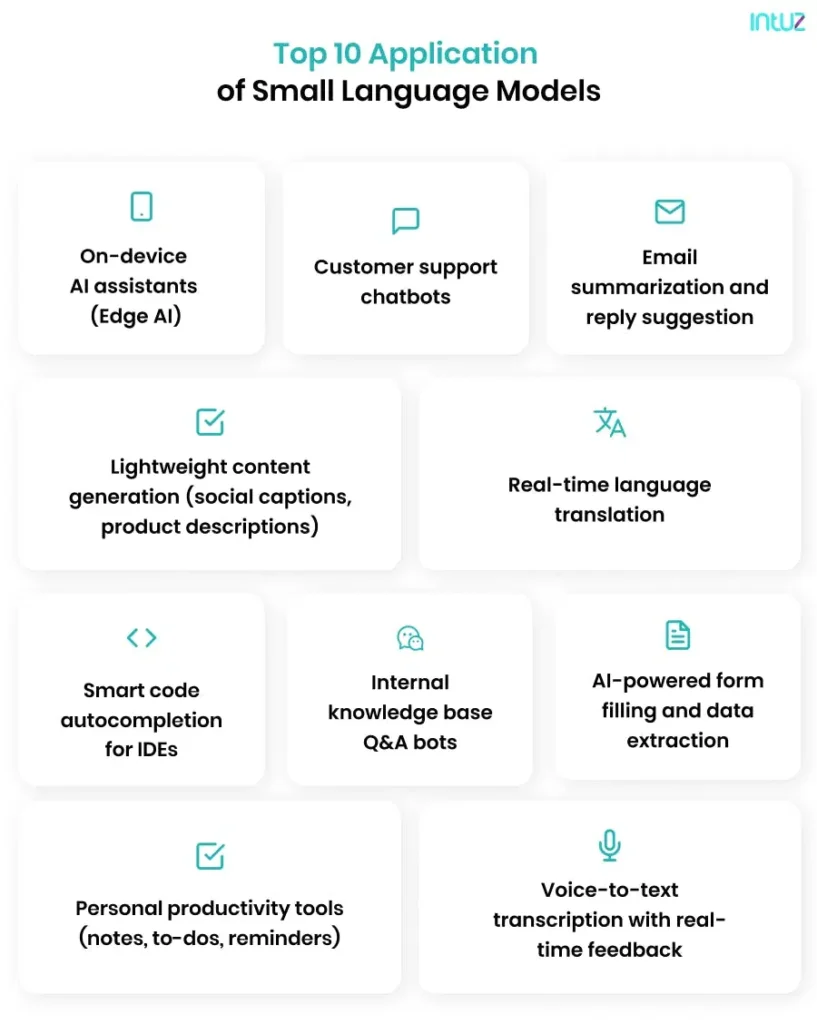
At Intuz, we help SMBs find and deploy the right SLM for optimizing supply chain operations, personalizing customer experiences, or enhancing financial forecasting.
In this blog, we’ll walk through 10 of the best small language models in 2026: what they do well, where they work best, and how they can help you. Let’s get started.
Show
- “Small” now means sub-4B parameters, not the 7B–24B range most 2025-era lists (including our own previous version) were built around.
- There’s no single “best” SLM in 2026 — the right pick depends entirely on use case: general-purpose, reasoning, agentic tool-calling, multilingual, vision, mobile/edge, reasoning distillation, or RAG.
- RAG needs a pair of models, not one: an embedding model (jina-embeddings-v5-text-small-retrieval) for retrieval and a reranker (jina-reranker-v3) to filter candidates, plus a separate generation model to produce the answer.
- Open-weight licensing (Apache 2.0, MIT, Llama Community) now covers nearly every production use case at sub-4B sizes, making on-prem fine-tuning and full data control the default rather than a workaround.
- Quantized 4-bit footprints for these models range from under 1GB (jina-reranker-v3, Llama-3.2-1B) to ~3GB (Qwen3-4B-Instruct-2507) — most run on a single consumer GPU or CPU-only server.
- Specialist models are now viable at small scale: dots.ocr for document OCR and Qwen3.5-2B-MTP for vision-plus-light-coding fill jobs that general-purpose SLMs handle poorly.
- Agentic and tool-calling reliability at this size still breaks down on long chains (6+ sequential calls) — verification steps matter more than model choice past that point.
- SLMs deliver 80–90% of frontier-LLM quality on scoped tasks (classification, RAG, extraction, structured dialogue) but still lag on open-ended, multi-hop reasoning over long documents.
What Are Small Language Models?
An Small language models is a transformer language model, typically under 4B parameters, small enough to run inference on a single consumer GPU, a CPU-only server, or directly on a phone, without a cloud API call.
They get small through three techniques: distillation (training a small model to mimic a larger one’s outputs), quantization (compressing weights from 16-bit to 4-bit or 8-bit precision, cutting memory 2–4x with minor accuracy loss), and architecture choices like grouped-query attention or mixture-of-experts routing that activate only a fraction of parameters per token.
The tradeoff against an LLM isn’t raw quality, it’s scope. An SLM tuned for one job — summarization, classification, tool-calling — matches or beats a general-purpose 70B+ model on that job, at a fraction of the latency and cost, but works with a narrower context and a smaller world-knowledge base.
Are SLMs Good Enough for Production?
Yes, for scoped tasks. Teams running SLMs in production consistently report 80–90% of frontier-LLM quality on classification, RAG, extraction, and structured dialogue — the tasks most SMB products actually need. Where they still fall short is open-ended, multi-hop reasoning over very long documents and tasks requiring broad world knowledge outside the training domain. Match the model to a defined task rather than a general-purpose assistant role, and production reliability holds.
Small Language Models Vs Large Language Models – The Differences
| Factor | LLMs (Large Language Models) | SLMs (Small Language Models) |
|---|---|---|
| Infrastructure Cost | High (requires GPUs or cloud credits) | Low (runs on local devices, edge, or CPU-only servers) |
| Inference Speed | Slower, higher latency | Faster, near real-time responses |
| Deployment Flexibility | Mostly cloud-based | Cloud+ Edge + On-device |
| Privacy & Data Control | Lower (data passes through cloud) | Higher (can run fully offline or on-premise) |
| Best for Use Cases | Complex reasoning, long documents | Task bots, chatbots, summarization, embedded Al |
| Monthly Operational Cost | $$$ (cloud compute, storage, APIs) | $ (can run on commodity hardware or local server) |
| Fine-tuning Needs | High effort, expensive | Easy to fine-tune on small datasets |
| Startup Time/ Cold Start | Slower, heavy loading | Instant start, low memory footprint |
| Model Size (Parameters) | 65B+ (e.g., GPT-4, Claude 3) | 0.5B-7B (e.g., Phi-3, Mistral, Gemma) |
| Open-source Availability | Limited | Widely available (many open models) |
| SMB Fit | Overkill for most SMB use… | Purpose-built for resource… |
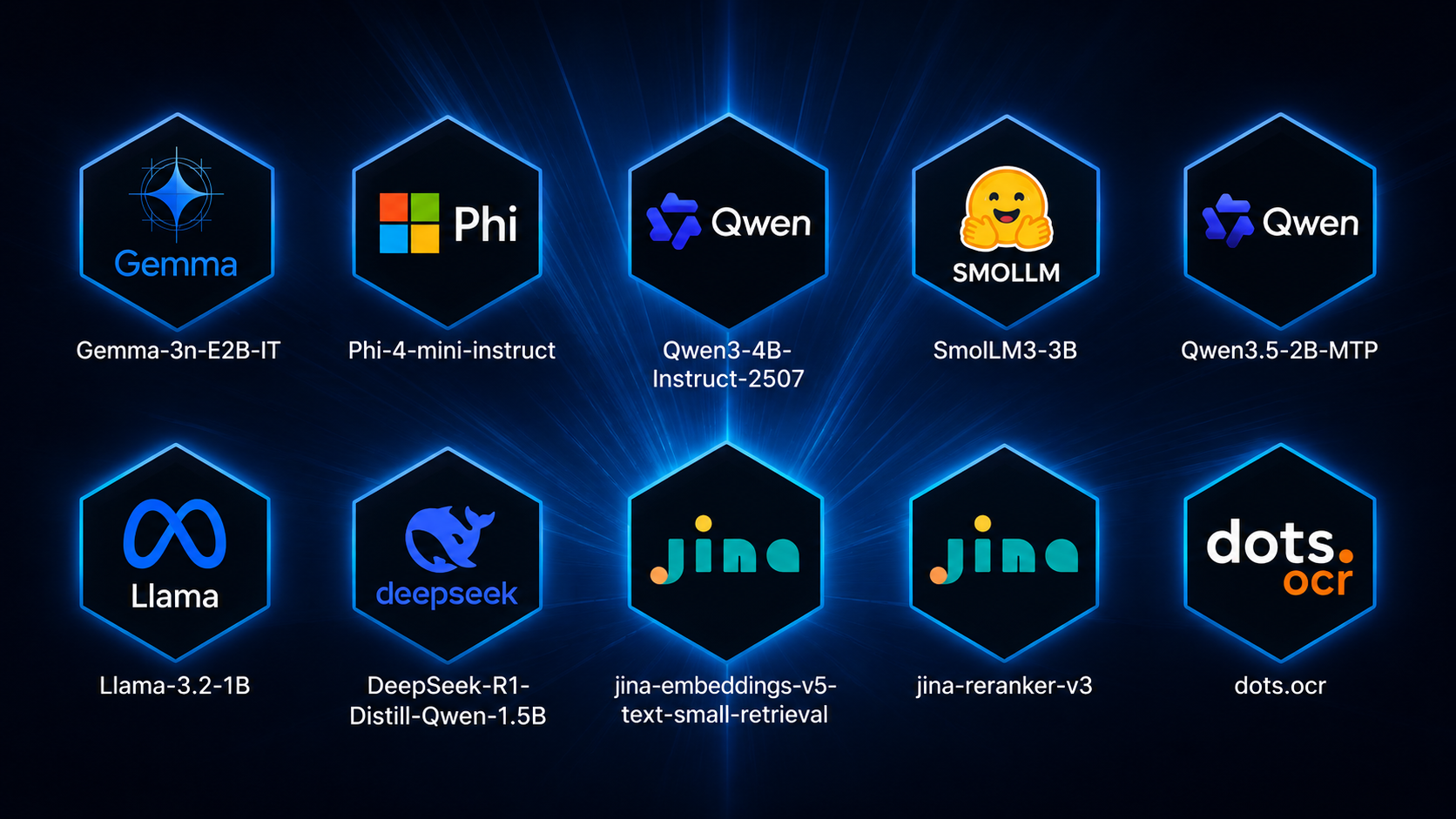
Top 10 Small Language Models in 2026 (by Use Case)
1. Gemma-3n-E2B-IT (General-Purpose & Everyday Tasks)
Google’s Gemma 3n-E2B-IT is an instruction-tuned small language model optimized for multilingual reasoning and on-device AI applications. Despite its compact size, it delivers strong conversational quality, making it suitable for assistants, summarization, and mobile inference where latency and memory matter.
- Why use it: Strongest all-purpose model in this size class — reliable summarization, Q&A, and light creative writing without needing a specialized use case.
- Caution: It’s a generalist, not a specialist. On any single narrow task, a purpose-tuned model elsewhere on this list will outperform it.
- Best-fit use case: Default model for a product handling varied, unpredictable requests rather than one repeated task.
- Real-world use: Powering a general support chatbot that fields mixed questions — billing, product info, troubleshooting — without a separate model per topic.
2. Phi-4-mini-instruct (Complex Reasoning & Instruction-Following)
Microsoft’s Phi-4-mini-instruct focuses on delivering high reasoning performance from a compact model trained for instruction following. It performs particularly well on coding, mathematics, and structured problem-solving tasks, making it a strong option for enterprise copilots and edge deployments.
- Why use it: Trained on reasoning-dense data — holds up on math, logic, and structured instruction-following better than its size suggests.
- Caution: Reasoning strength comes from a narrow, curated training mix, so general world-knowledge and casual conversation quality lag Gemma-3n.
- Best-fit use case: Compute-constrained apps that need multi-step reasoning, not open-ended chat.
- Real-world use: Insurance claims triage — following a fixed decision tree of eligibility rules and flagging exceptions for human review.
3. Qwen3-4B-Instruct-2507 (Agentic Workflows)
Qwen3-4B-Instruct-2507 is Alibaba’s latest 4B-parameter instruction model designed to balance reasoning accuracy with deployment efficiency. It supports multilingual conversations, coding, and long-context understanding while remaining practical for self-hosted AI applications.
- Why use it: Alibaba’s current small pick for tool-calling — strong function-calling accuracy and instruction adherence across multi-turn tool use.
- Caution: Reliability degrades on long agent chains of six or more sequential calls — validate against your actual tool schema before trusting it.
- Best-fit use case: Research agents and workflow orchestrators that chain API calls off model output.
- Real-world use: An internal research assistant that searches, pulls data from three internal APIs, and compiles a summary in one pass.
4. SmolLM3-3B (Multilingual & Long-Document Tasks)
SmolLM3-3B is Hugging Face’s compact open-weight model built for developers who need strong instruction-following without large infrastructure requirements. It offers competitive reasoning and coding capabilities while remaining lightweight enough for local inference and edge devices.
- Why use it: Dual-mode model (with or without extended reasoning traces), tuned for consistent performance across multiple languages rather than English-first with translation bolted on.
- Caution: Multilingual breadth costs some peak English-only performance versus a same-size English-focused model.
- Best-fit use case: Support or content products serving non-English markets without maintaining separate fine-tunes per language.
- Real-world use: A single support model handling tickets in English, Spanish, and French without routing to language-specific endpoints.
5. Qwen3.5-2B-MTP (Vision, Object Detection & Light Coding)
Qwen3.5-2B-MTP combines a compact 2B architecture with Multi-Token Prediction (MTP), enabling faster token generation during inference. This makes it particularly attractive for latency-sensitive applications where both response speed and instruction quality are important.
- Why use it: Pairs a vision projector with a small language backbone — reliable for object detection and image-grounded Q&A, usable for basic Python, JS, and HTML generation.
- Caution: Tool-calling and longer coding tasks are noticeably weaker than in text-only models of the same size.
- Best-fit use case: Products needing both light vision and light coding from one model, rather than two separate ones.
- Real-world use: A retail app that identifies products from a photo and generates a short HTML snippet for the listing.
6. Llama-3.2-1B (Mobile & Edge Deployment)
Llama 3.2-1B is Meta’s smallest instruction-capable Llama model, designed specifically for resource-constrained environments. It enables conversational AI, summarization, and simple reasoning tasks on laptops, mobile devices, and embedded hardware with minimal compute requirements.
- Why use it: Meta’s smallest instruction-tuned release and the most-deployed model for on-device inference — runs natively via llama.cpp or MLX with no server round-trip.
- Caution: Noticeably weaker on anything requiring nuance or multi-turn context retention — built for narrow, single-turn tasks.
- Best-fit use case: On-device classification, autocomplete, or offline assistant features where latency and connectivity are the constraint.
- Real-world use: An offline field-service app that classifies technician notes into categories with zero network dependency.
7. DeepSeek-R1-Distill-Qwen-1.5B (Reasoning / Chain-of-Thought Distillation)
DeepSeek-R1-Distill-Qwen-1.5B distills the reasoning capabilities of the larger DeepSeek-R1 models into a compact 1.5B parameter model. It excels at step-by-step reasoning, logical problem solving, and mathematical tasks while remaining efficient enough for local deployment.
- Why use it: A Qwen2.5 backbone distilled from DeepSeek-R1’s reasoning traces — produces step-by-step chain-of-thought output at a fraction of R1’s compute cost.
- Caution: Distilled reasoning models tend to over-generate intermediate steps, increasing token cost and latency versus a direct-answer model.
- Best-fit use case: Tasks needing visible reasoning steps — audit trails, explainable scoring — on modest hardware.
- Real-world use: A loan pre-screening tool that shows the step-by-step logic behind a recommendation for compliance review.
8. jina-embeddings-v5-text-small-retrieval (RAG — Embeddings & Retrieval)
jina-embeddings-v5-text-small-retrieval is a specialized embedding model built for semantic search and Retrieval-Augmented Generation (RAG) pipelines rather than text generation. It converts documents into high-quality vector representations that improve search relevance while keeping indexing costs low.
- Why use it: Built specifically for retrieval, not generation — ranks close to embedding models 5–10x its size, and its small footprint makes re-embedding a full corpus cheap whenever it changes. Qwen3-Embedding-0.6B is a solid multilingual alternative.
- Caution: Doesn’t generate text — it’s infrastructure for the retrieval step, not a standalone answer engine.
- Best-fit use case: The retrieval layer of any RAG pipeline, paired with a generation model.
- Real-world use: Indexing a product knowledge base so a support model can pull the three most relevant articles per query.
9. jina-reranker-v3 (RAG — Reranking)
jina-reranker-v3 is a cross-encoder reranking model that improves search accuracy by reordering retrieved documents based on their semantic relevance to a query. It is commonly used as the final ranking stage in RAG systems to increase answer quality without changing the underlying retrieval engine.
- Why use it: A Qwen3-0.6B fine-tune that re-scores the embedding model’s top candidates before they reach the generation model — the step where most RAG accuracy is actually won or lost.
- Caution: Adds an inference hop and latency to every query — benchmark whether the accuracy gain justifies the round-trip for latency-sensitive apps.
- Best-fit use case: Pairing with jina-embeddings-v5 for a full small-footprint retrieval stack.
- Real-world use: Cutting down a 20-document retrieval set to the 3 most relevant before they’re passed to the generation model.
10. dots.ocr (OCR & Document Understanding)
dots.ocr is a compact OCR-focused model designed to accurately extract text from scanned documents, PDFs, invoices, receipts, and images. Its lightweight architecture makes it suitable for high-throughput document processing pipelines where speed and deployment efficiency are priorities.
- Why use it: Purpose-built for document OCR — handwriting, dense unstructured documents, and degraded or banded scans, where general-purpose vision models typically fail.
- Caution: A specialist — not built for general image understanding or vision-grounded conversation.
- Best-fit use case: Products ingesting scanned forms, invoices, or handwritten notes.
- Real-world use: Extracting line items from scanned vendor invoices, then passing the text to a generation model for classification and entry.
How These SLMs Score on Standard Benchmarks
Descriptions like “strong reasoning” only mean something next to numbers, so here is where the general-purpose models in this list actually land on published benchmarks.
Every score below is the vendor’s own reported figure from the official model card; we’ve kept each model to the benchmarks its makers actually publish rather than forcing incompatible tests into one column.
| Model | Params | MMLU | GSM8K | MATH | GPQA (Diamond) | Reasoning / code | Context | License |
|---|---|---|---|---|---|---|---|---|
| Gemma-3n-E2B-IT | ~2B eff. | 60.1 | — | — | — | Hella Swag 72.2 | 32K | Gemma |
| Phi-4-mini-instruct | 3.8B | 67.3 | 88.6 | 64.0 | 25.2 | ARC-C 83.7 | 128K | MIT |
| Qwen3-4B-Instruct-2507 | 4B | 69.6 | — | — | 62.0 | Live Code Bench 35.1 | 262K | Apache 2.0 |
| SmolLM3-3B (reasoning) | 3B | — | — | — | 41.7 | AIME25 36.7 · Live Code Bench 30.0 | 64K (128K YARN) | Apache 2.0 |
| Llama-3.2-1B | 1B | 49.3 | 44.4 | 30.6 | 27.2 | IFEval 59.5 | 128K | Llama 3.2 Community |
| DeepSeek-R1-Distill-Qwen-1.5B | 1.5B | — | — | 83.9 (MATH-500) | 33.8 | AIME24 28.9 | 32K | MIT |
Qwen3-4B-Instruct-2507 reports MMLU-Pro (69.6), a harder successor to MMLU, not the classic MMLU.
This is worth understanding when you compare across generations: 2026-era models increasingly report MMLU-Pro, AIME, and LiveCodeBench because the original MMLU and GSM8K are largely saturated at the top of this size class.
A blank cell above means the vendor didn’t publish that specific test, not that the model failed it. Treat the numbers as directional across families, and as directly comparable only within the same benchmark.
The embedding, reranking, and OCR models in this list (jina-embeddings, jina-reranker, dots.ocr) are deliberately left out of this table, they aren’t text generators and are measured on different suites entirely — retrieval quality (MTEB, nDCG) and character-level OCR accuracy — so an MMLU column would be meaningless for them.
Need Help Choosing the Best Model For Your Business?
Contact UsSLM Deployment: Costs, Infrastructure & Options
SLM deployment costs 5–20x less than equivalent LLM API usage. Here’s what to expect:
Cloud inference:
- $0.10–$0.50 per 1M tokens for SLMs (vs $2–$30 per 1M tokens for GPT-4 class LLMs)
- A private SLM endpoint on AWS, Azure, or GCP serving 10,000 daily queries typically runs $500–$2,000/month
- Equivalent LLM API usage for the same workload: $5,000–$50,000/month
On-premise / self-hosted:
- A single NVIDIA A10G GPU ($1,500–$3,000 hardware) can serve Mistral 7B at production scale
- Ollama, vLLM, and NVIDIA TensorRT-LLM are the standard serving options
- Edge deployment on Apple Silicon or Qualcomm chips requires no additional hardware beyond the device
Fine-tuning:
- Models under 13B can be fine-tuned on a single NVIDIA A100 (40GB)
- Models above 13B require multiple GPUs or cloud-based TPU access
What GPU You Actually Need: VRAM by Quantization
Runs on consumer hardware” is vague. What matters is whether a model fits your card at the precision you plan to serve. Weight memory scales predictably with parameters and precision — roughly 2 GB per billion parameters at FP16, ~1 GB at INT8, and ~0.5 GB at INT4 — plus 1–2 GB of runtime and KV-cache overhead that grows with context length.
The table below applies that math to the generative models in this list; treat these as minimums for short-context inference and add headroom for long prompts.
| Model | Params | FP16 | INT8 | INT4 (Q4) |
|---|---|---|---|---|
| Llama-3.2-1B | 1B | ~3 GB | ~2 GB | ~1.5 GB |
| DeepSeek-R1-Distill-Qwen-1.5B | 1.5B | ~4 GB | ~2.5 GB | ~1.5 GB |
| Gemma-3n-E2B-IT | ~2B eff. | ~2 GB† | ~2 GB | ~1.5 GB |
| SmolLM3-3B | 3B | ~7 GB | ~4 GB | ~2.5 GB |
| Phi-4-mini-instruct | 3.8B | ~9 GB | ~5 GB | ~3 GB |
| Qwen3-4B-Instruct-2507 | 4B | ~10 GB | ~5.5 GB | ~3 GB |
Gemma-3n-E2B is the exception to the parameter math: its raw weights are larger than 2B, but Google’s Per-Layer Embeddings offload part of the model to CPU, so its practical GPU footprint matches a 2B model (~2 GB) even before aggressive quantization.
- Anything up to ~4B runs comfortably on a single 8 GB consumer GPU at INT4 or INT8, and the sub-2B models will run on CPU-only or integrated graphics.
- FP16 is where you feel the ceiling — a 4B model at full precision (~10 GB) needs a 12 GB card or larger once you account for context.
- For most production RAG and tool-use workloads, INT8 is the sweet spot between quality and footprint.
How to Choose the Best Small Language Models for Your Business: Expert Tips by Intuz
| If your priority is… | Best-fit model | Why |
|---|---|---|
| General assistant / summarization | Gemma-3n-E2B-IT | Strongest all-rounder in its class, tiny footprint |
| Math & structured reasoning | Phi-4-mini-instruct | Reasoning-dense training; GSM8K 88.6, MATH 64.0 |
| Agentic tool-calling | Qwen3-4B-Instruct-2507 | Strong function-calling, 262K context |
| Multilingual / long documents | SmolLM3-3B | Multilingual-first, 128K extended context |
| On-device / mobile | Llama-3.2-1B | Smallest, best-supported edge runtime path |
| Chain-of-thought on a budget | DeepSeek-R1-Distill-Qwen1.5B | Step-by-step reasoning at 1.5B |
| RAG retrieval | jina-embeddings-v5 (small) | Purpose-built semantic search |
| RAG reranking | jina-reranker-v3 | Cross-encoder precision on top results |
| Document / OCR extraction | dots.ocr | Handwriting and degraded-scan specialist |
1. Assess your business requirements
Start with what you’re trying to build. Are you designing an AI onboarding assistant? Streamlining on-site appointment triage? Automating claims processing chats?
Different use cases demand different model strengths, such as length generation, summarization, and classification. Intuz can work with your team to define technical and functional requirements and then shortlist models based on relevance, size, and capability.
2. Evaluate integration and compatibility
Some language models are better suited to the cloud, while others can be optimized for mobile apps, edge devices, or on-premise systems. The best choice depends on where your SLM needs to run, the infrastructure you already have, and the tools your team knows best.
Intuz can assess your existing tech stack and deployment environment and then help you select and set up models that integrate cleanly with your systems, whether AWS, Azure, Docker, or anything else. We can help you avoid unnecessary complexity and speed up production.
3. Conduct a cost-benefit analysis
Smaller models may be cheaper to host compared to LLMs, but performance still varies. Consider inference cost, development time, accuracy, and long-term maintenance. A slightly larger model can sometimes reduce engineering overhead or improve user satisfaction.
Intuz can break down the full cost of ownership, including infrastructure, tuning, and support, so you can choose a model that meets your budget and performance requirements.
4. Plan for scalability and future needs
What works today should still work a year from now. If your customer base grows or your use cases evolve, your SLM needs to be able to keep up. You must check if it can be quantized for the edge, scaled horizontally across GPUs, and integrated with your existing MLOps stack.
Does the SLM have an active community or roadmap? At Intuz, we vet models not just for immediate fit but also for long-term flexibility. Our goal is to ensure you can adapt, scale, and optimize as your business grows.
5. Prioritize security and data privacy
Running a model in-house or on your infrastructure gives you better control over user data. This is critical, especially for businesses operating in healthcare, finance, or regions with strict compliance standards.
The good news is that Intuz can deploy small language models securely through private cloud, on-prem hosting, and secure API layers, so you can protect sensitive information and still meet compliance requirements.
Small Language Models Are a Strategic Choice. Choose Wisely
SLMs offer many advantages without the overhead of large, expensive models. They’re faster, easier to deploy, and often more secure—a dream combination for any SMB. However, choosing the right model extends beyond size or benchmarks.
Our AI consulting services can help you identify what matters most for your SMB, integrate the right AI tools, and launch features that deliver real value quickly and securely. If you’re exploring how to bring practical, efficient AI into your product, our team is here to help.
Book your free consultation today and let’s discuss your product roadmap.
FAQs
What’s the actual difference between a small language model and a large language model in practice?
Parameter count is the surface difference — SLMs typically run between 1B and 13B parameters versus 65B+ for LLMs — but the practical difference is where and how they run. LLMs like GPT-4 require cloud APIs, large GPU clusters, and per-token costs that add up fast. SLMs like Phi-3 or Mistral 7B can run on a single GPU, an on-premise server, or even consumer hardware like an Apple Silicon Mac. For most SMB use cases — chatbots, document summarization, classification, onboarding flows — an SLM delivers 80–90% of GPT-4 quality at a fraction of the infrastructure cost. The tradeoff is that SLMs struggle with complex multi-step reasoning over very long documents, which is where LLMs still lead.
How much does it actually cost to deploy and run a small language model for a mid-sized business?
Running a private SLM endpoint that handles 10,000 daily queries typically costs $500–$2,000 per month on cloud infrastructure — compared to $5,000–$50,000 per month for equivalent LLM API usage. On-premise is even cheaper: a single NVIDIA A10G GPU ($1,500–$3,000 hardware cost) can serve Mistral 7B at production scale with no recurring API fees. Edge deployment on Apple Silicon or Qualcomm devices requires no additional hardware beyond the device itself. Fine-tuning a sub-13B model like Phi-3 or Gemma 2 on your own dataset costs roughly one A100 GPU session — achievable in hours on most cloud platforms. The total cost of ownership is 5–20x lower than equivalent LLM usage over a 12-month horizon.
Can a small language model be fine-tuned on my company’s internal data without leaking it to third parties?
Yes — and this is one of the biggest advantages SLMs have over proprietary LLM APIs. Models under 13B parameters can be fine-tuned entirely within your own infrastructure using techniques like LoRA or QLoRA, which dramatically reduce compute requirements. Your training data never leaves your environment. A typical fine-tuning run on a focused dataset (customer support transcripts, product documentation, internal SOPs) takes hours on a single NVIDIA A100 and produces a model that outperforms a general-purpose LLM on your specific domain. For businesses with proprietary terminology, workflows, or compliance constraints, fine-tuned SLMs consistently outperform prompt-engineered LLMs on task-specific accuracy.
What infrastructure do I need to self-host a small language model — do I need a dedicated GPU server?
Not necessarily. Models under 4B parameters, including TinyLlama, Phi-3 Mini, and MobileLLaMA, can run on CPU-only servers or even high-RAM cloud instances with no GPU required — though inference is slower. For production deployments serving real users, a single NVIDIA A10G, L4, or consumer RTX 4090 GPU is sufficient for most 7B models. Deployment stacks like Ollama (easiest setup), vLLM (production-grade throughput), and NVIDIA TensorRT-LLM (optimized inference speed) are widely used and well-documented. For edge or mobile deployment — IoT devices, mobile apps — models like MobileLLaMA 1.4B or TinyLlama 1.1B run natively using llama.cpp with no server dependency at all.
What’s the biggest mistake businesses make when adopting small language models?
Choosing the model before defining the use case. Most SLM adoption failures trace back to selecting a model based on benchmark rankings or hype, then trying to fit it to a business problem — rather than starting with a clear task definition and selecting the model that fits. A 1.1B model like TinyLlama is ideal for low-latency classification tasks on edge devices but will underperform on nuanced multi-turn conversations. Mistral 7B is the most fine-tuning-friendly architecture but is overkill for simple structured outputs. The second most common mistake is skipping fine-tuning entirely and relying on prompting alone — which consistently produces worse results than even lightweight fine-tuning on 500–1,000 domain-specific examples. Define the task, then choose the model.
What’s the best small language model for RAG?
No single model — RAG needs a pair. Use jina-embeddings-v5-text-small-retrieval (or Qwen3-Embedding-0.6B for multilingual corpora) for retrieval, jina-reranker-v3 to re-score candidates, and a generation model like Phi-4-mini-instruct to produce the final answer.
What are the best open-source small language models?
Gemma-3n-E2B-IT, Phi-4-mini-instruct, Qwen3-4B-Instruct-2507, SmolLM3-3B, and Llama-3.2-1B lead their categories — all open-weight under Apache 2.0, MIT, or comparable commercial-friendly licenses.
Can small language models handle OCR and document understanding?
Yes — dots.ocr is purpose-built for it, outperforming general vision-language SLMs on handwriting, dense unstructured documents, and degraded scans, though it should be paired with a text model for downstream summarization.
Work with Intuz
Build AI Product Using SLMs?
Get expert help choosing the right SLM for your use case.
Let's Get Started
Share this article