



This guide is for: CTOs, tech leads, and product teams who want to run AI on their own infrastructure — without sending data to OpenAI, Google, or any third party. You don’t need: Prior ML research experience. If you can work with APIs and cloud infrastructure, you can follow this guide.
A private LLM is a large language model deployed entirely within your own infrastructure — on-premise, in a private cloud, or hybrid — so your sensitive data never leaves your environment. This guide covers the full build process: from model selection and data preparation to fine-tuning, deployment, and ongoing monitoring — without prior ML research experience.
This guide is for: CTOs, tech leads, and product teams who want to run AI on their own infrastructure — without sending data to OpenAI, Google, or any third party.
Show
- A private LLM is a large language model deployed entirely within your own infrastructure — on-premise, private cloud, or hybrid — so sensitive data, prompts, inference logs, and model weights never leave your security boundary.
- Most SMB deployments use fine-tuning or RAG on an open-source base (LLaMA 3, Mistral 7B, Falcon) and can go from planning to pilot in 6–12 weeks for under $80,000 in initial costs.
- RAG is the recommended default starting point for most use cases — it keeps sensitive data external and updatable in real time — while fine-tuning is reserved for when RAG cannot achieve the required accuracy or tone consistency.
- A private deployment becomes economically justified versus managed APIs when you process over 2 million tokens per day (or ~8,000+ conversations/day) or operate under strict compliance like HIPAA or PCI DSS, with payback typically within 6–12 months.
- GPU cost is only part of the equation — engineering, monitoring, and security (MLOps, guardrails, evaluation pipelines) typically add 1.5–2x on top of infrastructure spend, and ~68% of enterprise teams underestimate first-year spend by more than 3x.
How Public LLMs Fall Short for Industry-Specific Needs
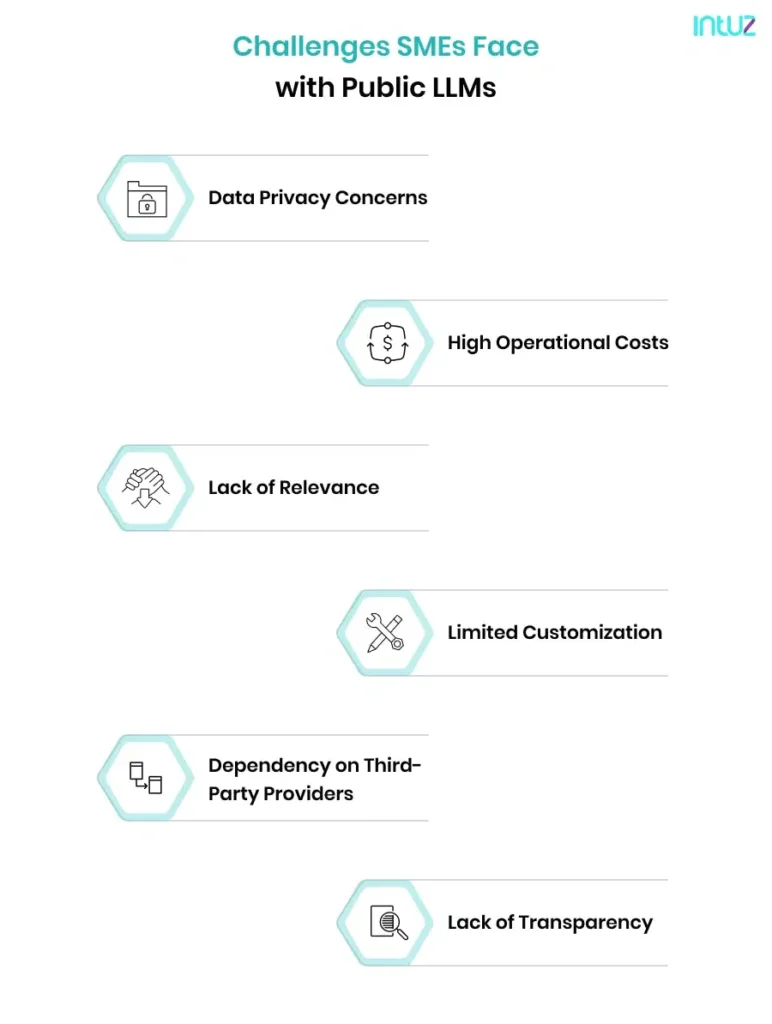
The core problem: Every prompt sent to ChatGPT, Claude, or Gemini leaves your network. For organizations handling regulated, confidential, or proprietary data, that creates unacceptable privacy, compliance, and cost risks.
Public LLMs face three pressing challenges
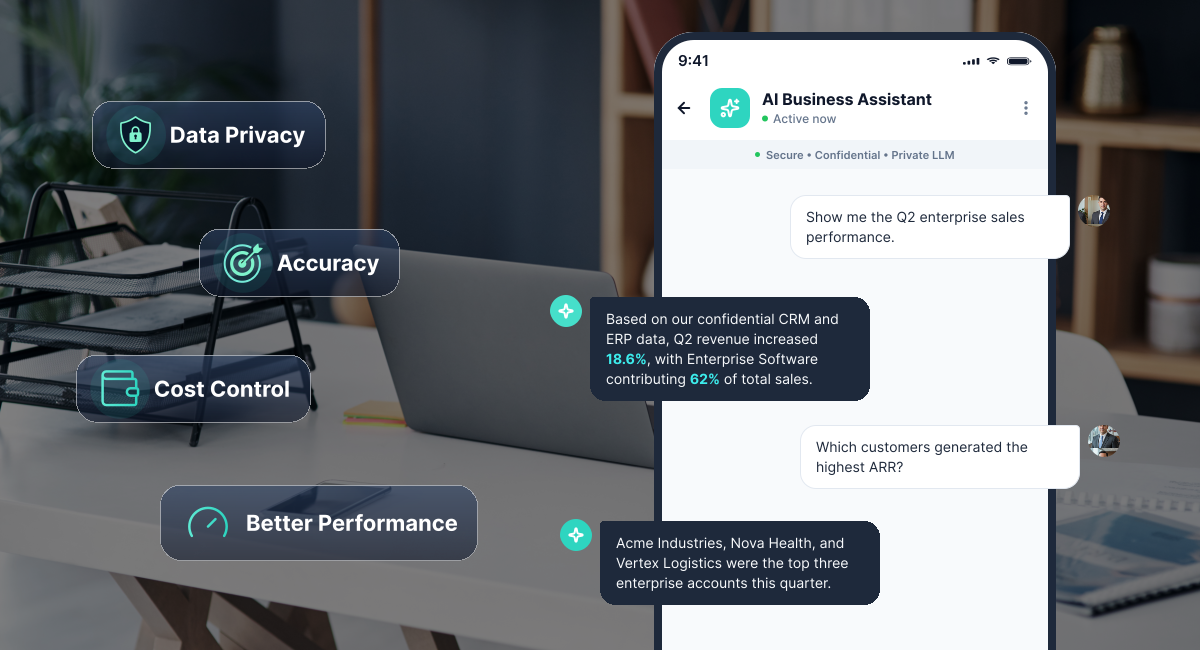
- Data privacy risk — Queries and outputs are processed on external servers. Even with enterprise agreements, you are trusting a third party’s retention policies and security practices.
- Unsustainable cost at scale — Usage-based pricing models appear affordable initially but compound quickly. One enterprise team’s API bill went from $15,000 in month one to $60,000 by month three — a $700K+ annual run rate before hidden costs.
- Domain knowledge gap — General-purpose models are trained on broad internet data. They lack the industry-specific terminology, internal workflows, and proprietary context your business requires.
What Are Private LLMs?
A private LLM (large language model) is an AI system trained, fine-tuned, and deployed within an organization’s own controlled environment — either on-premise servers, a private cloud, or a hybrid architecture. Unlike public LLM APIs, a private LLM keeps all data, prompts, inference logs, and model weights inside your security boundary. No third party ever processes your information.
A private LLM is custom-built on your organization’s specific data and goals. Since you control what it learns from, its outputs directly reflect your business — delivering accurate, contextually relevant insights for your specific industry rather than generic internet knowledge.
Why Does Your Business Need A Private LLM?
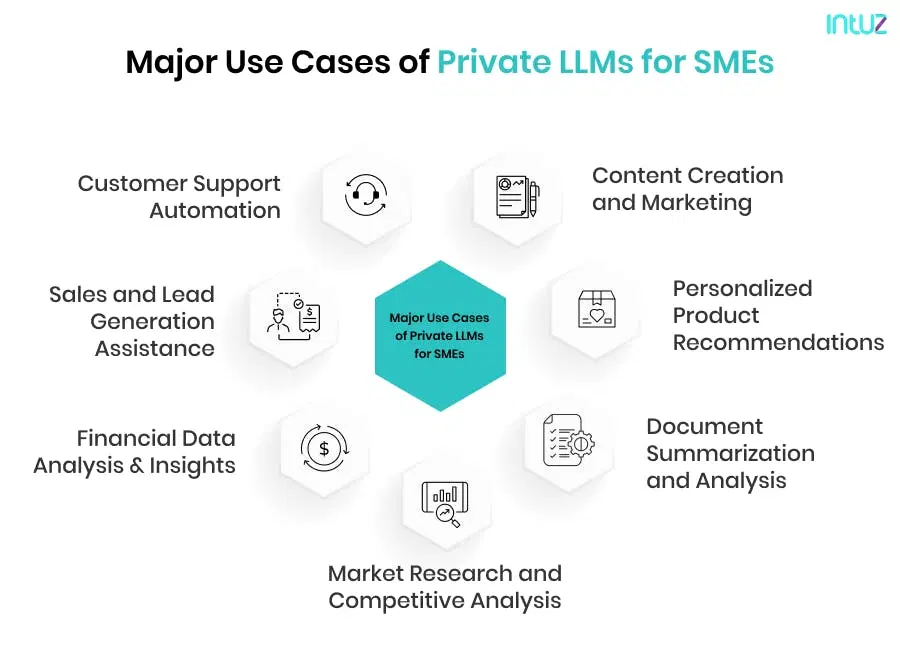
- Better data security: With a private LLM, all sensitive data remains under your control. This helps guarantee that your customer details will stay secure, mainly if you handle confidential information, such as healthcare or finance data.
- Industry-specific responses: The significant advantage of a private LLM is that you can train it in the exact language and nuances of your industry, be it legal jargon or IT support content. This helps deliver relevant insights that your team can immediately take action, enhancing operational efficiency.
- Lower operational costs over time: While building your LLM is an upfront cost, you save a considerable amount by not paying usage fees to a third party, allowing you to keep expenses low even when your business scales up.
- Supercharged sales with AI assistance: Your private LLM can give your sales and marketing teams personalized insights on customer behavior or product trends, helping them amp up their service and boost conversion rates.
Over 80% of enterprises are expected to have deployed generative AI APIs or models by 2026, up from less than 5% in 2023. The enterprise LLM market is projected to grow from $8.8B in 2025 to $71.1B by 2034 at a 26.1% CAGR.
Types Of LLMs
1. General-purpose LLMs
These are broad-based LLMs built on large internet datasets, like GPT-4 or OpenAI’s Davinci, and deliver more generalized insights rather than tailored industry-specific content.
2. Domain-specific LLMs
These are trained on industry-specific data so that they can understand relevant topics and contexts and deliver more precise insights than general-purpose models. For instance, Bloomberg has developed BloombergGPT, a financial LLM trained on financial data.
3. Instruction-tuned models
These models accurately follow many user instructions, including translation, summarization, step-by-step guidance, content creation, and code generation. The ChatGPT application is an ideal example here.
4. Multimodal models
These LLMs process and interpret various data types, such as text, audio, and images, to deliver hyper-specific and customized outputs. DALL-E and CLIP, for instance, can generate images based on text or identify objects within images.
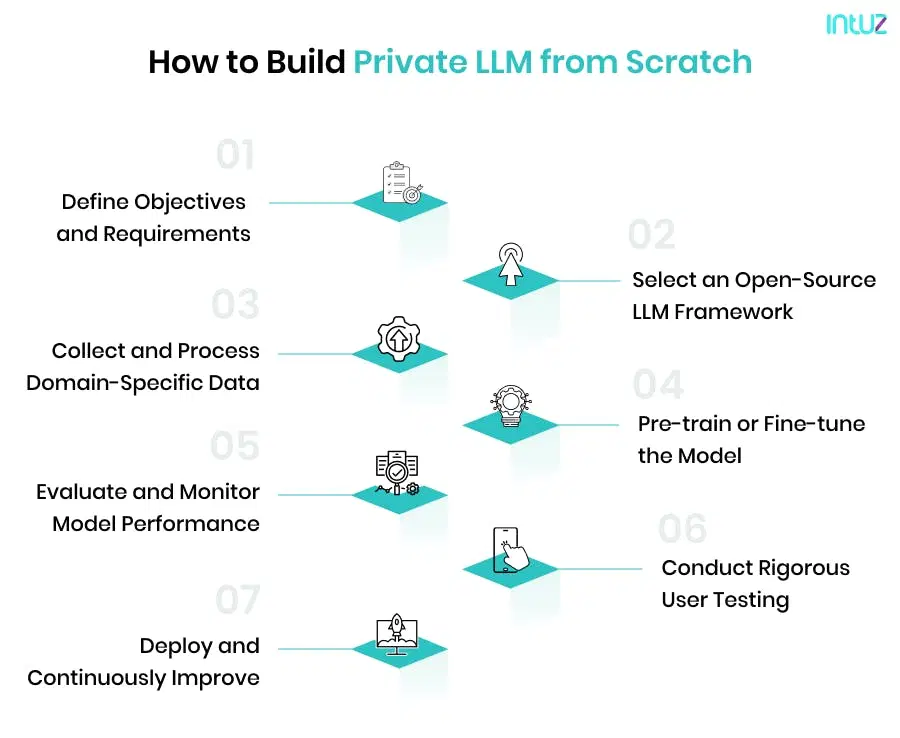
How to Build a Private LLM from Scratch — 6 Steps
Define objectives → Select framework → Collect + preprocess data → Pre-train or fine-tune → Evaluate + monitor → User testing and iteration. Most SMB deployments complete a pilot in 6–12 weeks.
Step 1. Define objectives and requirements
Before selecting a model or writing a line of code, define the specific business problem your private LLM will solve. This single decision determines your model size, data requirements, and infrastructure needs.
Common use cases by industry:
- Legal: Contract review, clause extraction, case research
- Healthcare: Clinical documentation, patient record summarization, coding assistance
- Finance: Fraud detection, risk analysis, regulatory reporting
- Internal operations: Knowledge base Q&A, HR assistant, code review automation
What to define at this stage:
- Specific use cases (e.g., “process insurance claims” not “improve productivity”)
- Success metrics and KPIs — for customer service: reduced average handling time, higher first-contact resolution rate
- Budget envelope — data acquisition, technical support, and hardware/cloud infrastructure
- Compliance requirements — GDPR, HIPAA, SOC 2, or PCI DSS obligations that constrain architecture choices
Step 2. Select an open-source LLM framework
Choosing the right framework saves significant time and cost. The four most production-proven options:
| Framework | Best For | License | Hardware Requirement |
|---|---|---|---|
| HuggingFace Transformers | General use, smaller teams | Free (compute costs apply) | 1 GPU for fine-tuning 7B models |
| TensorFlow / Keras | Large-scale model training | Free, Apache 2.0 | Multi-GPU, high expertise required |
| PyTorch | Complex custom architectures | Free, BSD | Scales with model size |
| Rasa | Conversational agents, chatbots | Free + enterprise tier | CPU-friendly for smaller models |
- With an extensive library of pre-trained models and customization tools, HuggingFace Transformers is one of the most popular frameworks for LLMs. It also comes with comprehensive documentation, which is ideal if your SME has a smaller technical time. Even though it’s free to use, computing costs apply.
- Google’s TensorFlow and its high-level API Keras offer a range of robust options for training large models. You can customize them extensively, but they require some technical expertise, making them expensive. View our TensorFlow development services.
- Meta’s PyTorch is a solid choice for projects requiring complex customization. It comes with extensive documentation and community support. The bigger the model, the more computing power is needed.
- Rasa is a specialized framework for Natural Language Processing (NLP) and dialogue management, perfect for building chatbots or conversational agents.
Model selection guidance:
- LLaMA 3 (Meta) — Open-source, instruction-tuned, strong benchmark performance. Recommended starting point for most private deployments.
- Mistral 7B — Fast, efficient, high accuracy per parameter. Best for resource-constrained environments.
- Falcon — Strong for custom fine-tuning on domain-specific corpora.
Hardware note: Small-to-mid models like Mistral 7B can be fine-tuned on a single NVIDIA A100 (40GB). Models above 13B typically require multiple GPUs or cloud-based TPU access. For 70B models, expect 8–16 H100 GPUs for continuous production inference.
Step 3. Collect and process domain-specific data
The more specific and high-quality your data is, the better your LLM will reflect and comprehend the nuances of your business. Sources of relevant data include:
- Your SME’s internal data sources like product documentation, customer support transcripts, and training manuals
- Publicly available data like research papers, industry reports, or relevant journals
- Web scraping to gather niche data from industry-specific websites or social forums
- Data partnerships with third-party providers who can offer specific datasets with valuable industry information
The next critical step is to preprocess the data so your model learns from high-quality input free of noise or irrelevant information. There are three steps involved:
- Cleaning: Remove any redundant or irrelevant data, such as customer conversations on off-topic matters, that could bias or confuse the model.
- Labeling and structuring: Organize your data as much as possible by labeling and sorting wherever relevant (such as annotated contracts). This will help your model’s insights be more contextually relevant.
- Data augmentation: This is useful when you have a small dataset to avoid having your model trained only on that dataset. Try creating variations on the data you have to help the model generalize better, such as by writing variations on common customer queries.
Intuz can help you collect, clean, and structure domain-specific data from internal sources or external partnerships to ensure your model is accurate and deeply aligned with your industry’s nuances. Our data experts streamline the process so your LLM gets trained on high-quality inputs from day one.
Step 4. Pre-train or fine-tune the model
The choice between pre-training from scratch and fine-tuning an existing model is the most consequential technical decision in a private LLM project.
| Criteria | Pre-Training from Scratch | Fine-Tuning (Recommended for most) |
|---|---|---|
| When to use | No aligned open-source model exists; high data volume; sufficient compute | Limited dataset; limited compute; aligned base model available |
| Cost | $500K–$5M+ | $5,000–$80,000 |
| Time to pilot | 6–18 months | 6–12 weeks |
| Best for | Highly specialized domains (e.g., proprietary scientific research) | Most enterprise SMB use cases |
Pre-training from scratch is the better option if:
- You don’t have an existing open-source model aligned with your needs
- You have high volumes of domain-specific data
- You have sufficient computing power
And fine-tuning is preferred when
- You have a limited dataset
- You have limited computing resources
- You have a closely aligned open-source model already
Here’s how to fine-tune an existing model:
- Choose a base open-source model like BERT or GPT.
- Clean your data and format it to the model’s input requirements.
- Define training parameters like batch size, learning rate, and epochs.
- Train the model on your data with a framework like Hugging Face’s Trainer API.
- Use techniques like data augmentation or dropout regularization to avoid overfitting the model to the training data.
- Test the fine-tuned model on a dataset to validate its accuracy, error rates, and response relevance.
Here’s how to pre-train a model from scratch:
- Choose an architecture that’s in line with your needs.
- Gather a large and varied dataset of domain-specific data.
- Set parameters with longer training times and lower learning rates than when fine-tuning an existing model.
- Assess what computing resources you will need. Consider using cloud-based solutions or optimizing with model distillation for more efficient resource usage.
- Have a warm-up phase to stabilize learning, then keep running training passes as needed.
- Keep evaluating the model on a validation dataset to verify it is learning how you want it to.
Lucky for you, Intuz makes this process seamless. We help you leverage the latest pre-trained models and AI frameworks and customize them to your business needs, significantly reducing development time and costs while improving the model’s accuracy for your specific use cases.
Fine-Tuning vs RAG: Which Approach Is Right?
Fine-tuning embeds domain knowledge permanently into model weights. RAG (Retrieval-Augmented Generation) connects the model to a private knowledge base at runtime, without retraining.
| Criteria | Fine-Tuning | RAG (Retrieval-Augmented Generation) |
|---|---|---|
| Best for | Consistent tone, domain-specific language patterns | Frequently changing data, compliance-sensitive environments |
| Data freshness | Requires retraining to update | Real-time — update the knowledge base without retraining |
| Cost | Higher upfront (training compute) | Lower upfront (vector DB + embedding pipeline) |
| Compliance risk | Sensitive data baked into weights | Sensitive data kept external, queried at runtime |
| Recommended for SMBs | Only when RAG cannot achieve required accuracy | Default starting point for most use cases |
Many organizations adopt a hybrid approach: a fine-tuned base model for linguistic style and domain terminology, combined with RAG for real-time knowledge retrieval.
Step 5. Evaluate and monitor model performance
Continuous monitoring is not optional — it is what keeps a private LLM aligned with business needs and regulatory requirements after launch.
| Metric | What It Measures | Target |
|---|---|---|
| Accuracy | Responses matching desired outputs | Baseline from user testing |
| Relevance | Alignment with query intent, including nuanced cases | > 90% user satisfaction |
| Error rate | False positives and false negatives | < 5% for production |
| Response time | Time-to-first-token for user-facing apps | < 2 seconds |
| Hallucination rate | Factually incorrect outputs | < 1% for high-stakes domains |
Recommended monitoring tools:
- MLflow — Track experiments, compare performance across model versions
- Prometheus + Grafana — Real-time response times and server performance
- Hugging Face Evaluation API — NLP-specific task assessment (question answering, classification)
- Custom dashboards (Flask / Streamlit) — User interaction monitoring, satisfaction scores
Step 6. Conduct Rigorous User Testing and Improve the Model
The buck doesn’t stop at building and implementing the LLM model.
Collecting feedback is crucial for refining the model to align with actual user needs. To capture detailed insights, utilize diverse feedback collection methods such as surveys, in-app prompts, and user interviews.
Also, a success criteria checklist should be established to gauge whether the model effectively serves its purpose. Be proactive in identifying common issues, like incorrect responses or ambiguous outputs, and have a set of solutions ready to address these problems.
In addition, pay close attention to scaling considerations as your user base grows, ensuring your system can handle increased load without compromising response times.
On-Premise vs Private Cloud vs Hybrid: Choosing Your Deployment Model
The deployment model determines your data control, operational complexity, and long-term cost structure. There is no universally correct choice — the right option depends on your data sensitivity, compliance obligations, and internal capabilities.
| Criteria | On-Premise | Private Cloud (VPC) | Hybrid |
|---|---|---|---|
| Data control | Maximum — nothing leaves your building | Strong — dedicated isolated environment | Balanced — sensitive data stays private, compute scales in cloud |
| Compliance | Ideal for air-gapped requirements (defense, government) | Meets HIPAA, GDPR, SOC 2 with proper configuration | Increasingly preferred for regulated SMBs |
| Upfront cost | High (GPU hardware, data center) | Lower | Moderate |
| Operational burden | High — you manage everything | Medium — provider handles infrastructure | Medium |
| Time to deploy | Months | Weeks | Weeks to months |
| Best for | Defense, financial institutions with strict data residency | Most enterprise use cases | Organizations balancing cost and control |
A private LLM deployment starts to outperform managed API costs economically when you process over 2 million tokens per day or operate under strict compliance requirements like HIPAA or PCI DSS. Most teams see payback within 6–12 months.
What Is Cost of Developing Private LLM?
Private LLM costs range from $1,000/month for small prototypes to $50,000+/month for enterprise-scale production. GPU costs are only part of the equation — engineering, monitoring, and security typically add 1.5–2x on top of infrastructure spend.
| Deployment Tier | Infrastructure | Monthly Cost | Best For |
|---|---|---|---|
| Small prototype | Cloud GPU, fine-tuned 7B model | $1,000 – $5,000 | Proof of concept, internal tools |
| SMB production | VPC + managed inference | $15,000 – $40,000 | Customer-facing apps, knowledge assistants |
| Enterprise scale | Multi-GPU cluster, HA setup | $50,000+ | High-traffic, multi-department workflows |
GPU cost reference (2026):
- NVIDIA A100 40GB: ~$2–$3/hr on cloud; ~$2,000–$3,000/month bare-metal lease
- NVIDIA H100 80GB: ~$25–$40/hr on cloud
- 70B model at production scale: 8–16 H100s — approximately $5,000–$15,000/day for continuous use
Hidden costs enterprises frequently underestimate:
- Prompt engineering & regression testing: $5,000–$25,000/quarter per model update cycle
- Evaluation & quality assurance pipeline: $3,000–$15,000/quarter
- Guardrails, PII detection, and safety filtering: 10–30% token overhead
- MLOps team (monitoring, retraining, incident response): often 1.5–2x the infrastructure cost
~68% of enterprise teams underestimate their first-year LLM API spend by more than 3x. Private deployment often becomes cost-justified at 8,000+ conversations per day versus a managed API.
Importance of Private LLM
1. Scale seamlessly without compromising speed or accuracy
When you own the LLM, you can optimize it for specific tasks and hardware, minimizing latency and maximizing throughput. You can scale workloads horizontally or vertically based on business demands without being constrained by shared infrastructure or third-party limitations.
2. Get more relevant results with custom-tailored AI
Private LLMs can be fine-tuned on proprietary or industry-specific data, enabling highly accurate and context-aware responses.
This personalized training ensures the model understands the niche terminology, organizational knowledge, internal workflows and products, and more relevant and actionable outputs compared to general-purpose public models.
3. Gain control and reduce vendor lock-in
Training and deploying LLMs internally ensures your sensitive data, confidential insights, and proprietary research never leave your secure environment. This approach significantly minimizes exposure to data misuse or leaks, which can occur when using public AI services.
4. Keep your data and ideas secure
Using a private LLM eliminates reliance on third-party APIs, reducing risks associated with vendor lock-in, changes in pricing, or service outages. It offers greater autonomy over updates, feature rollouts, and long-term strategic direction.
Considerations When Choosing Private LLMs for Your Business
1. Assess your data privacy and compliance requirements
Before deploying a private LLM, evaluate whether your organization needs complete control over data handling, storage, and processing. This is especially important for industries handling regulated, confidential information like healthcare and pharma. Ask yourself: is the LLM compliant with regulatory requirements and internal security policies?
2. Evaluate infrastructure for deployment and performance
Running private LLMs means provisioning your computing resources. Check whether your on-prem or cloud environment can support training, inference, and scaling requirements without bottlenecks. This is a key point, especially when dealing with latency-sensitive apps.
3. Prioritize data quality and governance
Private models thrive on curated, domain-specific data. Strong governance practices, such as structured data pipelines and labeling protocols, ensure the LLMs learn from accurate, relevant information and generate reliable outputs.
4. Plan for ongoing operational investment
When private LLMs avoid per-call API fees, they demand investment in fine-tuning, infrastructure, monitoring, and updates. That’s why it’s vital to factor in engineering resources and MLOps tooling for long-term sustainability and performance optimization.
5. Detect and mitigate embedded model bias
Even in private environments, models can carry forward biases from initial training datasets. Therefore, to ensure results remain fair, safe, and aligned with your organizational values, leverage diverse training data, bias audits, and human-in-the-loop evaluation.
Security Best Practices for Private LLM Deployment
Data leakage in a private LLM can occur at the training, inference, or API layer. Defense requires controls at all three.
- Access control: Role-based permissions (RBAC) on all model endpoints and training data stores
- Encryption: Data encrypted at rest (AES-256) and in transit (TLS 1.3)
- Prompt filtering: Input/output screening for PII, sensitive data patterns, and injection attacks
- Audit logging: Complete, immutable logs of all queries and responses for compliance review
- Air-gapped inference: For highest-sensitivity deployments, no outbound network connections from the inference server
- Avoid training on raw PII: Use RAG for sensitive data — query at runtime rather than baking into model weights
If you need expert support with the entire process, you can always count on our AI specialists.
Just book a 45-minutes call with us to dive deep into a custom AI consulting strategy we’ll develop for you then and will provide you the top-level implementation plan.
FAQs
Can I build my own LLM model?
You can build your own LLM using open-source architectures like LLaMA, Mistral, or Falcon. The process involves gathering a large, clean dataset, training it on high-performance compute clusters (typically GPUs or TPUs), and applying parameter optimization techniques to meet specific business goals.
How to deploy private LLM?
To deploy a private LLM, you must containerize the model (using Docker, for example), set up inference servers (e.g., using Triton or vLLM), and establish secure API endpoints. Monitoring, scaling, and hardware acceleration should be integrated for optimal runtime performance.
Can you run an LLM locally?
Many open-source models are optimized to run locally, especially quantized versions like those from Hugging Face or Ollama. With sufficient hardware (e.g., GPUs or Apple Silicon), developers can deploy models offline for tasks like coding, summarization, or document generation.
How much does it cost to build a private LLM?
Costs vary widely — from ~$500/month to pre-train a small open-source model on cloud GPUs to $500K+ to pre-train a large model from scratch. Most SMEs start with fine-tuning or RAG, which can be done for under $5,000.
What is the minimum infrastructure required to run a private LLM in production?
A production-ready private LLM setup typically requires GPU-enabled compute (A100/H100 or equivalent), a vector database for retrieval (like FAISS or managed alternatives), secure storage, and an API layer for serving responses. For SMBs, a hybrid setup—using managed GPU services with self-hosted orchestration—often balances cost and control better than fully on-prem deployments.
Should I choose on-premise, VPC, or hybrid deployment for a private LLM?
The choice depends on data sensitivity and operational maturity. On-premise offers maximum control but high upfront cost and maintenance overhead. VPC-based deployments (AWS, Azure, GCP) provide strong isolation with scalability. Hybrid models—where sensitive data stays private but compute scales in the cloud—are increasingly preferred for regulated SMBs.
How do I ensure my private LLM does not leak sensitive data?
Data leakage risks are mitigated through strict access controls, encryption (at rest and in transit), prompt filtering, and avoiding training on raw sensitive data. Instead of fine-tuning, many teams use Retrieval-Augmented Generation (RAG) so sensitive data is queried at runtime rather than embedded into the model weights.
Is fine-tuning necessary, or can I rely on RAG for a private LLM?
In most real-world SMB use cases, RAG is more practical than fine-tuning. It allows you to keep data external, update knowledge instantly, and reduce compliance risks. Fine-tuning is only justified when you need domain-specific reasoning patterns or tone consistency that cannot be achieved through prompt engineering and retrieval.
What are the real costs of running a private LLM beyond GPU pricing?
Running a private LLM typically costs $1,000–$5,000/month for small prototypes, $15,000–$40,000/month for production SMB use cases, and $50,000+ for enterprise-scale deployments with high traffic or compliance needs. However, GPU costs are only part of the equation—engineering, monitoring, and security can increase total expenses by 1.5x–2x. In practice, most SMBs start small and scale gradually based on ROI and usage demand.
How long does it take to build a private LLM?
A RAG-based pilot using an existing open-source model typically takes 6–12 weeks from planning to deployment. Fine-tuning on domain-specific data adds 4–8 weeks. Full custom pre-training from scratch requires 6–18 months and substantial GPU resources. Most enterprises start with RAG for speed, then layer in fine-tuning for accuracy.
What open-source models are best for private LLM deployment in 2026?
LLaMA 3 (Meta) is the leading choice for general enterprise use — fully open-source, strong benchmark scores, and wide ecosystem support. Mistral 7B is preferred for resource-constrained or latency-sensitive deployments. Falcon excels for custom fine-tuning on specialized corpora. All three support LoRA/QLoRA parameter-efficient tuning.
Work with Intuz
Build Your Private LLM With Intuz
Keep your data in-house. Get a free expert strategy call.
Let's Get Started
Share this article