




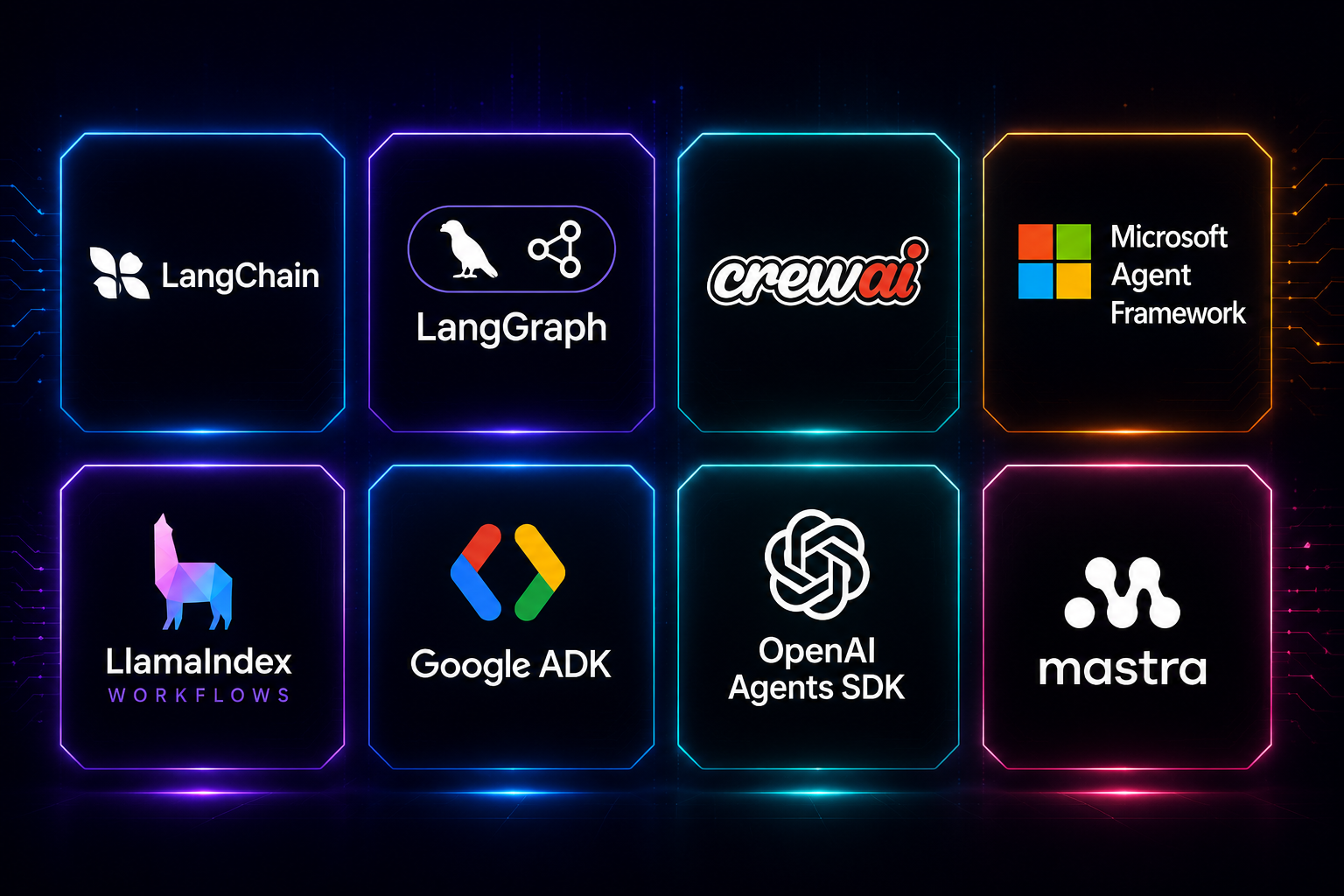
Choosing an AI agent framework in 2026 isn’t a tooling decision — it’s a 12-month production commitment. Pick wrong, and you’ll rewrite your agent stack at the 6-month mark when costs spike, reliability tanks, or your use case outgrows the framework’s design. This guide compares the 8 frameworks worth shortlisting in 2026: Langchain, LangGraph, CrewAI, Microsoft Agent Framework, Llamaindex, Google ADK, OpenAI Agents SDK, and Mastra. Real production cost data. Real reliability scores. Real decision criteria for picking the right one for your team.
You’ve probably heard a lot about AI agents lately. They’re showing up in conversations about customer support, operations, sales, and internal workflows. But here’s what matters: agent AI frameworks help businesses get more done with fewer manual steps.
They take tasks involving multiple people or tools, making them smoother, faster, and more intelligent. Now, as an SMB, you face different pressures than large enterprises:
You’re experiencing rapid growth
You need to keep a close eye on costs
You want to get things done as efficiently as possible
That’s why it makes sense to explore agentic AI. And you don’t even need to build everything from scratch. There are some remarkable frameworks you can use to make the process easy. This blog post will analyze the best AI agent frameworks in 2026.
Show
- No single “best” framework: LangGraph for control, CrewAI for speed, Microsoft Agent Framework for Azure/.NET, Mastra for TypeScript teams.
- AutoGen and Semantic Kernel are now in maintenance mode. Microsoft Agent Framework (GA April 2026) is their successor — build new projects on it.
- Independent benchmarks (AIMultiple): LangGraph runs ~2.2x faster than CrewAI on identical tasks; LangChain uses the most tokens because it re-sends fuller history at each step.
- Across Intuz’s 100+ deployments, monthly infra cost for 1,000 requests/day is $63–$171. Model choice, not framework choice, is the biggest cost lever.
- Not every workflow needs a framework — simple 1–2 tool agents are often faster to build directly against the model API.
- Real numbers: a LangGraph healthcare deployment logged zero unexpected-path incidents across ~18,000 patient intakes in 6 months. A CrewAI rebuild shipped in 1 week vs. 3 weeks on AutoGen.
What Is an AI Agent Framework?
An AI agent framework is a software toolkit that provides pre-built infrastructure for creating autonomous AI agents — systems that can perceive inputs, reason, plan, use tools, and execute multi-step tasks without constant human intervention. Frameworks handle memory management, tool integration, agent orchestration, and workflow coordination so developers can focus on business logic rather than low-level plumbing.
Without a framework, building even a basic multi-agent system can take weeks of engineering effort. With the right framework, the same system can be prototyped in days and deployed to production in a matter of weeks.
Key components every AI agent framework provides:
- Memory: Short-term (within a session) and long-term (across sessions) context storage
- Tool use: Ability to call APIs, search the web, query databases, or run code
- Orchestration: Managing how multiple agents communicate, delegate, and collaborate
- Human-in-the-loop: Approval and intervention checkpoints in automated workflows
- Observability: Logging, tracing, and monitoring agent behavior in production
How We Evaluated These Frameworks
Every claim below traces to one of three sources:
- our own production telemetry across 100+ client deployments run between 2025 and mid-2026, covering customer support, data pipeline, and compliance-workflow use cases
- Publicly available GitHub repository data (star count, issue volume, release cadence, and maintenance status) checked in July 2026
- Third-party benchmark data, specifically AIMultiple’s controlled test of four data-analysis tasks run 100 times each across CrewAI, LangChain, OpenAI Swarm, and LangGraph on identical hardware and identical LLM calls. Where a claim is a vendor’s own marketing number rather than an independently verified figure, we’ve flagged it as such.
The 8 AI Agent Frameworks That Actually Matter in 2026
The top 8 AI agent frameworks are LangGraph, Langchain, LlamaIndex (Workflows), Microsoft AutoGen, CrewAI, OpenAgents, Google ADK and Mastra. The field has consolidated. AutoGen and Semantic Kernel are sunsetting into Microsoft Agent Framework. LangChain, once “just” a wrapper library, now anchors an entire ecosystem (LangGraph, Deep Agents, LangSmith). And two frameworks barely discussed a year ago — Google ADK and Mastra — now show up constantly in enterprise and TypeScript-team conversations respectively. Here’s the list worth shortlisting, in the order most teams should evaluate them.
| Framework | Best For | GitHub Stars (approx., Jul 2026) | Maintenance Status |
|---|---|---|---|
| LangChain | Fast prototyping across model providers | ~134k | Actively developed |
| LangGraph | Stateful, auditable, long-running workflows | Part of LangChain org, actively developed | Actively developed |
| CrewAI | Role-based multi-agent teams, fastest time-to-prototype | ~49k | Actively developed |
| Microsoft Agent Framework | Azure/.NET enterprise stacks | ~10k (new repo) | Actively developed — GA April 2026 |
| LlamaIndex (Workflows) | Document-heavy, retrieval-centric agents | ~40k (core), separate Workflows package newer | Actively developed |
| Google ADK | GCP-native teams wanting an opinionated runtime | ~19k | Actively developed |
| OpenAI Agents SDK | Lightweight, low-abstraction OpenAI-stack agents | ~22k | Actively developed |
| Mastra | TypeScript/JavaScript production teams | ~23k | Actively developed |
1. LangChain
LangChain is the framework most people mean when they say “building with LLMs.” It’s a broad, modular toolkit — 1,000+ community-maintained integrations to models, vector databases, and APIs — designed for teams that want to swap model providers with a one-line change and move from RAG pipeline to tool-calling agent without switching tools.
Key features
- Model-provider abstraction — swap OpenAI, Anthropic, Gemini, or Bedrock with a one-line change, no application-logic rewrite
- 1,000+ community-maintained integrations for vector databases, document loaders, tools, and APIs via
langchain-community - Composable primitives (text splitters, retrievers, output parsers) usable standalone, outside a full chain
- Native pairing with LangGraph (stateful orchestration), Deep Agents (long-running tasks), and LangSmith (tracing/evaluation)
LangChain Use cases
- Tool-calling agents: straightforward single-agent workflows that call APIs, run code, or query databases
- RAG applications: internal knowledge bases and document Q&A that need to swap embedding/vector-store providers as requirements evolve
- Multi-provider prototyping: testing the same agent logic against several LLMs before committing to one for production
LangChain is best for teams that need to move fast across a broad set of use cases and multiple model providers without committing early, and that want a single ecosystem (paired with LangSmith) covering the whole lifecycle from prototype to production.
Strengths
- Broadest ecosystem and integration surface of any framework in this guide
- Fastest path from prototype to production without switching frameworks (LangGraph/Deep Agents/LangSmith all plug in natively)
- Large community — easiest framework to hire for and find documentation on
Limitations
- Chain-first architecture means more tokens and higher latency than graph-based alternatives on identical tasks (see benchmark below)
- Heavy dependency footprint — version upgrades require careful management
- Abstraction layers that accelerate early development can become friction when debugging edge cases in complex workflows
2. LangGraph
LangGraph is an open-source library built by LangChain that enables developers to build stateful, multi-agent applications using large language models (LLMs). It models complex AI agent workflows as directed cyclic graphs — a structure that gives developers fine-grained control over agent state, branching logic, and long-running processes.
Key features
- Add moderation, approval, or validation steps where needed, so agents stay aligned with business logic and guardrails
- Store memory and context across sessions for long-term interactions and more personalized user experiences
- Human-in-the-loop checkpoints to inspect and modify agent state at any point in a workflow
LangGraph use cases
- Customer support escalation: Agents that handle Tier 1 queries autonomously and escalate complex cases to human agents with full context preserved
- Multi-step data pipelines: Extract, transform, validate, and load data across systems with branching error-recovery logic
- Compliance workflows: Automated document review with human approval gates at each regulatory checkpoint
LangGraph is best for enterprises and technical SMBs that need durable, auditable, long-running agent workflows with precise control over execution order and error recovery. It reached v1.0 in late 2024 and has become the default runtime for LangChain agents.
Strengths
- Precise state management across complex workflows
- Native human-in-the-loop support
- Works seamlessly with the broader
- Production-ready with fault tolerance
Limitations
- Steeper learning curve than
- CrewAI More verbose setup for simple use cases
- State management overhead increases with scale
- Best suited for Python developers
For a production-grade deep-dive on LangGraph vs CrewAI vs AutoGen — including real cost numbers ($63–$171/month benchmarks), three enterprise case studies, and a six-factor head-to-head comparison — see our extended 17-minute analysis on Towards AI
3. CrewAI
CrewAI is an open-source Python framework that orchestrates AI workflows using a coordinated team of agents called “crews.” Support for code-based and no-code development enables fast deployment of agent automations across different business functions, including supply chain, HR, and media.
Key capabilities
- Use visual builders for fast iteration or write custom logic for complete control
- Connect agents to internal systems, APIs, or third-party tools with minimal setup
- Track agent activity, adjust behaviors, and involve humans in the loop when needed
- Automate market trend tracking, competitor analysis, and customer insights collection
- Run dynamic, multi-step campaigns with agents that adjust strategy based on real-time data
CrewAI use cases
- Marketing automation: One agent tracks competitors, another drafts content, a third schedules posts — all coordinated as a crew
- HR workflow automation: Agents that screen resumes, schedule interviews, and send follow-ups without manual intervention
- Supply chain monitoring: Multi-agent crews that monitor inventory levels, flag anomalies, and trigger reorder workflows autonomously
CrewAI is best for: marketing teams, research departments, and mid-sized businesses seeking a low-barrier entry into agent automation. It is the recommended starting point for SMBs without dedicated AI engineering teams. LangChain and CrewAI together are considered the top AI agent frameworks for SMBs in 2025, offering flexibility, scalability, and cost-effective integrations.
Strengths
- Lowest learning curve among the top frameworks
- No-code and code-first options available
- Excellent documentation and growing community
- Built-in task delegation, sequencing, and state management
Limitations
- Less fine-grained control than LangGraph
- Higher abstraction can limit customization
- Newer than LangChain/AutoGen — ecosystem still maturing
- Best for role-based workflows; less suited for financial or dev-specific tasks
4. Microsoft Agent Framework
Agent Framework combines AutoGen’s conversational multi-agent model with Semantic Kernel’s enterprise features (session state, middleware, telemetry) and adds graph-based workflows with type-safe routing.
Key features
- Graph-based workflows with type-safe routing, checkpointing, and human-in-the-loop support for debugging complex multi-agent orchestration
- Sequential, concurrent, handoff, group chat, and Magentic-One orchestration patterns shipped as first-class primitives
- Azure AI Foundry integration for responsible-AI guardrails — task-adherence checks, PII protection, prompt-injection defenses
- Native MCP support in core, plus A2A protocol support via a separate adapter package (beta)
- Python and .NET runtimes at GA simultaneously, with declarative YAML agent configuration and migration assistants from both AutoGen and Semantic Kernel
Use cases
- Conversational multi-agent research: deploying multiple agents to gather, evaluate, and synthesize information from diverse sources
- Enterprise workflow automation on Azure: agents that need session-based state management, middleware, and telemetry baked in
- Migration off legacy Microsoft frameworks: teams currently on AutoGen or Semantic Kernel who need a forward-compatible, supported path
Microsoft Agent Framework is best for: enterprise teams already invested in the Microsoft stack (Azure AI Foundry, Azure OpenAI, .NET services) who want a first-party orchestration layer with OpenTelemetry observability, and for anyone currently on AutoGen or Semantic Kernel who needs a forward-compatible migration path before Microsoft’s support window closes.
Strengths
- Unified successor eliminates the fragmentation that previously split Microsoft’s agent community across two incompatible frameworks
- Strong Azure/.NET ecosystem integration with a first-class C# runtime alongside Python
- Supports non-Microsoft providers (Anthropic, Bedrock, Gemini, Ollama) out of the box, so it’s not Azure-locked even though it’s Azure-optimized
Limitations
- Newer repo (GA April 2026) — smaller community and less battle-tested than LangGraph or CrewAI so far
- Community-reported issues cluster around sequential context handling and function-approval scoping in early orchestration designs
- Provider adapters outside the Azure OpenAI happy path are less exercised — validate thoroughly if you’re deploying on non-Azure infrastructure
- DevUI inspector is explicitly a sample tool, not intended for production use
5. LlamaIndex
LlamaIndex started as a data/retrieval layer for LLM apps and has evolved into an event-driven orchestration framework. Its Workflows component models agent execution as typed events triggering steps, which avoids a rigid graph DSL while still supporting composable, inspectable pipelines.
Key features
- Event-driven orchestration — typed events trigger steps, enabling composable and inspectable agent pipelines without a separate DSL
- Direct access to LlamaParse for OCR and document extraction through LlamaCloud, plus the broader LlamaIndex retrieval/loading tooling
- Python-first, actively maintained, with Starlette and FastAPI middleware support for embedding workflows into existing scripts and APIs
- Cloud deployment targets via
llamactl, plus containerized self-hosting including AWS Bedrock AgentCore
Use cases
- Research assistants: agents that reason over large volumes of proprietary or unstructured documents
- Internal copilots: domain-specific knowledge agents grounded in a company’s own document corpus
- OCR-heavy pipelines: scanned contracts, forms, and reports that need extraction before an agent can reason over them
LlamaIndex Workflows is best for developers building document-centric, data-intensive multi-agent systems who want event-driven orchestration in plain code, especially teams already invested in the LlamaIndex data ecosystem.
Strengths
- Tightest coupling with a document/retrieval ecosystem (LlamaParse + LlamaIndex data tooling) of any framework in this guide
- Notebook and script embedding — runs cleanly without a dedicated orchestration server
- Flexible, non-graph transitions between agent actions, well-suited to workflows that loop back or branch often
Limitations
- The AgentWorkflow abstraction has documented handoff failures where a receiving agent stops responding mid-run
- Tracing integrations have known gaps with concurrent execution, resulting in dropped spans and partial traces
- Weakest value outside the LlamaIndex data ecosystem — without a document-centric use case, the event-driven model requires meaningful boilerplate versus LangGraph or the OpenAI Agents SDK
6. Google ADK (Agent Development Kit)
Google ADK is an opinionated, batteries-included framework for teams building and deploying on GCP. It ships a CLI and a browser-based debugging UI, and deploys directly to Cloud Run, GKE, or Vertex AI Agent Engine with minimal configuration.
Key features
- Developer-first CLI (
adk web,adk run,adk api_server) for fast prototyping, debugging, and exposing agents as services without server boilerplate - Built-in browser-based debugging UI (ADK Web) for inspecting agent execution without external tooling
- Built-in session handling with a Memory Bank for persistent agent memory across interactions
- Native MCP, A2A, and OpenAPI spec support for connecting agents to external tools and services
Use cases
- GCP-native enterprise agents: teams already using Vertex AI, Cloud Run, or GKE who want to avoid assembling a custom agent stack
- Agents requiring code execution: built-in code execution environment reduces boilerplate for agents that need to run and evaluate code
- Deep GCP service integration: workflows that need to touch IAM, Pub/Sub, and BigQuery directly
Google ADK is best for: GCP-native teams that want an opinionated, end-to-end agent runtime with built-in debugging tooling and a clear path to production on Google Cloud.
Strengths
- Fastest path to a deployed agent service on Google Cloud, with minimal configuration
- Model-agnostic despite its GCP orientation — not locked to Gemini alone
- Strong protocol support (MCP, A2A, OpenAPI) for connecting to external tools
Limitations
- Batteries-included benefits diminish quickly outside GCP — non-GCP teams end up rebuilding the deployment and state layers other frameworks provide more generically
- In-memory session state is lost on Cloud Run container restarts unless external persistent storage is configured explicitly — a documented gap that has caused cross-user session bleed when misconfigured
- Smaller community than LangGraph or CrewAI outside Google’s own developer base
7. OpenAI Agents SDK
A deliberately minimal framework for multi-agent workflows on OpenAI’s model APIs. Its design philosophy favors a small API surface over comprehensive abstraction — handoffs and tool-calling are easy to reason about, and built-in tracing gives debugging visibility without extra setup.
Key features
- Minimal API surface — low-abstraction design makes agent execution easy to reason about and faster to debug than heavier frameworks
- Clean, built-in multi-agent handoff and delegation primitives
- Native tracing for debugging agent behavior during prototyping, with no external tooling setup required
- MCP integration for connecting agents to GitHub, Notion, local filesystems, and other tools; LiteLLM compatibility for non-OpenAI model routing
Use cases
- Tightly scoped assistants: single-purpose agents that don’t need heavy orchestration overhead
- Delegation workflows: a small set of agents handing off tasks to each other with clear boundaries
- Tool-driven MCP applications: agents built around GitHub, Notion, or filesystem tool integrations
OpenAgents is best for fintech startups, Web3 developers, and tech-forward teams that need AI agents to not just process information but actively execute financial transactions. It is the only major open-source AI agent framework with native payment and wallet capabilities.
Strengths
- Fastest framework to understand and debug in this guide, given its minimal abstraction
- Built-in tracing without needing a separate observability platform for prototyping
- Session primitives support common storage backends (SQLite, Redis, SQL-based stores) out of the box
Limitations
- Doesn’t natively absorb durable execution across process restarts — production teams typically pair it with Temporal or DBOS for that
- Cost is driven entirely by OpenAI API usage (GPT-5.4 input starts at $2.50/M tokens; the nano tier drops to $0.20/M) — multi-agent chains can accumulate cost quickly without early token-usage instrumentation
- Lighter feature set than LangGraph or Microsoft Agent Framework if you need complex, explicit state graphs
8. Mastra
The first TypeScript-native, batteries-included agent framework on this list — built by the team behind Gatsby. Mastra ships workflows, persistent memory (via a dedicated Memory Gateway), and a Studio debugging environment in one package, wired directly into React, Next.js, and the Vercel AI SDK.
Key features
- TypeScript-first developer experience, with types and conventions that feel native rather than a JavaScript port of a Python SDK
- Built-in workflow orchestration, observability, and a dedicated Memory Gateway in one package — fewer external systems to stitch together
- Mastra Studio — a dedicated development and debugging environment for building and testing agent workflows
- Frontend integrations with Vercel AI SDK UI and CopilotKit for wiring agents directly into React/Next.js frontends
Use cases
- TypeScript/JavaScript production agents: teams that don’t want to stand up a separate Python service just for the agent layer
- Frontend-integrated copilots: in-app assistants wired directly into a React/Next.js frontend
- Node-based automation: workflows already living inside a Node backend
Mastra is best for TypeScript-heavy teams building production custom agents who want a single framework covering workflows, memory, and observability without stitching together separate libraries — especially teams already working in React/Next.js.
Strengths
- Only framework in this guide built TypeScript-first — a genuinely underserved niche none of the Python-first frameworks serve well
- Batteries-included platform reduces the number of separate libraries a JS/TS team needs to assemble
- Direct frontend wiring via Vercel AI SDK UI and CopilotKit, with no custom middleware required
Limitations
- Partial open-source license — core is Apache 2.0, but enterprise (
ee/) directories sit under a separate Mastra Enterprise License - Opinionated defaults can become restrictive for workflows that diverge from the framework’s assumptions
- Memory Gateway pricing steps up quickly at scale — free up to 100,000 memory tokens/250MB storage, then $250/team/month for 1M tokens/1GB storage, plus background model-compression costs that scale with conversation volume
Open-Source vs. Commercial Frameworks: What You’re Actually Paying For
Every framework above is free (MIT/Apache 2.0). The real decision isn’t OSS vs. commercial — it’s when the paid layer sitting on top of the free core is worth it.
| Framework | Free Tier Limit | Paid Layer | Starting Price | Unlocks |
|---|---|---|---|---|
| LangChain / LangGraph | LangSmith: 5,000 traces/mo, 1 seat, 14-day retention | LangSmith Plus/Enterprise | $39/seat/mo + $2.50/1k traces over base | 10 seats, 400-day retention, overage capacity |
| CrewAI | 50 executions/mo | CrewAI Enterprise | Custom, reported $60K–$120K/yr | SOC2, SSO, PII masking, on-prem deploy (LLM costs run separately, ~2–3× the platform fee) |
| Microsoft Agent Framework | Framework free; Azure billed as used | Azure AI Foundry guardrails | Pay-as-you-go Azure consumption | Task-adherence, PII protection, prompt-injection defense |
| LlamaIndex | LlamaParse: 10,000 free credits/mo | LlamaCloud | 1,000 credits ≈ $1.25 | Higher parsing volume, concurrency, support |
| Google ADK | Framework free; GCP billed as used | Vertex AI Agent Engine / Cloud Run | Pay-as-you-go GCP consumption | Managed deployment, session persistence, IAM/BigQuery integration |
| OpenAI Agents SDK | Framework free; API usage only | None (pair with Temporal/DBOS separately) | $2.50/M input tokens (GPT-5.4) | Leanest cost structure of the eight |
| Mastra | Memory Gateway: 100k tokens / 250MB | Memory Gateway paid tier | $250/team/mo for 1M tokens / 1GB | Higher memory ceiling; enterprise modules gated separately |
The hidden cost of “free”
At ~50,000 LangGraph traces/month, LangSmith Plus runs a 3-person team roughly $300–450/month. Self-hosting Langfuse instead drops the subscription but adds a database to run and 1–2 engineer-weeks to build the dashboards, alerting, and retention policies LangSmith ships by default — a cost that’s easy to undercount when comparing “$0” to “$40.”
When to move from free to paid:
- You’re consistently over the free-tier cap (5,000 traces, 50 executions/mo)
- You need SOC2, SSO, or PII masking — no free-tier workaround exists
- You need audit retention beyond 14 days (common in healthcare/finance)
- A second engineer needs access — most free tiers cap at 1 seat
- You’re already on Azure/GCP — the “commercial” layer is just consumption billing, cheaper to adopt than a new vendor like LangSmith or CrewAI Enterprise
How to Choose the Right AI Agent Framework for Your Business
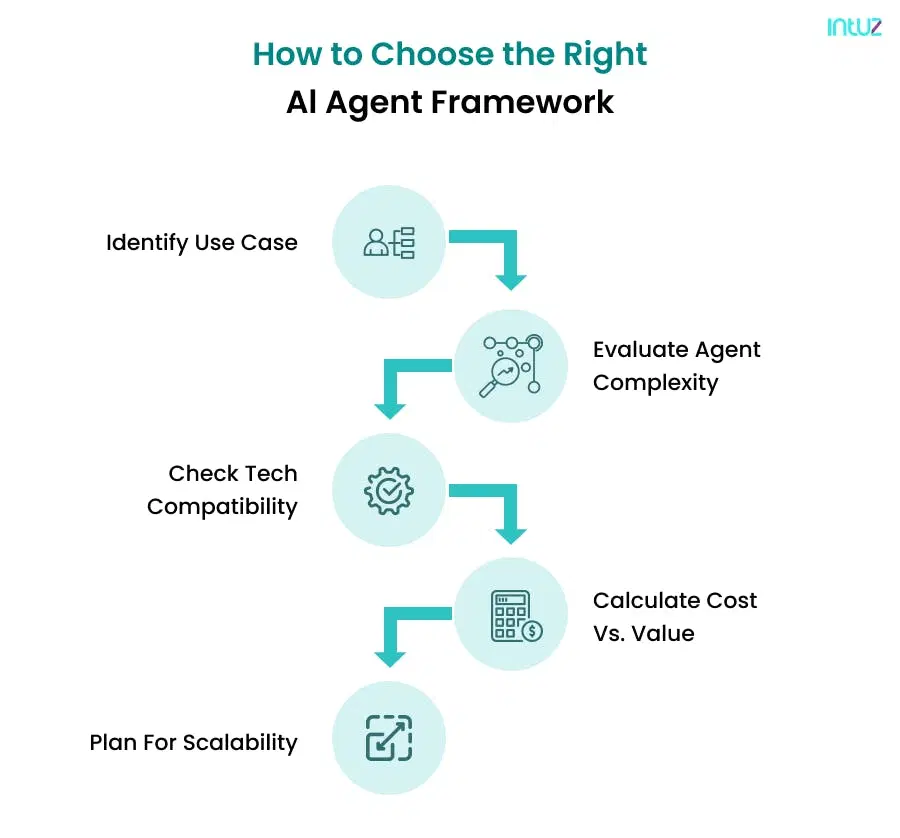
Choosing the right AI agent framework depends on four factors: your workflow complexity, your team’s technical capabilities, your integration requirements, and your industry’s specific automation needs. There is no universally best framework — the right choice is the one that aligns with your use case and scales with your growth.
At Intuz, we’ve worked closely with businesses of all shapes and sizes and learned that clarity at the start saves time and money. Here’s how you should choose an agentic AI framework to meet your requirements:
1. Identify your use case first
Before diving into feature lists or benchmarks, define your goal. Are you trying to automate support? Build a research assistant? Streamline internal operations?
Intuz believes the clearer the objective, the easier it is to match the right tools. It’s essential to articulate the use case in practical terms.
2. Evaluate agent role complexity
Some agentic AI frameworks shine when agents need to carry out simple tasks in a sequence. Others better manage multi-agent collaboration with memory, goal-setting, and task planning. Here’s a tip we always give our clients: How will your agent operate in the real world?
In addition, it needs to figure out how much autonomy it needs, how many roles it plays, and how often it needs to adapt.
Once you know this, moving towards a setup that can support that complexity without adding unnecessary overhead will be easier. Don’t worry, we’ll help you with that.
3. Ensure your tech stack is compatible
There’s no point in choosing a framework that won’t work smoothly with what you already have. We check how well it integrates with your current systems, whether you’re working with Python, cloud-native tools, or something more custom.
Intuz experts aim to plug the proper framework into your workflow with as little friction as possible.
4. Calculate cost vs. value
Some open-source AI agent frameworks are free to use but expensive to scale. Others save time but come with hefty licensing fees. Intuz helps you think through the trade-offs in real terms: setup effort, security, support, and how all of it fits into your budget.
And because we work on an outcome-first billing model, you always know what you’re committing to from the start. No hourly rate surprises. No pushing for features in multi-AI agent systems you didn’t ask for.
We believe in having a shared goal and a clear path.
5. Think about future scalability
It’s easy to plan for what you need right now. But we also help you think ahead. Building on a foundation that won’t buckle under pressure is vital if your SMB expects to grow by adding more features, users, and data.
We look at agentic AI frameworks that scale smoothly and evolve with your business, so you won’t have to hunt for a different option every time your operations expand.
Also Read
How Intuz Helps You Build with These Frameworks
Getting from an idea to a working solution can feel overwhelming when working with AI agents. There are many moving parts—business goals, technical decisions, and data questions—that don’t slow down.
That’s where we come in.
At Intuz, we work with you to determine what needs to happen, in what order, and why it matters for your business. We follow a streamlined, outcome-driven process:
Start with an in-depth business use case analysis
Move quickly into rapid prototyping and PoC development
Ensure a secure, scalable, production-ready deployment personalized to your infrastructure
But what sets our AI Agent Development Company apart?
AI-first approach
You’re building with intelligence at the core, and that’s precisely how we think too; we approach every project through the lens of what AI agents can truly enable—autonomy, adaptability, and ongoing learning
Rapid turnaround
We keep things tight and focused, working in sync with your team, sharing clear updates, and helping you ship faster without cutting corners
Business value focus
Whether it’s reducing cloud costs, getting to market faster, or validating a proof of concept, we make sure the work adds up to something meaningful—and measurable—for your business
Agile and future-ready
You stay in control, your data remains secure, and your team can scale the solution without hitting walls
In addition, we’ve worked with all the multi-agent frameworks discussed in the blog, such as LangGraph, Microsoft AutoGen, CrewAI, OpenAgents, and MetaGPT. We can help you evaluate, test, and implement the right ones for your needs.
My production research on AI agent frameworks — including LangGraph vs CrewAI vs AutoGen and Top AI Agent Frameworks 2026 — is published in Towards AI, where it’s cited by Google Gemini, NotebookLM, and Perplexity as reference material on enterprise AI agent architecture.”
Once you’ve chosen your framework, the next decision is which AI agent platform to run it on — we compared the three leading options in our latest analysis.
So, if you’re thinking about building something with open-source AI agent frameworks and want a partner to meet you where you are, we’d love to connect.
Book a free consultation with Intuz today. We promise it’ll only be a 15-minute call, but every second will be worth it.
FAQs
Which is the best AI agent framework in 2026 for startups and small businesses?
LangChain and CrewAI stand out in 2026 as top AI agent frameworks for startups and SMBs. Both offer flexibility, scalability, and cost-effective integrations, making it easier for small businesses to build AI-driven workflows without heavy infrastructure or specialized teams.
How do I choose the best AI agent framework for my business?
Focus on frameworks that align with your business goals, support low-code/no-code integrations, and scale with your growth. Evaluate community support, documentation, and ease of deployment. Partnering with an experienced AI development company can help ensure you select the best fit.
What are the key features to look for in an AI agent framework?
Look for features like modular architecture, multi-agent collaboration, API flexibility, integration with cloud services, and strong security. For SMBs, easy customization, low-code support, and cost efficiency are crucial to ensure faster ROI on AI investments.
What are the key differences between LangChain, AutoGen, and CrewAI?
LangChain is great for building customizable multi-agent workflows with robust tooling. AutoGen focuses on autonomous task execution with minimal setup. CrewAI excels at managing agent collaboration in dynamic environments. The right choice depends on your workflow complexity and team expertise.
Which industries benefit most from AI agent frameworks?
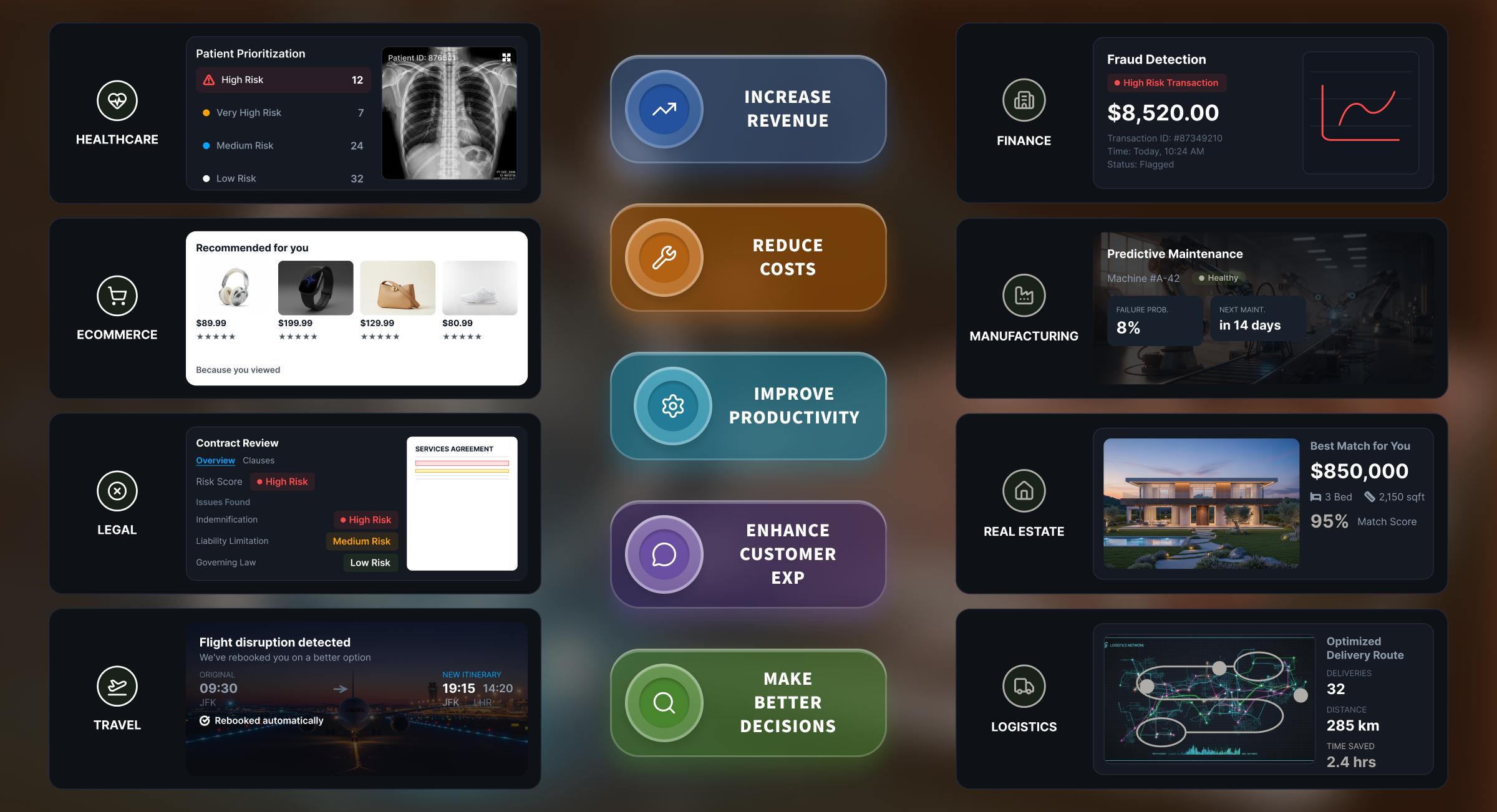
Industries like eCommerce, healthcare, real estate, finance, and logistics benefit most from AI agent frameworks. SMBs in these sectors can automate operations, improve customer experiences, and accelerate decision-making without significant technical overhead or investment.
How long does it take to build and deploy an AI agent?
A basic single-agent workflow can be prototyped in 1–2 weeks. A production-grade multi-agent system typically takes 4–12 weeks depending on workflow complexity, integration requirements, and the number of human-in-the-loop checkpoints needed. Intuz typically delivers an AI Proof of Concept within 2–4 weeks.
Which AI agent framework does Intuz recommend for SMBs?
For most SMBs, Intuz recommends starting with CrewAI for its accessibility, then layering in LangGraph as workflow complexity grows. For fintech businesses, OpenAgents is worth evaluating. For software development teams, MetaGPT offers unique advantages. The right framework always depends on your specific use case — which is why we offer a free consultation before making any recommendation.
How much does it cost to deploy an AI agent in production using these frameworks?
All five frameworks covered in this guide are open-source and free to use. The costs associated with AI agent deployment come from LLM API usage (e.g., OpenAI, Anthropic), cloud infrastructure, and development time. Across our 100+ deployments, monthly infrastructure costs for 1,000 requests/day range from $63 to $171 (with LangGraph and GPT-4o, plus complex toolchains). The biggest cost driver isn’t the framework — it’s your model selection. Switching from GPT-4o to Claude Haiku or Llama 3.1 70B can reduce costs 60-80% without significant accuracy loss for most use cases.
Which AI agent framework is most reliable in production?
Based on our 12-month uptime data across client deployments: LangGraph leads at 9/10 reliability (state checkpointing + explicit error handling), AutoGen scores 8/10 (mature error handling but more complex debugging), CrewAI scores 7/10 (improving rapidly but still has tool-call failure modes), All five frameworks can be made production-stable with the right observability layer (LangSmith, Langfuse, or custom telemetry) and circuit-breaker patterns. The choice of framework matters less than the reliability infrastructure you build around it.
Work with Intuz
Not Sure Which AI Agent Framework to Choose For Your Project?
Book 45-minute free consultation call with Intuz AI experts.
Let's Get Started
Share this article
![AI Agent Workflows: Top 5 Use Cases, Examples & Implementation Guide [2026]](https://www.intuz.com/wp-content/uploads/2026/04/AI-Agent-Workflows-Top-5-Use-Cases-Examples-Implementation.webp)


