



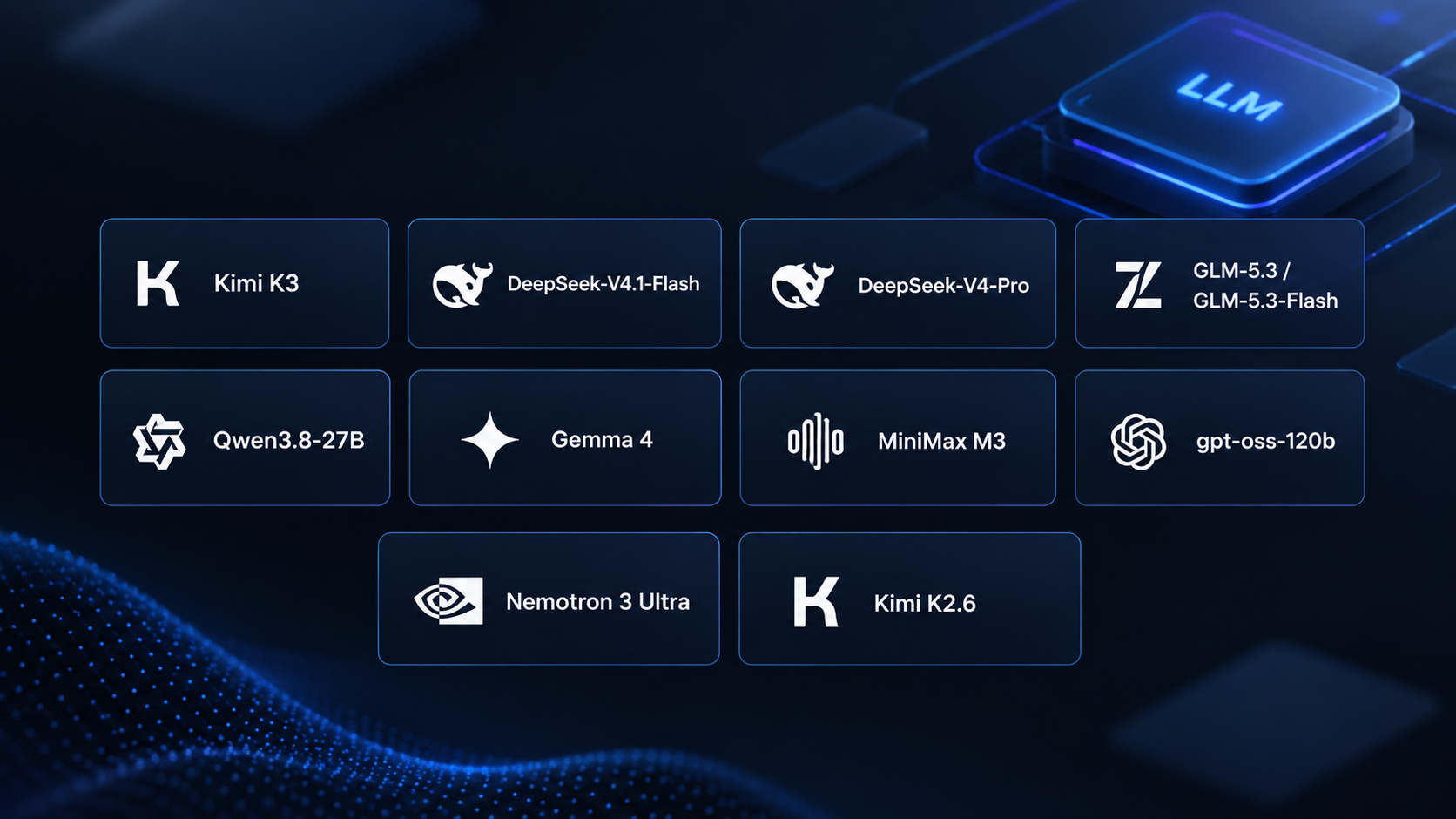
Most “best open source LLM” lists are written by companies that sell inference, so they end at “run it on our platform.” This guide is written for the person signing off on the build: a CTO, engineering lead or founder at a 20 to 500 person company who already has something running on GPT or Claude and wants to know if open models would cut cost, keep data in-house, or remove a single-vendor dependency.
As of October 2026, Kimi K3 is the strongest open-weight model overall. DeepSeek-V4.1-Flash gives the best quality per dollar. Qwen3.8-27B and Gemma 4 are the best picks if you need to run a model on a single GPU you control.
For most small and mid-sized businesses, the right question isn’t which model tops the leaderboard. It’s which license you can ship under, what hardware you can afford, and whether you should rent the model or host it.
Show
- Best overall: Kimi K3 (Moonshot AI). Top independent scores among open models, but the highest per-token price on this list.
- Best value: DeepSeek-V4.1-Flash. MIT license, about a twentieth of Kimi K3’s cost per task in independent testing.
- Best for long agent workflows: GLM-5.3, with GLM-5.3-Flash as the budget version.
- Best on a single GPU: Qwen3.8-27B (Apache 2.0, dense, 262K context).
- Best to run locally or on edge devices: Gemma 4 (Apache 2.0, sizes from 2B to 31B).
- Simplest license for commercial use: gpt-oss-120b and Gemma 4, both Apache 2.0.
How we built this guide: Intuz’s AI engineering team compiled specs from each model’s official Hugging Face card and license file, independent benchmark results from Vals AI and Epoch AI, and published pricing from inference providers.
The 10 best open source LLMs
These ten models come up across every serious ranking published in the last three months. The last column is our view on how practical each one is for a small or mid-sized business that doesn’t have a dedicated ML infrastructure team.
| Model | Developer | Size (total / active) | Context | License |
|---|---|---|---|---|
| Kimi K3 | Moonshot AI | 2.8T / 104B (MoE) | 1M | Kimi K3 License |
| DeepSeek-V4.1-Flash | DeepSeek | 552B backbone / 8B to 16B active | 1M | MIT |
| DeepSeek-V4-Pro | DeepSeek | 1.6T / 49B (MoE) | 1M | MIT |
| GLM-5.3 / GLM-5.3-Flash | Z.ai | 753B / 320B with 18B active | 1M | GLM-5.3 License |
| Qwen3.8-27B | Alibaba Qwen | 27B dense | 262K (1M with YaRN) | Apache 2.0 |
| Gemma 4 | 2B, 4B, 26B (3.8B active), 31B | 128K to 256K | Apache 2.0 | |
| MiniMax M3 | MiniMax | 428B / 23B (MoE) | 1M | MiniMax Community License |
| gpt-oss-120b | OpenAI | 117B / 5.1B (MoE) | 131K | Apache 2.0 |
| Nemotron 3 Ultra | NVIDIA | 550B / 55B (MoE) | 1M | OpenMDW-1.1 |
| Kimi K2.6 | Moonshot AI | 1T / 32B (MoE) | See model card | Modified MIT |
1. Kimi K3 – best overall
Moonshot AI’s 2.8-trillion-parameter mixture-of-experts model, with 104B parameters active per token, a 1M-token context window and native text, image and video input (model card)
Best for the hardest coding and multi-step agent work. In Vals AI’s independent testing it scored 57.81% on the Vals Index (8th of 43 models, open or closed) and 80.90% on Terminal-Bench 2.1.
Look for cost. Vals measured $6.38 per task on its index. Hosted pricing runs $2.70 per million input tokens and $13.50 per million output on Telnyx. The Kimi K3 License requires a visible “Kimi K3” credit in your UI once a product passes 100M monthly active users or $20M in monthly revenue.
Rent it through an API for the tasks that need it. Self-hosting a model this size isn’t realistic for most SMBs.
2. DeepSeek-V4.1 Flash – best value
A 552B-parameter model that activates only 8B parameters during prefill and 16B during decode, with a 1M context window, text and image input, and an MIT license.
Best for high-volume coding and agent workloads where cost matters. Vals measured $0.33 per task, about a nineteenth of Kimi K3’s cost, while still landing 2nd among open-weight models on Terminal-Bench 2.1.
Consider the gap between DeepSeek’s own numbers and independent ones. DeepSeek reports 90.6% on Terminal-Bench 2.1. Vals’ independent run measured 74.53%.
It is the default starting point for most SMB agent and automation projects. MIT means no license negotiation.
3. DeepSeek-V4-Pro – strongest DeepSeek for reasoning
1.6T total parameters, 49B active, 1M context, text only, MIT license, with three reasoning modes from fast to maximum depth. Useful for analysis-heavy tasks where you’d rather wait longer for a better answer.
Watch out for no image input. V4.1-Flash is newer and cheaper, so test it first and move up to Pro only where Flash falls short. So use it through an API when Flash isn’t good enough. Don’t self-host.
4. GLM-5.3 and GLM-5.3 Flash – best for long agent tasks
Z.ai’s 753B-parameter flagship with a 1M context window, plus a smaller Flash version (320B total, 18B active per Telnyx). GLM-5.3 reports 66.9% on DeepSWE v1.1 and 42.5% on SWE-Marathon, an hour-scale coding benchmark. Both figures are vendor-reported.
Best for Agents that run for a long time on one task, such as code migrations or multi-step back-office workflows.
Watch out for the license is not MIT. The GLM-5.3 License requires a security review before a company with more than $10B in annual revenue offers it as a model-as-a-service. That won’t affect an SMB, but your legal team will still want to read it.
GLM-5.3-Flash is one of the cheapest capable hosted options at $0.135 input and $0.45 output per million tokens on Telnyx.
5. Qwen3.8-27B – best for single-GPU self-hosting
A 27B dense model with text, image and video input, 262K native context (extendable to 1M), and an Apache 2.0 license (model card). Released August 2026.
Best for private deployments where data can’t leave your infrastructure: internal chatbots, document Q&A, coding assistants. Qwen reports 61.7 on SWE-bench Pro and 84.3 on OSWorld (computer use), both vendor numbers.
Watch out for thinking mode is on by default, which adds latency and tokens. Turn the reasoning effort down for simple tasks. The best self-hosting choice for most SMBs. One GPU, a permissive license, and support in Ollama, llama.cpp, vLLM and SGLang.
6. Gemma 4 – best to run locally
Google’s family of four models released April 16, 2026 under Apache 2.0: E2B and E4B for phones and edge devices, a 26B mixture-of-experts with 3.8B active, and a 31B dense model. All support function calling and structured JSON output.
Best for offline or on-device use, and fine-tuning on your own data. It’s not a frontier agent model. Don’t expect Kimi K3 results on complex coding. The easiest way to put a capable model on a laptop or a single GPU. For a deeper look at models this size, see our guide to small language models.
7. MiniMax M3 – strong, but read the license
428B total, 23B active, 1M context, text, image and video input. Best for agent work and multimodal input at a low hosted price ($0.27 input, $1.10 output per million tokens on Telnyx).
Watch out for MiniMax Community License. Any commercial use requires a one-time notice to MiniMax under $20M in annual revenue, prior written authorization above it, and a visible “Built with MiniMax M3” credit. Fine if you’re comfortable with the notice and attribution. Otherwise pick DeepSeek or Qwen.
8. gpt-oss-120b – simplest license, one GPU
OpenAI’s open-weight model, 117B total and 5.1B active, Apache 2.0, released August 7, 2025. It runs on a single 80 GB GPU such as an NVIDIA H100. Best for fast, cheap general reasoning and tool use. Fireworks measured it as the fastest model in its July 2026 comparison at 271.4 tokens per second.
It’s over a year old and trails the 2026 models on hard benchmarks. It also needs OpenAI’s “harmony” prompt format to work correctly. A safe, legally simple choice when speed matters more than peak quality.
9. Nemotron 3 Ultra: most transparent
NVIDIA’s 550B model with 55B active, 1M context, text only, released June 4, 2026 under OpenMDW-1.1, which discloses training data and recipes. Best for organizations that have to document what their model was trained on, such as regulated industries or public-sector vendors.
Watch out for size. It needs a multi-GPU cluster to self-host. Worth it only if training-data transparency is a hard requirement.
10. Kimi K2.6: best for real-time voice
Moonshot’s previous-generation 1T mixture-of-experts model with 32B active, released April 2026. Best for voice agents, where time to first token matters more than a few benchmark points.
It’s a generation behind Kimi K3 on reasoning. A good fit for phone and voice automation projects. Meta’s Llama 4 (Scout and Maverick) is still widely deployed, and Scout’s 10M-token context is unusual.
It has been passed on benchmarks by the 2026 releases above, and its Llama 4 Community License adds conditions for very large companies, so we left it out of the top ten.
Which open source LLM fits your business workload
Start from the job the model has to do, then check license and hardware. These are starting shortlists for the most common SMB AI projects.
| Workload | Start with | Why | Step up to |
|---|---|---|---|
| Customer support chatbot over your own docs (RAG) | Qwen3.8-27B | One GPU, Apache 2.0, long context for retrieved documents | DeepSeek-V4.1-Flash via API |
| Document extraction (invoices, forms, scanned records) | Qwen3.8-27B or Gemma 4 31B | Both accept image input and run on hardware you control | Kimi K3 for messy, multi-page layouts |
| Workflow automation agents (CRM, ERP, back office) | DeepSeek-V4.1-Flash | Low cost per task, MIT license, strong tool use | GLM-5.3 for long-running tasks |
| Internal coding assistant | DeepSeek-V4.1-Flash | Strong independent coding scores at low cost | Kimi K3 for the hardest tasks |
| Voice and phone agents | Kimi K2.6 | Low latency matters more than peak reasoning | Test GLM-5.3-Flash |
| Regulated data (healthcare, finance, legal) | Self-hosted Qwen3.8-27B, Gemma 4 or gpt-oss-120b | Data never leaves your environment; permissive licenses | Nemotron 3 Ultra if you must document training data |
| Offline or on-device apps | Gemma 4 E2B or E4B | Built for phones and edge hardware | Gemma 4 26B on a workstation |
One caution for regulated industries: self-hosting keeps patient or client data inside your environment, but it doesn’t make you HIPAA or GDPR compliant on its own. You still need access controls, audit logs, encryption, and a business associate agreement with whoever hosts your infrastructure.
Our guides to building a private LLM and building an AI agent on on-prem data with RAG cover the architecture.
Which licenses let you ship without asking
For almost every SMB, every model on this list can be used commercially. What differs is the paperwork. The table sorts them from least to most friction, based on each model’s license file.
| License | Models | Commercial use | What you must do |
|---|---|---|---|
| Apache 2.0 | Qwen3.8-27B, Gemma 4, gpt-oss-120b | Yes | Keep the license and notices |
| MIT | DeepSeek-V4.1-Flash, DeepSeek-V4-Pro | Yes | Keep the copyright notice |
| OpenMDW-1.1 | Nemotron 3 Ultra | Yes | Follow the license terms |
| GLM-5.3 License | GLM-5.3, GLM-5.3-Flash | Yes | Keep notices. Security review only if you exceed $10B in annual revenue and sell it as a model service |
| Kimi K3 License | Kimi K3 | Yes | Show “Kimi K3” in your UI above 100M monthly users or $20M monthly revenue. Separate agreement for model-as-a-service businesses above $20M in 12-month revenue. Internal use is exempt |
| MiniMax Community License | MiniMax M3 | Yes, with notice | Email MiniMax before commercial use (written approval above $20M annual revenue) and display “Built with MiniMax M3” |
Cost of open-source LLMs – rent, dedicate or self-host
There are three ways to run an open model, and for a typical SMB workload a hosted API is cheaper than self-hosting by an order of magnitude.
| Option | How you pay | You manage |
|---|---|---|
| Hosted API (serverless) | Per million tokens | Prompts and integration |
| Dedicated endpoint | Per GPU-hour, reserved for you | Prompts and integration; provider runs the servers |
| Self-hosted (your cloud or on-prem) | GPU rental or purchase, plus engineering time | Everything: serving, scaling, security, upgrades |
Let’s take example, take a support chatbot handling 50,000 conversations a month, averaging 3,000 input tokens (question plus retrieved documents) and 500 output tokens each. That’s 150 million input and 25 million output tokens a month.
| Setup | Monthly cost |
|---|---|
| GLM-5.3-Flash, hosted API | $31.50 |
| DeepSeek-V4.1-Flash, hosted API | $75.00 |
| Qwen3.8-27B, hosted API | $135.00 |
| Kimi K3, hosted API | $742.50 |
| Qwen3.8-27B, self-hosted on one H100, running 24/7 | $2,110 to $5,022 |
The self-hosted line excludes engineering time, monitoring and redundancy, all of which add to it. On these numbers, self-hosting Qwen3.8-27B only matches the hosted API price at around 780,000 conversations a month, assuming one GPU can carry that load, which you’d need to test.
When an SMB shouldn’t use an open model
Open models aren’t automatically the cheaper or safer choice. A closed API like GPT or Claude is often the better call when:
- Your volume is low. At a few thousand requests a day, the cost difference between a closed API and a hosted open model is small next to the engineering time spent switching.
- You need the very best quality right now. By Epoch AI’s measure, open models trail the closed frontier by about four months. If your use case only works at the frontier, that gap matters.
- Nobody on your team will own it. A self-hosted model needs someone to patch it, monitor it and upgrade it when a better model ships, which in 2026 has been every few weeks.
- You’re still proving the use case. Validate the workflow on whatever model is fastest to integrate. Optimize the model choice once you know the project is worth it.
The hybrid approach works well for many SMBs: route routine, high-volume requests to a cheap open model, and send the hard cases to a closed frontier model. You get most of the savings without giving up quality where it counts.
If you’re building agents on top of the model, our comparison of AI agent frameworks covers the orchestration layer.
Build on open models with Intuz
Intuz is an AI development company that helps small and mid-sized businesses build AI into their products and operations. We don’t sell inference, so we don’t have a model or a platform to push. Our job is to pick what fits your workload, license constraints and budget, and then build the system around it.
We can help you:
- Shortlist two or three models and test them against your own data
- Decide between a hosted API, a dedicated endpoint or a private deployment, with a cost estimate for each
- Build the retrieval, agent and integration layers that connect the model to your CRM, ERP or document stores
- Set up evaluation, guardrails and monitoring so you can swap models as better ones ship
Talk to our AI team about which open model fits your project.
FAQs
Should we build on an open source LLM or a closed API like GPT or Claude?
It depends on three things: where your data is allowed to go, how many requests you’ll run, and how much quality you need. Choose open models when data must stay in your environment or volume is high. Choose a closed API when volume is low or you need frontier quality. Many production systems use both, routing routine requests to an open model and hard cases to a closed one.
Can we switch from OpenAI to an open source model without rebuilding our app?
Usually, yes. Most inference providers, including Telnyx and Morph, serve open models through OpenAI-compatible APIs, so the integration code barely changes. What does change is model bCan we switch from OpenAI to an open source model without rebuilding our app? Prompts, tool-call formats and output parsing need retesting; gpt-oss-120b, for example, requires OpenAI’s harmony format. Plan for an evaluation round, not a rewrite.
Should we fine-tune an open source model or use RAG?
Start with retrieval-augmented generation (RAG) when the model needs your company’s knowledge, such as policies, product data or past tickets. That knowledge changes, and RAG updates without retraining. Fine-tune when you need a consistent output format, a specialist vocabulary or a narrow task done cheaply on a smaller model. Many projects end up using both.
Can an open source LLM connect to our CRM, ERP or EHR?
Yes, through tool calling. The model decides which function to call, and your code runs the actual query or update against the system. Gemma 4, Qwen3.8 and the DeepSeek, GLM and Kimi models all support function calling. The Model Context Protocol (MCP) is now a common way to expose business systems to models; see our list of MCP servers.
What does it take to put an open source LLM into production?
Four stages: an evaluation on your own data to pick the model, integration with your systems and data sources, hardening (guardrails, monitoring, fallback routing, access control), and a rollout with a plan for upgrades. Most of the effort sits in integration and hardening, not in choosing the model.
How much does an open source LLM project cost?
Think of it as two separate budgets. Running costs can be small: a support chatbot handling 50,000 conversations a month costs roughly $30 to $750 a month through a hosted API, depending on the model. Build costs depend on how many systems the model connects to, how much data prep is needed, and your compliance requirements.
Is it safe to use Chinese open models like DeepSeek, Qwen, Kimi or GLM?
The weights themselves don’t send data anywhere. If you self-host them, or call them through a provider running in your region, your data stays with you and that provider. The risk comes from calling the developer’s own hosted API, which sends prompts to their servers. Also check your customers’ procurement rules, since some regulated and public-sector buyers restrict models by country of origin.
Which open source LLM is best for healthcare and HIPAA workloads?
Pick a model you can self-host under a permissive license, such as Qwen3.8-27B, Gemma 4 or gpt-oss-120b, so patient data stays in your environment. No model is HIPAA compliant by itself. Compliance comes from the system around it: access controls, audit logs, encryption, de-identification where possible, and a business associate agreement with your infrastructure provider.
Is our data safer with a self-hosted model?
It stays in your control, which is different from safer. You remove the third-party provider from the data path, but you take on patching, access control and monitoring yourself. Self-hosted models are still exposed to prompt injection, so input filtering and output checks matter as much as where the model runs.
Can we use open source LLMs commercially?
Yes. Every model in this guide permits commercial use. Apache 2.0 (Qwen, Gemma, gpt-oss) and MIT (DeepSeek) add no extra conditions. Kimi K3, GLM-5.3 and MiniMax M3 have custom licenses with attribution, notice or revenue-threshold terms, so have counsel read them before you ship.
Work with Intuz
Confused Which Open-source Model Fits Your Use Cases?
Book free 45-minutes consultation call with our AI experts.
Let's Get Started
Share this article