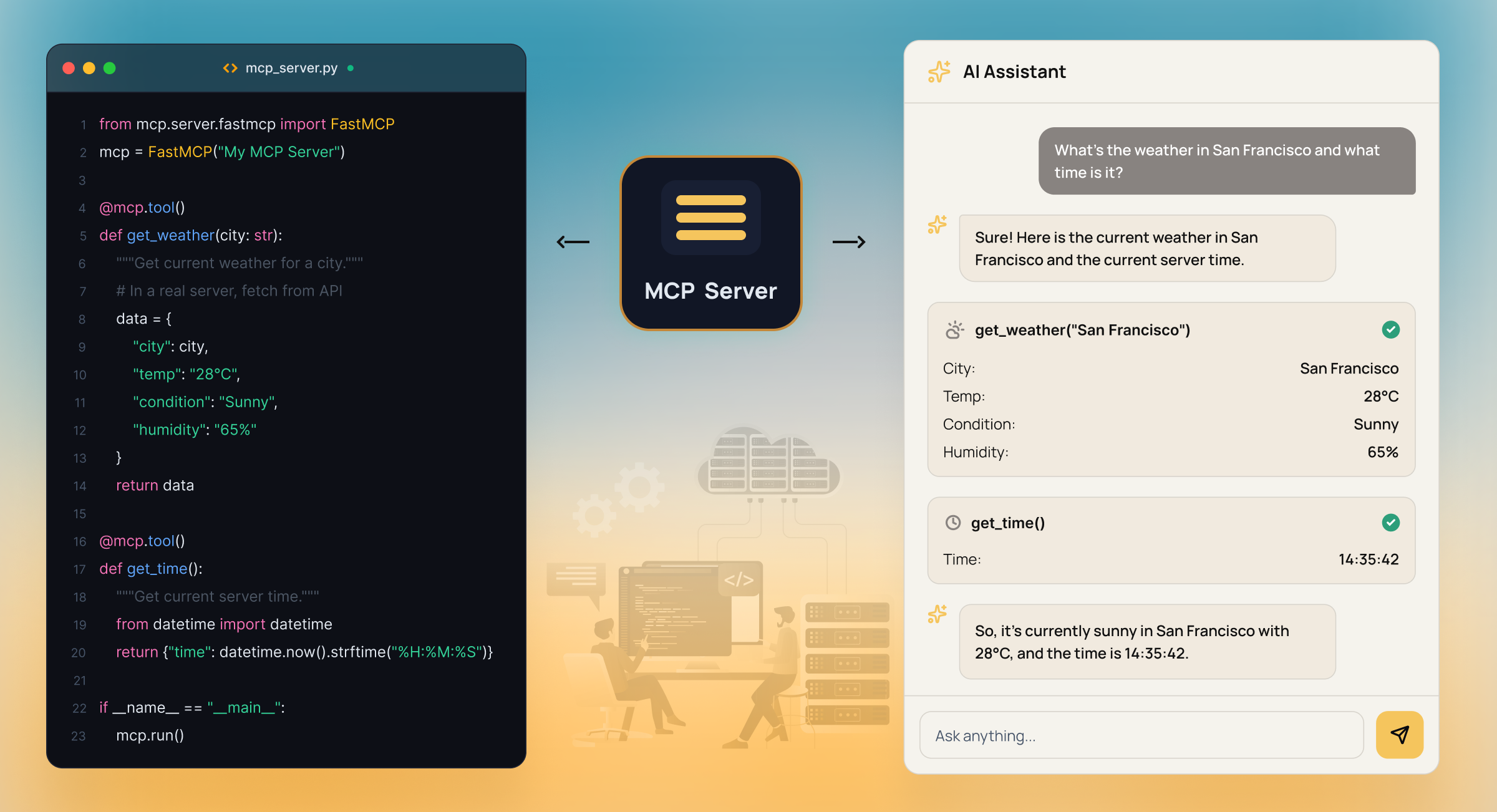



At Intuz, we’ve helped mid-market companies unify disconnected systems into intelligent automation environments. This guide explores the 10 best MCP servers shaping AI development— each vetted for scalability, integration simplicity, and cost-effectiveness for small and medium businesses.
In 2026, the leading MCP server development companies in the USA are Intuz (best for SMBs and SaaS), Klavis AI (AI-native products), Bitontree (platform modernization), LeewayHertz, Simform, Edvantis, Rapid Innovation, and Accenture (enterprise scale). The best choice depends on company size, security requirements, timeline, and budget.
For businesses, the challenge has never been building AI models — it’s about connecting them effectively to internal data, APIs, and real-world systems without ballooning costs or hiring a team of machine learning engineers.
Show
- MCP servers eliminate fragmented AI integrations by providing a standardized protocol that lets AI agents connect with internal data, APIs, and real-world systems without requiring a team of ML engineers.
- The 10 best MCP servers span four categories — Core Orchestration (Bedrock, Context7, GPT Researcher, Cloudflare), Developer/Automation (GitHub, n8n, Playwright), and Data/Knowledge Management (Qdrant, PostgreSQL, MindsDB) — each suited to different business needs.
- SMBs benefit most from open-source and freemium options like Context7, n8n, Qdrant, and GitHub MCP, which offer cost-effective entry points with solid scalability.
- Security and compliance are built into the top enterprise picks — Amazon Bedrock AgentCore and Cloudflare Remote MCP enforce granular IAM policies, zero-trust tunneling, and DDoS-resistant deployments for regulated industries.
- Intuz’s integration methodology follows a four-step approach — Assess workflow needs → Configure the right MCP stack → Build secure connectors → Orchestrate and automate — designed specifically for SMBs entering contextual automation.
| Server Name | Category | Best For | Licensing |
|---|---|---|---|
| Amazon Bedrock AgentCore MCP | Orchestration | Scalable enterprise-grade agent environments | Usage-based |
| Context7 MCP | Context Management | Multi-agent collaboration for startups | Open-source |
| GPT Researcher MCP | AI Reasoning | Autonomous research workflows | Community |
| Cloudflare Remote MCP | Edge Orchestration | Global, secure automation | Freemium |
| GitHub MCP Server | Dev Automation | CI/CD integration | Open-source |
| n8n MCP Server | Workflow Automation | No-code AI orchestration | Freemium |
| Playwright MCP | Testing Automation | AI-driven testing pipelines | Open-source |
| Qdrant Vector MCP | Vector DB | RAG memory and semantic similarity | Open-source |
| PostgreSQL MCP | SQL Integration | Legacy data management with modern AI | Self-hosted |
| MindsDB MCP | Predictive DB | Machine-learning-enabled queries | Open-source |
So, let’s explore in-depth top 10 best MCP servers for AI development category wise.
Core AI Agent Orchestration & Context Management Servers
1. Amazon Bedrock AgentCore MCP Server
Amazon’s Bedrock AgentCore is the enterprise anchor of MCP-based orchestration. Integrated into AWS’s Bedrock ecosystem, it acts as a context manager, routing queries, maintaining multi-session memory, and assigning actions between agents and data sources.
Key Features
- Native support for Claude, Titan, and Llama models
- Context streaming across Bedrock endpoints
- High-security parameters with granular IAM policies
- Zero-infrastructure management on AWS
Use Cases
- AI-driven support desks integrated with CRM
- Multi-agent orchestration across workflows
- Intelligent chatbot with recall of historical context
- Context-sensitive business analytics
Advantages
- Enterprise-grade scalability and reliability
- Tight integration with LangChain-like tools
- Excellent for compliance-heavy industries
Limitations
- Vendor lock-in with Amazon Web Services
- Cost increases with volume
- Requires AWS expertise
2. Context7 MCP
A rising star in the open-source MCP landscape, Context7 was designed for developers building custom, lightweight multi-agent systems.
Key Features
- Stateless and stateful context caching
- Multi-LLM compatibility (OpenAI, Anthropic, Mistral)
- Built-in plugin environment for external API calls
- Cloud-hosted or local deployment options
Use Cases
- Custom micro-agent systems for small-scale automation
- Prototyping AI-enabled support flows
- Academic and research environment orchestration
Advantages
- Easy to deploy and highly configurable
- Works seamlessly across multiple LLM APIs
- Ideal for startups or innovation teams
Limitations
- Limited documentation
- Scaling requires manual configuration
- Small developer community
3. GPT Researcher MCP
Built for autonomous research, GPT Researcher MCP is engineered for agents that browse, summarize, and synthesize information independently.
Key Features
- Modular research pipelines with deep web integration
- Autonomous context refreshing
- Semantic file handling and knowledge graph creation
- Configurable reasoning depth
Use Cases
- Automating literature reviews or domain-specific research assistants.
- Generating detailed, source-backed reports from large corpora.
- Multi-agent orchestration in scientific, legal, or technical domains.
- Building workflows where an agent stages partial results and revisits them later.
Advantages
- Extremely powerful for data-rich environments
- Ideal for advanced reasoning tasks
- Integrates with local or cloud data stores
Limitations
- Complex initial configuration
- High compute resource consumption
- Overkill for simple chatbot use cases
4. Cloudflare Remote MCP
Cloudflare’s MCP offering opens a new frontier — edge orchestration for AI agents. It distributes computation and contextual data flows across the edge network, improving latency and privacy.
Key Features
- DDoS-resistant deployment
- Zero-trust tunneling for data flows
- Edge-cached agent responses for speed
- Domain-level AI context routing
Use Cases
- AI web assistants with sub-50ms response
- Privacy-first agent clusters
- Global automation workflows for SaaS SMBs
Advantages
- Lightning-fast data access and routing
- Ideal for global SaaS systems
- Edge security-first design
Limitations
- Documentation is still evolving
- Limited real-world case studies
- Configuration is slightly technical
Developer & Automation MCP Servers
5. GitHub MCP Server
GitHub’s MCP implementation lets agents execute, test, and commit code changes autonomously inside repositories — a major leap for DevOps automation.
Key Features
- AI-triggered PR suggestions
- Workflow integration with Actions & Codespaces
- Role-based access and audit logging
- Multi-agent code collaboration models
Use Cases
- Autonomous code reviews
- Error detection and test suite execution
- Automated version and patch management
Advantages
- Natively integrated with GitHub tools
- Supports automation and governance
- Great for software SMBs or agencies
Limitations
- Dependent on GitHub stack
- Requires robust CI/CD setup
- Token limits for open-source plans
6. n8n MCP Server
Bridging low-code/no-code automation with AI, n8n’s MCP server lets agents trigger workflows, integrate systems, and orchestrate logic flows.
Key Features:
- Expose n8n workflows as MCP tools.
- Parameterize workflows dynamically via agent input.
- Chain automations (e.g. fetch data → transform → update).
- Combine agent reasoning with enterprise logic flows.
Use Cases:
- Agents triggering business workflows (e.g. marketing emails, notifications).
- Orchestrating multi-step internal processes (CRM, ERP updates) via AI logic.
- Handling conditional logic in pipelines where agents decide which path to call.
- Replacing manual triggers with intelligent, context-driven automation.
Advantages
- Low barrier integration to internal systems
- Rapid prototyping of AI + automation flows
- Good for SMB business logic automation
- Allows agents to “do work” beyond reasoning
Limitations
- Less suited for high-throughput transactional use
- Potential orchestration failure points
- Monitoring and error handling must be robust
- Workflow design complexity increases
7. Playwright MCP Server
Playwright MCP brings browser-level automation to AI — a game changer for testing and repetitive UI-based tasks.
Key Features
- Multi-browser parallel test execution
- AI-guided test scenarios
- Assertions driven by model context (adaptive testing)
- Built-in result analytics
Use Cases
- Automated website testing and monitoring
- AI-powered E2E test creation
- User behavior simulation for UX validation
Advantages
- Drastically speeds up testing cycles
- Excellent for QA and automation companies
- Integrates naturally with CI pipelines
Limitations
- Heavy on environment setup
- Requires developer onboarding
- Overhead for simple agents
Data & Knowledge Management MCP Servers
8. Vector Search MCP Server (Qdrant)
Qdrant powers context memory across agent frameworks using high-performance vector similarity search. Its MCP wrapper lets agents recall semantically similar data or documents instantly.
Key Features
- High-speed vector search API
- Horizontal scalability
- Secure data storage (encryption in transit)
- Integrates with embeddings frameworks (OpenAI, Cohere, Bedrock)
Use Cases
- Retrieval-Augmented Generation (RAG)
- Multi-agent shared knowledge store
- Semantic search in customer service AI systems
Advantages
- Excellent semantic recall accuracy
- Open-source and cost-effective
- Scales with minimal latency impact
Limitations
- Initial setup can be heavy
- Requires embedding management
- Needs infrastructure oversight
9. PostgreSQL MCP Server
PostgreSQL remains the workhorse of data systems. Its MCP server extensions bridge structured datasets and logical querying with AI context construction.
Key Features
- Native SQL query-to-language-model translation
- Transaction-safe contextual calls
- Supports schema-aware data reasoning
- Integration with cloud DBs (Supabase, Neon, RDS)
Use Cases
- Data-driven AI dashboards
- Contextual sales or inventory chatbots
- Real-time ERP/CRM automation
Advantages
- Widely adopted and well-documented
- Strong for regulated domains
- Integrates easily into any stack
Limitations
- Less optimized for unstructured data
- Scalability depends on DB tuning
- Requires query optimization expertise
10. MindsDB MCP Server
MindsDB acts as a unified data gateway for AI models, enabling federated queries over structured and vector stores via MCP.
Key Features:
- Federated query support across SQL, vector, and application data sources.
- Automatic embedding generation and vector store integration.
- Composite AI operations — multi-source joins, hybrid queries.
- Security, observability, and governance baked in.
Use Cases
- Sales prediction engines
- Supply chain optimization
- Dynamic anomaly detection in operations
Advantages
- Low-code SQLML interface
- Broad connector availability
- Predictive AI in-database
Limitations
- Still maturing feature set
- Moderate community documentation
- Best for analytic data-heavy orgs
How Intuz Helps Integrate MCP Servers into Your AI Workflows
While each MCP server serves a different purpose, value emerges when they’re intelligently orchestrated. That’s where Intuz steps in.
1. Assess Your AI Workflow Needs
Our experts begin by mapping your existing business logic, data flow, and user interactions — identifying where contextual AI can automate understanding and decision-making.
2. Consult and Configure Relevant MCP Servers
We help you choose the right MCP stack — mixing lightweight, open-source tools (like n8n or Qdrant) with enterprise-grade orchestrators (like Bedrock or Cloudflare Remote) that fit your budget, scale, and compliance needs.
3. Build Secure and Scalable Connectors
Our development team builds MCP adapters that integrate with your CRMs, data APIs, or third-party systems — ensuring privacy, encryption, and seamless communication between your apps and AI contexts.
4. Orchestrate and Automate AI Workflows
Finally, we connect the dots — unifying all MCP servers into an intelligent ecosystem that helps your bots, data, and decision systems collaborate autonomously with minimal maintenance.
Final Thoughts
By 2025, the companies embracing MCP-based architectures won’t just operate faster — they’ll learn faster. For small & mid-sized businesses, this means every process, from customer support to logistics, becomes self-improving and AI-enabled.
If your business is looking to leap into contextual automation, building MCP servers is your most strategic next move.
Schedule a 45-minutes free consultation to discover which MCP stack best fits your business objectives and architecture.
FAQs
How does MCP server integration simplify AI workflow automation?
MCP servers link AI agents with enterprise data, tools, and external APIs—removing manual context switching and enabling LLM-driven workflows. SMBs benefit by automating process orchestration, reducing deployment times, and unlocking real-time context updates, all without deep-code integration—making advanced AI automation feasible at lower costs.
Which MCP server offers the fastest setup for AI agent orchestration in existing business environments?
n8n MCP stands out for rapid deployment, thanks to its low-code node editor and 400+ built-in integrations. SMBs can visually connect AI agents to CRMs, emails, and internal databases, accelerating workflows without the need for custom code—typically achieving operational MVPs in under a week.
What security measures are critical when deploying MCP servers for sensitive operations?
Top MCP servers like Amazon Bedrock AgentCore and Cloudflare Remote enforce microservice-level access control, encrypted API tunnels, and automated audit logging. For SMBs, securing agent communication, restricting data retrieval, and monitoring session integrity are vital steps in protecting intellectual property and customer data during MCP integration.
How do MCP servers improve retrieval-augmented generation (RAG) accuracy for AI agents?
Vector-based MCP servers like Qdrant enable AI agents to quickly retrieve semantically similar records from enterprise knowledge bases, enhancing contextual accuracy and relevance. This RAG approach boosts agent performance in support, search, and research scenarios, enabling nuanced answers and context-dependent automation without costly retraining cycles.
Can MCP servers orchestrate AI workflows across hybrid cloud and on-premise systems?
Yes—Cloudflare Remote MCP and PostgreSQL MCP are built to route agent context securely across both cloud and on-premise environments. SMBs gain unified, dynamic AI workflows that can access real-time data regardless of its location, supporting compliance, scalability, and integration continuity in diverse IT infrastructures.
Work with Intuz
Scale AI With the Right MCP Stack
Tell us your use case—we'll match you to the best MCP setup.
Let's Get Started
Share this article
![Top MCP Server Development Companies in USA [2026]](https://www.intuz.com/wp-content/uploads/2026/05/Top-MCP-Server-Development-Companies-in-USA-2026.svg)