


Looking for workflow automation experts? Explore the top 9 development companies in the USA and choose the right partner.
Manual workflows are more than just inefficient; they are a direct drain on your bottom line, costing companies up to 30% of their revenue annually in lost productivity. AI-powered workflow automation offers a powerful solution, promising to slash operational costs, reduce errors, and deliver impressive ROIs.
But there’s a critical catch: the success of any automation initiative hinges entirely on the quality of its implementation. A poorly chosen partner can lead to a failed project, wasted resources, and complex systems that create more problems than they solve.
Choosing the right development firm is the single most important decision you’ll make. You need a partner who can do more than just connect applications—you need one who understands process engineering, AI-driven logic, and how to deliver measurable business outcomes.
This guide cuts through the noise. We’ve analyzed the top workflow automation development companies in the USA, ranking them based on their technical depth, proven ROI, and ability to build scalable, intelligent systems for businesses like yours.
Show
- The workflow automation market is projected to grow from $27.91 billion in 2026 to $65.26 billion by 2034 (CAGR: 11.2%), signalling massive demand for capable development partners.
- Manual workflows cost businesses 20–30% in lost efficiency (Gartner), while AI-driven automation cuts operational costs by up to 40% and delivers average ROIs of 284% within three years (Nucleus Research).
- Rankings are based on 50+ data points from Clutch, G2, and 2025–2026 client testimonials — prioritising AI-first technical depth and verifiable ROI outcomes.
- The shift from legacy RPA to AI-powered agentic automation is driving dramatic performance improvements, with AI-based automation delivering up to 250–300% ROI in some enterprise implementations.
- Intuz ranks #1 for AI-driven automation due to its LLM decision logic integration, transparent PoC pricing ($15K–$40K), and post-deployment monitoring included as standard — factors most firms overlook.
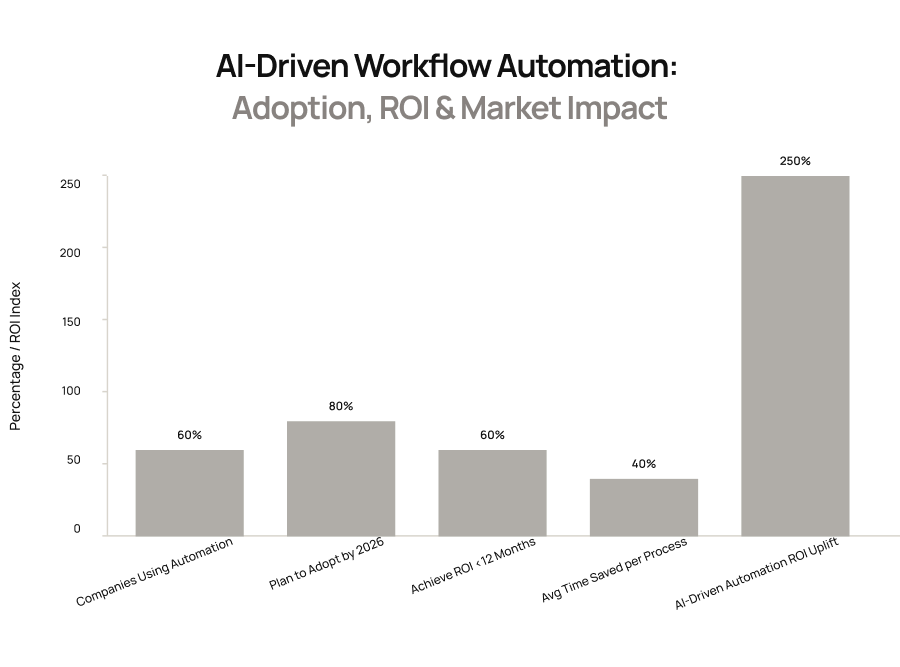
AI-Driven Workflow Automation: Adoption, ROI & Market Trends
To ground decision-makers in real data, here are current workflow automation trends and outcomes shaping enterprise investment:
Adoption & Market Growth
- Approximately 60% of U.S. companies use workflow automation in at least one department, though only ~4% have achieved fully hands-free operations.
- The workflow automation market is valued at ~$24–26 billion in 2025 and expected to grow steadily by 2030.
- An estimated 80% of organizations plan to adopt intelligent automation by 2025, highlighting rapid enterprise interest.
ROI & Efficiency
- Companies deploying automation see ROI within 12 months in ~60% of cases, with many reporting 30–200% returns in the first year.
- Workforce impact: Most organizations report 10–50% time savings and significant reductions in manual errors.
Technology Shift
- The shift from legacy robotic process automation (RPA) to AI-powered agentic automation is driving dramatic performance improvements — with AI-based automation delivering up to 250–300% ROI in some enterprise implementations.
What is Workflow Automation Development? — And Why Off-The-Shelf Tools Aren’t Enough
Workflow automation technology automates business processes, but the approach you take—using an off-the-shelf tool or commissioning custom development—determines its ultimate impact.
Off-the-Shelf Platforms (e.g., Zapier, Make) are ideal for simple, linear tasks and connecting modern SaaS applications. They are perfect for rapid experiments and empowering non-technical teams to automate their own workflows.
However, they fall short when business needs become more complex. Custom development is required for workflows involving:
- Legacy Systems: Off-the-shelf tools rarely have connectors for older, on-premise, or bespoke software.
- Complex Logic & Exception Handling: When a process has multiple decision branches, requires contextual data, or needs to handle frequent exceptions, custom AI logic is necessary.
- Enterprise Security & Compliance: Custom solutions can be built to meet strict security standards (like SOC 2 or HIPAA) and provide detailed audit trails that platforms cannot.
- Scalability & Performance: High-volume or mission-critical workflows demand a robust, scalable architecture that can only be achieved through custom development.
A skilled development partner doesn’t just connect apps; they engineer a resilient, intelligent system that becomes a core operational asset.
Explore Services
AI Automation Services Built to Run Your Business, Not Just Demo ItHow These Companies Were Ranked
Our ranking draws from 50+ data points across Clutch, G2, and 2025–2026 client testimonials, focusing specifically on US SMB and mid-market needs. Companies were evaluated on:
- AI Expertise & Tech Stack: Mastery of n8n, Zapier, Make.com, LangChain; custom AI agents for on-prem or cloud deployment
- Client ROI & Case Studies: Verifiable 200%+ returns, particularly for ecommerce and SaaS automations with quantifiable outcomes
- Scalability & Customisation: No-code/low-code for rapid scaling; deep Shopify, Salesforce, and ERP integrations
- Team & Track Record: 10+ years experience, US market presence, agile delivery cycles under 3 months
- Pricing Transparency & Support: $50K–$200K project ranges, clear SLAs, and documented post-launch support
Top 9 Workflow Automation Development Companies in USA
| Rank | Company | Best For | Automation Focus | Notable |
|---|---|---|---|---|
| 1 | Vention | Large enterprises with complex automation needs | AI/ML engineering, enterprise system automation | 3,000+ engineers globally |
| 2 | ScienceSoft | Enterprises needing governance and secure automation | BPA consulting, RPA, AI-assisted systems | Founded 1989; Microsoft, AWS, Oracle partner |
| 3 | Intuz | SMBs and mid-market seeking fast automation ROI | End-to-end + AI-driven automation, no-code/low-code (Zapier, Make, n8n) | US-based; 15+ yrs; 1,700+ solutions delivered |
| 4 | Bitcot | Teams using SaaS tools needing cross-tool workflows | No-code/low-code, AI decision automation, CRM/ERP/API integration | — |
| 5 | Imaginovation | Custom software with workflow integration | Custom RPA, AI decisioning, BI automation | 5-star rated |
| 6 | Wildnet Edge | AI-centric automation initiatives | AI-native automation, data analytics, app engineering | AI-native digital transformation focus |
| 7 | Quickway Infosystems | Automation built directly into custom software | AI/ML automation, cloud/DevOps, API integration | — |
| 8 | Biz4Group LLC | AI-led workflow automation | AI workflow automation, chatbots, process orchestration | Orlando-based |
| 9 | Boltflow | Startups and SMBs needing rapid automation | No-code/low-code design (Bubble, Zapier), CRM automation | No-code/low-code agency |
Rankings reflect our 50+ data-point methodology across AI expertise, client ROI, scalability, track record, and pricing transparency.
1. Vention
Vention is a global software engineering firm with 3,000+ engineers, known for custom software, AI, and automation projects. While not exclusively a workflow automation boutique, its engineering and integration expertise helps clients build scalable automation solutions as part of larger digital transformation efforts.
Services Offering:
- AI, machine learning, and automation engineering
- Workflow integration
- Enterprise system automation support
Case Studies:
- EliseAI – Built an AI-driven assistant that automated 90% of routine leasing and communication workflows for EliseAI, enabling 24/7 responses across channels. This automation boosted conversions by 125% and freed up leasing teams to focus on high-value tasks.
- Motum – Vention integrated AI-powered car damage detection and automated notifications into motum’s fleet management platform. The result was a 65% reduction in claim processing time and improved operational efficiency for thousands of vehicles.
Best For:
- Large enterprises with complex automation needs
- Cross-domain automation + custom engineering projects
- Integration across multiple platforms and stacks
2. ScienceSoft
ScienceSoft is a long-standing IT consulting and software development company (since 1989) with deep capabilities in business process automation, enterprise workflow design, and automation strategy backed by ISO certifications and partnerships with Microsoft, AWS, and Oracle.
Services Offering:
- Business process automation consulting and implementation
- Workflow and RPA solutions
- Automation design, orchestration, and performance monitoring
- Data-driven and AI-assisted automation systems
Case Studies:
- Bank BPM System: Multi-functional process automation for a bank with $7.5B assets
- SharePoint Intranet Automation: Automated workflows and collaboration for enterprise teams
Best For:
- Enterprises needing governance and secure automation
- Complex, industry-specific process automation
- Organizations with high compliance requirements
- End-to-end automation projects aligned with IT strategy
3. Intuz
Book a Free AI ConsultationIntuz is a US-based AI-first development company with 15+ years of experience, and 1700 + delivered digital solutions globally. The company has helped businesses automate core workflows, reducing operational costs by up to 40% and improving process turnaround time by 2–5× through AI-driven and low-code automation.
Services Offering:
- End-to-End Workflow Automation Consulting
- AI-driven workflow and process automation development
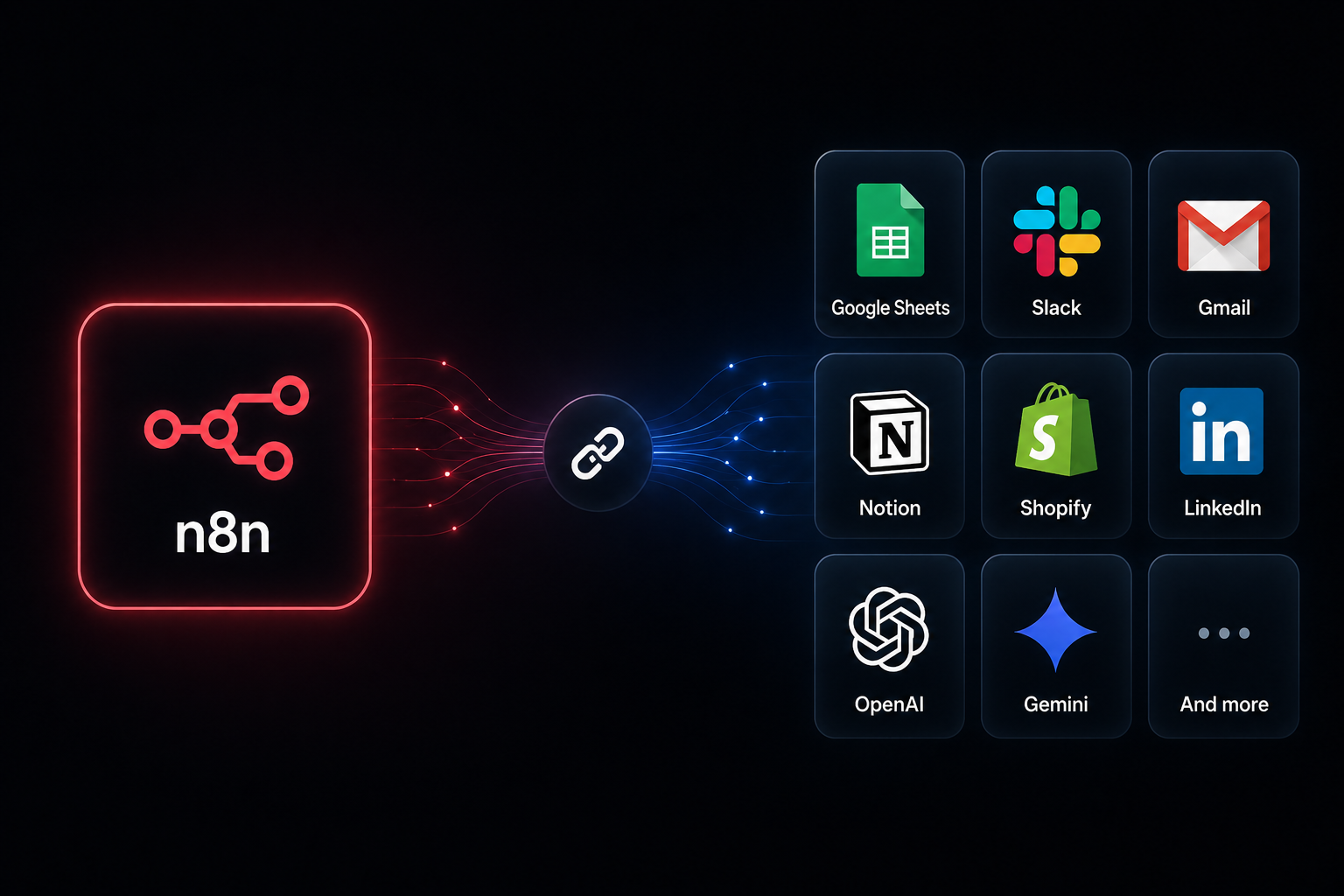
- No-code / low-code automation (Zapier, Make, n8n)
- Cross-platform data orchestration and system integrations
- Business Process Automation
Case Studies:
- QuickShift Logistics: Automated multi-step logistics workflows using n8n, reducing manual operations by ~45%
- TransIQ: Built AI-powered operational workflows and data pipelines for real-time logistics insights
- Careonix: Intuz built an AI-powered fax-to-EMR automation system for Careonix home healthcare, replacing manual order processing with real-time intelligent workflows. The solution achieved 90%+ OCR accuracy, reduced manual errors by 95%, and saved 15+ hours per week.
Best For:
- SMBs and mid-market companies seeking fast automation ROI
- Businesses adopting AI-driven or multi-agent-based workflows
- Companies needing complex cross-tool orchestration
- Teams looking for long-term, scalable automation partners
Why Intuz
- AI-first methodology: every automation project incorporates LLM decision logic, not just rule-based triggers
- Transparent pricing with fixed-scope PoC option ($15K–$40K) to validate before full commitment
- Post-deployment monitoring and model optimisation included — most firms stop at deployment
- Intuz Pro Tip: Tie automation to specific KPIs and measurement frameworks before development begins
4. Bitcot
Bitcot is a workflow automation and software development company delivering custom, no-code and AI-powered automation solutions that simplify operations, reduce manual work, and integrate tools like CRMs, ERPs, and project systems across business functions.
Services Offering:
- Custom no-code/low-code automation solutions
- AI-powered decision automation and KPI dashboards
- System integrations (CRM, ERP, APIs)
Case Studies:
- Web Scraping Automation – Bitcot automated data collection using Scrapy, Selenium, and Apache Airflow to replace manual scraping with scheduled, accurate workflows.
- Kord Fire Protection – Bitcot built an AI chatbot integrated with the client’s CRM to automate lead capture and quote generation. This turned manual sales tasks into an automated pipeline, improving conversion speed and reducing manual workload.
Best For:
- Teams using SaaS tools and needing cross-tool workflows
- Automation without heavy custom coding
- Internal operations acceleration
5. Imaginovation
Imaginovation is a 5-star rated US software development company offering business process automation as part of broader digital transformation with RPA, workflow automation, and system integration services.
Services Offering:
- Custom workflow and RPA automation
- AI-driven decision automation and integrations
- Enterprise software and API solutions
- Business intelligence and analytics automation
Case Studies:
- MagicTask – Built a custom task management and workflow automation platform that streamlined internal project tracking and team coordination across the organization. It boosted productivity by ~35% and cut tool complexity in half.
- Contractor Score – Developed a web-based automated scoring and management system for contractors, replacing manual scoring and tracking processes. The platform automates data handling and scoring workflows, making contractor performance insights faster and more accurate.
Best For:
- Projects with custom software and workflow integration
- Teams wanting end-to-end digital transformation
- Automation plus actionable insights
6. Wildnet Edge
Wildnet Edge is an AI-native digital transformation company blending intelligent software engineering with automation as part of broader custom solutions. While not strictly a workflow-only firm, its automation and cloud/mobile solutions are deeply integrated into engineered systems that drive operational efficiency.
Services Offering:
- AI-driven software and automation
- Custom workflow integration as part of digital platforms
- Data-driven analytics and AI support systems
- Enterprise application engineering
Case Studies:
- ChatGPT-Powered Form Filling & Workflow Automation App – WildnetEdge built an AI-driven automation solution that eliminated manual form handling and data entry across business processes, transforming repetitive tasks into intelligent automated workflows
Best For:
- AI-centric automation initiatives
- Teams needing automation embedded in complex systems
- Startups and enterprises building future-proof systems
7. Quickway Infosystems
Quickway Infosystems is a software engineering and digital transformation company offering custom solutions and workflow optimization as part of broader software and automation projects; it focuses on helping clients improve operations through technology integration.
Services Offering:
- AI/ML and business automation support
- Cloud and DevOps automation
- API integration and system automation
Case Studies:
- Enterprise Onboarding & Document Management – Automated onboarding and compliance workflows replaced manual verification and approvals. Resulted in ~50% faster onboarding and improved operational efficiency.
- Utility Management & Procurement Automation – Built an RFx-driven procurement platform with automated workflows.Cut procurement cycle time by nearly half and improved vendor collaboration.
Best For:
- Companies needing custom automation built into software
- Global teams seeking flexible delivery models
- Digital transformation with automation components
- SMEs and mid-market enterprises
8. Biz4Group LLC
Biz4Group is an Orlando-based digital technology firm with strong AI and automation capabilities, helping companies build AI-powered automation, workflow orchestration, and enterprise digital solutions.
Services Offering:
- AI workflow automation and integration
- AI consulting and discovery workshops
- Chatbot and assistant automation
- Intelligent process orchestration with AI
- Enterprise application automation
Case Studies:
- AI-Powered HRMS (ShiftFit): Biz4Group automated recruitment, scheduling, and workforce management workflows, significantly reducing manual HR operations and improving staffing efficiency.
- Ecommerce Listing Automation: Built an AI-driven workflow to automate product listing creation, eliminating repetitive manual tasks and accelerating listing accuracy and speed.
Best For:
- AI-led workflow automation initiatives
- Companies combining automation with IoT and apps
- Enterprise workflows needing intelligent automation
- Projects requiring AI integration and consulting
9. Boltflow
Boltflow is a no-code/low-code workflow automation agency enabling businesses to design, automate, and optimize internal processes using tools like Airtable, Zapier, and Bubble for rapid automation deployment.
Services Offering:
- No-code workflow design and automation
- Integration across core business tools
- Custom CRM and process automation
- Low-code automation using Bubble and Zapier
Case Studies:
- HOKALI (Sports Marketplace): Boltflow automated core workflows for this YC-backed marketplace, cutting 55% of manual tasks and boosting coach retention by 25% while driving ARR growth.
- UpChoose (Rental Subscription Platform): Boltflow’s automation solution reduced manual work by 60% and doubled customer retention through proactive workflow orchestration.
Best For:
- Startups and SMBs needing rapid automation
- Teams without heavy engineering resources
- Process structuring and tool orchestration
- No-code/low-code workflow adoption
How to Choose the Right Workflow Automation Development Partner
Selecting the right partner determines whether automation accelerates growth or adds complexity. Use this practical decision framework:
1. Clarify Goals
Are you aiming for:
- Time savings?
- Error reduction?
- Revenue productivity?
- Customer experience improvements?
Intuz Recommends
Tie automation to specific KPIs and measurement frameworks.
2. Assess Workflow Complexity
- Simple, repetitive tasks → low-code/no-code may suffice
- Cross-system, data-intensive, or AI-driven workflows → custom development
3. Integration Requirements
Ensure the partner can connect:
- CRM (Salesforce, HubSpot)
- ERP (SAP, Oracle)
- Finance systems (QuickBooks, Netsuite)
- Legacy tools
4. AI Intelligence Needs
Ask:
- Do they embed AI for decisioning?
- Can workflows adapt using contextual data?
- Do they provide monitoring and self-optimization?
5. Post-Launch Support
Automation isn’t “set and forget.” Ensure:
- Dedicated support
- Performance dashboards
- Continuous improvement cycles
Red Flags
- Tool-only setups sold as solutions
- No discovery or process mapping phase
- Lack of measurable ROI outcomes
How Much Does Workflow Automation Development Cost?
While every project is unique, AI workflow automation development costs in the USA generally fall into predictable tiers based on complexity. Understanding these ranges helps you budget effectively and avoid surprises.
1. Proof-of-Concept (PoC) or Simple No-Code Integration($15,000 – $40,000)
Scope: Automating a single, well-defined workflow using tools like n8n or Make, with limited AI decision-making. Ideal for validating an idea and demonstrating initial ROI.
Example: Automating lead routing from a web form into a CRM with basic AI-powered qualification.
2. Custom Multi-System Workflow Automation ($50,000 – $120,000)
Scope: Developing a robust automation that integrates multiple systems (e.g., CRM, ERP, internal databases), includes custom AI agents, and handles complex business logic.
Example: An end-to-end order processing system that syncs inventory, customer data, and financial records automatically.
3. Enterprise-Grade Integration & Transformation ($100,000+)
Scope: Large-scale projects involving legacy systems, strict security and compliance requirements, and the development of multiple, interconnected AI agents to transform a core business function.
Example: Automating the entire claims processing pipeline for an insurance company, from intake to validation and payment.
A fixed-scope PoC is the lowest-risk entry point: you validate measurable savings on one process before committing to a broader rollout.
Off-the-shelf tools carry lower upfront cost but hit ceilings on complex logic, compliance, and context-aware routing — which is where custom development earns its return.
Workflow Automation Development Project Timelines – From Planning to Production
Implementation timelines vary by complexity, but most projects follow a predictable schedule. Understanding these phases helps align expectations.
- Simple No-Code/Low-Code Workflows (2-4 Weeks): Projects using tools like Zapier or Make to connect existing SaaS applications can be deployed rapidly. The bulk of the time is spent on mapping logic and testing.
- Custom AI-Driven Solutions (2-3 Months): A typical custom automation project involves a discovery phase (2-3 weeks), development and integration (4-6 weeks), and user acceptance testing (1-2 weeks). This timeline allows for building robust, scalable solutions.
- Large Enterprise Integrations (3-6+ Months): Projects involving multiple departments, legacy systems, and stringent compliance checks require a longer timeline for architecture design, phased rollouts, and comprehensive change management.
Which Workflow Automation Company Is Right for Your Use Case?
| Use Case / Task | Best-Fit Company | Why This Company Fits Best |
| AI-driven workflow automation (LLM, agents, smart decisions) | Intuz | Strong AI-first automation, agent-based workflows, measurable ROI |
| Enterprise-scale workflow automation & integrations | Vention | Large engineering teams, complex enterprise system handling |
| Regulated industries (finance, healthcare, compliance-heavy workflows) | ScienceSoft | 35+ years experience, security, compliance, governance focus |
| Fast ROI with no-code / low-code automation | Bitcot | Outcome-focused workflows using low-code + AI |
| Mid-market digital transformation with automation | Imaginovation | Balanced automation + custom software approach |
| Automation embedded inside AI & cloud platforms | Wildnet Edge | AI-native engineering, complex system automation |
| Cost-effective custom workflow automation | Quickway Infosystems | Flexible delivery, automation built into custom apps |
| AI-powered enterprise workflows & intelligent orchestration | Biz4Group LLC | AI, chatbot, IoT-enabled workflow automation |
| Startup & SMB internal process automation (Zapier, Airtable, Bubble) | Boltflow | Rapid no-code automation, quick deployment |
Final Thoughts — Turn Automation into Measurable ROI
Workflow automation creates value only when it simplifies real operational work, not when it adds another layer of tools. Intuz helps businesses identify automation-ready workflows, design AI-driven decision logic, and integrate automation directly into existing systems like CRM, ERP, and internal platforms. The focus is always on measurable outcomes—reduced manual effort, faster cycle times, and scalable operations.
If you’re planning to automate workflows, book a free consultation with Intuz to evaluate where automation will deliver the highest ROI for your business.
FAQs
How do I choose the best workflow automation development company in the USA?
Choose a company based on your use case, not brand size. Evaluate their experience with AI-driven automation vs rule-based workflows, integration capability with your existing tools, proven case studies, and delivery speed. For regulated industries, prioritize compliance expertise. For fast ROI, choose firms strong in low-code or AI-powered automation.
What industries benefit the most from workflow automation services?
Industries with repetitive, data-heavy, and approval-based processes benefit most, including healthcare, finance, logistics, SaaS, eCommerce, and manufacturing. Workflow automation reduces manual effort, improves turnaround time, and ensures process consistency. US companies often automate operations, customer support, sales pipelines, and internal reporting to scale efficiently.
What is the average cost of workflow automation development in the USA?
Workflow automation costs typically range from $10,000 to $50,000+, depending on complexity, integrations, and AI involvement. Simple no-code automations cost less, while AI-driven or enterprise-grade workflows require higher investment. Most US companies recover costs within 3–6 months through efficiency gains and reduced manual labor.
What is the difference between AI-driven workflow automation and traditional automation?
Traditional automation follows fixed rules and triggers, while AI-driven automation adapts using machine learning, LLMs, and decision logic. AI workflows handle unstructured data, exceptions, and predictions, making them ideal for complex business processes. US enterprises increasingly adopt AI-driven automation for scalability and intelligent decision-making.
How long does it take to implement workflow automation for a business?
Implementation time ranges from 2–4 weeks for no-code workflows to 2–3 months for custom or AI-driven automation. Timelines depend on process complexity, data sources, and integrations. Most US automation companies follow phased deployment, delivering quick wins first before scaling automation across departments.
What tech stack should a workflow automation development company use in 2026?
Leading firms in 2026 use n8n or Make for orchestration, LangChain or custom LLMs for AI decision logic, and cloud-native infrastructure (AWS, GCP, Azure) for deployment. The key differentiator is whether the firm can build custom AI agents and handle unstructured data — not just connect pre-built app integrations.
Work with Intuz
Need Workflow Automation For Your Business?
Book 45-minutes free consultation, we will share complete roadmap.
Let's Get Started
Share this article