Generative AI is making a huge name for itself across diverse industries in a short span of time. With its remarkable ability to learn, create, and innovate autonomously, the technology is bound to revolutionize industries around the globe. In our exploration of Generative AI, we’ll delve into its transformative impact on the pharmaceutical sector.
From accelerating drug discovery to personalizing patient care, Generative AI in Pharma offers a multitude of use cases. These use cases showcase the potential of Generative AI in pharma and how it streamlines the healthcare processes and makes clinical trials more efficient.
So, let us begin and explore the world of Generative AI in healthcare.
Show
- Incorporating Generative AI in Pharma could save up to $200 billion annually in the US healthcare system and improve employee working hours by 40%, according to Accenture research.
- Generative AI accelerates drug discovery through virtual screening, molecular modeling, and predictive analytics — significantly reducing research timelines and costs.
- It enables personalized medicine by analyzing genetic data and medical histories, shifting healthcare from a one-size-fits-all model to individualized treatment plans.
- Generative AI optimizes clinical trials by improving patient recruitment, monitoring, and data analysis — enabling faster decision-making and reducing trial duration.
- Beyond discovery, it also automates manufacturing, supply chain operations, and regulatory approval processes, reducing administrative burdens and improving access to life-saving medications.
Generative AI in Pharma: What Does it Mean?
In the pharmaceutical realm, Generative AI’s growth is invincible. The industry is embracing various Generative AI solutions to cover the rising healthcare costs and operational complexities.
Research by Accenture suggests that incorporating Generative AI in Pharma would save up to $200 billion annually in the US healthcare system and improve the working hours of employees by 40%.
Additionally, generative AI also streamlines the process of drug discovery and development. It harnesses various machine algorithms to accelerate the identification of potential drug candidates.
This approach significantly reduces research timelines and costs. Leveraging generative AI, tailored solutions for individual medical needs can be crafted, and more effective outcomes can be achieved.
That said, generative AI is a great possibility that healthcare institutions must integrate.
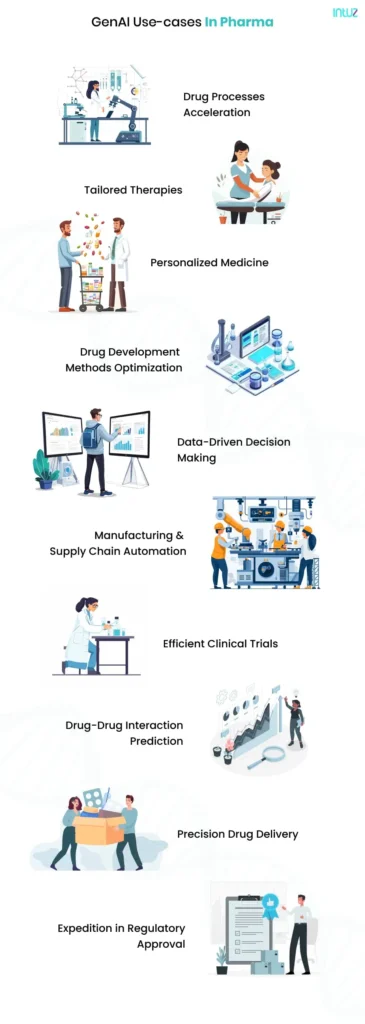
10 Practical Use Cases of Generative AI in Pharma
Generative AI is all set to reshape the ways and future of healthcare. Here are some of the essential generative AI use cases you can leverage and learn about:
1. Acceleration of the Drug Discovery and Formulation Processes
AI in drug discovery encompasses numerous technologies and methodologies to accelerate the identification and development of new medications, with many innovative solutions being driven by leading AI development company.
By leveraging machine learning algorithms and advanced data analytics, AI enables researchers to sift through vast amounts of biological, chemical, and clinical data to identify potential drug candidates more efficiently.
The three fundamental approaches used in it are:
- Virtual Screening: It utilizes computer simulations to identify potential drug candidates from vast chemical databases and expedites the initial screening process.
- Molecular Modeling: It involves computational techniques to simulate and analyze molecular structures, aiding in designing and optimizing potential drug compounds.
- Predictive Analytics: It applies statistical algorithms to analyze large datasets and predict outcomes to facilitate the identification of promising drug candidates and potential interactions.
Using these approaches, the pharmaceutical industry can more actively discover efficient drugs and bring innovative solutions for improved patient outcomes.
2. Tailored Therapies for Better Patient Care
Generative AI is also pivotal in designing targeted therapies tailored to individual patients’ genetic profiles. The AI model analyzes genetic data and medical histories of the patient to identify molecular targets and develop customized treatment regimens.
This personalized approach to medicine ensures that patients receive treatments optimized for their unique biological characteristics. Hence, it significantly maximizes therapeutic efficacy while minimizing its adverse effects.
Consequently, Generative AI empowers healthcare providers to deliver precision medicine that addresses each patient’s specific needs. This ultimately improves treatment outcomes and quality of life for patients.
3. Effective Personalized Medicine
AI in pharma enables the development of personalized medicine by analyzing diverse patient datasets, including genetic information and medical histories.
The software identifies the biomarkers and further predicts treatment responses, providing Generative AI the ability to facilitate the creation of tailored treatment plans that optimize patient outcomes.
This new Generative AI-based model revolutionizes healthcare by shifting from a one-size-fits-all model to individualized treatment plans that deliver improved outcomes.
4. Optimization of Drug Development Methods & Strategies
One of the greatest advantages of using Generative AI in pharma is its ability to optimize the processes to generate quick and optimal results. The AI models can effectively screen vast datasets and discover methods to optimize drug development methodologies.
Hence, this improvised approach leads to a reduction in research costs and lowers the time-to-market for new medications.
5. Data-Driven Clinical Decision Making
Data analysis is the foundation of Generative AI, which helps generate valuable insights into various medical parameters. Some of these parameters include patient demographics, treatment responses, disease progression, etc. Using this data, healthcare providers can empower themselves to make adequate informed process decisions and promote evidence-based medicine.
6. Manufacturing & Supply Chain Automation
One of the best advantages of Generative AI in pharma is it streamlines pharmaceutical manufacturing processes and supply chain operations by automating various tasks. Generative AI enhances efficiency and reduces costs throughout the pharmaceutical supply chain by optimizing:
- Production schedules
- Inventory management
- Distribution logistics
This automation ensures the timely delivery of medications and minimizes wastage in manufacturing units. Ultimately, with the use of Generative AI, operational expenses are fairly reduced, which leads to better access to life-saving medications for individuals.
7. Improvement in Clinical Trial Efficiency
Generative AI is a powerhouse of technology in Pharma. It not only helps in efficient drug discovery but also optimizes various aspects of the trial process. It assists in patient recruitment, selection, and monitoring by enhancing trial enrollment and retention rates and accelerating clinical research.
Additionally, it aids in data analysis and interpretation, facilitating faster decision-making and reducing trial duration. This improved efficiency enables pharmaceutical companies to bring new treatments to market more quickly, benefiting both patients and healthcare providers.
8. Prediction of Drug-Drug Interactions
In today’s tech-savvy world, medical professionals leverage many techniques, including mixing two drugs to achieve a more potent third drug for a specific outcome. However, with Generative AI, this process can be made more efficient.
Generative AI accurately predicts potential drug-drug interactions by analyzing vast datasets of drug interactions and adverse reactions. This data helps the AI model identify potential risks and interactions before they occur.
This predictive capability enables healthcare providers to make informed treatment decisions and avoid potentially harmful drug combinations. Thus, it substantially reduces adverse drug reactions and improves patient care.
9. Enablement of Precision Drug Delivery
Personalized treatment is the way forward in the healthcare industry, and Generative AI is a big part of it. Generative AI can customize drug delivery systems based on individual patient needs by monitoring patients’ health and medical history. Access to this data and its insights significantly minimizes the risk of side effects and maximizes treatment efficacy. Therefore, it underscores the transformative impact of leveraging Generative AI in healthcare innovation.
10. Expedition in Regulatory Approval
Generative AI also can expedite regulatory approval processes by automating various tasks. It generates comprehensive regulatory submissions to ensure compliance by boosting the review and approval process for new medications and therapies.
This automation reduces administrative burdens for pharmaceutical companies and regulatory agencies and enables faster access to innovative treatments for needy patients. Therefore, by integrating Generative AI, you can streamline the regulatory approval process and bring life-saving medications to market more quickly and efficiently.
Explore Solutions
AI Solutions for Pharma
With various phenomenal use cases, GenAI is ready to change how the healthcare industry works. By leveraging its potential, healthcare businesses are driving higher efficiency in work processes, accelerating innovation, and ultimately delivering enhanced patient outcomes.
If you running a pharma company & ready to leverage generative AI to revolutionize your processes, products, and research?
Book Your Free 45-minute Consultation with Our Generative AI Experts Today!
During this personalized session, our team will:
- Create a GenAI proof-of-concept tailored to your top use case
- Design a custom GenAI implementation plan for your pharma company
- Provide strategies for integrating GenAI into drug discovery and development
FAQs
How does generative AI speed up drug discovery compared to traditional methods?
Traditional drug discovery takes 10–15 years and costs upward of $2.6 billion per approved drug. Generative AI compresses this by running virtual screening across vast chemical databases to identify promising candidates without physical lab trials, using molecular modeling to simulate how drug compounds behave at a structural level, and applying predictive analytics to flag interactions and side effects early. These three approaches run simultaneously and at scale — what used to require years of bench research can now be narrowed down in months. Pharmaceutical companies using AI-driven discovery report significantly reduced research costs and faster time-to-candidate identification.
What role does generative AI play in clinical trials?
Generative AI improves clinical trial efficiency across three stages. In recruitment, it analyzes patient records to identify candidates who match trial criteria faster and more accurately than manual screening. During the trial, it monitors patient data continuously, flagging anomalies and predicting dropout risks to improve retention rates. In data analysis, it processes large volumes of trial data to surface insights faster, reducing time to decision. This acceleration shortens the average trial timeline and allows pharmaceutical companies to move promising treatments to market faster — which matters most when the treatment addresses unmet medical needs.
How does AI predict drug-drug interactions before a patient is prescribed a combination?
Generative AI models are trained on vast datasets of known drug interactions, adverse event reports, and pharmacological data. When a new drug candidate or combination is being evaluated, the model cross-references its chemical and biological profile against this training data to predict the likelihood of harmful interactions. This predictive step happens before clinical exposure, giving prescribers and researchers a risk map for any given combination. It significantly reduces the chance of adverse drug reactions reaching patients — a critical safeguard given that drug interactions are a leading cause of preventable hospitalizations in the US.
How much does it cost to integrate generative AI into a pharma company’s operations?
Costs vary significantly depending on scope — a focused proof-of-concept targeting one use case (say, automating regulatory submissions) typically runs $50,000–$150,000, while a full-scale deployment across drug discovery, clinical trial management, and supply chain can reach $1M+. The more relevant question is ROI: pharma companies report reductions in R&D cycle time, lower trial costs, and fewer adverse event incidents. A scoped initial engagement — starting with your highest-volume, most data-rich process — is the practical path. Intuz offers a free 45-minute consultation to map your top use case to a GenAI proof-of-concept before any budget commitment.