
Surprisingly, it turns out that less than 11% of the hiring companies out there deploy artificial intelligence (AI) to complement their recruitment processes. It is the gap that makes up the remaining 89%, which is what the entire article is going to be about.
Conventional recruitment processes are age-old, time-consuming, and full of limitations. Ask any HR associate, and they will mention one or all of the below concerns in recruiting:
- Limited availability of recruitable talent
- Budget constraints in appointing the right talent
- Unavailability of stakeholders for interviews, resulting in repeated reschedules
- Bias in applicants and their filtering processes
- Lack of soft skills in candidates and more
In the context of time consumption, an interesting statistic reveals that 51% of recruiters find their most suitable candidates after three rounds of interviews. Besides, every single job posting attracts over 250 applications, leaving approximately 7 seconds for candidates to make an impression with their resumes.
While we are at resumes, reports also share that over 85% of the candidates lie in their resumes. This translates to the fact that there could be surprises on how dependable resources are only in the long run.
The development and integration process is systematic, as we mentioned. Specifically, training models require assistance from experts and AI development services specialists to fast-track your ambitions with deploying Gen AI for recruitment.
To add to this, HR professionals face contemporary challenges such as the onset of an entirely new wave of workforces called the Gen Zs, remote work cultures with geographical and language barriers, freelancers, and more.
Show
- Less than 11% of hiring companies currently use AI to complement their recruitment processes, leaving a massive adoption gap that early movers can capitalize on.
- Generative AI uses NLP to scan resumes and shortlist candidates based on skills, certifications, experience, and salary expectations — reducing manual screening time dramatically.
- Predictive analytics powered by Gen AI can identify candidates most likely to stay long-term by analyzing historical data points like CV gaps, company tenure, and career aspirations, directly addressing the statistic that 30% of new hires leave within 90 days.
- Beyond screening, Gen AI automates the full recruitment lifecycle — from drafting job descriptions and social media posts to scheduling interviews, generating onboarding kits, and collecting feedback.
- Personalized job recommendations driven by Gen AI match candidates to roles based on skills, preferences, job history, and career vision — similar to Netflix’s content recommendation engine — benefiting both candidates and recruiters.
Generative AI & The Talent Recruitment Revolution
Gen AI is an HR professional’s ultimate superpower that allows them to save time in recruiting and onboarding professionals, sieve through eligible candidates, minimize expenses, and accomplish more. This technology is rewriting conventions in the L&D space, allowing HR associates to make informed, data-driven decisions when selecting candidates.
Let’s look at some of the incredible ways this is done.
Streamline Candidate Screening Using Gen AI
Candidate sourcing and filtering is one of the most daunting tasks in the process, as professionals need more time to validate the skillsets of a candidate, do preliminary background checks, map salary and budgets, and decide if they want to take it forward.
When 250 applications are the average pool for every job posting, it puts pressure on associates to manage time and vacancy fulfillment. However, AI-enabled tools can minimize the entire process and complete the screening process in a few seconds.
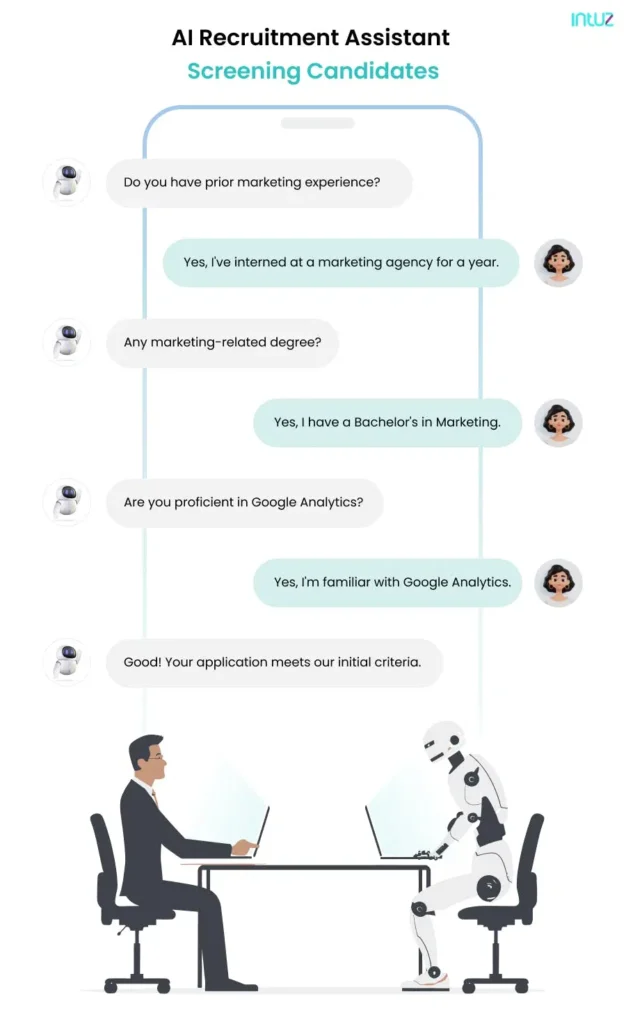
This is achieved through Natural Language Processing (NLP) modules functioning at the backend, scanning and processing resumes for data on
- Candidates’ skills
- Certifications
- Experience levels
- Academic backgrounds
- Salary expectations and more
By picking up such details, it can incredibly reduce an associate’s time in manually going through a pile of resumes and shortlisting eligible candidates.
Advanced uses of Gen AI can also fetch benefits such as the deployment of chatbots in the preliminary recruitment processes. Once shortlisted, HR professionals can use chatbots to get basic details on notice period duration, open for negotiation, convenient time for interviews and more.
Boost Efficiency Through Faster Recruitment and Content Generation
Posts and announcements on job openings have been traditionally dull. This predominantly stems from the lack of time or tools associates have to come up with quirky job postings.
With Generative AI, this changes, as by using just prompts, striking job descriptions can be developed. Besides, different candidates have different job-hunting techniques. With the rise of social channels, a report reveals that over 73% of millennials landed their jobs from social media.
By leveraging Gen AI, associates can ensure they deliver an omnichannel experience to candidates through customized content for each platform. A step further, the entire recruitment process can be given an overhaul with:
- Fresh and captivating job descriptions
- Contemporary interview questions
- Intriguing questions to gauge culture fit
- Curate onboarding materials and more
Predictive Analytics In Assessing Attrition
A Forbes statistic shares that over 30% of recruits leave within 90 days of joining. This ultimately leads to the commencement of the recruitment process all over again for HR associates. Furthermore, there are expenses involved in onboarding and training both in terms of money and time.
Gen AI can fix this concern with the help of predictive analytics, where accurate assessments of candidate behavior and intentions can be deduced through the analysis of historical data. By leveraging data touchpoints and parameters like gaps in CV, work experience, years worked with one single company, Aspirations, Skillsets, compensation, and more, models can complement the filtration process by zeroing in on the most ideal candidate.
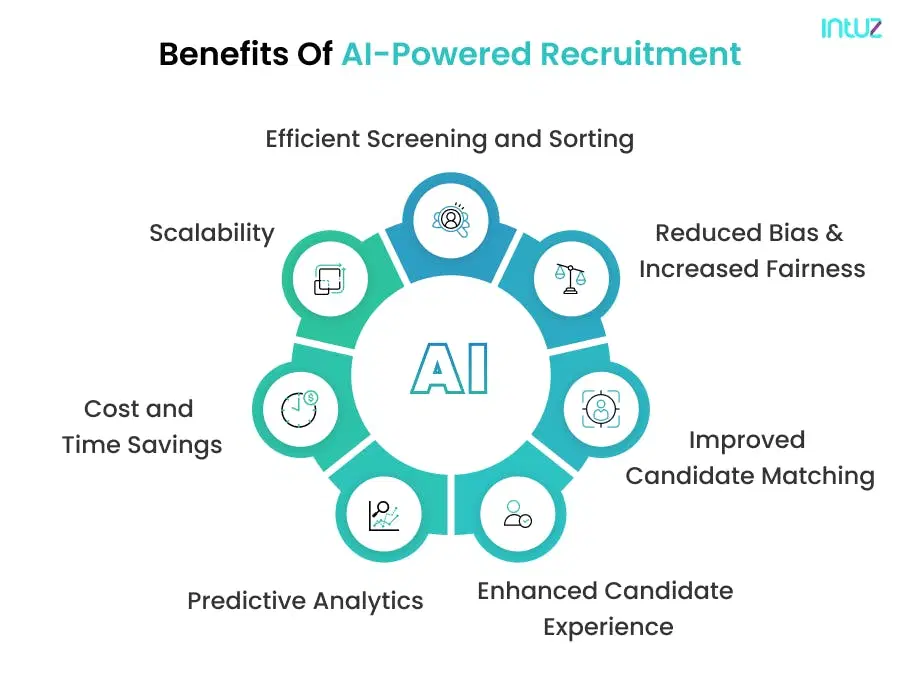
Decisions stemming from such models can enable HR associates to select employees who are most likely to commit longer to their organizations so enterprises can seamlessly implement learning, upskilling, and growth opportunities.
Personalized Job Recommendations In Real Time
One of the reasons why candidates either ghost or leave organizations in a short time is because of skills-job mismatch. While there is innate desperation to land a job, there is also a compelling urge to apply for almost every vacant position on recruitment platforms.
An aspect of personalization is missing in the process that allows candidates to find jobs that are in line with their:
- Innate and cultivable skill sets
- Aspirations and career visions
- Preferences in terms of employment type, city, shifts, and more
- Job search history
- Academic qualification and core work experience and more
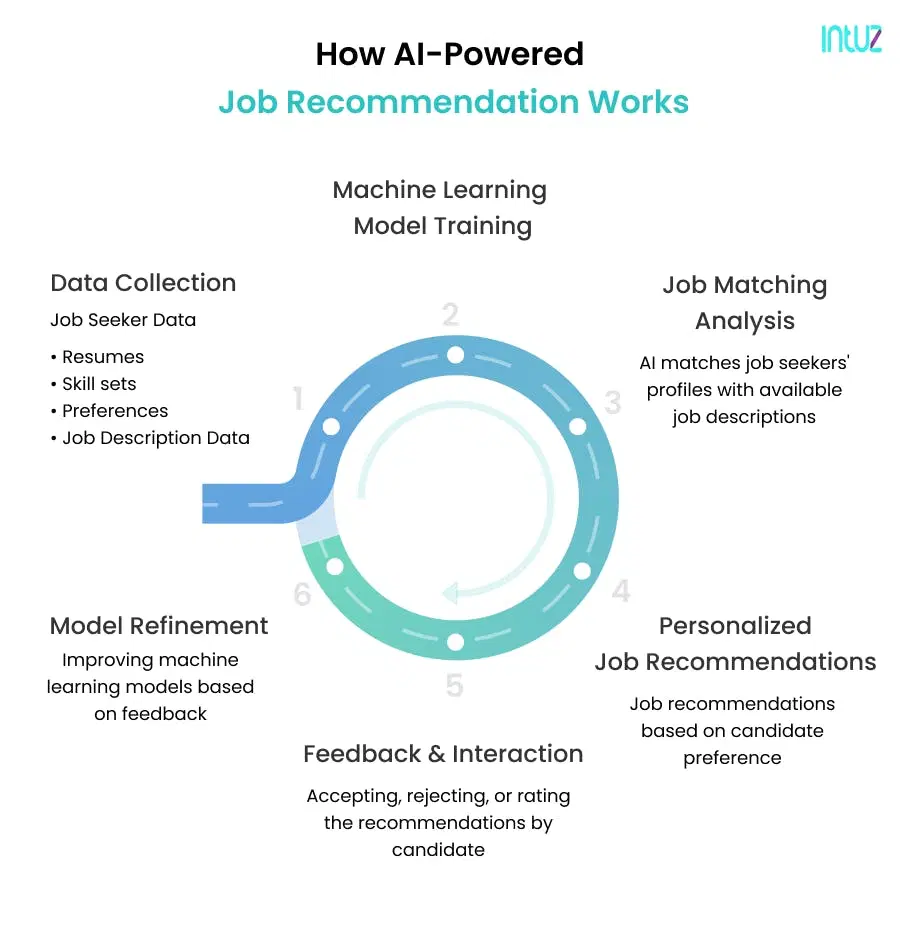
Gen AI can help with the personalization angle by curating job vacancies that align with any factors considered by candidates. This filtration of opportunities by models ensures handpicked jobs and companies that a candidate is most likely to be interested in and get selected at.
This recommendation engine is similar to that of Netflix’s in curating and personalizing content a user is most likely to watch and enjoy.
From the recruiters’ perspective, this is a win-win as personalized job recommendations ensure interests are received only from serious candidates and show fundamental promise. This reduces interview durations and the skepticism around the employee staying for a longer time.
Eliminate Redundant Tasks With Automated Recruitment Processes
The recruitment process is dominated by redundant and meticulous tasks including paperwork. From filtering candidates and scheduling back-to-back interview calls to form-fill tasks during onboarding, diverse mundane tasks are involved.
Gen AI can do a solid job of automating all such tasks including:
- Generating job descriptions for different roles
- Copies for social channels announcing job openings
- Drafting and scheduling emails that are hyper-personalized
- Chatbots to answer some of the most common questions from candidates
- Scan calendars for ideal times for both candidates and stakeholders and schedule interviews
- Generate interview questions and evaluate performances
- Prepare welcome kits and materials for seamless onboarding
- Have checklists and protocols for pre-boarding
- Feedback collection and aggregation from candidates and more
Explore Now
Looking for a Custom AI Development Solution?How To Integrate Generative AI For A More Efficient And Effective Recruitment Processing
It’s reassuring to state that over 63% of the recruiters foresee conventional screening practices getting replaced with AI. While this is a significant shift in terms of digital transformation, the shift also comes at a price if not systematically planned out.
Integrating Generative AI in recruitment ecosystems is tedious and diverse factors have to be considered before finalizing. To help you get started, here’s a brief picture of what the steps can look like:
- Start by identifying areas for automation and have modules in place accordingly. This could include content generation, candidate screening, scheduling automation, resume summarizing, and more that you want to include in your systems.
- Once identified, the next stage is getting the tech stack in place. Decisions on whether you want to build proprietary Gen AI models for your needs or integrate existing tools is a call that can trickle down from the management.
- Now that the model is fixed, it’s time to train it on customized data. Sourcing contextual, relevant, and recent data is often a bottleneck.
- Optimization of results with additional training and elimination of bias is inevitable at this stage. A fiasco in Amazon’s recruitment models is a good example of how bias can kill ambitions.
The development and integration process is systematic, as we mentioned. Specifically, training models require assistance from experts and AI development services specialists to fast-track your ambitions with deploying Gen AI for recruitment.
That’s why we recommend GenAI services from Intuz. Our end-to-end solution ensures you focus on other aspects of running an enterprise rather than spending time developing AI models. From consulting to custom development and deployment, we take care of every minute aspect required to make your HR processes AI-ready.
Get in touch with us to schedule a consultation today.
- When the model is ready to go live, it can be then integrated into your recruitment systems.
- Compliance with any legal and ethical mandates and regulations is considered at this stage and implemented. This can include data privacy concerns, prevailing laws, fairness, transparency, accountability, and other mandates.
- Post integration, further scopes for iterative improvement are studied and carried out. This ensures precision in results.
FAQs
Can generative AI actually replace human recruiters in the hiring process?
Not entirely, and that’s not the goal. Generative AI handles the high-volume, repetitive layers of recruitment — resume screening, interview scheduling, onboarding content generation — so human recruiters can focus on judgment-intensive decisions like culture fit and final selection. Think of it as removing the administrative burden, not the recruiter. In practice, companies that deploy AI in hiring report faster time-to-fill and reduced cost-per-hire, while still relying on humans for final calls. The most effective setups combine AI speed with recruiter intuition.
How does Gen AI screen resumes without introducing bias?
Bias in AI screening is a real concern — Amazon’s failed recruitment model is the most cited example of what goes wrong when training data reflects historical bias. Well-implemented Gen AI uses structured, skills-based criteria (certifications, experience level, salary fit) rather than demographic signals. Bias mitigation requires intentional data curation, regular audits, and ongoing model retraining. If you’re building or integrating a screening model, bias testing should be a mandatory step before going live — not an afterthought. A properly governed system reduces bias compared to human screening, but only if built that way.
What recruitment tasks can be fully automated with generative AI today?
Several. Gen AI can reliably automate job description writing, social media posting for open roles, initial candidate outreach via personalized email, chatbot-based pre-screening (notice period, availability, salary expectations), interview scheduling by syncing calendars, onboarding material generation, and feedback collection. These aren’t experimental capabilities — they’re production-ready with today’s tools. What still requires human oversight: final candidate selection, offer negotiation, and assessing soft skills or cultural alignment in later interview rounds.
How long does it typically take to integrate Gen AI into an existing recruitment system?
It depends on scope. Integrating a pre-built AI tool (like an ATS plugin or AI scheduling assistant) can take 2–6 weeks. Building a custom Gen AI model trained on your company’s historical hiring data takes 3–6 months, including data sourcing, training, bias testing, and compliance review. The highest-effort component is usually data preparation — getting clean, labeled, and legally compliant training data. For most mid-sized businesses, starting with a targeted integration (screening automation or JD generation) rather than a full custom build delivers faster ROI.
Is generative AI in recruitment compliant with data privacy laws like GDPR?
Compliance is possible but not automatic. Gen AI recruitment systems handle sensitive personal data — resumes, salary expectations, employment history — which falls squarely under GDPR in Europe, CCPA in California, and equivalent laws elsewhere. Key requirements include obtaining candidate consent for AI-based processing, enabling data deletion requests, and ensuring that automated decisions (like AI-based shortlisting) can be explained and contested. Any recruitment AI deployment should involve a legal review before going live. Intuz builds compliance considerations into the integration process, not as a post-launch retrofit.
![Best AI & Enterprise App Development Companies in USA [2026]](https://www.intuz.com/wp-content/uploads/2026/05/Best-AI-Enterprise-App-Development-Companies-in-USA-2026.webp)
![Best 15 AI Software Development Companies in USA [2026]](https://www.intuz.com/wp-content/uploads/2026/05/Best-15-AI-Software-Development-Companies-in-USA-2026.webp)


