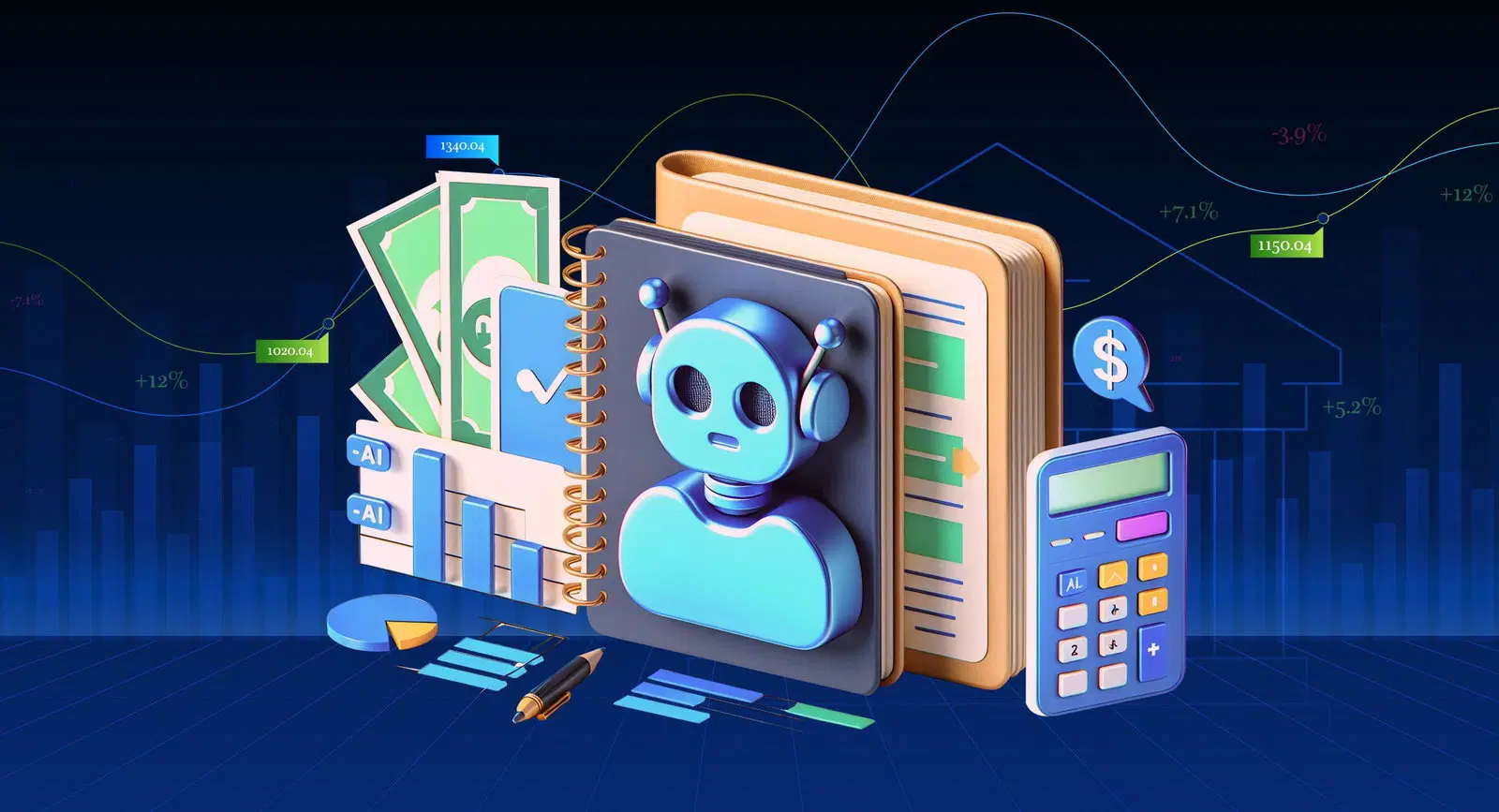






Artificial intelligence-led FinTech transformation is making the industry more efficient, secure, and customer-centric. FinTech companies are using AI for risk assessment, fraud detection, predictive analytics, and personalization of the customer experience. With further advancements, we can expect more intelligent services driven by neural networks, quantum computing, and blockchain to enter the market.
From digital wallets to neural networks, the FinTech industry has risen with speed while delivering innovative solutions. Digital wallets created the ground for mobile payments, leading to open banking, blockchain, smart contracts, cybersecurity, neural networks, and much more.
With AI in FinTech, every development and innovation comes with an unprecedented security level due to the nature of information these solutions access and transmit. Artificial intelligence (AI) plays a pivotal role in shaping the tools and solutions at every level. The complex AI-based algorithms and neural networks are helping to fine-tune the decision-making process.
Let’s understand the FinTech revolution driven by AI and helping the industry steam ahead.
Show
- AI is making FinTech more efficient, secure, and customer-centric through risk assessment, fraud detection, predictive analytics, and personalization of the customer experience.
- Digital wallets have evolved from closed-source proprietary integrations into modern architectures built on microservices, real-time processing, AI, and machine learning — with 53% of Americans now using digital wallets and over a quarter of UK payments going contactless.
- The top 4 AI applications driving the industry are fraud detection, personalized finance, chatbots, and predictions/forecasting — with AI reducing tedious data-entry tasks by 80% and potentially increasing industry revenue by 34%.
- Progressive technologies — blockchain and smart contracts, robotic process automation (RPA), and deep learning/neural networks (CNNs) — are reshaping security, back-office operations, and market trend analysis.
- The future points to generative AI, quantum computing, and evolving business models, alongside new FinTech spin-offs like InsurTech and RegTech — with AI expected to remain human-regulated.
The Rise of Digital Wallets
The first digital payment system was introduced by Coca-Cola in 1997. However, the first digital wallet system in the banking sector came in the 1980s in the form of DigiCash and Millicent.
The 1990s brought Mondex, and in the 2000s, Nokia Mobile Wallet and Google Checkout were introduced. Today, we have Apple Pay, Venmo, and even crypto digital wallets.
The earlier digital wallets ran on proprietary integrations with payment processors, which were largely closed-source. In the 2000s, payment gateways went through integrations with networks like Visa and Mastercard. The modern-day technical architecture for digital wallets is improved with microservices, real-time processing, AI, and machine learning technologies.
With digital wallets, the banking sector has become more streamlined and productive. From standing in lines to deposit, withdraw, and transfer money, we can process these transactions within seconds from a smartphone.
The added convenience and accessibility have led to a substantial decrease in cash utilization. More than a quarter of payments in the UK have gone contactless, and 53% of Americans use digital wallets, with PayPal taking the highest share of all.
As digital wallets streamline transactions, advanced technologies like encryption and two-factor authentication are ensuring the utmost security. Improvements in user convenience and accessibility have paved the way for financial inclusion for anyone with an NFC-enabled smartphone to accept or make payments through digital wallets.
Overall, digital wallets have improved the banking experience and are helping build a cashless society.
Explore Solutions
Leading FinTech Software Development CompanyTop 4 AI Applications in FinTech
The integration of artificial intelligence in FinTech has led to several innovations. Overall, FinTech has become customer-centric and secure. AI is helping FinTech companies improve customer experience and make their internal operations productive and streamlined.
The tedious data entry tasks in the FinTech industry have improved by 80%. Moreover, it can potentially increase the industry revenue by 34% if utilized correctly. Here are a few functions of AI in FinTech;
1. Fraud Detection
AI can detect bank fraud through AI’s analytical power to identify suspicious user behavior and transactions. AI can effectively monitor user behavior and their actions, especially those that are deviating from a set or expected course of action.
2. Personalized Finance
With AI, FinTech companies already provide personalized recommendations to their users for better financial security. Banks use AI to provide instant personalized customer support, leading to better engagement. AI systems analyze customer data to understand their behavior and preferences, creating a pool of shareable suggestions with the customers.
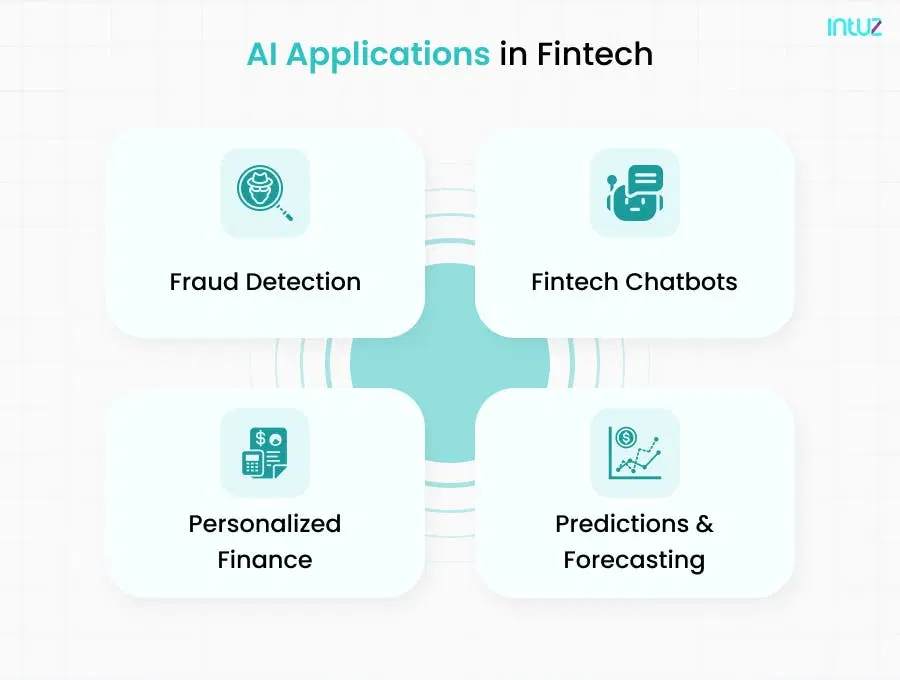
3. Chatbots
Customer service FinTech chatbots with personalization systems have become a common occurrence. Banking applications are integrated with these chatbots to provide instant support and answers to customers. These chatbots also harness natural language processing technologies to converse with the customers, humanizing the service.
4. Predictions and Forecasting
For FinTech companies, AI-powered forecasts and predictions mean they can make better decisions. Since AI can provide more accurate predictions than traditional predictive models, FinTech companies can implement effective risk management strategies and gain from improved portfolio performance.
Better predictions, effective analysis, risk management, trends analysis, and other capabilities combine together to help investors make better investment decisions and strategies.
We have several examples of AI implementation in FinTech;
- PayPal is using machine learning algorithms and AI for fraud detection in real-time to protect its customers and merchants.
- Zestfinance uses AI capabilities for credit risk assessment and establishes a customer’s creditworthiness.
- Betterment is a FinTech service provider using AI to assess investors and suggest optimized investment strategies. It also accounts for individual risk profiles to provide guidance.
Modern Technologies in FinTech
The earlier AI applications driven by ML technology used primitive algorithms. These include logistic regression, decision trees, and support vector machines (SVMs). These algorithms are currently employed for fraud detection, churn prediction, and customer credit risk analysis.
The integration of neural networks into the ecosystem is led by the need to assess and analyze unstructured and non-linear financial data. So, now the FinTech companies are not only processing alphanumeric data, they are also assessing images, video, and audio data.
Let’s take an overview of how progressive technologies have helped shape the FinTech industry;
Blockchain-Enabled Security
With blockchain integrated into the FinTech sector, organizations benefit from higher security. Smart contracts added an extra layer of security and gave way to self-executed contracts.
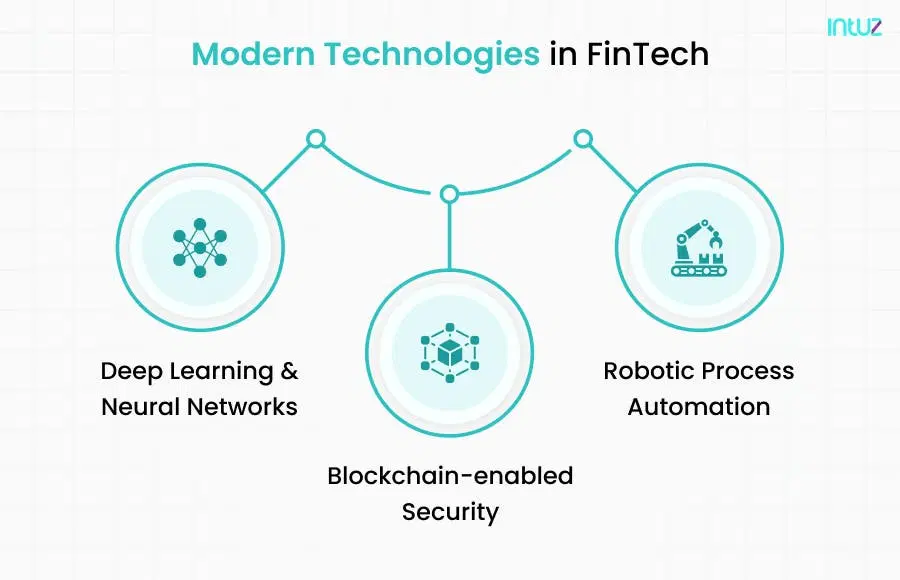
Robotic Process Automation
It automates repetitive tasks based on pre-set rules and conditions. RPA has helped reduce operational costs for FinTech organizations and improve efficiency. RPA is successfully handling back-office operations and compliances for FinTech companies.
Deep Learning and Neural Networks
CNNs can effectively analyze market trends and insights. It allows investors and financial institutions to make informed decisions. Specifically, they can assess risks in trading by analyzing historical stock trade prices, patterns, and trends to help users make informed decisions.
Inspired by the structure of the human brain, these neural networks composed of deep learning architectures can learn and adapt through the data it processes. These networks can handle non-linear and complex relationships between unstructured data.
Image and audio analysis algorithms are run on convolutional neural networks (CNNs). CNN is also used in smartphones for face recognition, and now it is employed by FinTech companies.
The Future of AI in FinTech
As we step into the future, the implementation of AI and related technologies has the potential to add more use cases and improve the existing applications. So, the existing applications of AI in FinTech, like fraud detection, risk management, customer analysis, trend analysis, etc., will become better, more precise, and more accurate.
We can see more branches of FinTech emerging in the future, like InsurTech, RegTech, etc. Each of these spin-offs will have industry-specific benefits and applications. As these sectors will improve, so will the customer experience.
Automation is going to become a natural occurrence in every FinTech, RegTech, and InsurTech company. As a result, the companies will experience better productivity, higher profit margins, and the capability to innovate.
Among the potential advancements of AI in FinTech, we can include;
A. Generative AI
Generative AI presents fintech-specific ways of providing customized analytical solutions. As AI in fintech mimics human-like speech and sentiment analysis, it translates to better fraud detection.
Generative AI excels at assessing complex data and patterns that are unique to financial transactions. It also helps emulate the complexity and inter webbed transactions of the financial industry to train AI models for better results.
B. Quantum Computing
Quantum computers can perform complex computations on a larger scale than traditional computers. Leveraging quantum principles, we will see AI systems in the future that vigorously check for fraud detection through inherent parallelism and probability amplitude techniques.
Although at its nascent stage, Quantum computing is helping FinTech companies with faster calculations. Quantum computing algorithms employed in FinTech include the Quantum Monte Carlo Method, Quantum Machine Learning Algos, Quantum Fourier Transform, and others.
Quantum computing can outperform classical computers. However, their real-world applications are still under development. We can expect further advancements in this field in the near future.
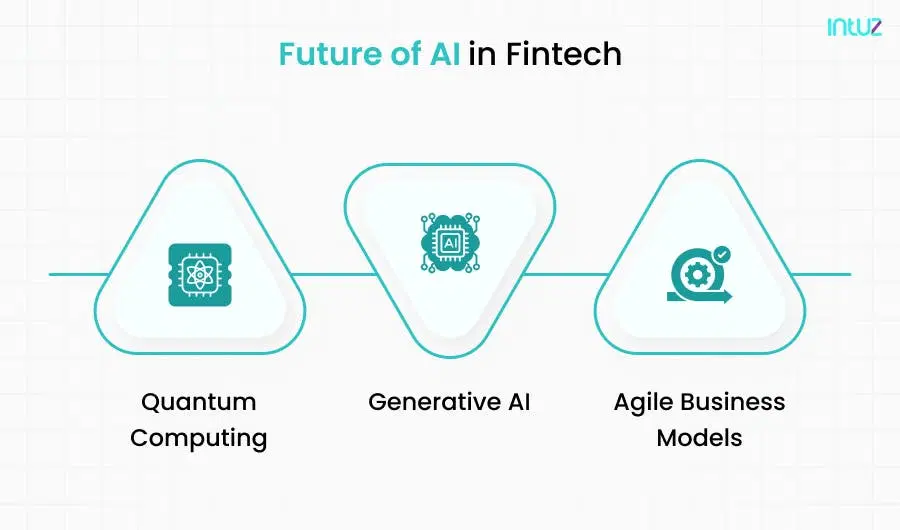
C. Transformation of Business Models
AI has the capability to improve routine and complex analytics. FinTech companies can work on adaptive, proactive, and evolving business models as AI-driven solutions go deeper into understanding customers, markets, and trends.
As a result, they will be able to remain relevant to their audiences and continuously provide ways to enhance customer value propositions. This leads to better revenue and sales.
Going forward, AI will become a strategic partner for FinTech companies, making them more customer-centric and agile than before.
Will the Human Touch Completely Vanish from FinTech Due to AI?
Today, we have FinTech chatbots servicing the customers, providing instant support as and when needed. At present, AI in FinTech is still growing amidst practical tests, analysis, and experimentation.
However, whether AI will take over depends on how much responsibility we want AI to have in the future. With privacy and data leakage debates still ongoing, we can expect the future AI to be human-regulated.
Explore Solutions
A Leading AI Development Services CompanyConclusion
AI in FinTech is creating new pathways for companies to build and deploy better solutions than before. While the companies are enhancing their security with FinTech’s assistance, they are providing better customer solutions. Effective AI-based trend analysis allows personalizing customer services, where FinTech chatbots are improving customer experience through instant assistance.
FinTech AI will become more important in the future. Intuz excels in FinTech app development with a comprehensive understanding of AI technology. We deliver AI-enabled future-ready FinTech applications and solutions. Get in touch.
FAQs
What is the best AI technology for fintech in 2026?
There’s no single best — the right stack depends on the problem. For fraud and credit risk, machine learning models (logistic regression, decision trees, SVMs) remain workhorses. For unstructured data like images, audio, and complex market patterns, deep learning and convolutional neural networks (CNNs) are the stronger choice. Blockchain and smart contracts add security and self-executing logic, while RPA automates back-office compliance. Looking ahead, generative AI and early-stage quantum computing are the technologies to watch. The smartest approach is matching the technology to your specific use case rather than chasing the newest trend.
How does AI detect fraud in financial transactions?
AI detects fraud by continuously monitoring user behavior and flagging actions that deviate from an expected pattern — an unusual login location, an atypical transaction size, or a spending sequence that doesn’t fit the customer’s history. Unlike static rule-based systems, machine learning models learn from new data and adapt as fraud tactics evolve. PayPal, for example, uses machine learning for real-time fraud detection to protect both customers and merchants. The advantage is speed and scale: AI reviews millions of transactions instantly and catches anomalies a human team would miss, reducing losses without slowing down legitimate payments.
What role do digital wallets play in the AI fintech shift?
Digital wallets are the foundation that made AI-driven fintech possible. They moved banking from physical queues to instant smartphone transactions, and modern wallets run on microservices, real-time processing, and machine learning rather than the closed-source integrations of the past. Adoption is significant — 53% of Americans use digital wallets and more than a quarter of UK payments are now contactless. Because wallets handle sensitive data, they pair AI with encryption and two-factor authentication for security. They’ve also driven financial inclusion: anyone with an NFC-enabled smartphone can send or accept payments.
How will generative AI and quantum computing change fintech?
Generative AI brings fintech-specific advantages in analyzing complex transaction patterns, mimicking human-like sentiment analysis, and training models for sharper fraud detection. Quantum computing, though still early-stage, performs large-scale computations far faster than classical machines — using techniques like the Quantum Monte Carlo Method and quantum machine learning to accelerate fraud checks and risk calculations. Both point toward fintech systems that are more precise and proactive. Real-world quantum applications remain under development, so treat it as a strategic watch-item rather than an immediate deployment, while generative AI is ready to deliver value now.
Work with Intuz
Bring AI Into Your Fintech Product
Talk to our AI experts about your fintech roadmap today
Let's Get Started
Share this article

![AI Agent Workflows: Top 5 Use Cases, Examples & Implementation Guide [2026]](https://www.intuz.com/wp-content/uploads/2026/04/AI-Agent-Workflows-Top-5-Use-Cases-Examples-Implementation.webp)