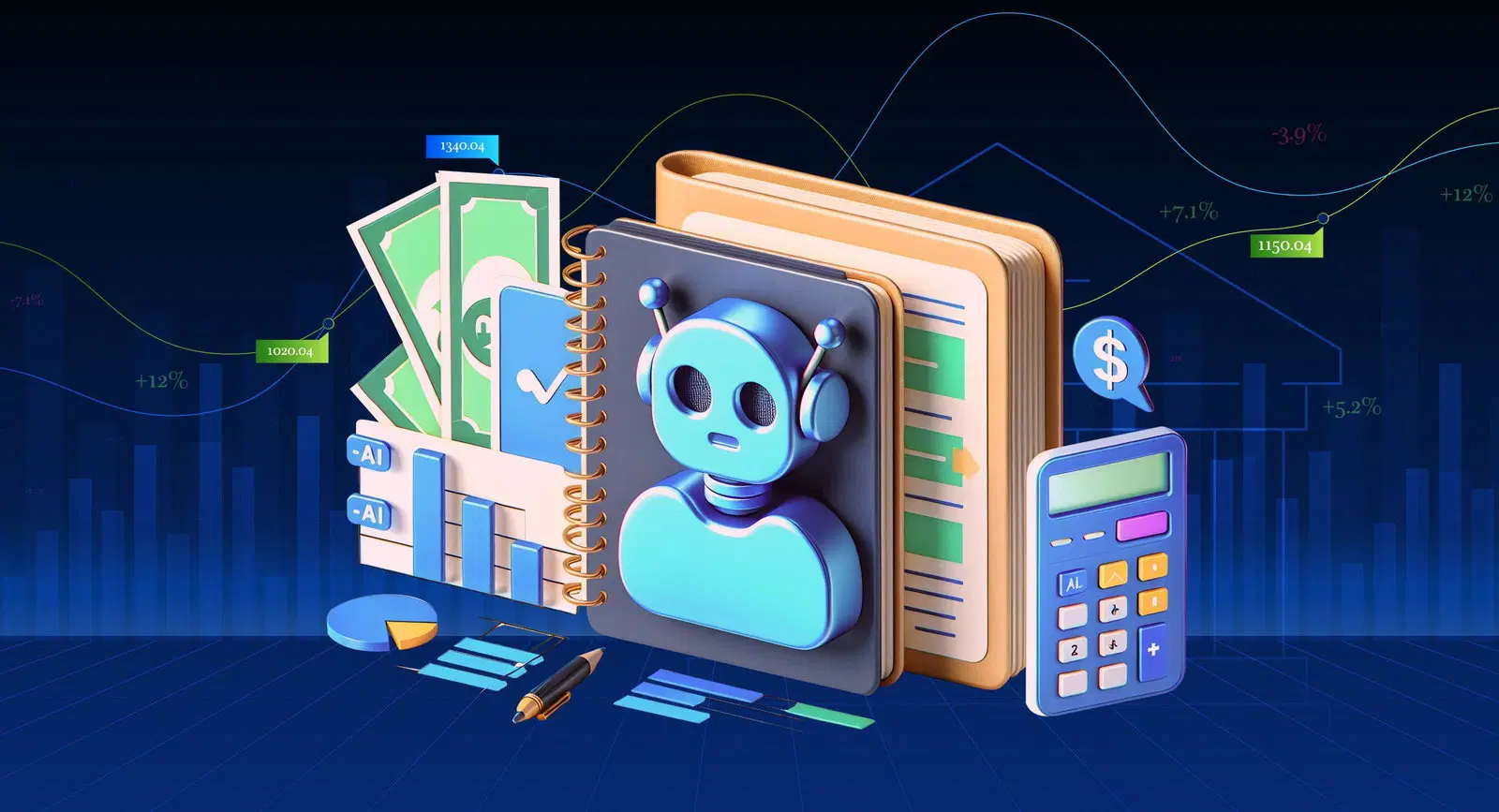




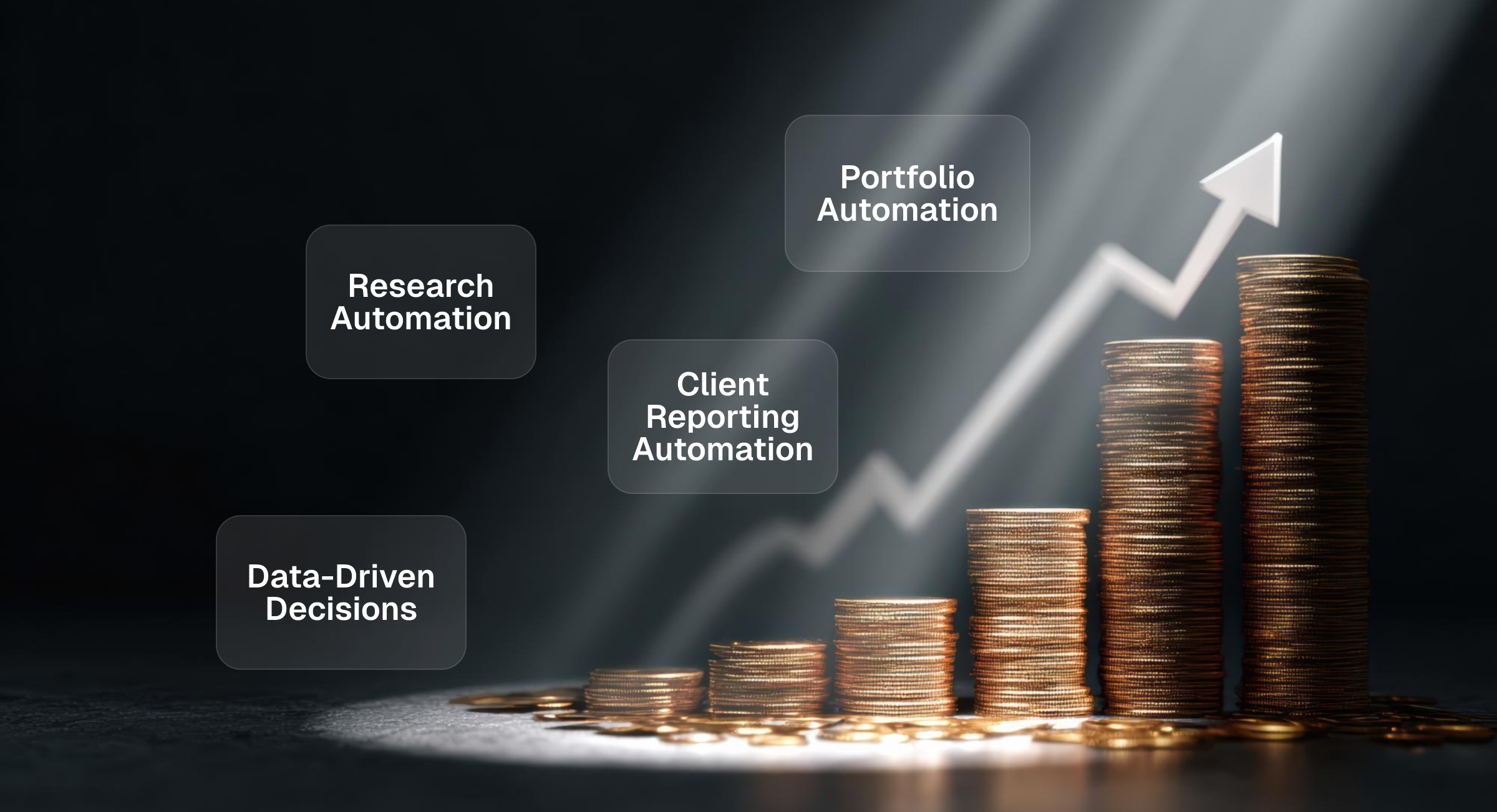
This guide looks at the practical applications of AI in investment management, the platforms already available, where custom AI makes sense, and what your firm should consider before putting it into production.
Here’s the deal: before your analysts can answer a single investment question, they must always have to pull information from filings, market feeds, portfolio systems, research archives, and client data. But that legwork is exactly where AI is gaining ground.
In EY’s 2025 survey of 100 wealth and asset managers, 95% said they had already scaled GenAI to multiple use cases. Yet only 27% reported a substantial business impact. The gap is telling: adopting AI is becoming easier.
However, making it genuinely useful inside an investment workflow is harder.
For mid-market investment firms and wealthtech platforms particularly, the opportunity here is to connect fragmented information, automate repetitive work, and give people better evidence when a decision requires judgment.
What Is AI in Investment Management?
It refers to the integration of Machine Learning (ML), Natural Language Processing (NLP), GenAI, and agentic systems across portfolio construction, risk oversight, market research, and other front, middle, and back-office workflows.
Each layer handles a different part of the job:
- ML detects patterns and estimates outcomes from structured data
- NLP and GenAI work with unstructured information such as filings, transcripts, news, and research
- Agentic AI in asset management can coordinate multi-step workflows across tools and systems
Key Applications of AI in Investment Management
Let’s take a look at five areas where AI is making the clearest difference:
1. Accelerate investment research
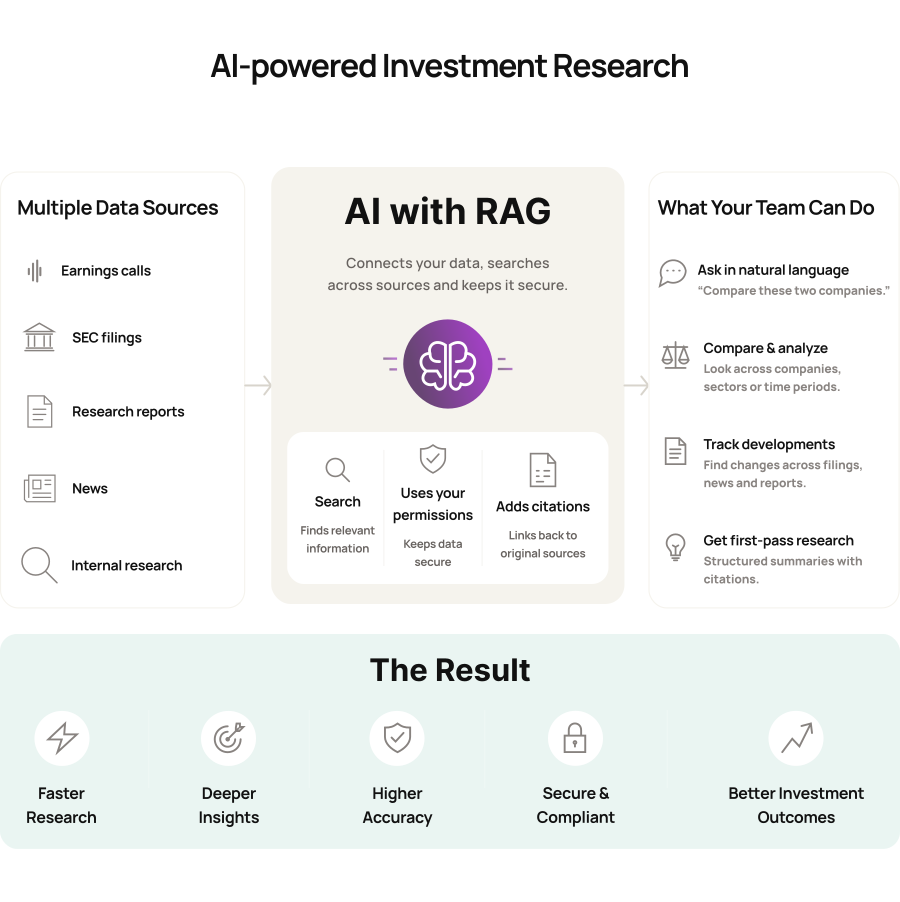
There’s no surprise that your analysts rarely struggle because information is unavailable. The harder problem is finding the evidence that matters across earnings calls, SEC filings, research reports, news, and years of internal research.
AI can let your team interrogate those sources in natural language, compare companies or sectors, trace developments across documents, and generate first-pass research with citations back to the original material.
Using an LLM with retrieval-augmented generation (RAG), you can connect your proprietary research repository with approved external data, apply your existing permission controls, and require citations for every answer.
2. Make Faster Portfolio Decisions Using AI Insights
Before increasing a position or rebalancing a portfolio, you must understand what the change could do to concentration, factor exposure, liquidity, tracking error, and other constraints.
AI for portfolio management can support allocation analysis, scenario testing, and what-if comparisons before a proposed decision is taken forward.
Let’s understand this with an example – suppose you’re considering increasing a semiconductor holding from 4% to 7%.
Now, instead of evaluating that change in isolation, you could test its effect on technology exposure, factor concentration, stressed liquidity, and tracking-error limits, then compare 5%, 6%, and 7% side by side.
According to McKinsey, implementing integrated AI tools can unlock productivity lifts equivalent to 25% to 40% of an average asset manager’s cost base.
The same analysis can extend into execution. Once you approve a portfolio change, you can use market and historical trading data to assess liquidity conditions, transaction costs, and post-trade review.
3. Catch portfolio risks and exceptions earlier
Portfolio analysis asks, “What happens if we make this change?” But risk monitoring? It compels you to ask something completely different: “What’s changing now that requires attention?”
By unifying portfolio holdings, market data, and internal risk rules, you can monitor for limit breaches, unusual exposure changes, deteriorating liquidity, or combinations of signals that warrant review.
For example, if an issuer’s credit spread widens sharply at the same time your exposure crosses an internal concentration threshold, an AI-enabled workflow can connect them, apply the relevant rules, and route the exception to the appropriate reviewer.
4. Customize wealth management and investor experiences
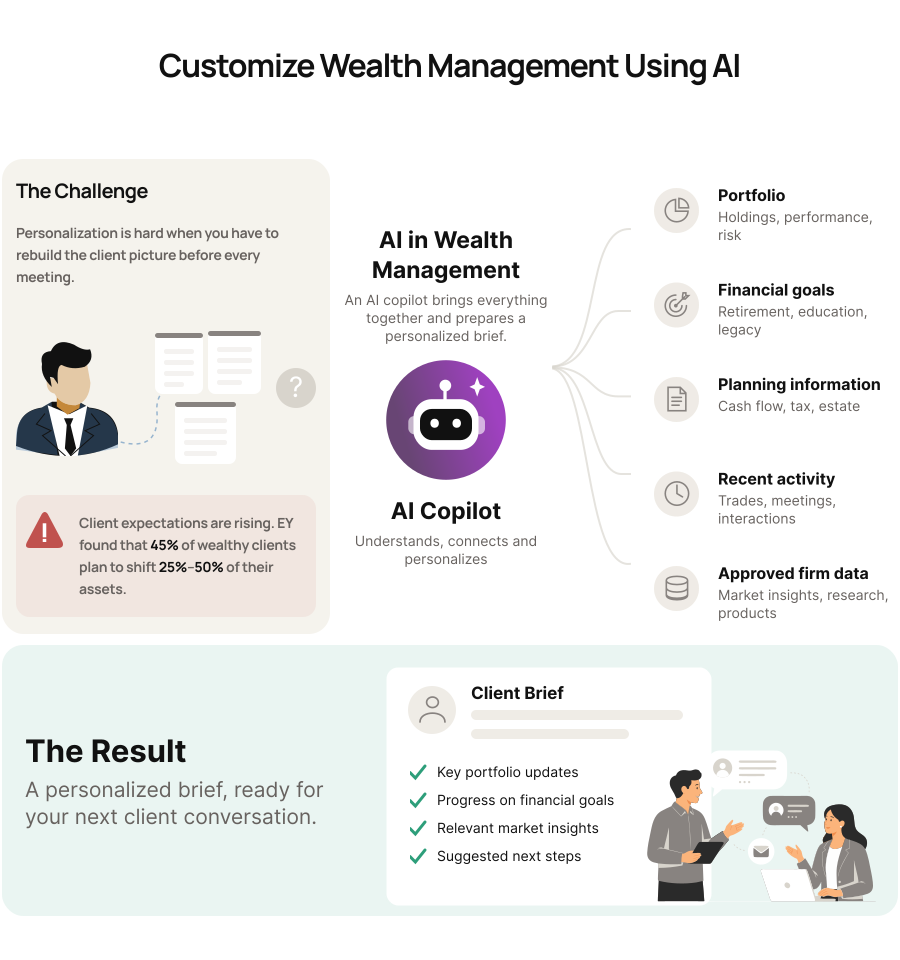
Personalization becomes difficult when you have to reconstruct the client picture manually before every meeting.
And the stakes are getting higher. EY found that 45% of wealthy clients plan to shift 25%–50% of their assets, as client relationships become more fluid and expectations around timely, relevant advice rise.
With AI in wealth management, a copilot can bring together a client’s portfolio, financial goals, planning information, recent activity, and approved firm data, then use that information to tailor a brief aligned with the conversation you’re about to have.
5. Discover signals in alternative data
Some investment insights never appear in a filing or earnings transcript. They emerge from patterns across datasets such as transaction activity, web traffic, supply-chain information, geospatial data, or other alternative sources.
ML models can analyze those datasets at a scale that would be difficult to handle manually, helping investment teams detect relationships, shifts, or emerging signals worth testing.
The important step is validation. A pattern that looks predictive in historical data may disappear as market conditions change, so signals need to be tested for robustness, bias, and decay before they influence a portfolio decision.
AI-Powered Investment Management Platforms and Tools
A Mercer survey found that 55% of asset managers have integrated AI into at least one investment process, even though 69% say data quality or access is still holding them back. If you’re ready to join them, you don’t have to build from scratch.
Several existing AI investment management tools already cover common research, portfolio, risk, and wealth workflows:
| Category | Examples | Best fit | Watch for |
| Investment research | AlphaSense | Searching and synthesizing filings, transcripts, broker research, news, expert content, and internal information | Firm-specific research logic or deeper proprietary integrations may need additional work |
| Portfolio and risk | BlackRock Aladdin Risk | Portfolio analytics, factor and exposure analysis, stress testing, scenarios and what-if modeling | Fit depends on asset classes, data environment, and existing portfolio infrastructure |
| Wealth and advisor AI | TIFIN Sage, Orion Denali AI | Advisor workflows, portfolio insights, meeting preparation, personalization and connected wealth workflows | Value depends heavily on integration with CRM, custodian, planning and portfolio systems |
When does custom AI make more sense?
An existing platform is usually the quickest option when your workflow matches what it already does well.
The equation changes when your advantage depends on proprietary research, specialized portfolio rules, firm-specific permissions, unique approval paths, or several systems that need to exchange data in a particular sequence.
That’s where Intuz can help.
We build AI around your data, workflows, and business logic rather than asking you to adapt them to a generic product.
That can mean a RAG-powered research copilot, predictive and anomaly-detection models, agentic workflows spanning multiple systems, or a custom application connected to your existing infrastructure.
And we build for production. Intuz has 54+ AI systems live today, spanning agentic LLMs, predictive models, computer-vision pipelines, and automation workflows, backed by 16+ years of enterprise software delivery.
AI Investment Management Tools: Should Investment Firms Buy a Platform or Build Custom AI?
Below is a comparison table to help you make a decision:
| Approach | Best fit | Main trade-off |
| Buy | Standard research, portfolio, risk, or advisor workflows | Faster adoption; less control over workflow logic |
| Customize | Existing platform plus proprietary data, rules, or integrations | More flexibility, within the platform’s boundaries |
| Build custom | Distinctive workflows, complex integrations, or proprietary processes | Maximum control; more implementation and governance work |
For many mid-market firms, the right answer will be a mix: keep the platforms that handle standard functions well, then add custom AI where the workflow is proprietary or consumes disproportionate manual effort.
Challenges of Adopting AI in Investment Management
The model itself is only one part of the problem. Here are the roadblocks you may encountering while deploying AI for investment management:
| Challenge | What it means in investment management |
| Data quality and lineage | Portfolio, market, research, and client data may sit across different systems, update at different speeds, or use inconsistent definitions. AI outputs are only as reliable as the data and source history behind them. |
| Validation and explainability | An investment team should be able to trace an insight, recommendation, or alert back to the data and evidence that produced it—and know where the model is likely to fail. |
| Security and permissions | Proprietary research, portfolio positions, client information, and other sensitive data need role-based access so AI does not expose information to the wrong user or workflow. |
| Integration | AI has limited value if it cannot work reliably with the systems your team already uses for research, portfolio management, risk, CRM, and reporting. |
| Model and vendor risk | Models, APIs, and third-party AI services can change over time. Firms need to understand dependencies, monitor performance, and plan for failures or provider changes. |
| Governance and human oversight | Define who can approve outputs, where human review is mandatory, how exceptions are escalated, and what gets logged before AI influences investment or client-facing workflows. |
Where Should You Start With AI in Investment Management?
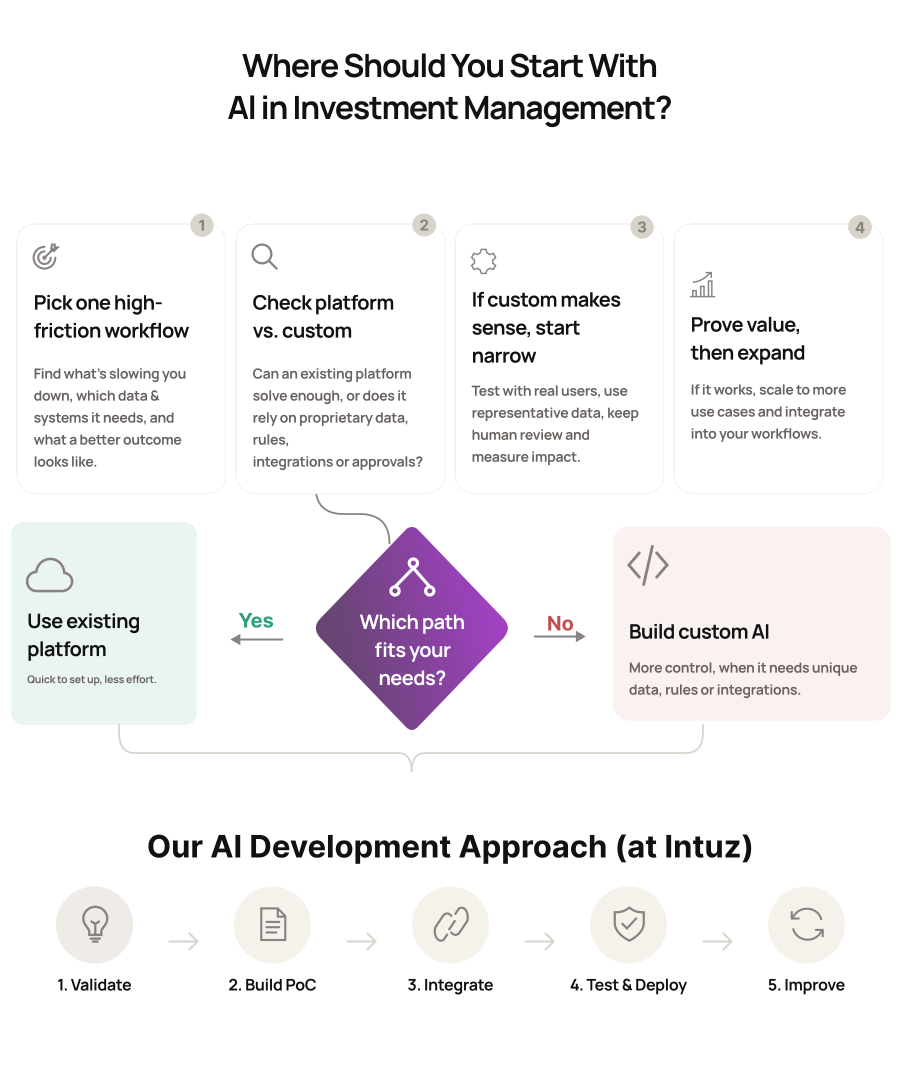
Start with one high-friction workflow. Define what’s slowing it down, which data and systems it depends on, and what a better outcome would actually look like.
Then ask a more practical question:
“Can an existing platform solve enough of the problem, or does the workflow depend on proprietary data, rules, integrations, or approvals that make custom AI worthwhile?”
If custom development makes sense, keep the first use case narrow. Test it with real users and representative data, preserve human review where judgment matters, and measure whether it improves speed, quality, or manual effort before expanding further.
That is also how we approach AI development at Intuz: validate the use case first, prove it through a working PoC, then move into integration, testing, deployment, and ongoing improvement. We won’t ask you to reinvent your technology stack to make AI in investment management useful.
Book a free 30-minute consultation with us and get a custom AI use-case assessment to identify where AI can reduce manual work, improve research productivity, or strengthen portfolio intelligence.
FAQs
What is AI in investment management used for?
Investment firms use AI to speed up research across filings and transcripts, test portfolio changes before acting, flag risk exceptions early, prepare personalized client briefs, and find signals in alternative data. Most start with research and operations, where the manual effort is heaviest.
Will AI replace portfolio managers or analysts?
No. AI does the legwork, gathering data, summarizing documents, running scenarios and flagging exceptions. Investment decisions still need human judgment, accountability and client context. What changes is the analyst’s day, with less time spent collecting information and more spent interpreting it and challenging assumptions.
Should a mid-market firm buy an AI platform or build custom AI?
Buy when your workflow matches what tools like AlphaSense or Aladdin already do well. Build custom when your edge depends on proprietary research, firm-specific rules, unique approval paths, or several systems that must share data.
How does RAG make AI research tools reliable for investment teams?
Retrieval-augmented generation bases answers on your approved documents instead of the model’s general training. Each response cites its source, follows existing user permissions and stays traceable. That lowers hallucination risk and lets analysts check a claim quickly before relying on it.
What data does an investment firm need before adopting AI?
You need clean portfolio, market, research and client data with consistent definitions and clear lineage, because AI outputs are only as reliable as their inputs. Start by mapping where your data lives, how often it updates, and who is allowed to access it.
Are there regulations on using AI in investment management?
In the US, the SEC withdrew its proposed predictive data analytics rule in June 2025. Existing obligations still apply: fiduciary duty, supervision, recordkeeping, data privacy and accurate marketing claims about AI. Firms should log AI outputs and keep human review on client-facing decisions.
How long does it take to implement custom AI for an investment firm?
It depends on how ready your data is, how many integrations you need, and your governance requirements. The fastest route is one narrow use case proven through a working proof of concept with real users and data, then expanded into full production.
How do you measure the ROI of AI in investment management?
Record baseline metrics before launch, such as analyst hours per research task, meeting prep time, exceptions caught before a breach, and error rates, then compare them after deployment. EY found only 27% of firms report substantial impact, so measuring is what proves the value.
Work with Intuz
Need Custom AI for Your Investment Platform?
Build smarter investment solutions with custom AI.
Let's Get Started
Share this article