



How much should you spend on AI automation before you know it will pay off?
That question gets harder for CEOs and CTOs once a promising use case starts competing for budget, engineering time, and executive attention – and for the attention of the people who have to approve it.
IBM’s 2025 CEO Study found that only 25% of AI initiatives had delivered their expected ROI, while 64% of C-suite execs said pressure to keep pace was driving some technology investments before their organizations clearly understood the value they’d generate.
AI automation consulting is one way to narrow that uncertainty early. It gives you a structured way to test the business case, pick a technical approach, get a realistic estimate of implementation effort, and work out where you’ll need outside expertise.
That’s exactly what this guide is for – the thinking worth doing before a promising use case turns into a production system. Let’s get started with one basic question.
Which Business Processes Are Worth Automating With AI?
The strongest candidates are the ones where you can put a number on the business value before implementation starts.
Let’s assume that your finance team spends 100 hours each month reviewing invoices, correcting entries, and routing approvals. You already know what that costs in staff time, how much of it are re-works, and how long a single invoice takes to clear.
Those numbers give you a baseline for estimating potential savings and measuring the result against your deployment. That discipline is rarer than it sounds, which is why so few companies can show actual returns.
According to BCG’s 2026 AI Radar, 82% of CEOs were more optimistic about AI ROI than a year earlier, while only 6% of companies were seeing meaningful value measured through lower costs or higher revenue.
Use the following scorecard to compare candidate workflows on the same basis:
| Factor | Question to ask | Strong candidate |
| Frequency | How often does the work occur? | Daily or high-volume activity |
| Labor cost | How much staff time does it consume? | Meaningful recurring cost |
| Error and rework | What happens when the process goes wrong? | Errors create measurable cost or delay |
| Input quality | Can the system access usable information? | Structured or manageable semi-structured inputs |
| Measurement | Can you define success before implementation? | Clear time, cost, accuracy, throughput, or SLA metric |
| Feasibility | Can the required systems exchange data reliably? | Accessible APIs, databases, files, or approved interfaces |
After that, think about the agentic workflows on value and feasibility. For example:
- A high-volume process with modest savings per transaction may outrank a lower-volume process that looks more sophisticated
- A technically simple workflow can deserve priority when it releases enough staff capacity to create a fast payback period
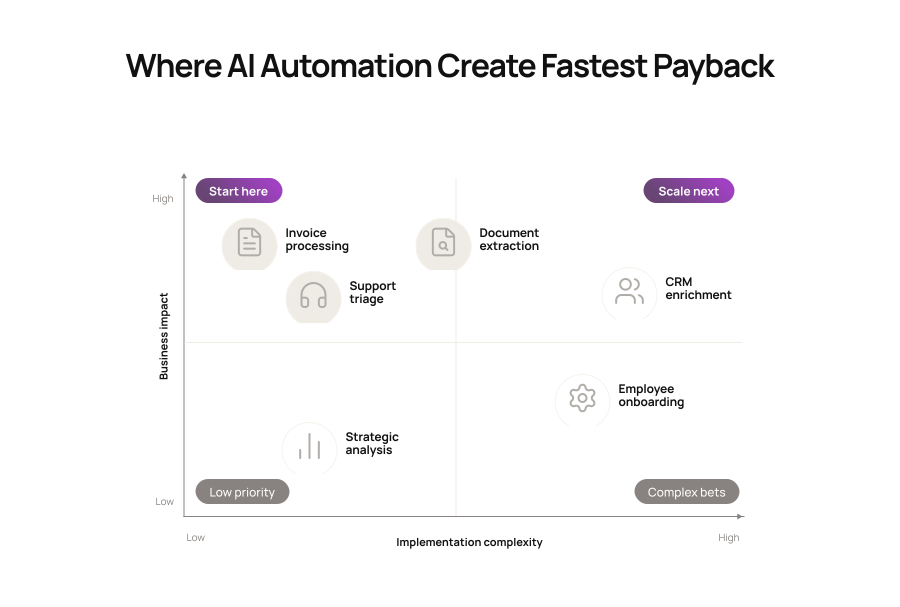
When should you leave a process alone?
Low-volume strategic work, poorly defined processes, work that depends heavily on human judgment, and workflows without a clear owner make weak first candidates. In these cases, process cleanup or clearer ownership may create more value before automation is done.
How to Choose the Right AI Automation Approach
Once you have a suitable workflow, the next decision is architectural. Ideally, the setup should reflect how predictable the workflow is, what type of information it receives, how many systems it touches, and how much judgment the system must exercise.
We’ve identified three approaches for AI automation:
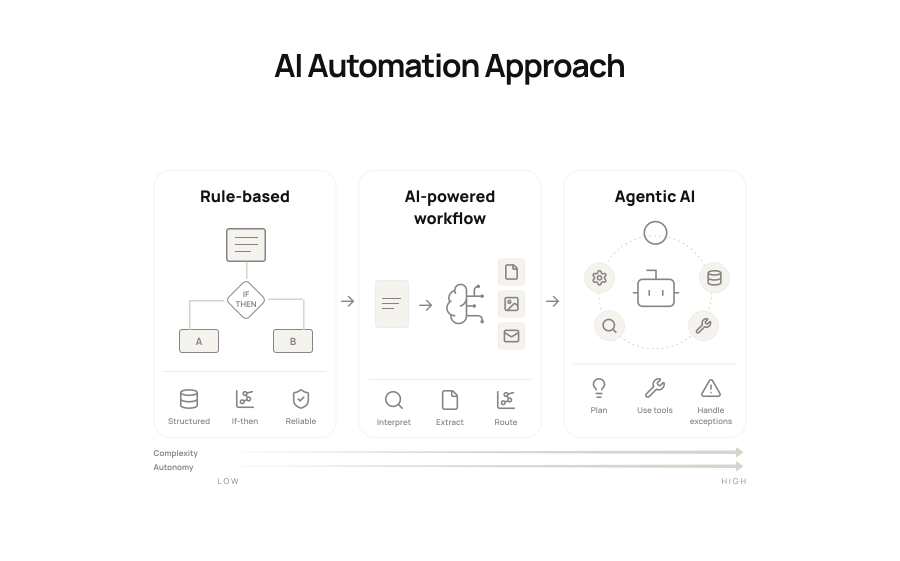
| Approach | Best fit | Example | Relative complexity | Key limitation |
| Rule-based or classic workflow automation | Structured inputs and predictable if-then logic | Moving approved form data into a CRM and triggering notifications | Low | Becomes fragile when inputs vary or interpretation is required |
| AI-powered workflow automation | Emails, PDFs, documents, and free text that require interpretation before an action | Extracting invoice data, classifying support requests, or summarizing documents | Medium | Requires evaluation and controls around model output |
| Agentic AI | Multi-step goals requiring planning, tool use, decisions, and exception handling | Resolving a service request across several systems while adapting to new information | High | Greater testing, governance, inference cost, and failure exposure |
The key distinction here is how much control the AI has over what happens next. For example, generative AI is often enough when the workflow needs extraction, classification, summarization, or content generation before a deterministic action.
On the other hand, agentic AI becomes relevant when the system must plan across several steps, use tools, interpret changing context, and decide what to do next.
McKinsey reports that 40% of respondents at organizations with more than $1 billion in annual revenue were scaling AI agents, compared with 22% at smaller organizations.
For an SMB like yours, that gap must support a disciplined architecture decision. Therefore, match autonomy to the workflow and the controls your business can support.
How Long Is the AI Automation Implementation Process?
Implementation time changes sharply once automation starts touching production systems, customer data, approval paths, or business-critical actions. Here’s what our research found on how long SMB AI projects take:
| Project type | Practical planning range |
| Bounded low-code or rule-based workflow | 2 to 6 weeks |
| AI-powered workflow with integrations | 6 to 12 weeks |
| Single-domain production AI agent | 8 to 16 weeks |
| Multi-agent or multi-workflow program | 4 to 7+ months |
A sound implementation comprises four phases:
- Assessment establishes the workflow, baseline metrics, constraints, and highest-value opportunity
- Architecture maps data, models, workflow logic, integrations, approvals, and fallback paths
- Implementation connects and tests those components against representative data
- Validation covers edge cases, permissions, exception handling, user acceptance, documentation, and handoff
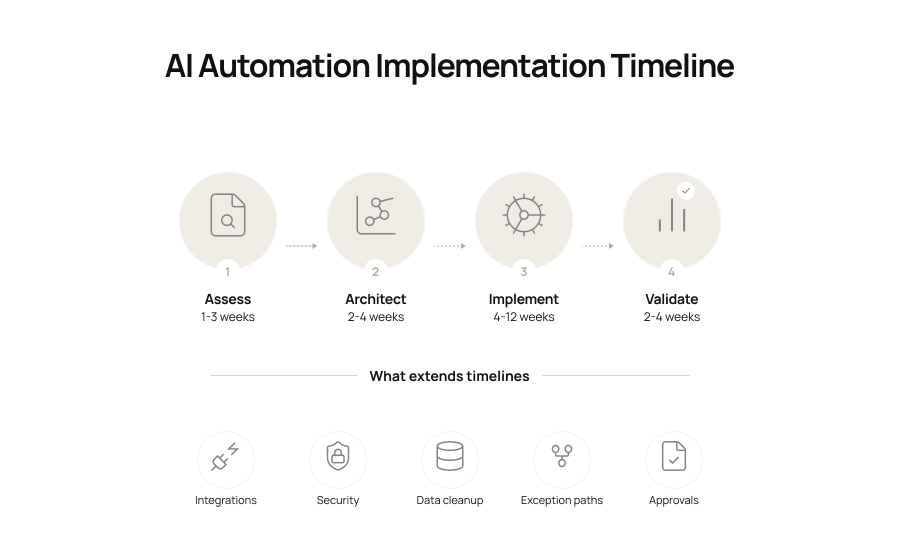
Faster projects tend to have narrow scope, clean system access, and clear decision ownership. Timelines expand with undocumented exceptions, delayed permissions, security requirements, or ambiguous approval rules. Those same variables affect how much you’ll spend.
How Much Does AI Automation Consulting Cost?
AI automation consulting can cover anything from a short opportunity assessment to a multi-system production program. Public pricing data spans a wide range because the phrase covers very different scopes, skill levels, and implementation requirements.
For an SMB, the following 2026 ranges are more useful when you analyze the engagement types. They combine current marketplace and agency pricing signals across consulting, workflow automation, and AI agent projects.
| Engagement | Indicative planning range | What the budget covers |
| Opportunity audit or readiness assessment | $1,500 to $4,000 | Workflow review, feasibility, prioritization, initial business case |
| AI strategy and roadmap | $4,000 to $10,000 | Prioritized use cases, architecture direction, KPIs, phased roadmap |
| Proof of value or focused pilot | $8,000 to $20,000 | One bounded use case tested against representative data |
| Simple workflow implementation | $3,000 to $15,000 | Low-code or rule-driven automation with limited integration |
| Custom AI-powered workflow | $10,000 to $50,000 | AI interpretation plus orchestration and business-system integration |
| Agentic business process | $25,000 to $75,000 | Multi-step tool use, evaluations, controls, and integrations |
| Multi-agent or complex program | $100,000 to $250,000+ | Several processes, deeper integrations, security, governance, and rollout |
| Ongoing advisory and optimization | $1,500 to $8,000/month | Review, optimization, additional use cases, and technical guidance |
Treat these as budgeting bands rather than standardized market rates. Integration depth, security requirements, autonomy, custom engineering, and the condition of your existing systems can move the final quote substantially.
The type of engagement also changes what you receive for that investment – for instance:
- Advisory work may end with a prioritized roadmap, while implementation adds integrations, testing, controls, deployment, and handoff
- AI transformation consulting can extend across several processes, teams, and governance requirements
Pricing structure matters as well:
- Fixed-scope pricing fits a well-defined workflow and clear deliverables
- Hourly pricing suits exploratory or specialist work where requirements may change.
- A retainer makes sense for an organization with a continuing pipeline of workflows to review, implement, and improve
What is ROI of AI Automation – Example
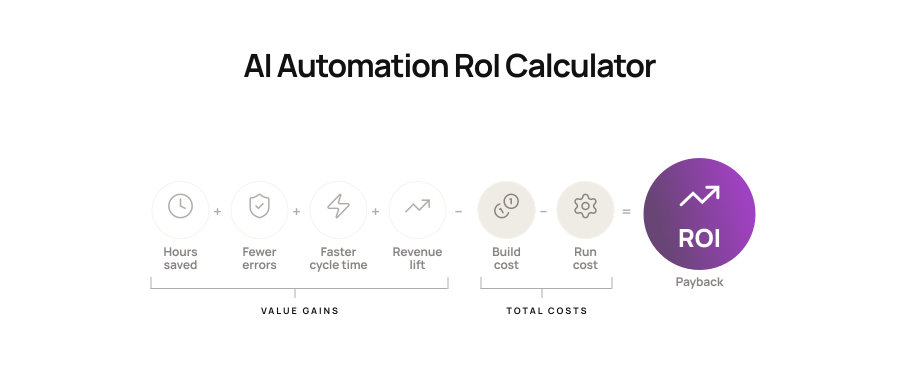
Assume an automation project generates the following first-year financial benefits:
| First-Year Benefits | Value |
|---|---|
| Staff capacity value | $46,800 |
| Rework reduction | +$8,000 |
| Total first-year benefit | $54,800 |
The associated first-year costs are:
| First-Year Costs | Value |
|---|---|
| Implementation cost | $25,000 |
| Operating cost | +$6,000 |
| Total first-year cost | $31,000 |
First-Year ROI
Using the standard ROI formula:
ROI = (Total Benefit − Total Cost) ÷ Total Cost × 100
ROI = ($54,800 − $31,000) ÷ $31,000 × 100 = 76.8%
Estimated first-year ROI: approximately 77%
This assumes the freed staff capacity can be productively redeployed.
Should You Buy, Build, or Hire an AI Automation Consultant?
A positive business case still leaves one execution decision: who should deliver the capability? Below are three options:
| Route | Best when | Main consideration |
| Buy | The process is standard and an existing SaaS or low-code product covers most requirements | Fast entry and lower initial engineering effort, with less differentiation |
| Develop in-house | AI is strategically important and you have sustained demand plus strong engineering and data capability | Greater control requires permanent talent, infrastructure, and ownership |
| Hire experts | You need specialized skills, faster delivery, architecture validation, or capacity your internal team cannot provide | Partner quality and knowledge transfer become critical |
| Hybrid | Parts of the workflow are standard while other components require custom logic or integration | Combines mature platforms with targeted custom development |
For many SMBs considering agentic AI consulting services, the hybrid route is the most practical.
Existing platforms can handle standard functions, internal teams retain process knowledge, and an external AI automation consultant handles deeper AI, integration, or production work.
If external expertise works better for the project, the next question is how to evaluate the firm taking responsibility for it.
How to Choose an AI Automation Consulting Partner
If your use case involves generative AI consulting services, the provider type may affect price, team structure, delivery capacity, and the kind of engagement you receive. Compare against the scope you defined earlier rather than using hourly rate as the primary filter.
| Provider type | Public pricing signal | Best fit |
| Independent consultant | $35 to $60/hour on Upwork; experienced specialists can exceed $100/hour | Focused assessment, advisory work, or narrow technical scope |
| AI automation or development firm | $24 to $49/hour is common on Clutch; reviewed projects often fall between $10,000 and $49,999 | Workflow implementation and integration |
| Specialist AI consultancy | About $150 to $350/hour | Higher-complexity strategy, architecture, and technical programs |
| Large consultancy/ Big Four | About $300 to $600+/hour | Large transformation, governance, and cross-enterprise programs |
After narrowing the provider type by budget and scope, the harder part is judging whether the team can handle the work well. These questions will help you determine that before you sign:
1. Can the AI automation consultant tell you when AI adds unnecessary complexity?
A credible consultant should recommend a deterministic workflow when the process doesn’t require AI. Ask why the proposed architecture aligns with the work, which alternatives were considered, and what each added layer costs.
2. Can they prove they have delivered comparable systems?
A prototype proves technical feasibility under controlled conditions. Ask for evidence of systems handling integrations, exceptions, permissions, monitoring, and operational consequences after deployment.
3. Can they define how performance will be evaluated?
The proposal for AI automation consulting should establish acceptance criteria before implementation begins. For AI components, those criteria can include accuracy thresholds, task completion, escalation rates, latency, model cost, and failure behavior.
4. Who owns the system after deployment?
Clarify documentation, access, source code where applicable, platform accounts, monitoring, support, knowledge transfer, and responsibility for future changes before signing the statement of work.
Red flags when choosing an AI automation consultant
Be cautious when a provider:
- Recommends agentic AI before mapping the workflow
- Promises ROI without establishing a baseline
- Avoids specific answers about security or exception handling
- Shows demos without production evidence
- Creates unnecessary dependence on proprietary components
- Is vague about ownership post-deployment
Ready to Automate? See How Intuz Approaches AI Automation Consulting
By this point, you should have a clearer sense of what deserves automation, what the project may cost, and what a credible implementation should involve. Now you need a strong consulting partner who can carry that thinking through to production.
At Intuz, we can do that for you.
We start by looking at the workflow and its economics: where time, cost, errors, or capacity are being lost, what improvement would justify the investment, and whether the process calls for rule-based automation, an AI-powered workflow, or greater autonomy.
From there, we list all production requirements across systems, data, integrations, model behavior, approval points, exception paths, security, and performance metrics.
Our teams then handle implementation, integration, testing, and deployment. We validate the system against representative data and real workflow conditions, including cases that need human escalation.
We also cover documentation and handoff so your team understands how the system functions, performs, and what ongoing management is required.
Trust us – this work draws on 16+ years of engineering experience, 700+ products delivered, 54+ AI systems in production, and work across 40+ countries. If you have something in mind, book a free 30-minute consultation with Intuz.
FAQs
How much does AI automation consulting cost?
AI automation consulting costs range from $1,500–$4,000 for an opportunity audit to $100,000–$250,000+ for multi-agent programs in 2026. A focused pilot runs $8,000–$20,000, and custom AI-powered workflows $10,000–$50,000. Integration depth, security needs, and autonomy shift final quotes significantly, so treat these as budgeting bands.
What is the ROI of AI automation?
AI automation ROI depends on labor savings, reduced errors, faster processing, and increased operational capacity. A practical ROI calculation compares the annual financial benefits from automation with implementation and operating costs. Many businesses target measurable payback within 6–18 months, although results vary by workflow and automation complexity.
How long does AI automation implementation take?
Timelines depend on scope. A bounded low-code or rule-based workflow takes 2–6 weeks, an AI-powered workflow with integrations 6–12 weeks, a single-domain production AI agent 8–16 weeks, and a multi-agent program 4–7+ months. Undocumented exceptions, delayed permissions, and security requirements extend these ranges.
Should you buy, build, or hire an AI automation consultant?
Buy when the process is standard and existing SaaS covers most needs. Build in-house when AI is strategic and you have sustained demand plus strong engineering talent. Hire experts for specialized skills or faster delivery. For most SMBs, a hybrid route combining platforms and external expertise is most practical.
How do you choose an AI automation consulting partner?
Compare providers against your defined scope, not hourly rate alone. Independent consultants run $35–$60/hour, AI development firms $24–$49/hour, specialist consultancies $150–$350/hour, and Big Four firms $300–$600+/hour. Before signing, confirm they can recommend simpler non-AI options, prove comparable production systems, define acceptance criteria, and clarify post-deployment ownership.
Which business processes can AI automation consultants automate?
AI automation consultants can automate processes involving repetitive decisions, document processing, customer interactions, data entry, approvals, reporting, and system updates. Common examples include invoice processing, lead qualification, customer support, employee onboarding, claims processing, order management, and compliance workflows. The best candidates usually have high volume and measurable manual effort.
How do I identify the right processes for AI automation?
Start by mapping repetitive workflows and measuring time spent, transaction volume, error rates, delays, and labor costs. Prioritize processes that are frequent, rule-driven, time-consuming, and connected to measurable business outcomes. Avoid automating poorly defined processes first; standardizing the workflow can be necessary before introducing AI automation.
Work with Intuz
Not Sure What to Automate First?
We’ll identify high-value automation opportunities and outline the right approach for your business.
Let's Get Started
Share this article