


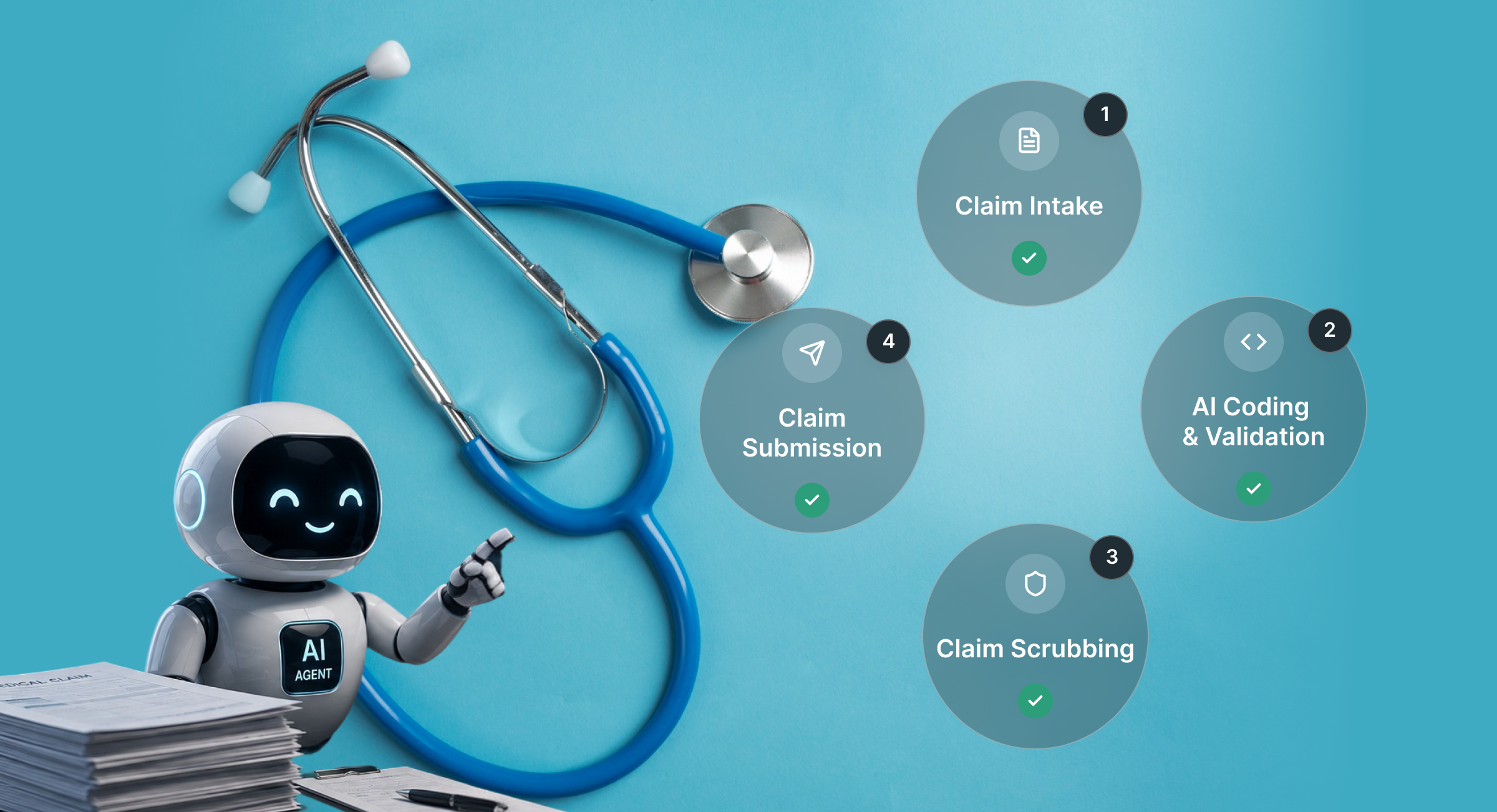
In this blog, you’ll learn how AI medical billing automation works, where AI adds value, what real-world results look like, and how you can choose a practical starting point for your organization.
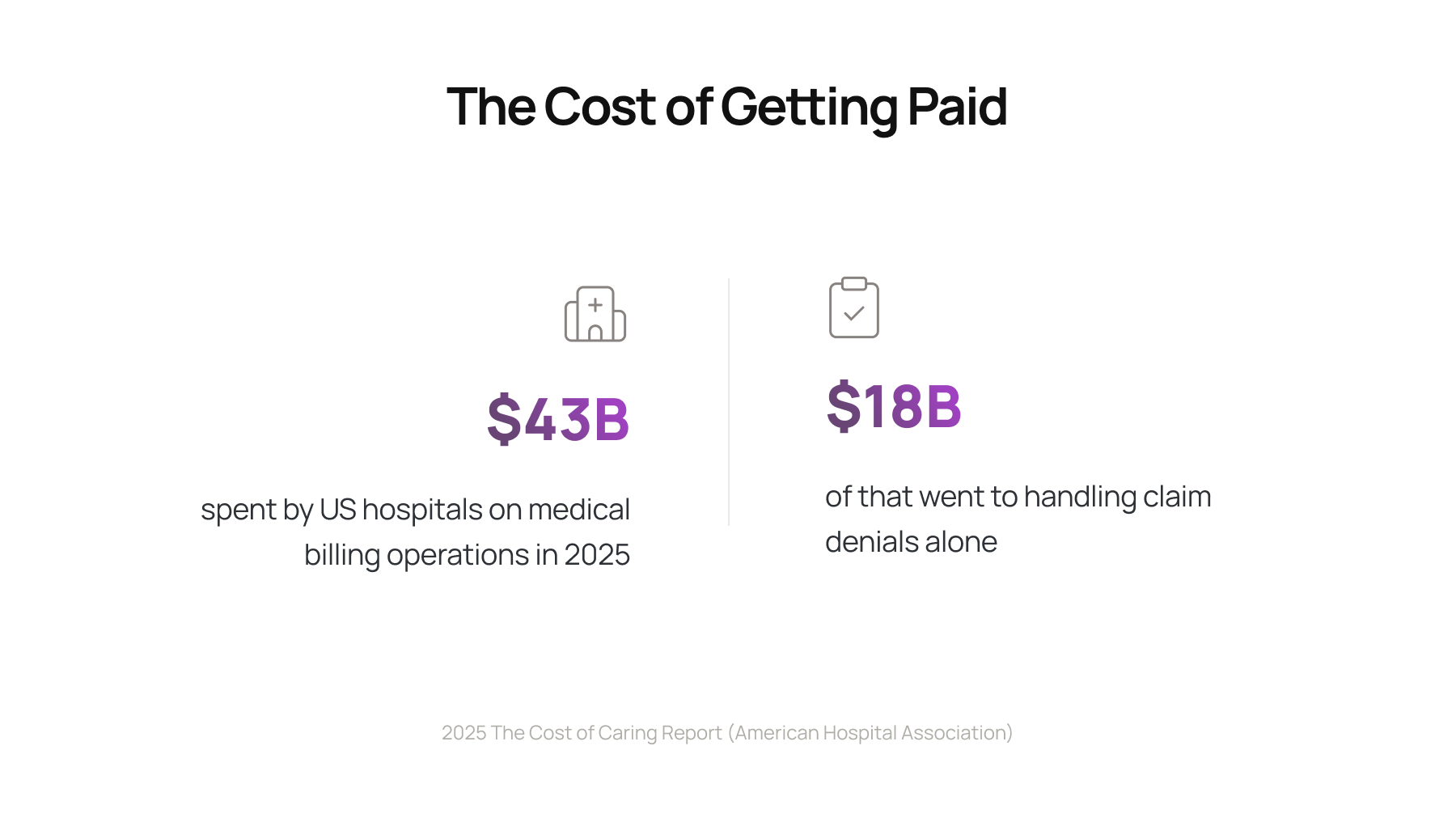
How much are you spending just to get paid for care you’ve already delivered? For US hospitals, that number reached an estimated $43 billion in 2025, with nearly $18 billion spent dealing with claim denials alone. If you think about it, it isn’t surprising.
Your billing operation carries that workload across eligibility, coding, claims, denials, payments, and follow-up.
You may manage it internally or rely on outsourcing medical billing services for additional capacity. But when AI is built into an automated billing workflow, it can take on decisions and admin work that conventional rule-based automation can’t handle as easily.
In this blog, you’ll learn how AI medical billing automation works, where AI adds value, what real-world results look like, and how you can choose a practical starting point for your organization.
What Is AI Medical Billing Automation?
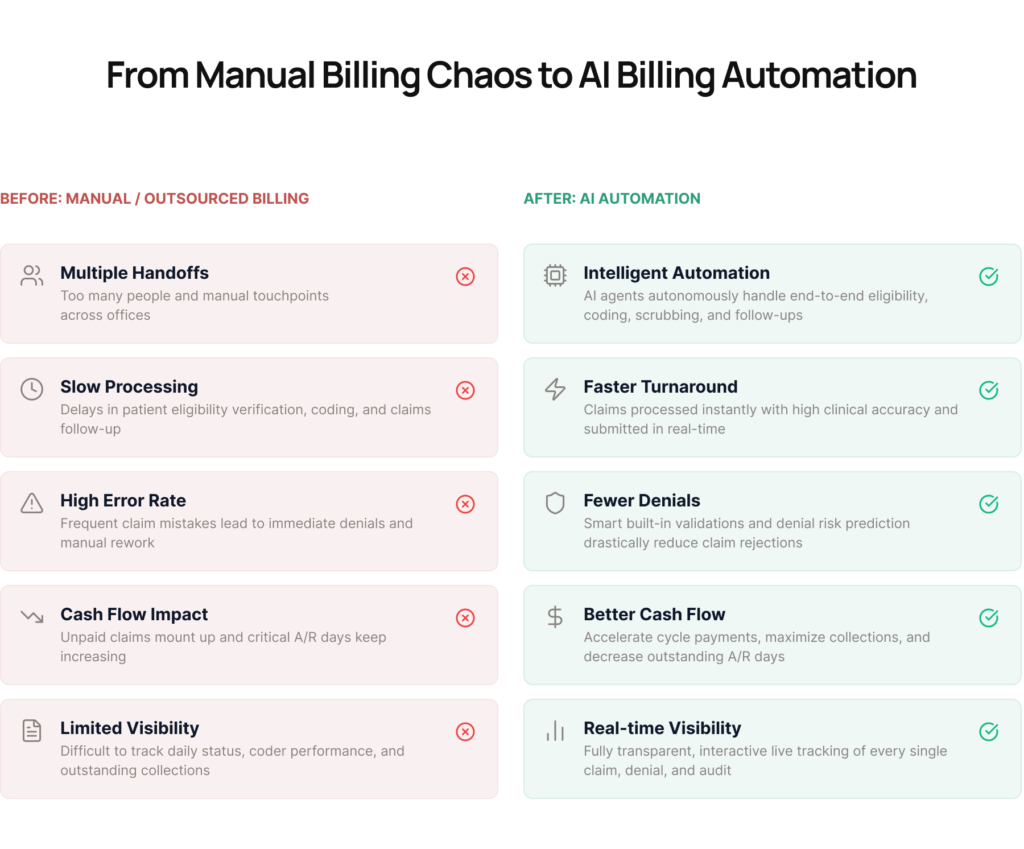
AI medical billing automation refers to a connected system of software, AI models, rules, and integrations that performs and coordinates billing tasks across your revenue cycle with limited manual intervention.
It can read and structure information, validate data, recommend or assign codes, check claims against payer requirements, identify denial risk, trigger follow-up actions, and route exceptions to the appropriate person for review.
| Area | Traditional automation | AI-enabled automation |
|---|---|---|
| Inputs | Works with structured, standardized data | Also handles notes, PDFs, and payer responses using OCR and NLP |
| Decision-making | Follows predefined rules | Uses rules and AI models to assess context, risk, and priority |
| Exceptions | Sends failed items to a queue | Identifies the issue and routes it with relevant context |
| Follow-up | Triggers reminders or scheduled checks | Interprets responses and triggers the appropriate next action |
| Impact | Automates repetitive, rule-based tasks | Extends automation to more variable and decision-heavy work |
How AI Automates the Medical Billing Workflow
Here’s how AI can take on different parts of that process without treating every claim the same way:

Step 1: Verify insurance eligibility automatically
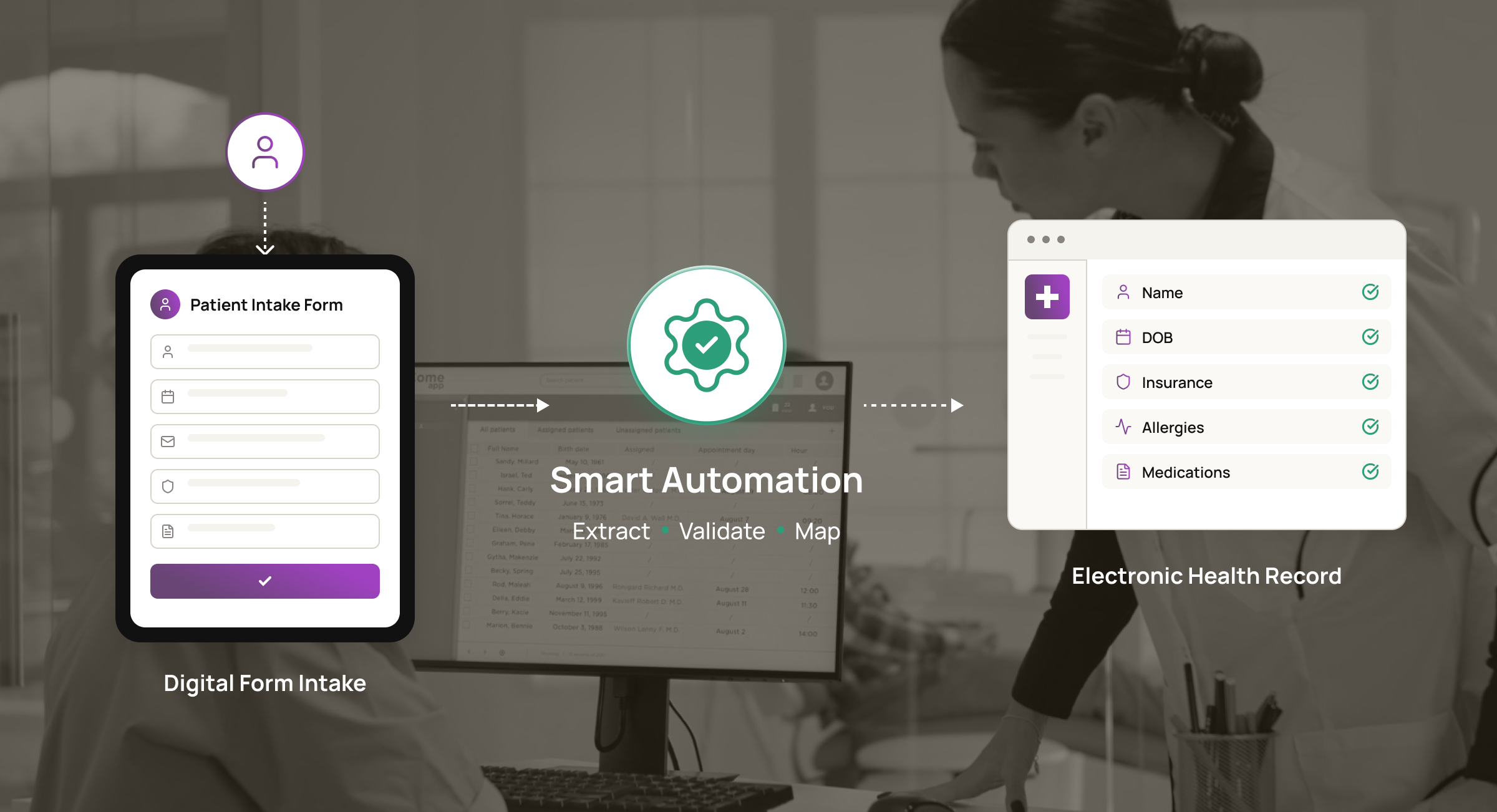
When you schedule an appointment, the eligibility workflow can automatically send an inquiry to the payer and capture details such as coverage status, member information, deductibles, copays, and available benefits.
AI can compare the payer response with the patient information already captured during scheduling and identify issues such as inactive coverage, demographic mismatches, incomplete benefit information, or conflicting payer data.
This allows the clean cases to continue without staff intervention, while exceptions are sent for verification with the problem already identified.
Intuz Best Practice
We recommend defining eligibility exceptions before automating the workflow, so routine cases keep moving without unnecessary review. For example, inactive coverage might go to registration, demographic mismatches to verification, and unclear payer responses to manual follow-up.
Step 2: Use AI-assisted medical coding for charge entry
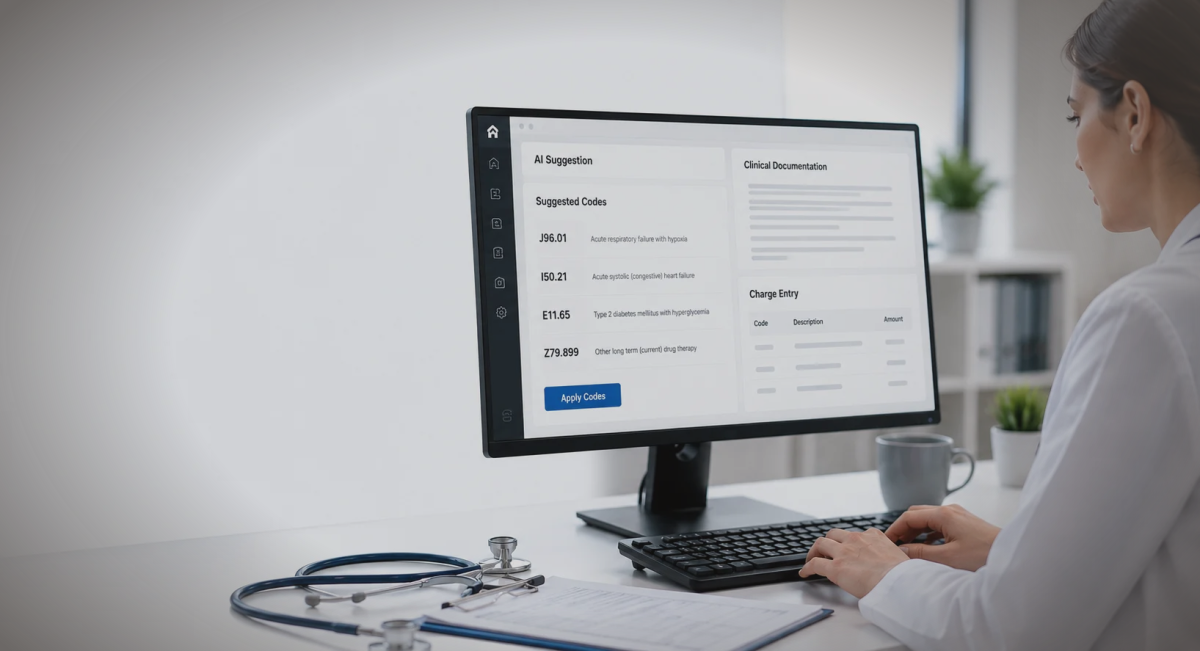
Once clinical documentation is complete, you can use Natural Language Processing (NLP) to extract diagnoses, procedures, medications, and other relevant clinical information.
If information arrives through scanned records, PDFs, or other document-based sources, OCR can convert it into structured data first.
AI can then use that information to suggest ICD-10-CM, CPT, or HCPCS codes and assign confidence scores to the recommendations.
Intuz Best Practice
Keep the source evidence next to every AI-suggested code so reviewers can validate it quickly. For instance, if the model proposes a CPT code, show the procedure text that triggered the suggestion rather than making the coder reopen the record.
Step 3: Scrub claims and predict denial risk before submission
Before you submit a claim, healthcare revenue cycle automation can check it for missing authorization data, incorrect patient or provider information, unsupported code combinations, modifier issues, and payer-specific submission requirements.
Claims with clear validation errors can be held back for correction before they reach the payer.
For claims that pass those checks, Machine Learning (ML) models can assess denial risk using historical outcomes, payer behavior, documentation completeness, and previous denial patterns.
You can use that risk assessment alongside claim value, filing deadlines, documentation completeness, and other priorities to decide where pre-submission review will have the greatest value.
Intuz Best Practice
Log every failed validation as structured data. Capture the rule that failed, the original value, the correction or reviewer action, and the final outcome. Once the same issue starts appearing repeatedly, you have a concrete candidate for a new validation rule or workflow change instead of relying on anecdotal feedback from your billing team.
Step 4: Automate payment posting and claims follow-up
After adjudication, automatically match electronic remittance information with the corresponding claim, payment, adjustment, and patient account. Straightforward payments can then be posted without requiring your team to reconcile every transaction manually.
If a claim remains unpaid, is denied, or requires further action, AI can interpret the available payer response and help determine the next step.
You can use that information to prioritize follow-up and send cases for correction, documentation, or appeal based on what the claim requires.
Intuz Best Practice
In follow-up automation, we advise mapping each payer response to a specific action and defining where the process ends. “Pending” can schedule another check; “denied” or “documentation required” should hand the claim to the appropriate person.
Real-World Results: Medical Billing Automation Case Studies
Peer-reviewed evidence on end-to-end AI billing automation is still developing, but medical coding already offers us useful evidence of how AI performs inside real healthcare workflows. Two studies illustrate different benefits:
1. Kaohsiung Medical University Hospital
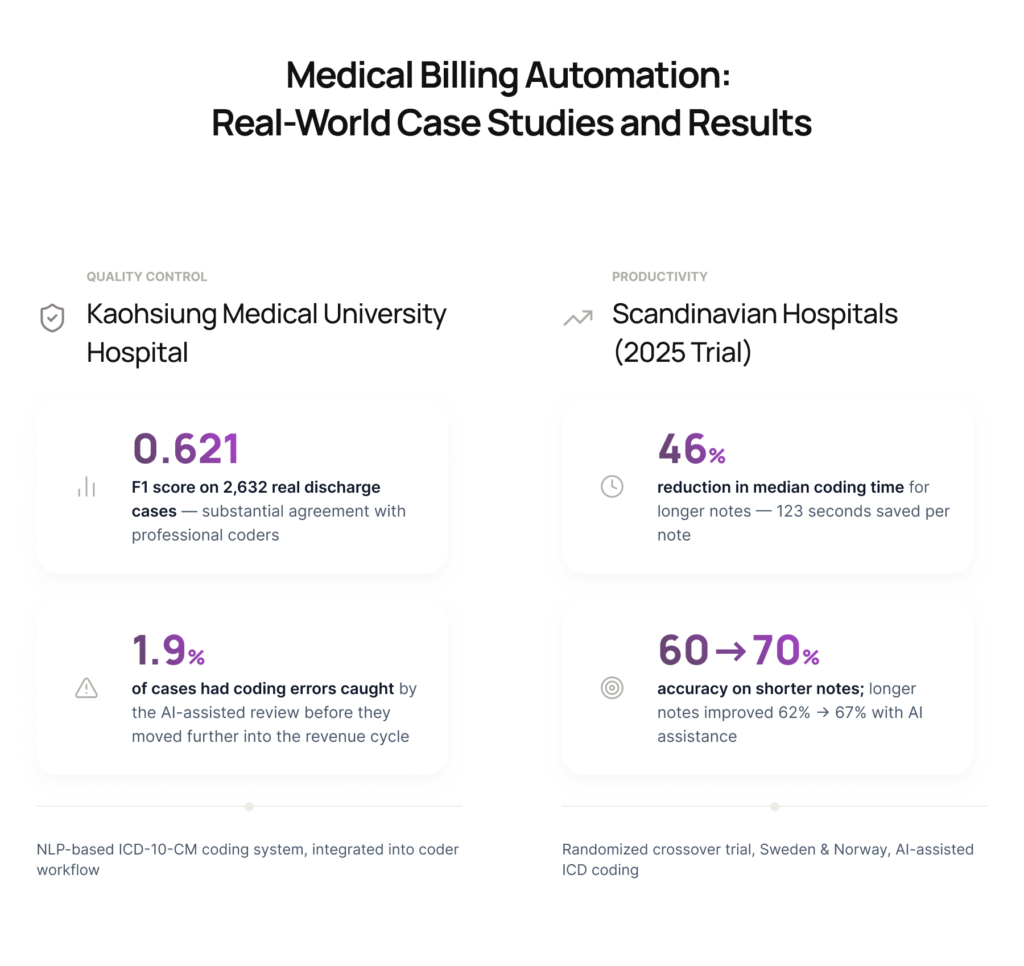
At the hospital, researchers integrated an NLP-based ICD-10-CM coding system into the workflow of certified coding specialists and tested it on 2,632 real discharge cases.
The system analyzed clinical documentation and generated coding predictions that specialists could review alongside their own decisions.
The best-performing model achieved an F1 score of 0.621 on real hospital data and showed substantial agreement with professional coders for major diagnostic categories.
More importantly from a billing perspective, the AI-assisted workflow identified coding errors in 1.9% of cases. The value here is quality control. AI created an additional opportunity to catch discrepancies before incorrect coding travelled further into the revenue cycle.
2. Scandinavian Hospitals
A 2025 randomized crossover trial involving healthcare professionals in Sweden and Norway looked at a different question: whether AI could help clinicians and coders work through documentation faster without materially compromising coding accuracy.
Participants coded clinical notes both manually and with an AI-assisted ICD coding tool. For longer notes, AI assistance reduced median coding time by 46%, or 123 seconds per note. Accuracy also increased from 62% to 67% for longer notes and from 60% to 70% for shorter notes – a small change.
The more convincing result was therefore productivity. When your team is dealing with documentation-heavy cases, AI assistance can shorten the time required to reach a coding decision while keeping professional judgment in the process.
How to Implement AI Medical Billing Automation Successfully
Once you understand where AI could help, the implementation question becomes much more practical. Before development begins, you should be able to answer three things.
1. Where exactly is the bottleneck?
Start with the current operation rather than the technology. Look at your transaction volumes, handling time, reworks, denial or delay impact, and the number of staff interactions required for different billing activities.
You’re trying to find a problem that’s both consequential and narrow enough to address properly. A recurring denial category, eligibility checks for a specific payer group, or claim-status follow-up for a defined account segment can all be easier to test than a broad “automate billing” initiative.
Then set clear boundaries: where does the process start, where does it end, and which exceptions are outside the first release?
2. Can your workflows supply and receive the required data?
List every application involved, such as your EHR, practice management or billing platform, clearinghouse, and payer portals and identify which one owns each piece of information the automation needs.
Then confirm how data can pass between them through APIs, EDI transactions, secure files, portal access, or other available interfaces.
At Intuz, we also establish the source of truth for critical fields at this stage. If, for example, your EHR and billing platform contain different patient or payer information, the healthcare revenue cycle automation needs a predefined rule for which source takes precedence.
3. Can your billing applications exchange the data you need?
Your success criteria should reflect the original problem rather than a generic automation metric.
For an eligibility project, you might track manual verifications or registration delays. For claims, clean-claim rate or avoidable denials may matter more. For follow-up, staff hours and days in A/R could be more useful measures.
Record the current performance and define the improvement required before launch. That way, the pilot has an explicit acceptance test rather than ending with a subjective judgment that the automation “seems to work.”
Build Medical Billing Automation Around a Real Billing Priority
Knowing where AI can help is one thing. Translating that vision and strategy into an actual workable framework is where the harder engineering decisions begin.
Your automation has to integrate with the applications you already use, handle imperfect data, account for payer and process exceptions, preserve human review where it matters, and remain traceable when something goes wrong.
That’s why the workflow automation partner you choose matters as much as the AI itself. At Intuz, we bring those pieces together, from integrations and AI models to decision logic, exception handling, monitoring, and audit trails.
More than 54 AI systems we’ve built are already running in production, including healthcare automation designed for real operational use. Let Intuz audit your medical billing workflow to identify automation gaps, integration requirements, and the best place to start.
Book a free consultation today.
Work with Intuz
Automate Your Billing Cycle with Custom AI Agent
Let Intuz audit your medical billing workflow for free of cost.
Let's Get Started
Share this article