



Manual healthcare workflows continue to slow operations, increase costs, and strain clinical teams. Learn how agentic AI is enabling autonomous workflow automation across healthcare, the use cases delivering measurable ROI today, and the governance framework needed for safe enterprise adoption. By the end, you’ll know which AI initiatives offer the fastest business impact and how to implement them successfully.
A prior authorization request that used to sit in a queue for 2-3 days can now be completed the same day. A health system running $6 billion in patient revenue could eliminate $60-120 million in annual revenue cycle costs. A clinician losing more than a full work week every month to documentation can get that time back.
These aren’t projections. They’re published outcomes from organizations that moved from piloting agentic AI in healthcare to deploying it in production.
After helping healthcare organizations across the US design and build AI-enabled workflows over the past several years, what we’ve learned is this: the technology gap closed faster than most executives expected. What remains is the organizational gap. Knowing where to start, what to govern, and how to avoid the failure modes that are already well-documented.
This guide covers all of it.
Show
- Agentic AI in healthcare differs from generative AI in one critical way: it acts autonomously across multi-step workflows rather than responding to prompts. For healthcare, that difference determines whether a tool handles a task or merely assists with one.
- Revenue cycle management, specifically back-end functions like denials, AR follow-up, and cash posting, is the clearest and lowest-risk entry point for most health systems today.
- 61% of US healthcare leaders are already building or have secured budgets for agentic AI; 85% plan to increase investment in the next two to three years (Deloitte, 2026).
- The risks that matter most for CXOs are not the ones getting media coverage. Hallucinations in clinical workflows, FDA regulatory scope, and HIPAA exposure from third-party AI vendors are the live issues.
- Most health systems are still running point deployments, not integrated agent networks. The organizations pulling ahead are the ones that defined enterprise-wide governance before scaling their pilots.
What Is Agentic AI in Healthcare? (And Why It’s Different From What Came Before)
Let’s be precise, because the term is being used loosely.
Generative AI is reactive. It produces output (text, code, a summary, an answer) when you give it a prompt. It completes one action and stops.
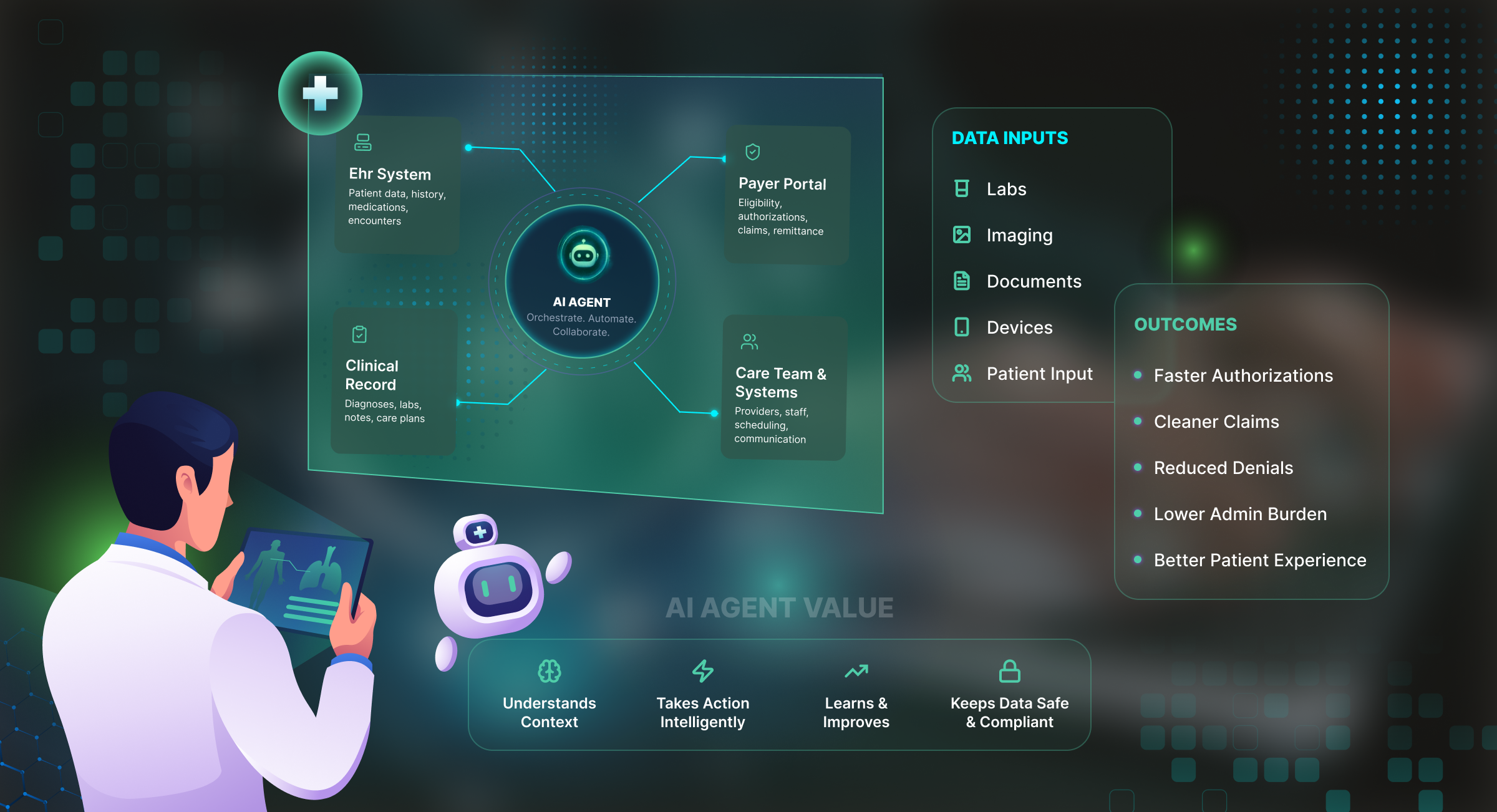
Agentic AI is goal-directed. Give it an objective, and it breaks that objective into steps, calls the tools or systems it needs (an EHR, a payer portal, a scheduling system), evaluates what it gets back, decides what to do next, and continues until the task is done or escalates to a human when it can’t.
McKinsey described this distinction in their January 2026 analysis of revenue cycle transformation: agentic AI “can function more like a coworker than a tool.”
That functional difference explains why agentic AI is relevant to healthcare in a way that earlier AI generations weren’t.
Healthcare workflows are multi-step by design. A prior authorization involves retrieving clinical records, cross-referencing payer criteria, populating a form, submitting it, monitoring the queue, following up on delays, and appealing if denied. That’s 7-12 steps across 3-5 systems. A generative AI model can help with step 3. An agent handles all of them.
The same logic applies to denials management, patient triage routing, appointment scheduling, diagnostic workup coordination, and medication reconciliation. The work isn’t difficult because any individual step is complex. It’s difficult because it never stops, it never fits neatly into one system, and it requires judgment at every transition point.
How Agentic AI Compares to What Came Before
| Capability | RPA / Rule-Based | Gen AI Copilot | Agentic AI |
|---|---|---|---|
| Handles multi-step workflows | ✗ | Partial | ✓ |
| Adapts when workflow changes | ✗ | ✗ | ✓ |
| Integrates across EHR + payer systems | Limited | Limited | ✓ |
| Operates without human trigger | Partial | ✗ | ✓ |
| Escalates exceptions to humans | ✗ | Sometimes | ✓ |
| Learns from corrections over time | ✗ | ✗ | ✓ |
Sources: McKinsey (Jan 2026), Deloitte (2026 Healthcare AI Survey), IDC Healthcare Research
RPA broke when the workflow changed. Generative AI still requires someone to prompt it. Agentic AI runs. That’s the operational difference executives need to understand before evaluating any vendor or platform.
The Business Case: Five Areas Where Agentic AI Is Already Creating Value
1. Revenue Cycle Management
- Health systems spend: $140B+ annually on revenue cycle (McKinsey, 2026)
- Average claim denial rate: ~20%
- Denials never appealed: ~60%
- McKinsey’s modeled cost reduction: 30-60% reduction in cost to collect
- Savings example: $60M-$120M annually for a system with $6B in patient revenue
- Real deployment: Greenway Health + AWS Agentic AI Factory (January 2026)
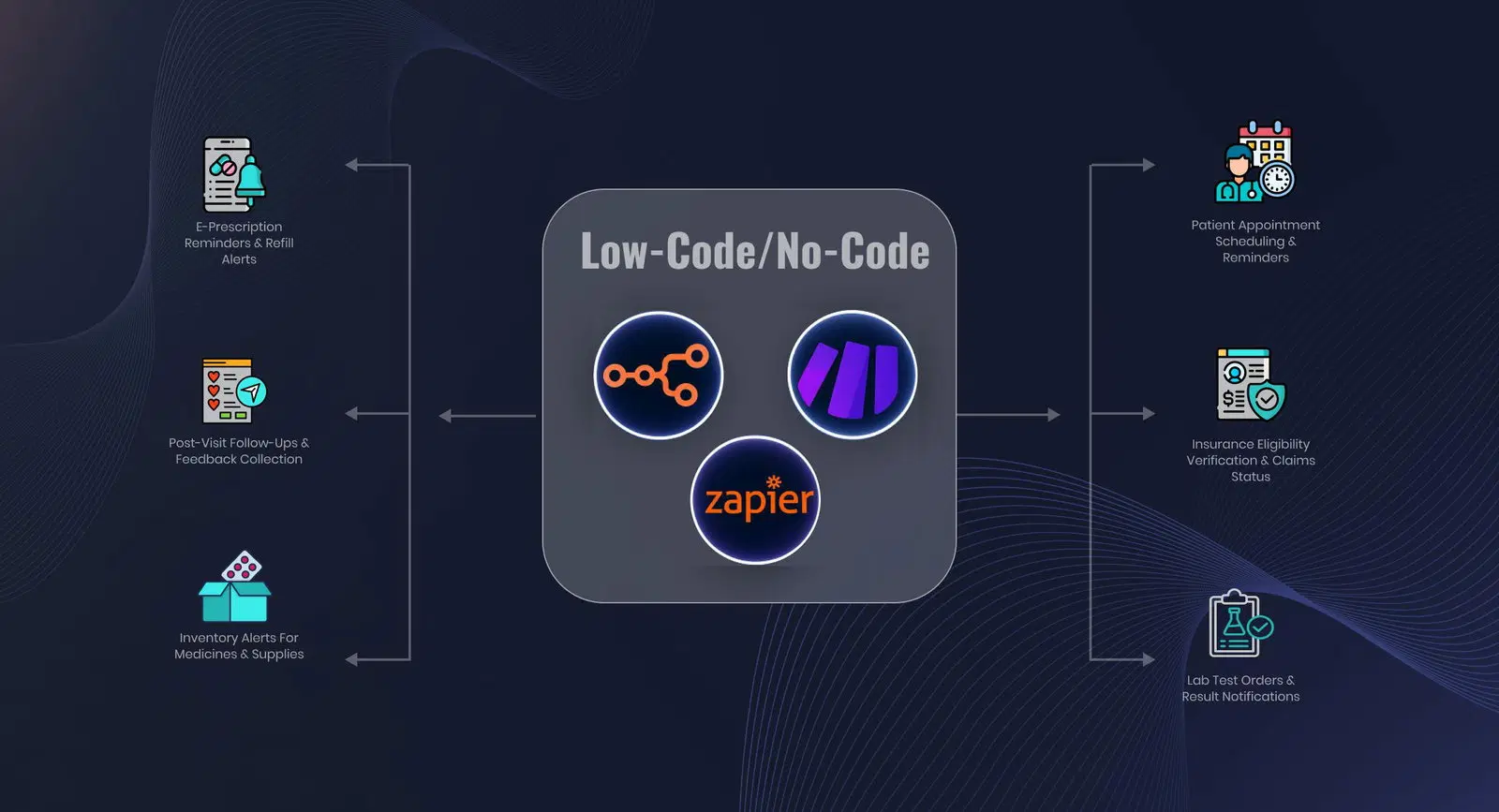
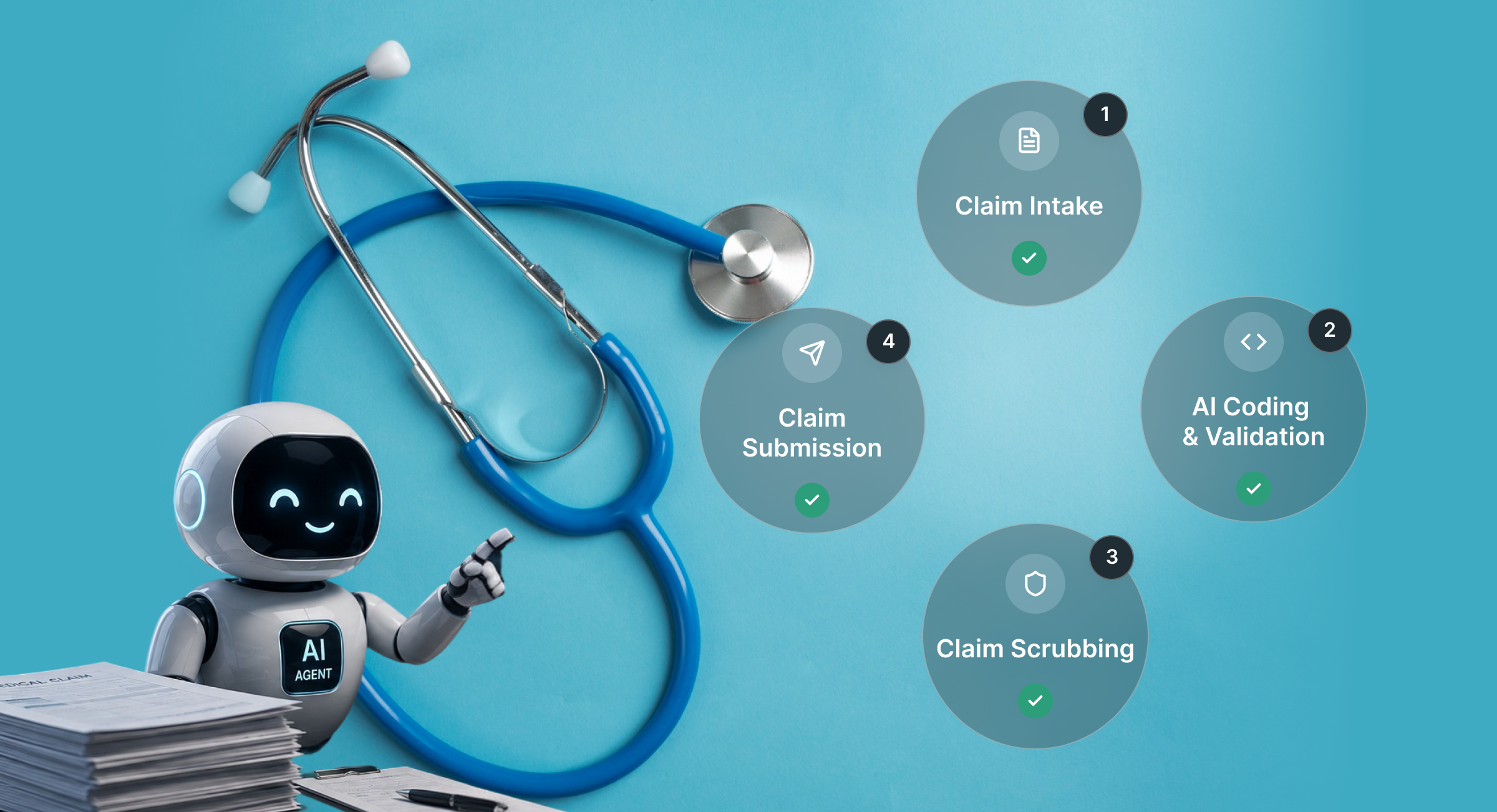
Revenue cycle management is where the financial stakes are clearest and the technical fit is strongest. The back end of the revenue cycle (denials management, accounts receivable follow-up, underpayment tracking, cash posting) consists of high-volume, rules-governed tasks where staffing constraints are the only reason work doesn’t get completed. That’s the gap agentic AI closes. For home health and care-at-home organizations, Healthcare AI Automation closes this gap across the full revenue cycle — from intake and authorization through claims submission and payment reconciliation.
Current average touchless rates for most health systems sit at 30-40%. Best-in-class organizations are hitting 60-70%. McKinsey’s modeled target, achievable with current technology for standard encounters, is 80-85% touchless.
In 2025, more than 30% of providers prioritized AI implementation for seven specific revenue cycle use cases, compared to four or five in 2023 and 2024. Denials and prior authorization surged to the top of that list, both up dramatically year-over-year.
When this fits your organization
Any health system or care delivery organization spending more than 3-4% of net patient revenue on revenue cycle operations. That’s industry standard, which means almost everyone has this problem. The question is scale: organizations above $1B in annual revenue have enough denial management volume alone to justify a focused deployment.
When it doesn’t (yet)
Smaller practices and ambulatory groups without dedicated RCM infrastructure often lack the data maturity and system connectivity that agentic RCM requires. The right starting point there is likely a managed service or embedded solution rather than a custom build.
Our experience
The organizations that capture the most value from agentic RCM start narrow. One workflow, one payer type, one denial category. Then they expand methodically. The ones that struggle try to solve the whole revenue cycle at once and can’t define success clearly enough to know whether the pilot is working.
2. Prior Authorization
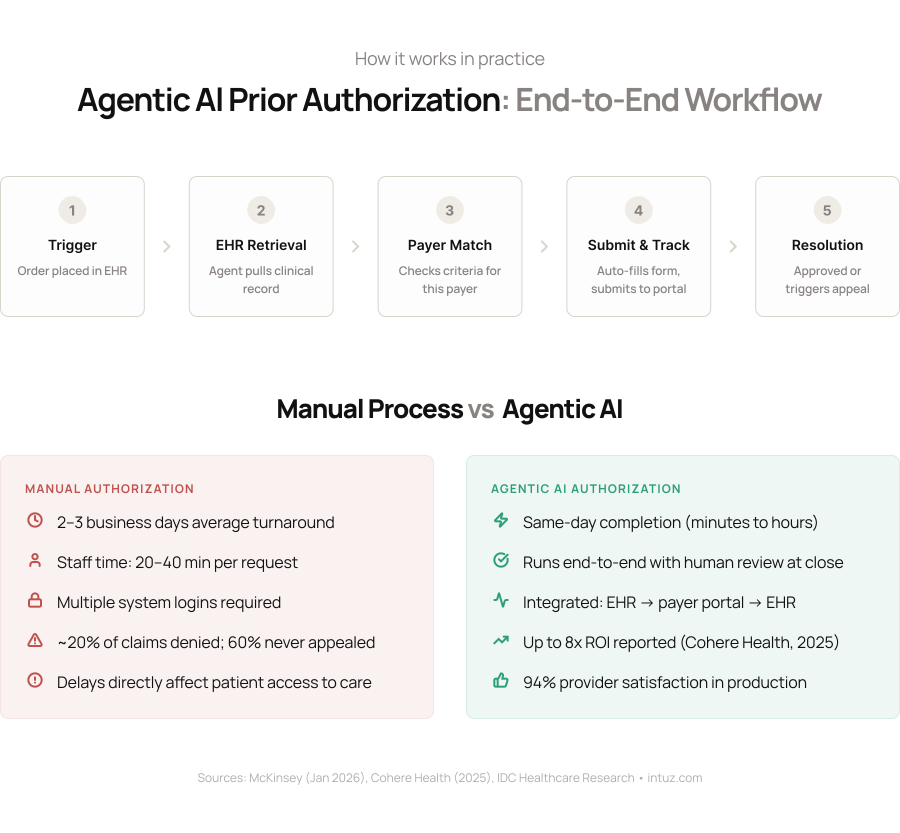
- Processing time (manual): 2-3 business days, often longer
- Processing time (agentic): Same-day
- Cohere Health reported ROI: Up to 8x across deployments
- Provider satisfaction: 94% in published customer data
- Industry signal: IDC (2026) identified prior authorization as the domain where agentic AI could bridge the gap between traditional automation and context-aware workflows
Prior authorization is where clinical time goes to die and patient access stalls. It’s also exactly the kind of multi-step, document-heavy process that agentic AI handles well. The agent determines whether authorization is needed, retrieves relevant information from the EHR, populates the payer form, submits it, monitors status, and triggers follow-up or appeal workflows when required.
The clinical stakes here are direct. When treatment approval is the bottleneck, the difference between a 2-day queue and same-day processing affects patient outcomes, not just operational margins.
Cohere Health’s agentic prior authorization platform is the most documented example of production deployment at scale. Their published data shows up to 8x ROI across deployments and 94% provider satisfaction. Those numbers reflect what happens when the use case and the technology are genuinely well-matched.
When this fits your organization
Health systems with high authorization volume, specialty practices in oncology, cardiology, and orthopedics, and any organization where payer-driven delays are generating clinical complaints or access to care concerns.
When it doesn’t
Prior auth automation requires clean EHR connectivity and accurate clinical documentation. Organizations with fragmented documentation practices or non-standard EHR configurations will see lower automation rates until the data foundation is solid. Home health agencies deal with prior authorization volume every day, across multiple payers and episode types. Our home health automation platform covers prior authorization tracking as one of its core workflow lanes: submission, portal monitoring, expiration alerts, and staff notification when action is needed.
Build Your Agentic AI Workflow
3. Clinical Documentation and Ambient Scribes
- Documentation time lost per clinician: 44+ hours per month (Freed, 2025)
- Clinicians citing admin tasks as primary time drain: 73% (Elsevier, 2025)
- Burnout before ambient AI scribe: 51.9%
- Burnout after 30 days: 38.8% (quality improvement study across 6 health systems, PMC 2025)
- Real deployment: VoiceCare AI pilot with Mayo Clinic (February 2025)
Physician burnout is real, measurable, and expensive. Every point of burnout reduction translates to lower turnover, and physician turnover costs health systems an estimated $500,000 to $1 million per physician depending on specialty.
Ambient AI scribes are already moving these numbers. A quality improvement study across six health systems found burnout decreased from 51.9% to 38.8% within 30 days of deployment. A separate 2025 study found prevalence dropped from 54.9% to 33.3%.
These tools work by listening to the clinical encounter, generating structured documentation in real time, and surfacing it for physician review and sign-off. The physician reviews and attests, but the transcription, structuring, and EHR entry work disappears.
The next generation extends further. Agents that not only generate notes but pull relevant clinical history, flag missing documentation for billing compliance, suggest coding, and route completed notes to the appropriate downstream workflow.
When this fits your organization
Ambulatory practices and outpatient clinics see the clearest ROI because documentation volume is highest relative to available time. Hospital inpatient settings have more complex documentation requirements and typically need more customization.
When it doesn’t
Organizations without clear EHR integration pathways will find that ambient scribes produce documentation output that still needs to be manually transferred. The time savings disappear in that scenario. The technology only works when the downstream systems are ready to receive its output.
Our experience
The fastest wins we’ve seen have been in primary care and specialty outpatient settings where documentation volume is high and encounter structure is relatively predictable. Emergency and ICU settings require significantly more customization before the automation rates justify the implementation cost.
4. Diagnostic Decision Support
- Validation status: High diagnostic accuracy reported in oncology and cardiology; most evidence is from controlled simulation environments, not live clinical deployment (npj Digital Medicine, 2026)
- Key finding: Agentic architectures can reduce cognitive workload by up to 52% compared to traditional clinical decision support, though this finding comes from controlled simulation, not clinical deployment (Frontiers in Artificial Intelligence)
- Published research: npj Digital Medicine (2026) documented high accuracy in cancer diagnosis support and alert generation, noting that clinical outcomes and safety endpoints “were rarely addressed”
In oncology and cardiology, multi-step agentic workflows are being evaluated for tasks that would otherwise require hours of manual record review: correlating imaging findings with lab trends, surfacing clinical history relevant to a differential, generating alerts when documentation patterns suggest a missed diagnosis.
The technical capability is ahead of the clinical validation right now. Organizations deploying agentic AI in high-stakes diagnostic workflows are, to some degree, generating the evidence base in real time. Governance and monitoring requirements are especially high as a result.
When this fits your organization
Radiology and imaging centers and oncology programs with high imaging and report volumes are seeing the strongest signal.. These settings have structured data, defined workflows, and clearer accuracy metrics.
When it doesn’t
Clinical decision support that touches recommendations a physician will act on without independent verification enters FDA regulatory scope (see Risk section below). Getting the architecture right before deployment isn’t optional here.
5. Patient Access and Scheduling
- Problem it solves: No-show rates, scheduling bottlenecks, care gap outreach
- Real deployment: SuperOS by Superhealth (agentic AI operating system for hospital operations, February 2026)
Agentic AI in patient access handles the coordination layer that currently lives in call centers, scheduling desks, and patient engagement platforms: outbound outreach to close care gaps, appointment scheduling and rescheduling, eligibility verification, pre-visit preparation reminders, and post-discharge follow-up.
These are multi-step, often multi-channel workflows (SMS, phone, patient portal) that require adapting to patient responses in real time. The rule-based chatbots of the last generation couldn’t handle the variation. Agents can.
When this fits
Health systems with high no-show rates, large panels with care gaps, and organizations trying to extend patient engagement capacity without adding headcount.
Our experience
The ROI calculation here is straightforward since no-show reduction directly affects utilization and revenue. But the implementation requires clear governance around what the agent is and isn’t authorized to communicate, particularly anything that touches clinical advice. Scope creep in patient-facing agents is a real and recurring risk we’ve seen across deployments.
Where Healthcare Leaders Stand: The 2026 Adoption Snapshot
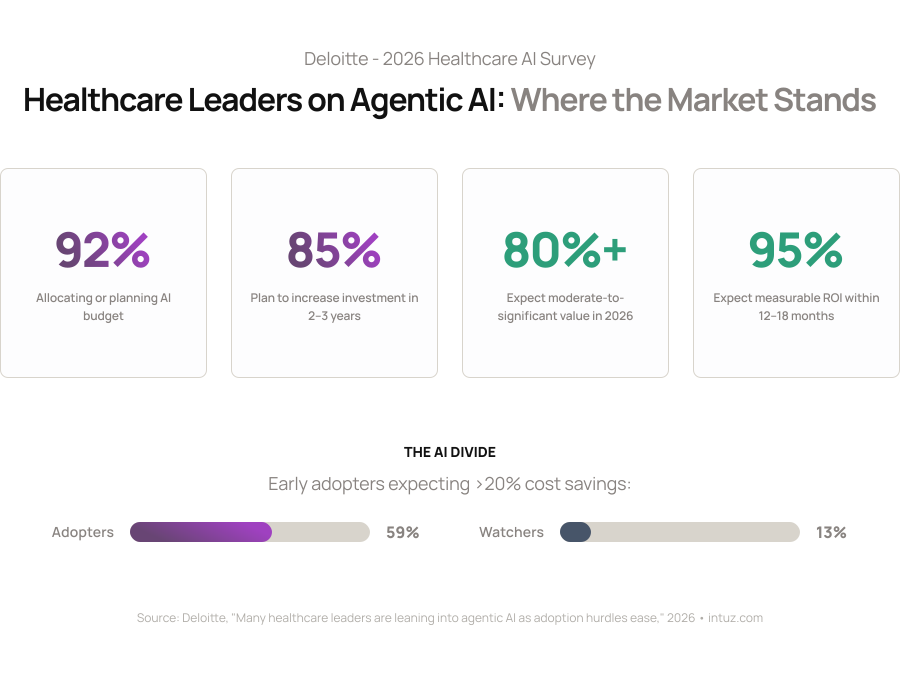
Deloitte’s 2026 survey of US healthcare executives provides the clearest picture of where the market actually is:
| Metric | Finding |
|---|---|
| Already building / have secured budget | 61% of respondents |
| Plan to increase investment in next 2-3 years | 85% |
| Expect moderate-to-significant value in 2026 | 80%+ |
| Expect at least 10% cost savings | 98% |
| Expect savings above 20% | 37% |
| Early adopters expecting >20% savings | 59% |
| “Watchers” expecting >20% savings | 13% |
Source: Deloitte, “Many health care leaders are leaning into agentic AI as adoption hurdles ease,” 2026
The last two rows tell the most important story. The gap between early adopters and organizations still evaluating is widening into a compounding advantage. Organizations that captured early value are now reinvesting it, extending into more workflows, refining their governance models, and building institutional knowledge about what works in their environment.
That knowledge doesn’t transfer. It accumulates.
The Risk Landscape CXOs Cannot Ignore
Agentic AI in healthcare is not a plug-and-play deployment in a regulated industry. The risks that matter most aren’t the ones getting covered in trade press.
Hallucination Is a Patient Safety Event, Not a UX Problem
In a consumer context, an AI hallucination is a bad answer. In healthcare, a fabricated drug interaction, an invented clinical guideline, or a misapplied payer policy creates downstream harm before anyone catches it. In agentic systems, that error can propagate through multiple workflow steps before a human reviews it.
Censinet’s governance research frames it directly: “an AI agent that invents a medical recommendation or fabricates policy information creates real regulatory exposure.”
Guardrails, audit logs, and human-in-the-loop checkpoints matter here. Not at every step, but at the high-stakes junctions where errors compound.
FDA Regulatory Scope Begins Where Clinical Recommendations Begin
On January 6, 2026, the FDA published updated guidance for clinical decision support software. The threshold is clear: if an AI agent provides clinical recommendations that a healthcare provider cannot independently review and verify, it falls under FDA regulatory scope.
This is an architecture decision as much as a compliance question. How transparent an agent is about its reasoning determines whether a deployment requires FDA clearance. Healthcare CIOs and CTOs need to understand this before any clinical-facing agent goes into production.
HIPAA Compliance Does Not Automatically Extend to Third-Party AI Vendors
Every agentic AI vendor in your stack is a potential breach vector. A 2025 report found that nearly half of health IT leaders had experienced a data breach or cyberattack involving third-party network access. Healthcare breaches averaged more than $7.4 million per incident in 2025 (Censinet).
Business Associate Agreements need to be scrutinized, not rubber-stamped. BAAs that were adequate for an EHR vendor may be insufficient for an AI vendor that ingests unstructured clinical notes and communicates with payer APIs.
Shadow AI Is Already Running in Your Organization
In 2025, 20% of organizations experienced a breach tied to unsanctioned AI tool usage. Clinicians and administrative staff are using AI tools that IT doesn’t know about, in workflows that touch PHI, with no governance frameworks in place.
Restriction isn’t the answer. Governance that moves fast enough to keep up with adoption is. Organizations that built governance frameworks before an incident are in a fundamentally different position than those building them in response to one.
Build Governed AI Roadmap
Which Use Case Should Your Organization Start With?
Not every organization should start in the same place. Here’s how the decision breaks down by organization type:
| Organization Type | Recommended Starting Point | Why |
|---|---|---|
| Large health system ($1B+ revenue) | Revenue cycle back-end (denials, AR) | Highest volume, lowest patient-facing risk, clear ROI metrics |
| Health plan / payer | Prior authorization automation | Multi-step, document-heavy, measurable speed and cost impact |
| Multispecialty ambulatory group | Clinical documentation / ambient scribes | High documentation volume, direct burnout impact, fast ROI |
| Specialty practice (oncology, cardiology) | Diagnostic decision support (with governance) | Structured data, defined accuracy metrics, high-value use case |
| Community hospital | Patient access and scheduling | Lower technical complexity, visible operational impact |
| Health tech / digital health company | Agent infrastructure / custom workflow | Build for your specific use case rather than adapting off-the-shelf |
The consistent finding across all of these: start with one workflow, one use case, and measurable success criteria. Organizations that try to automate the entire value chain at once don’t build conviction fast enough to sustain the investment.
What Good Implementation Actually Looks Like
McKinsey’s 2026 research on revenue cycle transformation offers a sequencing model that applies well beyond RCM.
Start at the back end, not the front
Administrative workflows that are rules-governed and carry lower patient-facing risk are the right proving ground. Front-end patient engagement and clinical decision support involve more complexity and higher stakes. Get your governance model right before you’re in front of patients.
Avoid pilot purgatory
A proof of concept is necessary. Getting stuck in one is expensive. Define pragmatic success metrics before you launch: denial overturn rate, AR days, documentation time per encounter. Then set a clear timeline for the decision to scale or stop. Perpetual pilots don’t build organizational capabili
Be explicit about build, buy, or partner
Most health systems will need a combination. The question isn’t which vendor has the best demo. It’s which approach matches your infrastructure, data architecture, and timeline, and where you want to retain institutional IP.
Invest in the human side
Staff who interpret agentic AI as a headcount reduction will work around it. Organizations that frame the shift as moving people toward higher-value work (training models, handling exceptions, managing vendor relationships) see faster adoption and better model performance over time. Agents learn from human corrections. A resistant workforce produces worse agents.
Set up governance before you scale
This means deciding who owns AI decisions, how exceptions get escalated, what gets logged and audited, and how you respond when something goes wrong. The organizations that built this framework ahead of deployment are in a fundamentally different position than those building it after an incident.
How Intuz Approaches Healthcare AI
We’ve built AI-enabled workflows across healthcare organizations in the US, from health systems working through revenue cycle modernization to digital health companies building agent-native products.
What we’ve consistently found is that the technology question resolves faster than the organizational one. Most health systems can identify three or four workflows tomorrow where agentic AI would create measurable value. The harder questions are: what data do you actually have, how clean is it, which systems can be integrated without a 12-month IT project, and who inside the organization owns the outcome?
We map clinical and operational workflows against data readiness and integration complexity to find the use cases that have high value, reasonable technical risk, and a clear path to measuring success. That’s usually not the most exciting use case. It’s the one that works.
For teams working through the operational workflows specifically (patient intake, physician orders, EVV, billing, documentation), our healthcare automation platform covers those across home health, dental, and imaging settings.
If you’re working through where to start, our AI consulting team is set up for exactly this conversation. We figure out the use case first, then the technology. Not the other way around.
The Market Outlook
The agentic AI in healthcare market was valued at approximately $538 million in 2024 and is projected to reach $4.96 billion by 2030, growing at a CAGR of 45.56% (Grand View Research). North America leads with roughly 55% of the global market, driven by the administrative intensity of US healthcare and the scale of the staffing problem.
Epic is already building what it calls an “AI Factory” toolkit, enabling health systems to create their own agents within the EHR platform (Becker’s Hospital Review, 2026). When your EHR vendor ships agents as a standard feature, the question stops being “should we try this?” It becomes “what are we governing?”
The organizations that will look back on 2026 as a turning point are the ones that treated governance as a precondition rather than an afterthought, and that defined what “working” means before they deployed anything.
Agentic AI in Healthcare: Frequently Asked Questions
Answers to the questions healthcare executives ask most before moving from evaluation to deployment.
What is agentic AI in healthcare?
Agentic AI in healthcare refers to AI systems that can autonomously execute multi-step clinical and administrative workflows, retrieving data, making decisions within defined parameters, taking actions across integrated systems, and escalating exceptions to humans. Unlike generative AI, which responds to individual prompts, agentic AI operates toward a goal. Current production deployments include prior authorization, revenue cycle management, clinical documentation, and patient access workflows.
How is agentic AI different from RPA in healthcare?
RPA (Robotic Process Automation) follows fixed rules and breaks when a workflow changes. Agentic AI adapts to variation, handles unstructured inputs like clinical notes and payer correspondence, and makes contextual decisions within defined boundaries. RPA automates predictable tasks. Agentic AI handles the adjacent decision-making that RPA couldn’t reach.
What is the ROI of agentic AI in healthcare revenue cycle?
McKinsey’s analysis (January 2026) models a 30-60% reduction in cost to collect for health systems that fully implement AI in revenue cycle operations. For a health system with $6 billion in patient revenue, that translates to $60-120 million in annual savings. Cohere Health’s prior authorization platform reports up to 8x ROI across deployments. Real-world results vary based on claim volume, payer mix, and implementation quality.
Is agentic AI regulated by the FDA?
Yes, in certain applications. The FDA’s updated clinical decision support guidance (published January 6, 2026) makes clear that AI systems providing clinical recommendations a clinician cannot independently review and verify fall under FDA regulatory scope. Administrative applications such as billing, scheduling, and prior auth generally do not. The regulatory status of any healthcare AI deployment depends on what it recommends, how it presents those recommendations, and whether the clinician can verify the basis independently.
What are the HIPAA compliance requirements for agentic AI?
Any agentic AI vendor that accesses, processes, or stores Protected Health Information (PHI) must operate under a Business Associate Agreement (BAA) with the covered entity. Standard BAA templates often don’t address the specific risks of AI systems, particularly around training data use, model updates, and multi-vendor data sharing. Organizations deploying agentic AI should have their legal team review vendor BAAs specifically for these gaps.
Which EHR systems currently support agentic AI integration?
Epic is the furthest along, with its AI Factory toolkit enabling organizations to build custom agents within the platform. Oracle Health (Cerner), Athenahealth, and other EHR vendors have announced AI integration roadmaps, but integration depth and API maturity vary significantly. Organizations should evaluate integration requirements against their specific EHR before selecting any agentic AI platform.
How long does it take to implement agentic AI in a health system?
Timelines vary by use case and complexity. A focused back-end revenue cycle deployment covering denials management and cash posting can reach production in 3-6 months with the right data and integration infrastructure. Broader initiatives spanning multiple workflows or requiring significant data cleanup typically take 9-18 months to reach meaningful scale. The most common bottleneck isn’t the AI technology itself. It’s EHR integration and change management.
What is the biggest risk of deploying agentic AI in healthcare?
The risks CXOs most commonly underestimate are: hallucination in clinical-adjacent workflows where an AI fabricating a clinical or policy reference goes undetected until downstream harm occurs; HIPAA exposure from third-party AI vendors that weren’t designed for regulated data environments; and shadow AI, which refers to unsanctioned tools already in use across the organization. Healthcare breaches averaged $7.4M+ per incident in 2025. The governance question is how many of those will touch your AI stack.
What is the difference between agentic AI and generative AI in healthcare?
Generative AI tools are reactive: they respond to a prompt and stop. They can write a clinical note draft if you paste in a transcript. Agentic AI is goal-directed: it retrieves the transcript, generates the note, routes it into the EHR, checks it against billing codes, and flags discrepancies, without being prompted for each step. For healthcare, the meaningful applications are almost all multi-step workflows that generative AI alone can’t automate end to end.
How should a healthcare CXO evaluate agentic AI vendors?
Beyond the standard questions around security, HIPAA, BAAs, and references, the questions that separate real deployments from demos are: What is the agent’s completion rate on end-to-end tasks? What happens when it fails? How does the system handle exceptions, and who owns the exception workflow? What audit logs exist? How does the model improve over time, and do we control the training data? What integrations do you have in production (not planned) with our EHR?
Work with Intuz
Automate Your Healthcare Workflows
Book 45-Minute free consultation with Intuz AI experts, we will assess your AI readiness and identify high-impact use cases.
Let's Get Started
Share this article