



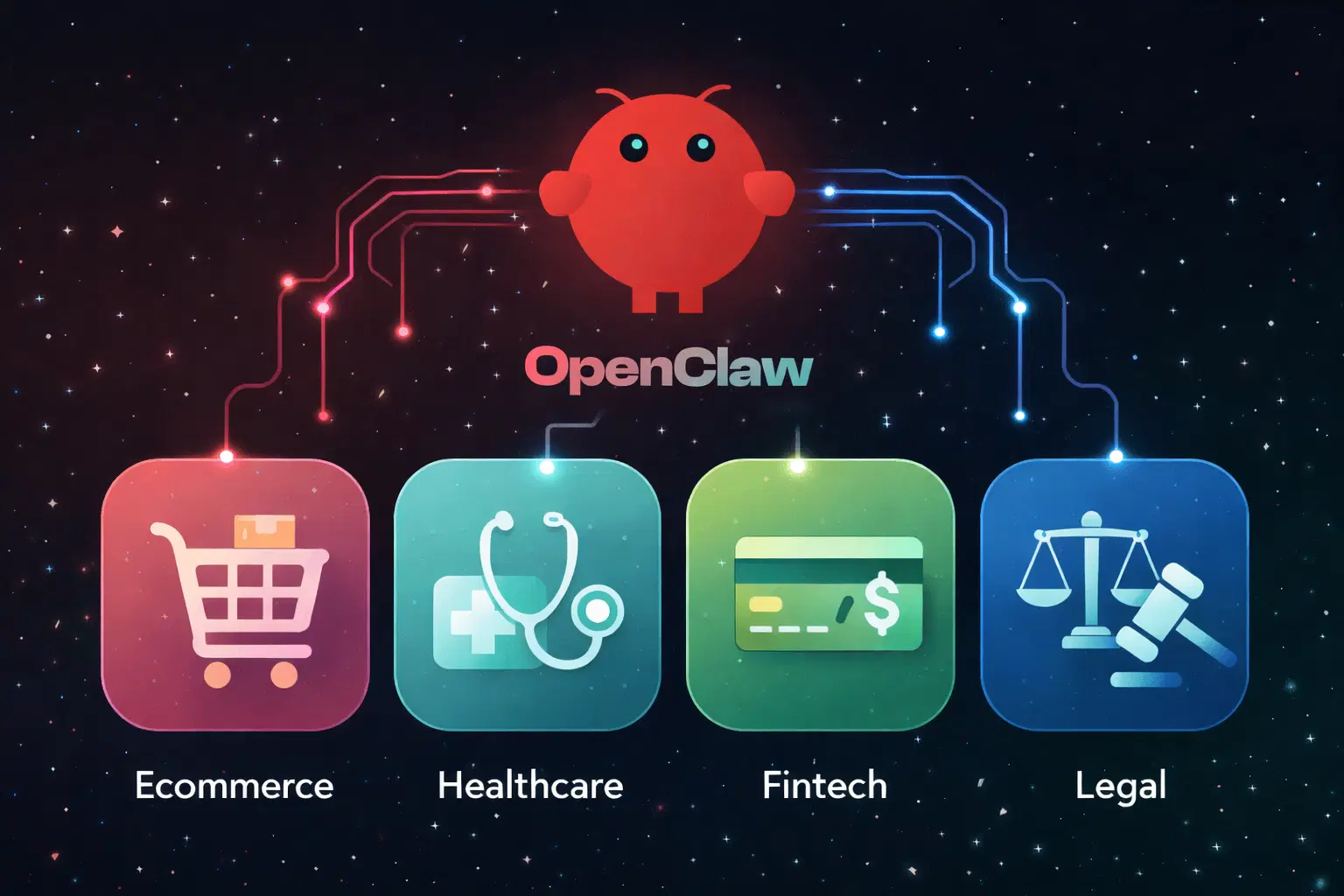
Most businesses waste time on tools that don’t fit their needs. OpenClaw changes that. Explore 10 powerful applications tailored for major industries that streamline workflows, cut costs, and drive real results.
Every minute counts: your operations run on multiple disconnected platforms—customer data in your CRM, payments in one system, vendors on their own portals.
Regulatory submissions, internal approvals, and customer workflows span a wide range of disconnected systems. So, how much time do you and your team spend logging into different systems, copying information, and completing routine workflows?
If you think about it, quite a lot, right?
Now, the challenge is that traditional automation tools can solve only part of this problem. They largely depend on fixed workflows and break when systems change.
OpenClaw introduces a different approach. It functions as an execution-level AI agent that can navigate applications, retrieve and enter data, interact with external systems, and execute operational workflows on your behalf end-to-end.
This enables you to minimize manual effort, improve accuracy, and increase efficiency across your business. If you’re an SME that wants to automate but doesn’t want the hassle that most AI tools bring, check out this blog.
Before we dive into industry-specific examples, let’s transition from problem and solution to the real-world applications of OpenClaw. In the following sections, you’ll see its value across various fields and discover how industry leaders automate critical workflows .
Show
- OpenClaw automates execution-level workflows across healthcare, ecommerce, fintech, insurance, real estate, and legal industries.
- It can interact with portals, internal systems, and external applications without relying on fixed integrations.
- Businesses can reduce manual work, improve operational efficiency, and accelerate workflow execution using OpenClaw.
- OpenClaw enables faster deployment and lower operational overhead compared to custom AI agent development.
- Intuz helps businesses deploy OpenClaw, build custom execution agents, and integrate automation into existing systems.
Best OpenClaw Business Application Across Major Industries
1. Healthcare
a. Prior authorization submission and tracking
OpenClaw retrieves patient demographics, procedure codes, and insurance details from your EHR or practice management system. It logs into payer portals, completes prior authorization forms, and submits the request.
It monitors authorization status by checking payer portals at defined intervals and retrieves approval, denial, or pending updates. OpenClaw also records the status in your internal system and notifies your team if additional documentation is required.
This reduces manual portal work and ensures authorization workflows progress without delays.
b. Claim denial investigation and resubmission
OpenClaw monitors claim status in your billing or revenue cycle system and identifies denied claims. It retrieves denial reasons from payer portals, gathers required supporting data from your EHR, and corrects missing or invalid information.
It logs into the payer portal, resubmits the corrected claim, and records the submission reference. If additional documentation is required, OpenClaw flags the claim for review.
This helps recover denied revenue without requiring your team to manually investigate and resubmit claims.
2. Ecommerce
a. Dynamic pricing adjustment based on competitor monitoring
OpenClaw monitors competitor listings for your products across marketplaces such as Amazon, Flipkart, and other online stores. It retrieves competitor prices at defined intervals and compares them with your pricing rules and margin thresholds.
When a price change is required, OpenClaw logs into your store, updates the product price, and records the update. It can notify your team if prices approach minimum margin limits.
This allows you to respond to competitor pricing changes immediately without manually checking and updating listings.
b. Supplier restocking coordination
OpenClaw monitors inventory levels across your inventory management or eCommerce platform.
When stock falls below defined thresholds, it retrieves supplier details, generates a purchase order using your predefined templates, and submits it through supplier portals or email. It tracks supplier confirmations and updates restocking status in your inventory system.
If delays occur, OpenClaw alerts your team for follow-up. This ensures timely restocking and compresses the risk of stockouts without requiring manual inventory monitoring.
3. Fintech and insurance
a. Regulatory reporting compilation and submission
OpenClaw retrieves the required transaction, customer, and compliance data from your internal systems to meet reporting requirements. It validates the data, formats it according to regulatory templates, and logs in to regulatory portals to submit the reports.
It captures submission confirmations, records reference IDs, and updates your internal tracking systems. If submissions fail or data is incomplete, OpenClaw flags the issue for correction.
This ensures timely, accurate regulatory reporting without requiring your team to manually compile and submit reports.
b. Policy eligibility determination during application
OpenClaw retrieves applicant data from your application system and verifies required information across internal records and external verification sources.
It evaluates the data against your eligibility rules, including age, coverage criteria, risk indicators, and completeness of documentation.
Based on the outcome, OpenClaw approves, rejects, or routes the application for manual review. It also records the decision and updates your policy administration system. This eliminates manual review workload and accelerates policy processing.
4. Real estate
a. Buyer–property matching and recommendation generation
OpenClaw retrieves buyer preferences, budget, location, and property requirements from your CRM. It scans listing platforms and property databases to identify matching properties based on defined criteria.
It compiles relevant listings, attaches property details, and updates the buyer’s record in your CRM. OpenClaw can also send matching property recommendations to agents or buyers based on your workflow.
This helps you to respond to buyer requirements quickly without manually searching and filtering listings.
b. Transaction milestone tracking across stakeholders
OpenClaw monitors transaction records in your CRM or transaction management system and tracks milestones such as inspection completion, financing approval, and document signing. It retrieves status updates from connected systems and updates the transaction record.
If a milestone is delayed or completed, OpenClaw notifies the responsible agent or stakeholder. This ensures transaction progress is tracked consistently without requiring manual follow-ups across multiple parties.
5. Legal
a. Court filing submission and status tracking
OpenClaw retrieves case details, filing documents, and required metadata from your case management system. It logs into court e-filing portals, enters filing information, uploads documents, and submits the filing.
It captures confirmation receipts, retrieves filing reference numbers, and updates your case management system. OpenClaw can also check filing status periodically and notify your team if the court requests corrections or additional documents.
This means no more manual filing and always accurate submission tracking.
b. Contract obligation tracking and compliance monitoring
OpenClaw scans executed contracts stored in your document or contract management system and extracts key obligations, deadlines, and compliance requirements. It records these obligations in your tracking system and continuously monitors timelines.
When deadlines approach or obligations require action, OpenClaw notifies the responsible team. It can also update obligation status based on completed actions. This helps you manage contractual commitments without manually reviewing and tracking contract terms.
OpenClaw vs custom AI agent development
If you’re evaluating execution-level AI agents, then you must first decide whether to adopt a platform like OpenClaw or develop a custom agent internally. This decision affects deployment time, operational overhead, and long-term maintenance.
To make things easier, we’ve prepared a table as you can see below, comparing the key factors that influence this decision:
| Factor | OpenClaw | Custom AI agent development |
|---|---|---|
| Deployment time | You can deploy workflows within days using existing execution capabilities | Development, testing, and deployment can take several months |
| Engineering dependency | Your operations team can configure and run workflows with minimal engineering support | Requires ongoing engineering involvement for development, fixes, and improvements |
| System interaction capability | OpenClaw can navigate portals, internal tools, and web applications without custom integration work | You must build and maintain portal interaction logic and system integrations |
| Maintenance responsibility | Platform handles execution reliability, monitoring, and workflow stability | Your team must monitor failures, fix workflows, and maintain execution logic |
| Failure handling and recovery | Built-in monitoring, retry logic, and workflow tracking reduce operational disruption | You must build error handling, retry mechanisms, and monitoring systems |
| Scalability across workflows | You can automate additional workflows without rebuilding core execution capability | Each new workflow may require additional development and testing |
| Cost predictability | Predictable operational cost without large upfront engineering investment | High upfront development cost and ongoing maintenance expense |
| Time to operational value | You can automate workflows and see operational impact quickly | Operational value is delayed until development and testing are complete |
| Workflow flexibility | You can modify workflows as your operational processes change | Workflow changes require development, testing, and redeployment |
| Long-term operational overhead | Lower internal overhead since execution infrastructure is managed | Higher operational overhead due to ongoing engineering and maintenance needs |
Move From Manual Workflows to Execution-Level Automation With Intuz
You’ve seen what OpenClaw can automate across functions and industries. For many SMEs, deploying OpenClaw is the fastest way to reduce manual work and improve operational efficiency.
However, some workflows require deeper customization. You may need OpenClaw to interact with proprietary systems, support unique business logic, or operate within a broader automation architecture.
In these cases, custom execution agents or extensions become necessary.
This is where Intuz helps you move forward with clarity and control.
Our enterprise AI development company begins by evaluating your operational workflows, system architecture, and automation goals.
Based on this assessment, we help you deploy OpenClaw where it fits best and build custom execution agents where deeper integration or customization is required.
All development happens within your cloud environment, including repositories and access controls. Your data, infrastructure, and intellectual property remain fully under your ownership, and access can be revoked at any time.
You work with Intuz through shared Slack channels, documented roadmaps, and transparent progress tracking. Every workflow, integration, and automation component is documented so your team has full visibility and long-term control.
Intuz can initiate deployment within days, integrate automation into your existing systems, and ensure workflows run reliably with proper monitoring and failure handling. This allows you to start with one workflow, validate its impact, and expand automation across your operations with confidence.
Whether you want to deploy OpenClaw, extend its capabilities, or build custom execution agents tailored to your systems, Intuz provides the technical expertise and implementation support required to make automation work reliably in your business.
Book a free 45-minute consultation with Intuz to find out more.
FAQs
What can OpenClaw do for my business?
OpenClaw helps businesses automate repetitive tasks using AI agents. It can handle activities like customer support responses, data processing, workflow orchestration, and system integrations. Instead of manual operations, OpenClaw allows AI agents to complete tasks across tools, improving productivity, reducing operational costs, and enabling teams to focus on strategic work.
How much does OpenClaw cost?
OpenClaw itself is typically open-source, so there is no direct licensing cost to use the framework. However, businesses may incur expenses for infrastructure, API usage (such as LLM providers), customization, and deployment. The overall cost depends on how complex the AI workflows are and the scale of automation implemented.
How is OpenClaw different from other AI agents?
OpenClaw focuses on structured task execution and workflow automation rather than simple conversational AI. It allows AI agents to interact with tools, APIs, and business systems in a controlled way. This makes it better suited for operational automation, where agents must follow defined workflows and complete multi-step business processes.
What are the most common business use cases of OpenClaw?
Common OpenClaw use cases include customer support automation, data extraction from documents, sales lead qualification, workflow automation across SaaS tools, and internal knowledge assistants. Businesses also use it for operational tasks such as ticket routing, report generation, and automated decision support within existing business systems.
How does OpenClaw help automate business workflows?
OpenClaw automates workflows by allowing AI agents to execute tasks across multiple systems. Agents can trigger APIs, analyze data, generate responses, and move tasks between tools automatically. This reduces manual intervention in processes like lead management, customer support, reporting, and document processing across business applications.
How do I install OpenClaw?
OpenClaw can typically be installed by cloning the repository from GitHub and setting up the required dependencies in a Python or containerized environment. After installation, businesses configure API keys, define agents, and connect tools or services. Deployment can be done locally, on cloud infrastructure, or within enterprise environments.
Does OpenClaw require advanced AI expertise to implement?
Basic implementation can be done by developers familiar with APIs, Python, and workflow automation. However, building advanced AI agents or complex business workflows may require knowledge of LLMs, prompt design, and system integration. Many businesses work with AI development partners to implement scalable OpenClaw solutions.
Why are businesses adopting OpenClaw for AI automation?
Businesses are adopting OpenClaw because it enables practical AI automation beyond chatbots. It allows AI agents to perform real operational tasks, integrate with existing tools, and automate multi-step workflows. This helps organizations reduce manual workload, improve efficiency, and scale operations without increasing headcount.
Work with Intuz
Automate Business Workflows Faster
Deploy AI-powered execution agents with expert support.
Let's Get Started
Share this article
![AI Agent Workflows: Top 5 Use Cases, Examples & Implementation Guide [2026]](https://www.intuz.com/wp-content/uploads/2026/04/AI-Agent-Workflows-Top-5-Use-Cases-Examples-Implementation.webp)