


![How to Build an AI-Powered Marketplace: 8 Steps for SMBs [2026 Guide]](https://www.intuz.com/wp-content/uploads/2026/05/How-to-Build-an-AI-Powered-Marketplace.webp)
No wonder companies are 3.5X more likely to generate over 30% of their revenue through AI. In this blog, we’ll explore how to plan, build, and enhance an AI-powered marketplace step by step. It breaks down 8 proven steps to create intelligent, scalable platforms with features like dynamic pricing, smart search, personalized recommendations, and more. Learn how Intuz, an AI-first development company, can help you build a scalable AI-powered marketplace.
If you’re an SMB with plans to build a marketplace, you may already be aware that this task is no cake walk. You might not have in-house developers or data experts. You might feel the strain of launching fast and then improving steadily. And the budget? That’s limited, too.
But with AI, you can create a marketplace that works in ways that feel practical and immediate. It can learn what each customer of yours cares about and helps them find it faster. It can watch transactions in real time and flag patterns that look risky.
Show
- AI-powered marketplaces differ from traditional ones through intent-aware NLP search, ML-driven personalized recommendations, real-time fraud detection, and dynamic pricing — capabilities that continuously improve with data.
- Building an AI marketplace requires 8 structured steps: from defining your niche and choosing a marketplace model, to training AI models, integrating them into workflows, and iterating post-launch.
- You don’t need all AI features on day one — prioritize based on your niche, data maturity, and transaction risk (e.g., fraud detection for high-value transactions, smart search for discovery-heavy platforms).
- Data quality is the foundation: planning collection pipelines, labeling, and compliance (GDPR/CCPA) early prevents expensive retrofitting and unreliable model outputs.
- MVP cost starts at $50,000–$120,000 with a 3–6 month timeline, scaling up to $1M+ for enterprise builds with multilingual AI, multi-region support, and custom agent workflows.
AI-Powered vs. Traditional Marketplace: Key Differences
| Capabilities | Traditional Marketplace | AI-Powered Marketplace |
|---|---|---|
| Search | Keyword-based, static filters | Intent-aware, NLP-driven, adapts to behavior |
| Recommendations | Rule-based (“users also bought”) | ML-driven, personalized to individual user |
| Pricing | Manual or fixed rules | Dynamic — adjusts to demand, season, competition |
| Fraud Detection | Manual review or basic rules | Real-time ML anomaly detection |
| Onboarding | Manual form completion | AI auto-categorizes listings, flags duplicates |
| Support | Human-staffed or FAQ pages | AI chatbots with 24/7 resolution |
| Analytics | Historical reporting | Predictive — forecasts demand, churn, pricing trends |
| Improvement Over Time | Requires manual updates | Continuously learns from new data |
Core Features to Include in an AI-Powered Marketplace
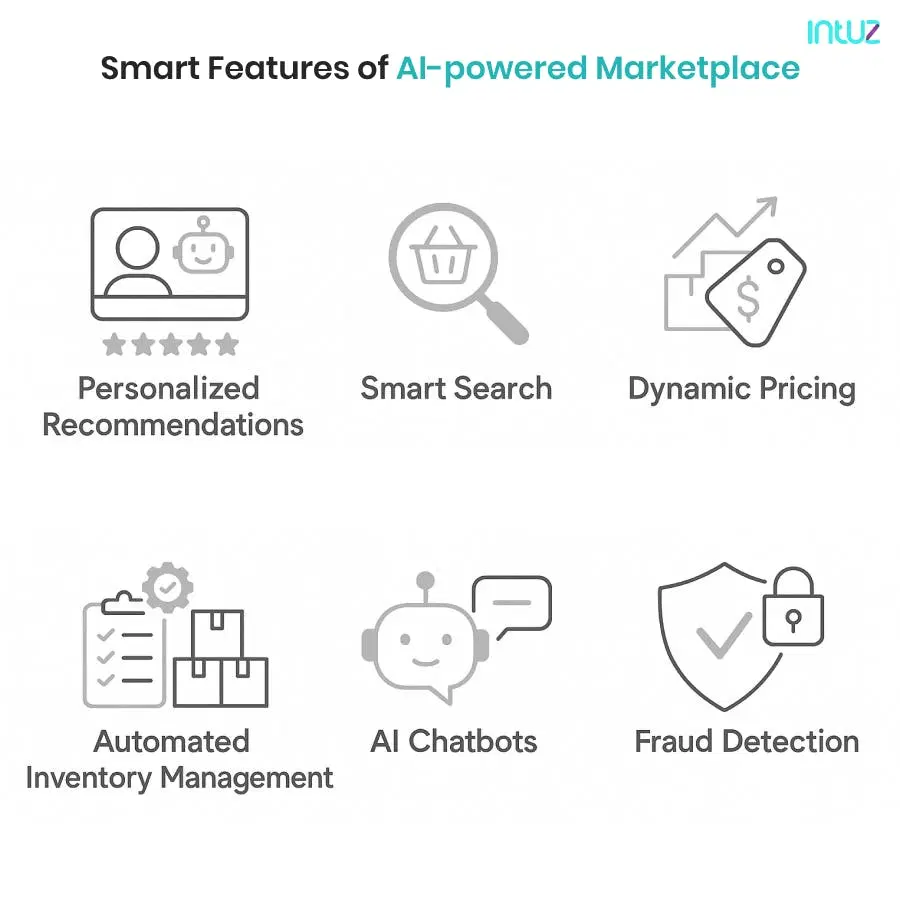
| Feature | What It Includes | How AI Enhances It |
|---|---|---|
| User profiles, listings, and transactions | Basic building, such as rich listings, secure sign-up, safe payments, and verified profiles | Automates ID and fraud checks, Auto‑categorizes listings and flags duplicates or incomplete entries, Tracks transactions with smart invoicing and real-time fraud alerts |
| Recommendation engine | Suggests relevant products or services to boost engagement and conversions | Learns from user behavior and item data, Starts with simple trends, improves over time with ML |
| AI‑powered search and filters | A search function that helps users find what they need quickly, supported by filters for narrowing results | Adapts filters dynamically to user preferences, past behavior, and price ranges, Understands intent via natural language, Supports image‑based search |
| Predictive analytics | Insights that guide decisions for sellers, buyers, and operators | Generates sales forecasts, inventory planning, and price trend analysis for sellers, Predicts churn and demand shifts, Sends personalized alerts |
| Dynamic pricing engine | A pricing system that adjusts to demand, season, or competitive trends to increase revenue | Automates pricing rules with AI models, Enables surge or volume-based pricing |
| Data dashboards and analytics | Dashboards that show performance metrics for sellers and platform‑wide insights for marketplace owners | Highlights top‑performing categories, user engagement patterns, and fraud reports, Embeds predictive recommendations such as the best time to list or when to adjust pricing |
How to Develop an AI‑Powered Marketplace: Step by Step Guide
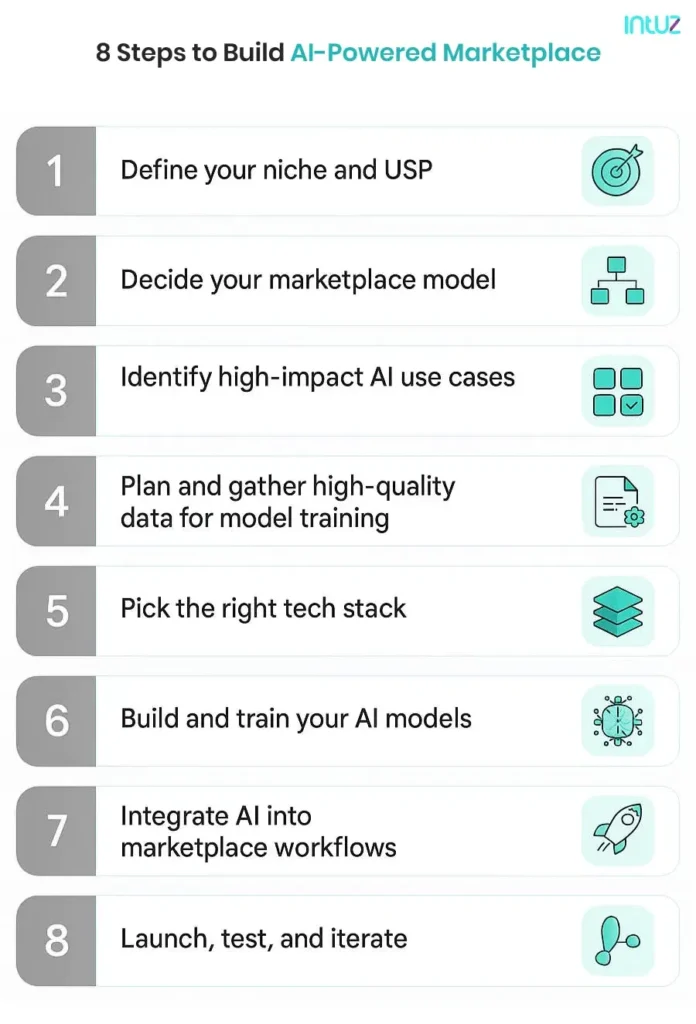
1. Define your niche and USP
Begin by identifying a specific problem or gap that your AI-powered marketplace can address. You might notice certain products or services are hard to find or that existing platforms are slow or confusing. Narrow your focus so your SMB speaks directly to a clear need.
Once you have an idea, validate it:
- Study your competitors
- Look closely at their reviews and see what users wish they did better
Next, talk with potential buyers and sellers through surveys or interviews to understand their pain points.
You should also be clear about how AI will improve things for your marketplace.
- Will it match buyers and sellers faster?
- Will it recommend better products?
- Will it cut down on fraud?
Intuz Recommends
In our custom AI development projects, we use short workshops with SMB clients to uncover the “why” behind an idea, i.e., the problem that needs to be solved. Moreover, capture exact phrases used for describing frustrations and refer back to them whenever you make a feature decision.
2. Decide your marketplace model
Choose a model that fits your audience and the kind of transactions you expect your AI-powered marketplace to handle. For instance:
- A Business-to-Consumer (B2C) is apt when you want many sellers to reach buyers in one place
- A Peer-to-Peer (P2P) model works best when individuals list and sell directly to other individuals
- A Business-to-Business (B2B) model serves wholesale buyers and often needs features like volume pricing or credit terms
A fourth emerging model worth noting: AI Agent Marketplaces, where developers publish and users deploy specialized AI agents. This model — exemplified by OpenAI’s GPT Store and Hugging Face Hub — is growing at a CAGR of 45.8% and may be relevant if your marketplace distributes AI tools or automation services.
Then, define how your marketplace will earn revenue:
- Subscription plans for sellers who want more visibility
- Commission on each sale
- Ads or premium services
This will fuel your next task—laying out key roles for all stakeholders involved in the process.
Intuz Recommends
Before you commit to a model, sketch simple user-flow diagrams on paper for buyers, sellers, admins, and AI agents. Walk through a sample transaction in each role. If a step feels unclear or overloaded, refine the model before moving to design.
3. Identify high-impact AI use cases
Now that you’ve seen the core AI features a marketplace can support, it’s time to choose the ones that matter most for your niche, stage, and customer needs. You don’t need all of them on day one. Here’s how you can think:
- B2B marketplaces may benefit more from predictive analytics and volume-based pricing logic
- For high-value or risk-prone transactions, fraud detection and dynamic pricing are crucial
- If your marketplace relies on discovery (like fashion or home décor), prioritize AI-powered search and recommendations
Consider your data maturity as well: some features require large datasets to work well, while others (like rule-based fraud checks or natural language search) can deliver value early.
Intuz Recommends
We’ve found that the most overlooked AI opportunities often live in the boring back office. Before jumping into user-facing features, look at repetitive internal tasks, such as reviewing flagged listings, moderating content, or assigning support tickets. Automating just one of these can make your operations scale-ready from day one.
4. Plan and gather high-quality data for model training
As AI models rely on data, plan early. This task involves deciding:
- Which data can you collect yourself?
- Which third-party data might you want to license?
- Could synthetic data help you train the initial model?
Then, design pipelines that collect and clean data continuously.
When new listings, searches, or transactions happen, your AI-powered marketplace should capture them for your models to keep improving. In addition, have guardrails to protect user data from the start. These include privacy regulations like GDPR and CCPA.
Intuz Recommends
Create a simple data checklist for your team. For every new feature, ask: what data will this generate, where will we store it, and how will we label it? This habit prevents the scramble for clean training data later.
Fact – One US retailer improved customer value perception by 10% after using AI to make targeted price reductions on Key Value Items (KVIs). — BCG
5. Pick the right tech stack
Select tools that balance cost, performance, and growth potential, serving multiple use cases, such as the following:
| Category | Recommendation |
|---|---|
| AI frameworks | TensorFlow and PyTorch are well-supported and widely used |
| NLP libraries | Use libraries like spaCy, Hugging Face Transformers, and Haystack that handle chatbots or search queries effectively |
| Hosting and scaling | Cloud platforms, such as AWS, GCP, or Azure, can help you scale infra without managing own servers |
| Marketplace backend | Node.js, Python, and Ruby are strong choices with many prebuilt components |
| Database | PostgreSQL and MongoDB, which are good for handling real-time updates and responsiveness |
Plug-and-Play AI vs. Custom AI: When to Use Which
| Approach | Best For | Examples |
|---|---|---|
| Plug-and-play APIs | Rapid launch, lower upfront cost, standard use cases | OpenAI API, Google Vertex AI, AWS AI services |
| Custom-built models | Proprietary differentiation, data privacy, specialized domains | TensorFlow, PyTorch — trained on your own data |
6. Build and train your AI models
Once your data pipelines are in place, it’s time to bring AI into action.
You can speed up marketplace development by starting with pre-trained models, which are large, general-purpose datasets that can be adapted to your domain with relatively little effort.
Depending on the use case, such as search, recommendations, chatbots, or fraud detection, choose a suitable platform: Hugging Face, OpenAI, or TensorFlow. Fine-tune them with your marketplace’s data to make their output more relevant and accurate.
Lastly, always test thoroughly for performance, fairness, and accuracy, and monitor for bias that could harm user trust.
Fact – Companies that excel at personalization generate 40% more revenue than those that don’t. — McKinsey
7. Integrate AI into marketplace workflows
Once your AI models are ready, embed them directly into key workflows, like onboarding, search, checkout, and customer support, where they can enhance user experience.
For example, use AI to recommend categories during seller onboarding, show relevant results in real time as buyers type, auto-fill address details at checkout, or power smart assistants that resolve common support queries at your marketplace.
Don’t forget to include fallback workflows: if an AI prediction fails or lacks confidence, default to human review, manual filters, or basic search logic.
Intuz Recommends
In our marketplace builds, we introduce AI enhancements gradually, starting with features users already expect (like smart search or recommendations). This builds trust and gives you room to monitor model behavior before expanding to critical tasks like fraud prevention or dispute resolution.
8. Launch, test, and iterate
Roll out your MVP with just the essential AI functionality that supports core user actions, such as discovering products, completing transactions, or resolving support issues for a small but diverse user group.
Once live, collect both qualitative feedback (e.g., user confusion or delight) and quantitative metrics (e.g., click-through rates, prediction accuracy, error rates). As your marketplace grows, retrain your models with fresh data to improve relevance and responsiveness.
Be sure to set regular reviews, monthly or quarterly, and make improvements a part of your rhythm, not a one‑off project.
Intuz Recommends
We advise our clients to track both system-level metrics (like model accuracy) and user-level signals (like abandonment during AI-driven flows). For example, in one B2C marketplace we built, users were skipping AI-suggested tags during product uploads. Post-launch analysis showed users needed more context. A quick tooltip addition raised adoption by 40%, a small tweak made possible by watching the right signals.
Common Mistakes When Building an AI-Powered Marketplace
1. Building AI before validating the marketplace itself
AI adds cost and complexity. Validate your buyer-seller matching and transaction flow manually before layering in automation. AI should amplify a working marketplace, not rescue a broken one.
2. Underinvesting in data quality
AI is only as good as the data it learns from. Dirty, incomplete, or biased datasets produce unreliable recommendations and pricing — sometimes at scale, before you notice.
3. Launching all AI features at once
Users need to trust the platform before they trust AI recommendations. Introduce AI features incrementally and give users visibility into why the system is making suggestions.
4. No fallback logic
If an AI model fails or returns a low-confidence prediction, the user experience must degrade gracefully — not break. Always build a non-AI fallback for every AI-powered workflow.
5. Ignoring compliance from the start
Adding GDPR or CCPA compliance after launch is expensive and disruptive. Build consent management and data anonymization into your architecture before you collect your first user record.
Cost and Timeline for AI‑Powered Marketplace Development
When planning your marketplace, understanding what shapes the budget and the duration of each phase is helpful. Costs vary widely, but you can set expectations by looking at the factors that matter most. Here’s what Intuz’s internal studies suggest:
| Project Scope | Estimated Cost | Typical Timeline | What’s Included |
|---|---|---|---|
| MVP + core AI capabilities | $50,000 – $120,000 | 3 – 6 months | Secure sign-up, profile & listing feature, basic search with AI assistance, payments |
| Full-featured AI marketplace | $150,000 – $500,000+ | 6 – 12 months | Recommendation engine, analytics dashboard, dynamic pricing, search, fraud modules |
| Enterprise or highly customized | $500,000+ (up to $1M) | 9 – 18 months | Multi-region support, multilingual AI, custom agent workflows, compliance-heavy |
Also Read
See Intuz in Action
We helped Swiftryde, a leading ride‑sharing platform, build an AI‑powered dynamic pricing system that continuously analyzed rider requests, driver availability, traffic, and weather.
By applying ML models like XGBoost and Random Forest, the platform could forecast demand surges, adjust fares in real time, and personalize pricing based on trip history and location.
Results?
- Higher driver availability during peak hours
- Shorter wait times for riders
- increased revenue
Check out the full case study.
Why Intuz is the Perfect Choice For Your AI-Powered Marketplace Development
One big reason: we know what we’re doing and we do it well.
When you choose Intuz, you work with a team that cares about what your SMB is trying to build and how you want to grow. We agree on clear outcomes up front, so you always know what success looks like and what it’ll cost.
You get a responsive team that fits into your workday and works alongside you, regardless of your location, without stretching your budget. Your code and data stay in your cloud under your policies, giving you complete control and peace of mind.
We build with proven open‑source frameworks, which means you avoid lock‑in and keep a stack your team can manage and extend. You see precisely what we are working on through shared boards, reviews, and stand‑ups.
Security and compliance are part of the process from the start. We help you get started quickly, adapt as your priorities shift, and keep moving with you as your marketplace grows.
With Intuz by your side, you get to shape a marketplace that keeps learning and improving with every transaction.
Book your free consultation with us today.
FAQs
What’s the first step to building an AI-powered marketplace?
Start by identifying high-impact use cases where AI adds value—like personalization, fraud detection, or smart search. Define your core differentiator and data strategy early, as AI performance heavily depends on data quality and availability from day one.
How much does it cost to build an AI-powered marketplace?
The cost depends on the scope of your project. An MVP with core AI capabilities like smart search, secure sign-up, and basic AI assistance typically costs between $50,000 and $120,000. A full-featured AI marketplace with a recommendation engine, dynamic pricing, fraud detection, and analytics dashboard ranges from $150,000 to $500,000+. Enterprise builds with multi-region support, multilingual AI, and custom agent workflows can exceed $1 million.
How long does it take to build an AI-powered marketplace?
Timeline varies based on complexity. An MVP typically takes 3 to 6 months to build. A full-featured AI marketplace generally requires 6 to 12 months. For enterprise or highly customized platforms — such as those with compliance-heavy requirements or custom AI workflows — expect 9 to 18 months from planning to launch.
What is the recommended tech stack for building an AI-powered marketplace?
For AI frameworks, TensorFlow and PyTorch are widely used and well-supported. For NLP tasks like chatbots and smart search, libraries like spaCy, Hugging Face Transformers, and Haystack are strong choices. Cloud platforms such as AWS, GCP, or Azure handle scaling without managing your own servers. For the marketplace backend, Node.js, Python, and Ruby offer solid prebuilt components, while PostgreSQL and MongoDB are reliable database options for handling real-time updates.
How do I collect and manage data for my marketplace AI features?
Integrate structured data collection via user interactions, transactions, and behavior analytics tools. Use cloud-based data warehouses (like Snowflake or BigQuery) and ensure data labeling pipelines for supervised models are in place. Start small, but scalable.
Can I build an AI-powered marketplace without a huge team?
Yes. Use plug-and-play AI services (e.g., Google Vertex AI, AWS AI services) and low-code tools like Bubble or n8n for automation. Partnering with a specialized AI development company like Intuz can reduce development costs and accelerate go-to-market.
How can I ensure reliable, scalable AI performance as the marketplace grows?
Choose cloud-based, scalable AI solutions and regularly monitor both model and system performance. Amazon and Airbnb’s examples show robust monitoring, continuous retraining, and seamless integration with the backend are vital for maintaining speed and reliability as user traffic scales.
What compliance requirements do AI marketplaces need to meet?
AI-powered marketplaces must address GDPR (if operating in or serving EU users), CCPA (for California users), and PCI-DSS (for any platform handling card transactions). This requires consent management, data anonymization pipelines, the right to erasure, audit logging, and vendor data processing agreements. Building compliance into your architecture from day one is far less expensive than retrofitting it post-launch. Intuz operates from an ISO 27001-audited facility and builds GDPR-compliant data handling into every marketplace engagement.
Work with Intuz
Ready to Build Your AI Marketplace?
Talk to our experts and get a free project estimate and roadmap.
Let's Get Started
Share this article