



A therapist who sees 30 clients this week will spend more than eight hours writing notes for them, on top of the sessions themselves. A utilization review nurse justifying a continued stay for a patient in crisis will spend one to two hours per patient preparing for a single call with a payer, a call she may not get to make until she’s been on hold for twenty minutes (MedCity News, 2026). Neither of them took a job in behavioral health to do this work, and both of them are more likely to leave the field because of it.
That’s the operational reality behind every conversation about workflow automation for behavioral health right now. Before evaluating any tool, it’s worth being precise about where the hours are actually going, because “workflow automation” gets pitched as a single fix for three fairly different problems: documentation, authorization, and scheduling. That pattern holds across healthcare workflow automation generally, but behavioral health carries a heavier version of all three at once. Each one has its own evidence base, its own vendors, and its own honest limitations.
Show
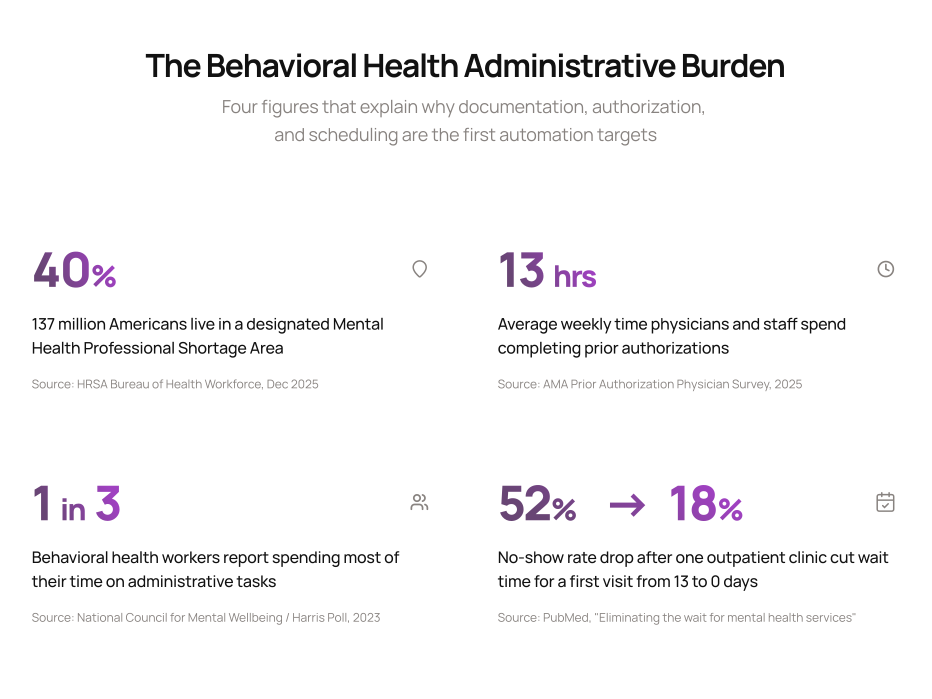
- A third of the behavioral health workforce reports spending most of their working time on administrative tasks rather than direct care, and most of them say it actively takes time away from clients (National Council for Mental Wellbeing, 2023).
- Prior authorization costs physicians and their staff an average of 13 hours a week, and 95% report it delays patient care (AMA, 2025).
- Vendor claims about ambient AI documentation (up to 80% less note-taking time) are considerably stronger than what independent, peer-reviewed trials have measured so far. Both are worth knowing before you buy.
- 40% of the U.S. population, 137 million people, now lives in a designated Mental Health Professional Shortage Area, which means the administrative burden falls on a workforce that is already too thin (HRSA, Dec 2025).
- The February 2026 compliance deadline for the updated 42 CFR Part 2 rule changes how SUD treatment records can be shared, and it directly affects what an automation platform needs to handle for consent management.
Why the Administrative Load Doesn’t Compress the Way It Does Elsewhere
Behavioral health carries a specific combination of problems that most other specialties don’t face together. Documentation requirements are higher (progress notes, treatment plans, and risk assessments are typically more narrative than a primary care visit note). Reimbursement is more fragmented, with Medicaid, commercial payers, and self-pay often running through the same practice with different authorization rules for each. And the workforce shortage is severe enough that there’s rarely slack capacity to absorb a bad week.
Nine in ten behavioral health workers report experiencing burnout, and 62% describe it as moderate or severe (National Council for Mental Wellbeing, 2023). That statistic gets cited constantly, but the more useful number sits underneath it: a third of the workforce spends most of its time on administrative tasks, and 68% of clinicians who provide direct care say that time comes directly out of time they could spend with clients. When 38% of the same workforce says less time on admin work would be the single biggest relief, that’s a specific, measurable target for automation, not a vague complaint.
The Documentation Problem, and Where the Evidence Actually Lands
Reported burnout contributor
Documentation and charting, cited by 16% of physicians as their top burnout driver, with 62% citing bureaucratic tasks broadly (Medscape 2024 Physician Burnout & Depression Report, as reported by Advisory Board)
Independent trial result
In a randomized trial of 238 outpatient physicians across 14 specialties, one ambient AI scribe (Nabla) cut average time spent writing a note by 9.5% compared to a control group; a second tool (Microsoft DAX) showed no statistically significant change (NEJM AI, 2025)
Vendor-reported result
Qualifacts reports that more than 150 behavioral health organizations using its Qualifacts iQ documentation tool have cut note-taking time by up to 80% and increased provider capacity by 50% (Qualifacts, Sept 2025)
Those two numbers don’t agree, and the disagreement matters more than either one alone. The NEJM AI trial is the most rigorous evidence available on ambient scribes: randomized, controlled, peer-reviewed, and the effect it found was real but modest, a matter of tens of seconds per note rather than an 80% reduction, and it wasn’t run in behavioral health specifically. The Qualifacts figure comes from the vendor’s own customer base and hasn’t been independently replicated, though the underlying logic, that structured behavioral health templates paired with ambient transcription save more time than a general-purpose scribe built for primary care, is plausible given how narrative behavioral health notes tend to be.
The honest position for a CXO evaluating this category: expect real time savings, budget for something closer to the independently measured range than the vendor-reported range, and treat any specific percentage a vendor quotes as a starting point for your own pilot, not a guarantee.
When this fits your organization
You have session volume high enough that even a modest per-note time reduction compounds into meaningful hours weekly, and your clinicians are willing to review AI-drafted notes rather than treating them as final.
When it doesn’t
Your documentation bottleneck isn’t note-writing speed but note-writing requirements set by a specific payer or state Medicaid program. No ambient scribe fixes a template that’s simply too long.
Prior Authorization and Utilization Review: The Heavier Burden
Care delays
95% of physicians report that prior authorization delays access to necessary care, and 94% say it increases physician burnout (AMA Prior Authorization Physician Survey, 2025)
Time cost
Physicians and their staff complete an average of 40 prior authorizations per physician per week, consuming roughly 13 hours of staff time (AMA, 2025)
Automation gap
Only 24% of physicians report their EHR offers electronic prior authorization for prescription medications; phone remains the most common method for medical service authorizations (AMA, 2025)
Behavioral health specific
Utilization review staff at behavioral health facilities spend 1 to 2.2 hours of prep work per patient before a single concurrent review call with a payer (MedCity News, 2026)
This is a more structured problem than documentation. Utilization review follows defined logic: it pulls from the clinical record, applies payer-specific criteria, and produces a level-of-care justification in a known format, distinct from the open-ended, judgment-heavy work of writing a clinical note. A 2026 Becker’s Hospital Review survey of 103 healthcare leaders found that reducing low-value administrative work has become a top workforce priority for the year, and UR is frequently the first place organizations point to.
Most incumbent behavioral health EHRs still route prior authorization through manual phone calls and portals rather than structured electronic submission. Automation here isn’t replacing clinical judgment, it’s replacing the repetitive parts (chart-pulling, criteria look-up, form assembly) so UR staff spend their hours on the call itself, not preparing for it.
When this fits your organization
You run any meaningful volume of inpatient, residential, PHP, or IOP level-of-care reviews, where UR staff time is a defined, trackable cost center.
When it doesn’t
Your practice is entirely outpatient, low-acuity, and rarely touches prior authorization. The ROI math doesn’t work at that volume.
See What a Phased Rollout Looks Like
Start with one workflow, prove it in six weeks, then expand.
Scheduling, Intake, and the No-Show Problem
Wait time and no-shows
When one outpatient mental health clinic reduced the wait time for a first appointment from 13 days to 0 days, its no-show rate dropped from 52% to 18%, alongside a reduction in psychiatric hospitalizations (PubMed, “Eliminating the wait for mental health services”)
Behavioral health no-show rates run consistently higher than general medical practice, and the mechanism is different from a scheduling conflict. Patients often book an appointment at the peak of a crisis, then lose motivation, forget, or feel ambivalent about showing up by the time the appointment arrives, especially when there’s a two-week gap between booking and being seen. A reminder text addresses part of that. Compressing the gap between referral and first visit addresses the actual mechanism, which is what the clinics above did.
Automating intake (structured referral processing, insurance verification, and same-day slot matching) addresses the mechanism directly rather than the symptom.
When this fits your organization
Your waitlist for a first appointment is measured in weeks, and no-shows are a visible drag on both revenue and continuity of care.
When it doesn’t
You’re already running near-immediate access. In that case, documentation or UR automation will show ROI faster than intake automation would.
Comparing the Approaches Honestly
| Approach | What it actually does | Evidence of impact | Where it falls short |
|---|---|---|---|
| Native EHR AI add-on (e.g., Qualifacts iQ, Netsmart with AWS HealthScribe) | Ambient note generation built into the behavioral health EHR you already use | Vendor-reported: 150+ organizations, up to 80% cut in note time (Qualifacts, 2025) | Self-reported by the vendor, not independently replicated for behavioral health specifically; ties you to that EHR’s roadmap |
| General-purpose ambient AI scribe bolted onto any EHR | Transcribes and drafts notes from session audio | Independently measured: one tool cut time-in-note 9.5% versus control; a second showed no significant change (NEJM AI, 2025) | Tested in general outpatient medicine, not behavioral health; therapy-note nuance at scale is unproven |
| Manual utilization review process | Staff calls payers and builds clinical justifications from scratch | AMA: 95% of physicians report care delays; average 13 hours weekly per physician on prior auth alone (AMA, 2025) | Doesn’t scale with caseload growth; the leading driver of UR staff attrition (MedCity News, 2026) |
| End-to-end workflow automation spanning intake, documentation, and UR | Human-in-the-loop automation across the full administrative chain, not one isolated task | A wait-time reduction from 13 to 0 days cut no-shows from 52% to 18% in one outpatient redesign (PubMed) | Requires a phased rollout and genuine process mapping; not a plug-and-play single tool |
Where to Start, by Organization Type
| Organization type | Recommended starting point | Why |
|---|---|---|
| Solo or small group practice | Ambient documentation only | Session volume is too low to justify building out UR automation, and the return shows up fastest here |
| Outpatient clinic or IOP with 5+ clinicians | Documentation plus scheduling/intake automation | No-show attrition and intake delay usually cost more at this size than documentation time does |
| Multi-site SUD treatment organization | Prior authorization and utilization review automation first | Carries the highest documented administrative burden per AMA and MedCity News data, and is most directly affected by the 42 CFR Part 2 consent changes |
| CCBHC or safety-net behavioral health organization | Phased rollout starting with intake automation | CCBHC funding already requires detailed operational reporting; automating intake reduces the burden of that reporting layer first |
What the 42 CFR Part 2 Changes Mean for Automation Vendors
If your organization treats substance use disorder patients, this isn’t optional context. The February 2024 final rule aligned 42 CFR Part 2 more closely with HIPAA under the CARES Act, and the compliance deadline lands February 16, 2026. Two changes matter directly for any workflow automation platform: patients can now execute a single consent covering all future treatment, payment, and operations uses of SUD records rather than a new consent for every disclosure, and the rule no longer requires SUD counseling notes to be segregated from the rest of the record (HHS, 2024).
That sounds like it simplifies things, and in some ways it does. It also means breach notification for Part 2 data now follows HIPAA’s rules, including notification to HHS and, for breaches affecting 500 or more people, the media. Any automation vendor handling SUD records needs consent-tracking logic built for the new single-consent model and audit logging strong enough to support HIPAA-grade breach reporting. If a vendor can’t describe how their platform handles Part 2 consent specifically, that’s worth a direct question before signing anything.
Handling Substance Use Disorder Records?
Get a compliance-first automation roadmap before you pick a vendor
What Good Implementation Looks Like
The organizations that get this right don’t automate everything at once. They pick the workflow causing the most measurable friction, whether that’s UR prep time, note backlog, or intake delay, instrument it, and prove value before expanding.
Start with one workflow and measure the baseline first
Track hours per note, days to first appointment, or PAs completed per week, whichever matches the workflow you’re automating. Without that baseline, there’s no way to prove the automation did anything.
/imag
Keep a human in the loop on anything that submits, signs, or discloses
Beyond the compliance value, this is what makes staff trust the system enough to use it instead of working around it.
Build the audit trail in from day one
Don’t treat it as a retrofit once a payer or state auditor asks for one. This matters more here than in most specialties given the 42 CFR Part 2 exposure above.
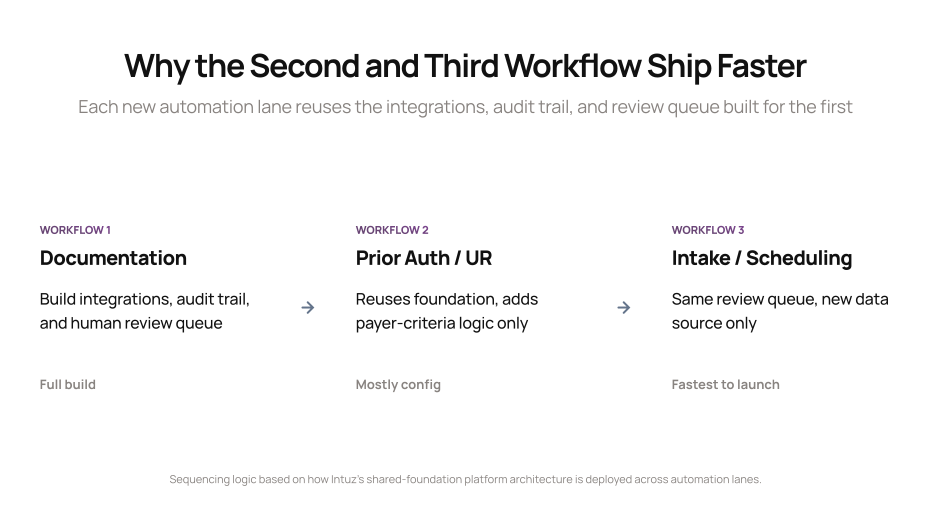
Expect the second and third workflows to ship faster than the first
Once integrations, exception handling, and review queues exist for one workflow, extending them to the next is mostly configuration rather than a rebuild.
How Intuz Approaches
We built the Intuz Healthcare AI platform around exactly this principle: one shared foundation covering integrations, audit trails, and human review, with automation lanes added one at a time rather than a single monolithic rollout. The platform’s behavioral health track handles intake assessments, insurance authorizations, session documentation, and care coordination, the same three problem areas this piece has walked through, built on the same infrastructure we use for home health, dental, and imaging clients.
Our clearest proof point isn’t in behavioral health specifically, but it’s directly transferable: an AI-powered fax-to-EMR build for a home health provider that replaced manual order processing with real-time workflows, hit over 90% OCR accuracy, cut manual errors by 95%, and saved more than 15 hours a week for the operations team (Careonix case study), the same category of document intake, verification, and EHR data entry that eats a third of a behavioral health clinician’s week.
If your organization is trying to figure out which workflow to automate first, our workflow automation services team maps the friction points before recommending a platform, rather than starting from a tool and working backward.
If you’re weighing where to start with workflow automation for behavioral health, our AI agent development team will map your specific documentation, authorization, and intake workflows before recommending anything, so the first automation you deploy is the one actually causing the most friction.
FAQs
What’s the difference between an AI documentation tool and full workflow automation for a behavioral health practice?
An AI documentation tool, like an ambient scribe, addresses one task: turning a session into a drafted note. Workflow automation is broader. It can cover intake, insurance verification, prior authorization tracking, and care coordination alongside documentation, all built on shared infrastructure so a new automation lane doesn’t require rebuilding integrations and audit logging from scratch. Most organizations start with documentation because it’s the most self-contained problem, then expand into UR or intake once the first workflow proves out.
Does workflow automation help with 42 CFR Part 2 compliance for substance use disorder records?
It can, but only if the platform is built for it specifically. The February 2026 compliance deadline changes how consent for SUD record disclosure works, moving to a single consent covering future treatment, payment, and operations uses. An automation platform handling these records needs consent-tracking logic that reflects that model and audit logging capable of supporting HIPAA-grade breach notification, since Part 2 breaches now follow HIPAA’s notification rules. Ask any vendor how their consent tracking specifically handles Part 2 before assuming general HIPAA compliance covers it.
How much does behavioral health workflow automation typically cost to implement?
Typically low five figures for a single workflow and into the tens of thousands for a multi-workflow deployment, though the exact number depends on scope. A single-workflow build, for example automating one intake process or one documentation lane, sits at the lower end. Multi-workflow deployments covering intake, documentation, and billing together run higher, with ongoing costs for monitoring and optimization. Organizations that phase the rollout (one workflow, proven, then the next) tend to see faster payback than those that try to automate everything in a single project.
Can workflow automation reduce prior authorization denials in behavioral health?
Automation can reduce the administrative time spent on prior authorization and improve the completeness and consistency of submitted justifications, which tends to reduce denials tied to missing or inconsistent documentation. It does not change payer medical necessity criteria, and it won’t fix denials driven by coverage policy rather than paperwork quality. The AMA’s 2025 survey found that only 24% of physicians have electronic prior authorization available through their EHR for prescription medications, which is the specific gap most automation in this category is built to close.
Is ambient AI documentation accurate enough for behavioral health notes?
Not fully on its own, no. Clinicians should plan to review and edit AI-drafted notes rather than treat them as final. The most rigorous evidence available, a randomized trial published in NEJM AI, found real but modest time savings from ambient scribes in general outpatient medicine, with meaningfully different results between two commercially available tools. Behavioral health notes carry more narrative and clinical judgment than a typical primary care note, so that review step matters even more here, at least until vendor-specific accuracy data for behavioral health documentation is independently validated.
What should a CCBHC or outpatient clinic automate first?
For most CCBHCs, intake automation tends to deliver the fastest measurable return, since CCBHC funding already requires detailed operational reporting and intake is where referral, insurance verification, and scheduling delays compound into no-shows. For a general outpatient clinic without CCBHC reporting requirements, the better starting point is usually whichever workflow has the clearest measurable baseline today, whether that’s hours spent on notes, days to first appointment, or hours spent on prior authorization.
Work with Intuz
Need Workflow Automation for Behavioral Health?
Book 45-minute free consultation with Intuz.
Let's Get Started
Share this article