




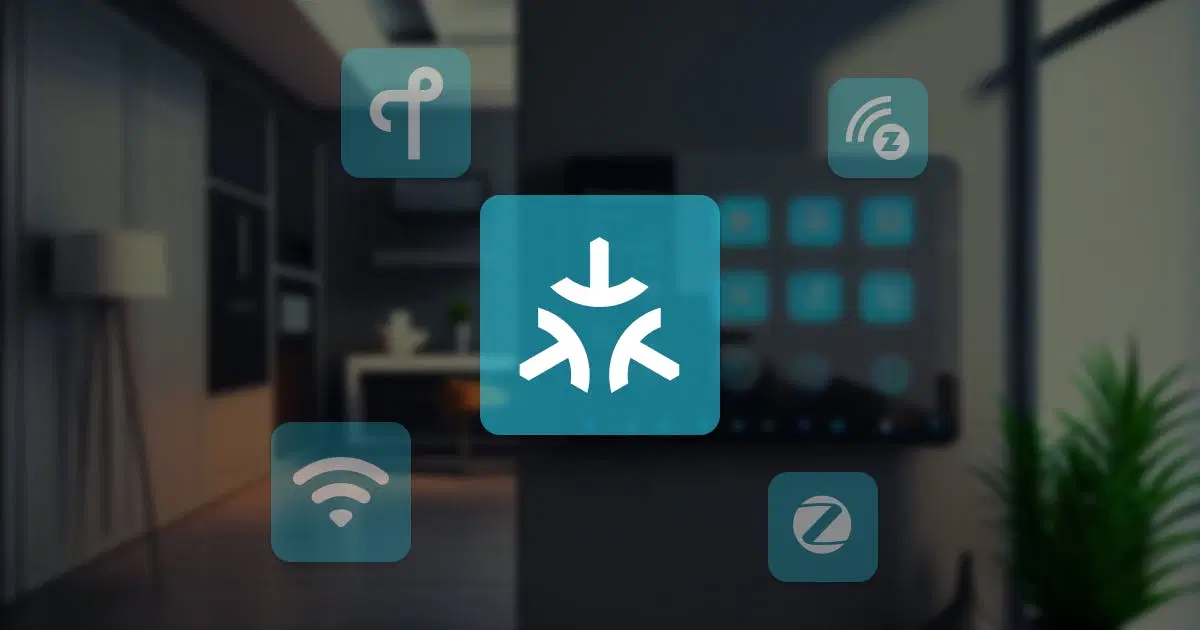
Matter is the ultimate next-gen smart home protocol. But how does it compare against other protocols like Zigbee, Z-Wave, and WiFi? And what benefits and disadvantages does it bring to the table? Let us find out in this blog post:
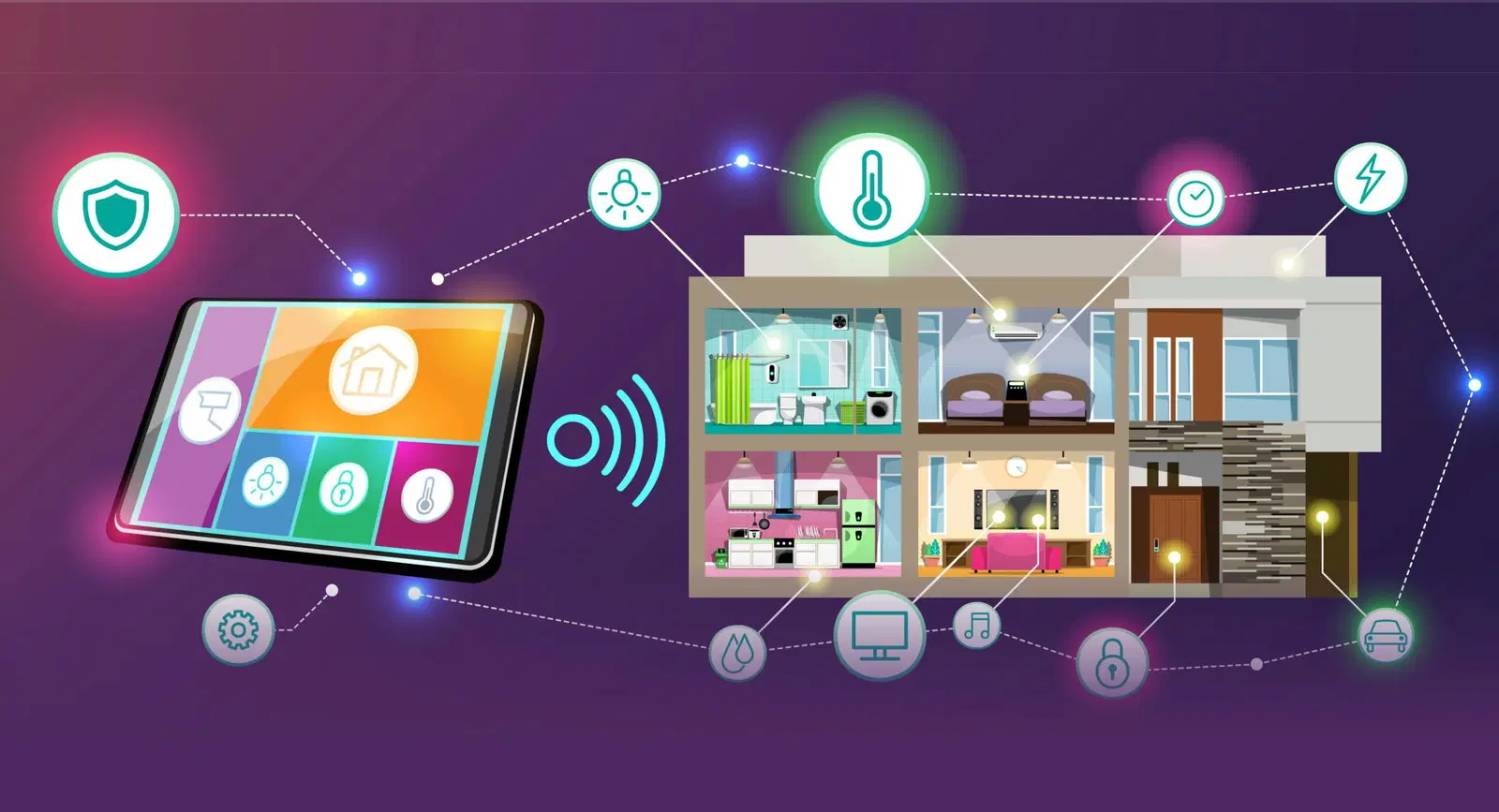
A smart home protocol refers to guidelines and regulations for transmitting information between internet-connected appliances and devices. Although some protocols may be more intricate, their primary objectives remain the same: to facilitate data sharing and communication amongst devices.
To distinguish their products or technologies from others, many companies like Google, Amazon, and Apple opt to create their own unique smart home protocol rather than modifying or adopting an existing one. Three key factors contribute to the success of smart home protocols, such as:
- Interoperability: It allows devices from different manufacturers to work together seamlessly. Without interoperability, consumers may be limited in their choice of devices. They may need to use separate apps or hubs to control each device, resulting in a fragmented user experience and reduced overall value of a smart home system.
Security: Smart home devices are vulnerable to cyber attacks. A security breach can result in serious consequences, such as stolen personal information or malicious actors’ control of the home’s systems. Smart home standards are designed with security, including data encryption, authentication, and access control.
Show
- Matter is a universal smart home standard launched in November 2022 by a coalition including Apple, Google, Amazon, Samsung, and LG — designed to enable seamless communication between smart devices regardless of manufacturer.
- Zigbee excels in low-power mesh networking but is limited to the 2.4 GHz band and is a proprietary technology — making it less interoperable compared to Matter’s open standard.
- Z-Wave offers longer range and broad device compatibility, but its proprietary nature and reliance on a central controller device limit flexibility that Matter’s unified, multi-network approach overcomes.
- WiFi is better suited for high-bandwidth applications like video streaming and gaming, while Matter is optimised for low-power, low-bandwidth IoT devices — though some devices can use both.
- Matter is not designed to replace Zigbee or Z-Wave, but to work alongside them as a common language — though it may gradually become the dominant standard depending on adoption, device availability, and performance.
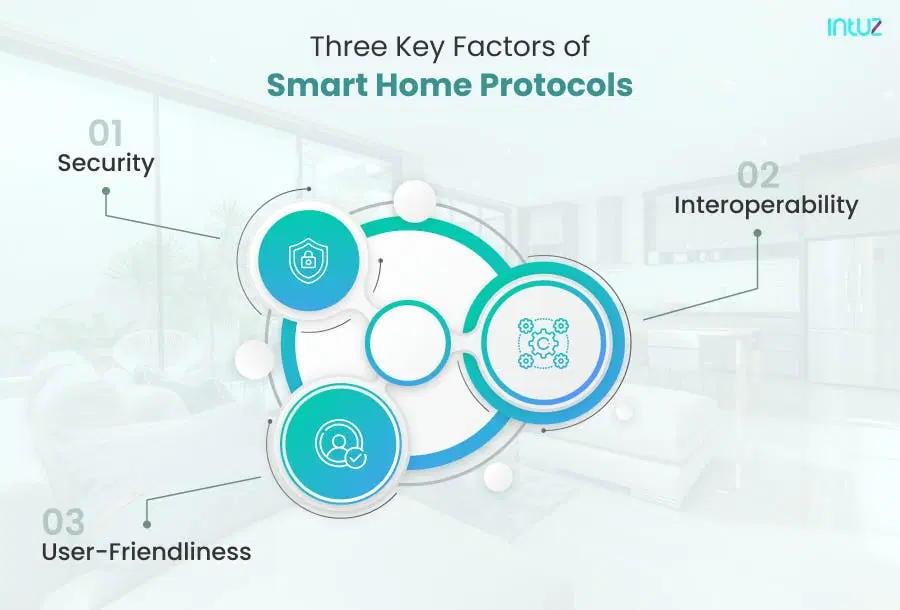
- User-friendliness: Home automation aims to make life easier and more convenient, requiring intuitive interfaces and straightforward setup processes. A user-friendly protocol minimizes frustration and confusion among users.
Meet Matter: The new smart home standard
Matter was developed and launched in November 2022 by a coalition of companies, including platform owners, manufacturers, and accessory makers, and it facilitates communication between smart devices regardless of the manufacturer. The coalition’s members are Apple, Google, Amazon, Samsung, LG, Nanoleaf, Eve, and Wyze.
One of Matter’s key features is enabling smart devices to function across platforms and ecosystems. This increases compatibility between IoT software solutions and minimizes user frustration when new devices are released.
Let’s Transform Your Home with Matter-Enabled IoT Automation!
Other smart home standards in the market and how they fare against Matter protocol
The smart home has the potential to enhance our daily lives by offering improved appliances, systems, and experiences. However, the industry’s current state is complicated, confusing, and expensive, with innovation stifled by walled gardens that force developers to focus on compatibility with multiple platforms rather than creating superior products and features.
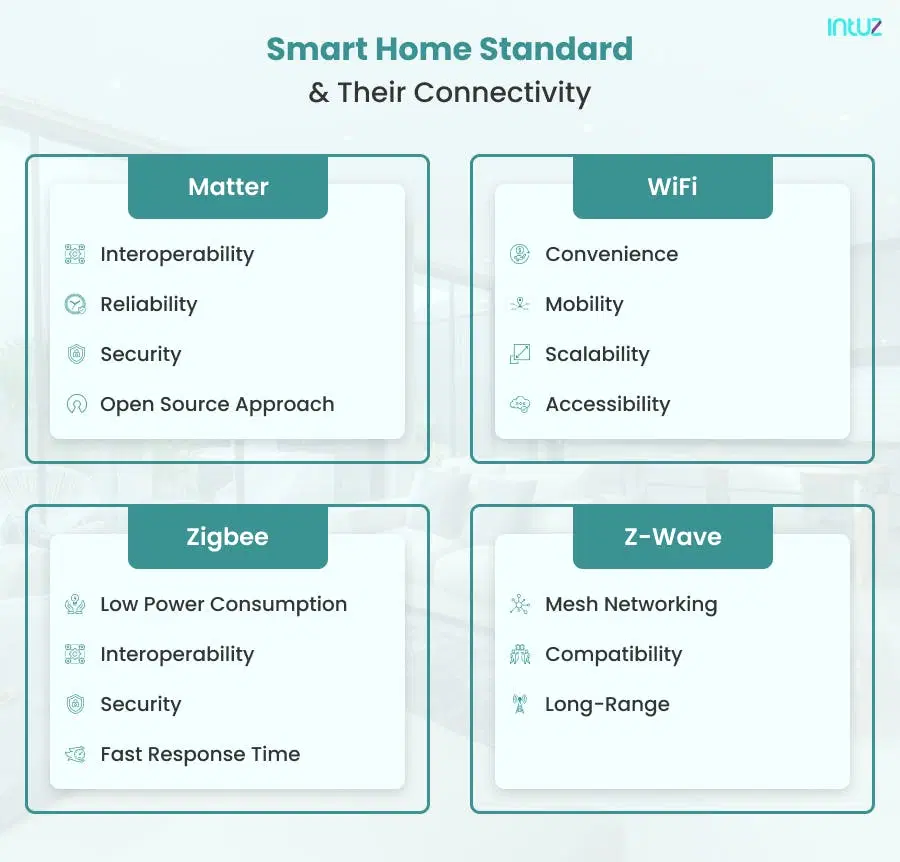
What is desperately needed is a universal connectivity standard that allows for seamless communication between devices. Besides Matter, other protocols in the market try to meet the diverse needs of the smart home:
1. Zigbee
Zigbee is a wireless communication protocol for smart home devices and IoT applications. It operates on a low-power, low-data rate mesh network, which means that each device in the network can communicate with other devices and act as a router, relaying signals to extend the range of the network.
It is managed by the Zigbee Alliance, a multi-stakeholder group with members including Cisco Systems, Philips, Samsung Electronics, and Sony. It is widely used in smart city applications such as building automation, energy management, and public lighting.
Advantages:
- Low power consumption: Such devices are designed to be low-power and have long battery life. It fits applications where devices must operate for long periods without being connected to a power source.
Interoperability:
Zigbee devices from different manufacturers can be integrated into a single network, which makes it easier to create a smart home or IoT system that incorporates devices from multiple sources.
- Security: It uses advanced encryption and authentication mechanisms to secure communications between devices, which makes it a secure option for smart home and IoT applications.
Fast response time:
Zigbee devices can respond to commands very quickly, which makes them ideal for applications where quick response times are essential, such as home automation and security systems.
While Zigbee has several advantages, there are also some disadvantages to consider:
Disadvantages
- While the mesh networking feature of Zigbee helps extend the range of the network, the variety of individual devices is limited compared to other wireless communication protocols, such as WiFi.
Zigbee operates in the 2.4 GHz frequency band, also used by WiFi, Bluetooth, and other wireless communication protocols. This can lead to interference and reduced performance if many devices use the same frequency band.
- Zigbee networks can be more complex to set up and manage than other wireless communication protocols, particularly for more extensive networks.
Matter vs. Zigbee: How do they compare against each other?
One of the main differences between Matter and Zigbee is that Matter is an open standard, while Zigbee is a proprietary technology. While Matter is built to be an interoperable standard that enables devices from different manufacturers to work together seamlessly, Zigbee is not as open and interoperable with devices from other manufacturers.
Another difference is their use of the 2.4 GHz frequency band. Matter uses the IEEE 802.15.4 standard, allowing communication over the 2.4 GHz frequency band and other frequency bands. In contrast, Zigbee uses only the 2.4 GHz frequency band, causing congestion and interference in areas with many smart home devices.
2. Z-Wave
Z-Wave is a wireless communication protocol designed specifically for home automation applications. It is managed by the Z-Wave Alliance, a consortium of over 700 companies, including manufacturers, service providers, and integrators.
Such devices communicate with each other directly or through intermediary nodes, such as repeaters, to extend the range of the network. It is popular for home automation applications such as lighting control, climate control, security, and energy management.
Advantages
- Mesh networking: It operates on a mesh network, which means that each device in the network can act as a router, relaying signals to other devices and extending the range of the network. This makes Z-Wave networks highly robust and dependable.
Compatibility:
Z-Wave devices are compatible with a wide range of different manufacturers, making it easier to create a home automation system that incorporates devices from multiple sources.
- Long-range: It operates on a lower frequency band than WiFi or Bluetooth, which enables it to transmit signals over longer distances.
Disadvantages
- Its limited bandwidth makes it unsuitable for applications requiring high data rates, such as video streaming.
Z-Wave networks require a controller device to manage the network, and if this device fails, the entire network can be affected.
Matter vs. Z-Wave: How do they compare against each other?
Compared to Z-Wave, the Matter protocol has the advantage of being a unified protocol that enables interoperability between devices from different manufacturers. It also supports more types of networks than Z-Wave, which is limited to mesh networking.
On the other hand, Z-Wave has a long track record and a wider range of devices available. Its low-power mesh network architecture and wide range of compatible devices make it a reliable and flexible option for home automation applications. However, using a proprietary protocol can limit interoperability with devices from other manufacturers.
Explore Solutions
3. WiFi
WiFi (short for Wireless Fidelity) is a wireless networking technology that allows electronic devices to connect to the internet or each other without using cables. WiFi uses radio waves to transmit data between devices within range of a wireless access point or router.
The technology was first developed in the late 1990s and has since become a popular method for connecting devices to the internet, especially in homes, offices, and public spaces such as airports and cafes. WiFi is commonly used for laptops, smartphones, tablets, gaming consoles, and other devices that require internet connectivity.
Advantages over wired networks and other forms of wireless connectivity
- Convenience: WiFi eliminates the need for cables, allowing devices to connect to the internet or each other without being physically tethered to a router or access point. This provides greater flexibility and mobility for users, who can move around freely without being constrained by cables.
Mobility
It enables the devices to connect to the internet or other devices from almost anywhere within range of a wireless access point or router, providing greater mobility and flexibility than traditional wired networks.
- Scalability: WiFi networks can easily be expanded or upgraded to accommodate additional devices or users, making it easy to scale as needed.
Accessibility
It is widely available in many public places, such as airports, cafes, and hotels, allowing users to connect easily to the internet or other devices while on the go.
- Easy setup: WiFi is easy to set up and configure, requiring minimal technical expertise. Most modern routers and access points come with user-friendly interfaces that make configuring and managing WiFi networks easy.
Drawbacks that should be considered:
- WiFi networks can be vulnerable to security breaches, such as unauthorized access or hacking, especially if the network is not properly secured. This can lead to the loss of sensitive data or the compromise of personal or financial information.
WiFi uses radio waves to transmit data, which can be power-intensive for mobile devices. This can lead to reduced battery life for smartphones and tablets, which may need to be charged more frequently.
Matter vs. WiFi: How do they compare against each other?
In terms of their use cases, Matter is more suitable for low-power, low-bandwidth IoT devices. At the same time, WiFi is better suited for high-bandwidth applications such as streaming video or online gaming. However, some IoT devices, such as smart speakers or security cameras, can use Matter protocol and WiFi, depending on the manufacturer and the intended use case.
Will Matter replace Zigbee and Z-Wave?
While Matter aims to provide a standardized and interoperable way for smart home devices to communicate with each other, it is not designed to replace existing wireless protocols such as Zigbee and Z-Wave.
Instead, Matter is intended to work alongside existing protocols to provide a common language for smart home devices, regardless of the manufacturer or brand. This means that devices compatible with Zigbee or Z-Wave may also be compatible with Matter and can communicate with other devices that support the standard.
However, it is possible that over time, Matter may become the dominant communication standard for smart home devices – depending upon the availability of compatible devices, consumer demand, and the overall performance and reliability of the technology.
This could lead to increased adoption of Matter-compatible devices and a gradual decline in using other wireless protocols such as Zigbee and Z-Wave.
Matter protocol advantages
Without a doubt, the Matter protocol future is shining bright in the smart home industry. But what makes it stand out? Check out these pros:
1. User-friendliness
Matter is designed to be easy to use and configure, with a user-friendly interface that makes it easy to set up and manage smart home devices. This can help to simplify the installation and operation of smart home systems, making them more accessible to a wider range of users, especially those who are new to smart home technology.
2. Enhanced security
It has built-in security features that help protect user data and maintain the privacy of smart home ecosystems. Devices that comply with the Matter protocol must adhere to security guidelines that ensure secure communication between devices and protect user information from unauthorized access.
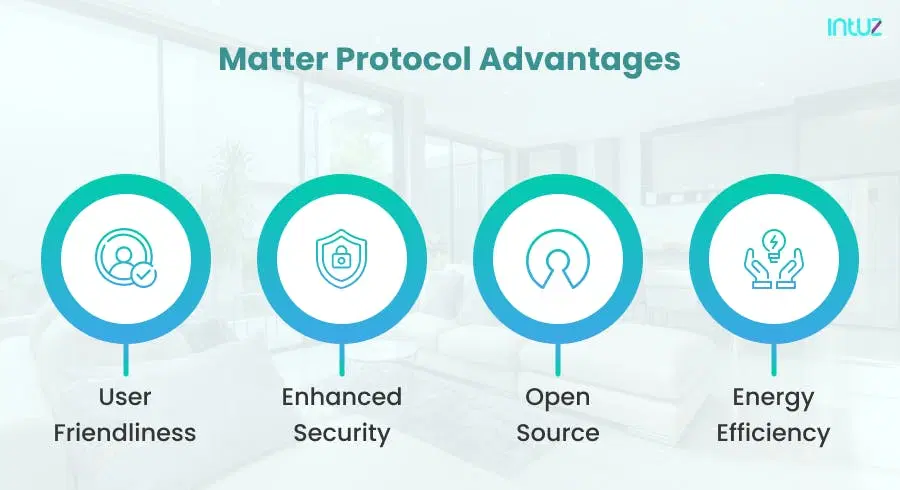
3. Open-source
Being open-source, Matter allows developers and manufacturers to contribute to the protocol, encouraging innovation and collaboration within the smart home industry.
4. Energy efficiency
Matter devices are designed with energy efficiency in mind, helping users save energy and reduce their environmental impact.
Matter protocol challenges
Despite the edge it has over Zigbee, Z-Wave, and WiFi, Matter has two major disadvantages that it is trying to overcome fast:
1. Adoption rate
While the standard has the support of many major tech companies and industry groups, it will take time for device manufacturers to implement it and for consumers to adopt Matter protocol-compatible devices.
2. Competition from established protocols
Matter faces competition from established wireless protocols such as Zigbee and Z-Wave, which have been widely used in smart home devices for many years. These protocols already have a large installed base of devices, and it may be difficult for Matter to displace them entirely.
Explore Solutions
Over to you
The Matter protocol, which fosters enhanced interoperability among IoT devices, maybe the game-changing breakthrough the end-to-end IoT development has long anticipated. Tech giants like Amazon, Apple, and Google embrace this development by integrating Matter support into their IoT offerings, further solidifying its potential impact on the market.
If you are looking for expert advice on Matter smart home automation or are interested in building an IoT product,
Book a Free 45-minute Consultation with Our IoT Experts Today!
Work with Intuz
Get Expert Matter Protocol Help
We respond within 24 hours with a clear point of view.
Tell Us What You're Building
Share this article