


Are you curious about building a Multi-AI Agent System? This guide breaks it down step by step—from choosing the right tools and frameworks to getting multiple AI agents to work together seamlessly. Learn how to design systems that communicate, collaborate, and scale with incredible potential for solving complex problems. Whether you’re an SME or an innovator, this is your road.
What Is a Multi-Agent AI System?
A multi-agent AI system (MAS) is a framework where multiple autonomous AI agents — each with a specialized role — collaborate to accomplish complex tasks that no single agent could handle alone. Each agent perceives its environment, makes independent decisions, and communicates with other agents through defined protocols to reach a shared goal.
Unlike a single AI model that handles all tasks sequentially, a multi-agent system divides work across specialized agents that operate in parallel, making it far more efficient for large-scale, dynamic, or multi-domain problems.
Common real-world examples include autonomous drone fleets in logistics, multi-step financial fraud detection pipelines, smart manufacturing quality control systems, and enterprise customer service platforms that route, analyze, and resolve queries simultaneously.
Show
- Multi-agent AI systems use specialized, autonomous agents to parallelize complex tasks — far exceeding single-agent capabilities.
- Three core architectures exist: centralized (one master agent), decentralized (peer-to-peer), and hybrid (combining both).
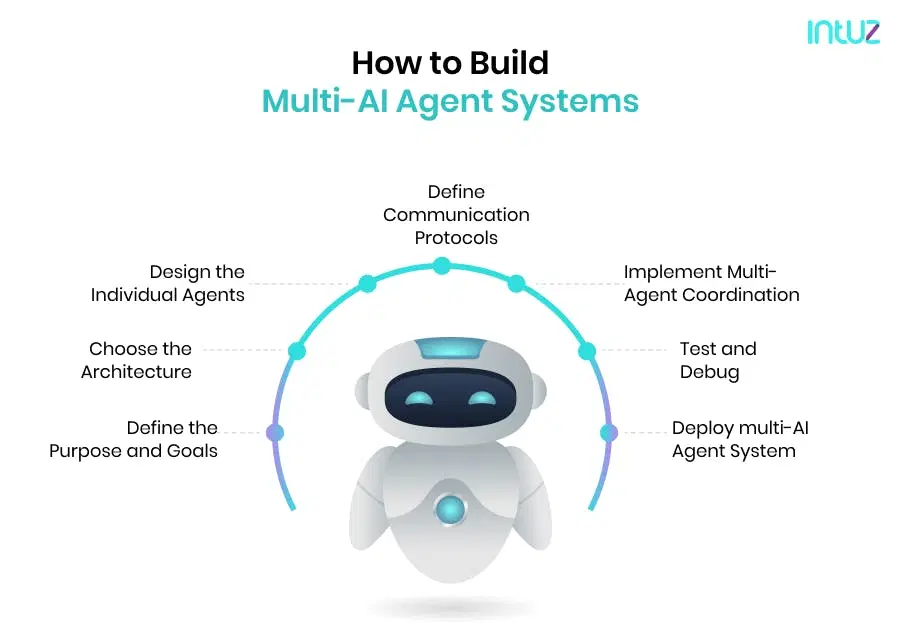
- Building a system follows six steps: define goals → choose architecture → design agents → set protocols → coordinate → test and deploy.
- Leading 2026 frameworks include AutoGen, LangGraph, CrewAI, JADE, and SPADE — each suited to different use cases.
- Most businesses deploying multi-agent AI see ROI of 200–400% within 12–24 months, with costs ranging from ~$10,000 for a basic prototype to $500,000+ for enterprise-scale deployments.
When Should You Use a Multi-Agent System vs. a Single Agent?
Not every AI problem requires a multi-agent system. Here’s a practical decision framework:
| Use Multi-Agent AI When… | Use Single Agent When… |
|---|---|
| The task can be parallelized across independent subtasks | The task is linear and sequential with no parallelization opportunity |
| Different subtasks require different specialized models or tools | One model or tool can handle all the work adequately |
| The system must scale horizontally to handle large volumes | Volume is low and a single process is sufficient |
| Failure of one component should not bring down the whole system | Simplicity and low maintenance are priorities |
| Real-time, dynamic adaptation to environmental changes is required | The task is well-defined, static, and predictable |
| You need audit trails and agent-level accountability | Budget or timeline constraints make orchestration overhead prohibitive |
Adoption of Multi-Agent AI System
The adoption of multi-agent AI systems is accelerating sharply across enterprise sectors:
- The global AI agents market was valued at $7.63 billion in 2025 and is projected to reach $182.97 billion by 2033, growing at a CAGR of 49.6%. (Grand View Research, AI Agents Market Report)
- The multi-agent system platform market specifically reached $7.81 billion in 2025 and is projected to reach $54.91 billion by 2030 at a 47.71% CAGR. (Nevermined, Multi-Agent Systems Revenue Statistics)
- Companies deploying multi-agent systems report average productivity gains of 35%, annual cost reductions of $2.1 million, and customer satisfaction improvements of 28%. (Terralogic, Multi-Agent AI Systems 2025)
- According to PwC’s 2025 AI Agent Survey, 66% of companies adopting AI agents report increased productivity, 57% report cost savings, and 55% report faster decision-making. (PwC AI Agent Survey, 2025)
- Gartner forecasts that by 2028, 33% of enterprise software applications will include agentic AI, up from less than 1% in 2024. (Datagrid, AI Agent Statistics)
How Multi-Agent AI Systems Work
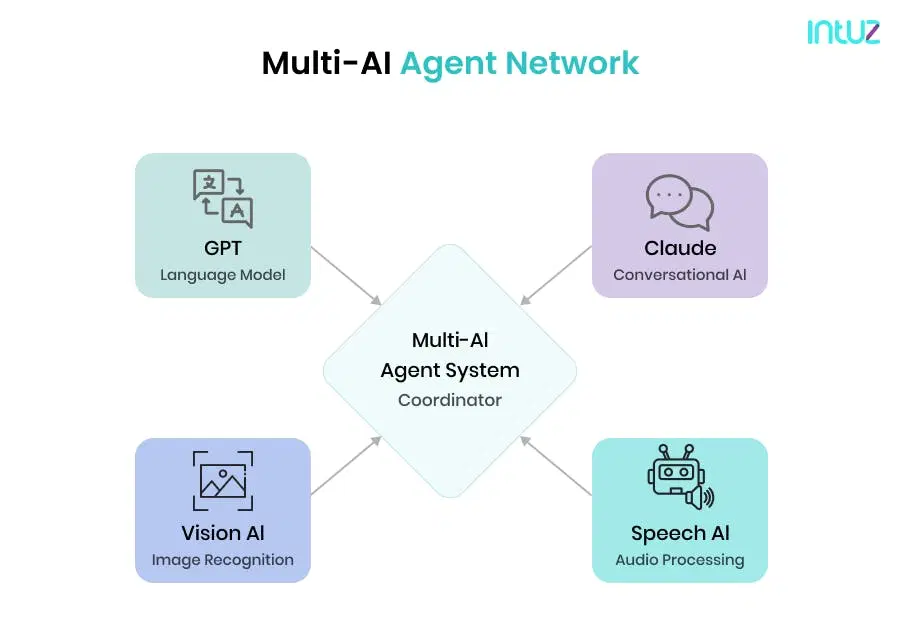
A multi-AI agent system involves multiple AI agents interacting to achieve a common, pre-defined goal. Each agent has a specific function and is designed to perform its tasks autonomously, communicating with each other through defined protocols or interfaces.
This structure allows the system to manage far more complex and dynamic projects than a single AI agent can while scaling up or down as needed. This blog will show you how to set up your multi-AI agent system, from conception to architecture to deployment.
Multi-Agent AI System Architectures Compared
Before building, you need to choose the right architecture. The three primary architectures each offer different tradeoffs between control, autonomy, and scalability.
| Architecture | Control Model | Best For | Example Use Case | Trade-off |
|---|---|---|---|---|
| Centralized | One master agent directs all others | Tightly coordinated tasks, shared datasets | Logistics order management | Single point of failure; less resilient |
| Decentralized | Agents coordinate peer-to-peer | Dynamic, real-time, unpredictable environments | Autonomous vehicle fleet management | Harder to debug; conflict resolution complex |
| Hybrid | Central oversight + autonomous sub-agents | Complex enterprise workflows requiring both control and speed | Supply chain with autonomous fulfillment agents | Most complex to implement; highest ROI potential |
How to Build a Multi-Agent AI System: 6 Steps
Building multi-ai agent system involves six steps: defining goals, choosing an architecture, designing agents, setting communication protocols, coordinating agents, and testing/deploying.
Step 1: Define the purpose and goals
The first step is to be clear about the pain points or opportunities you plan to address with the multi-AI agent system. Talk to relevant stakeholders about their needs, and examine your current AI workflows to identify the gaps that need fixing.
Then, break down the overarching purpose into smaller steps that each agent in the system will tackle. For instance, in a conversational AI system, you could have different chatbots for sentiment analysis, NLP, resolution generation, and so on.
It’s also important to set boundaries on what the system will and will not do and agree on metrics to assess its performance (such as a query resolution rate of 90% and a customer wait time reduction of 50% for a conversational AI system).
Step 2: Choose the right architecture
Your system architecture determines how AI agent solutions interact to generate the desired outcomes. There are three types of architectures to choose from:
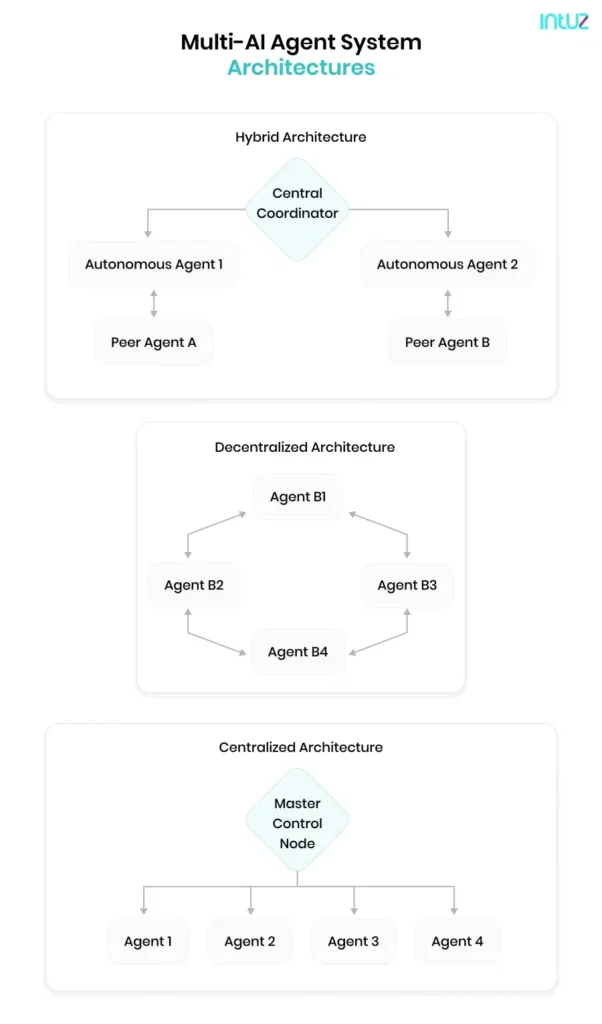
a. Centralized architecture
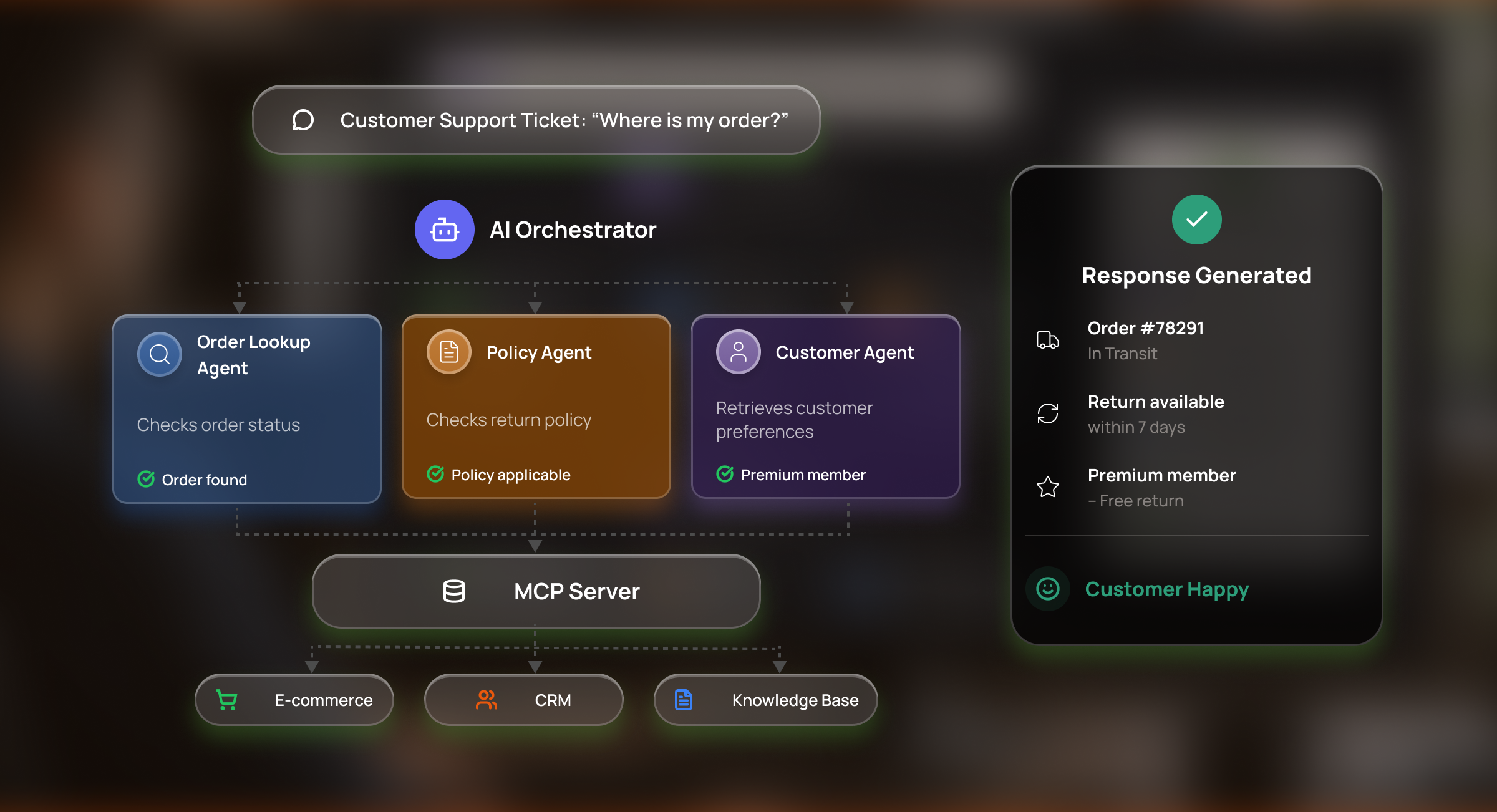
A central entity manages the actions of all the other AI agents and issues appropriate commands.
It’s ideal for systems that rely on a shared aggregate dataset and require tight control to perform tasks, such as a logistics system where a centralized agent delegate functions like order processing, order tracking, and return management.
b. Decentralized architecture
Each agent works autonomously here, only communicating with other agents as needed. This approach is perfect for dynamic environments where AI must adapt and act in real-time, such as multi-player gaming systems or autonomous vehicle fleet management systems.
c. Hybrid architecture
This combines the best of both worlds, typically by having one centralized agent issue high-level commands while the other agents handle specific tasks independently.
It’s suitable for business cases that call for centralized oversight and autonomy, such as one agent overseeing logistics planning in a supply chain management system while others autonomously schedule shipments and stock inventory.
You can use several tools to design a multi-AI agent system.
These include JADE and PyTorch for development frameworks, ZeroMQ and RabbitMQ as communication tools, AWS SageMaker and Google AI Platform for cloud services, and SUMO and AnyLogic for simulation tools.
Step 3: Design the individual AI agents
Depending on your system’s purpose, there are several types of agents you can set up:
- Reactive agents: These respond to immediate stimuli without maintaining memories of past actions.
- Learning agents: These use techniques like supervised learning or reinforcement learning to enhance their decision-making abilities.
- Specialized agents: These are trained to handle particular tasks, like image recognition or natural language processing.
- Deliberative agents: These employ reasoning abilities to make decisions.
- Collaborative agents: These work with humans and/or other agents to achieve a common goal.
Next, you must choose the right AI model for each agent. Your options depend on the function the agent is to perform. Examples include:
- Vision models like YOLO or OpenCV for image/video tasks
- Rule-based systems or reinforcement learning tools like DQN for decision-making
- NLP models like Claude or GPT-4 to handle chat and language tasks such as generating human-like conversations
- Specialized models for unique tasks, like audio models for speech recognition or time-series models for stock market forecasting
Typically, a multi-AI agent system will leverage a mix of models.
For instance,
- Smart home automation systems could use GPT-4 to process user commands
- YOLO to identify real-time activity on the security camera
- Reinforcement learning model to optimize energy consumption on lights and appliances
- BERT will conduct sentiment analysis to enhance the system’s performance.
The agents can then collaborate through APIs or messaging protocols as needed.
Step 4: Define communication protocols
AI agents communicate to coordinate their activities, share information, and work effectively to achieve a shared goal. Methods of communication include:
- Message passing, which involves sending and receiving messages with commands or data
- APIs involving agents making requests to each other’s APIs
- Shared data structures, including reading and writing to a common data source like a memory cache
To ensure that your custom AI solutions can communicate effectively, it’s essential to use established protocols. Popular ones include:
- FIPA-ACL (Foundation for Intelligent Physical Agents – Agent Communication Language), a standard messaging protocol
- HTTP/REST APIs, communication via the web using HTTP methods like PUT, POST, and GET
- WebSockets, for bidirectional real-time communication
- Custom Protocols for domain-specific needs like encryption in high-security environments
| Protocol | Type | Best For | When to Use |
|---|---|---|---|
| FIPA-ACL | Messaging standard | Formal agent-to-agent semantics | Academic/standards-based MAS deployments |
| HTTP/REST | Web API | Stateless, scalable request/response | Cloud-based agents, microservice architectures |
| WebSockets | Persistent connection | Real-time bidirectional communication | Live agents needing sub-second updates |
| Message Queue (RabbitMQ/ZeroMQ) | Async messaging | High-throughput, decoupled agents | Event-driven systems, fault-tolerant pipelines |
| Custom Protocol | Domain-specific | Specialized encryption or compliance | Healthcare, finance, defense deployments |
Finally, be sure to lay down some basic rules to avoid conflict and ensure smooth interoperability:
- Use standardized message formats like JSON, XML, or Protobuf to ensure all agents understand messages.
- Clear rules for inter-agent communication should be established to avoid overlapping responsibilities and to take corrective action if an agent doesn’t respond within a certain time.
- Include mechanisms like voting systems or priority rules to resolve conflicts.
- Keep testing inter-agent communication to ensure continued compatibility as the system evolves.
Step 5: Implement multi-agent coordination
Coordination ensures that AI agents operate harmoniously, avoid conflict, and use resources efficiently. Major coordination strategies include:
- Centralized coordination—where one central agent oversees the activities of all the other agents
- Decentralized coordination—where agents coordinate among themselves as needed without any central authority
- Hybrid coordination—where a central agent oversees high-level tasks while other agents handle their own sub-tasks independently
You can also choose to go for a cooperative problem-solving approach. This could look like:
- Task sharing—dividing tasks among agents based on availability or expertise
- Result sharing—agents sharing intermediate results to solve a bigger problem collectively
- Consensus-based decision-making—agents negotiating to reach a shared decision
To make the most of coordination, you need to have mechanisms in place for effective interoperability. These include:
- Using a common ontology for mutual understanding of standard concepts
- Implementing voting or weighted scoring algorithms for collaborative decision-making
- Setting up rules to enable agents to modify roles or responsibilities if the situation needs it
For instance, agents in a delivery robot fleet must coordinate to deliver items on time while avoiding collisions and using resources optimally. They’ll each take on different roles and coordinate with each other as needed.
The traffic monitoring agent can give the route planning agent real-time alerts about delays so that the agent can decide on an alternative delivery route.
If there are multiple deliveries in the same area, the robots can negotiate with each other to determine which robot should handle which order.
Step 6: Test, debug, and deploy
It’s vital to keep testing your multi-AI agent system for performance efficiency and to debug errors as they emerge. Your Generative AI development team will employ multiple testing strategies to do so, including:
- Unit testing for each agent in isolation
- Integration testing for interactions between agents
- System testing to assess system performance in real-world scenarios
- Stress testing to evaluate system behavior under extreme conditions to identify breaking points
- Edge case testing to assess responses under unusual scenarios
Be sure to keep some core metrics in mind to evaluate the performance of your agent system. Typically, you’d want to measure parameters like:
- The accuracy rate of each agent
- Communication latency between agents
- Time taken to process requests or complete tasks
- Resource utilization, such as memory, CPU, or bandwidth usage
- Ability to scale without system degradation as workload goes up, such as customer chatbot interactions during peak traffic hours
Debugging a multi-agent system can be challenging, which is why we recommend using the following tools and techniques to speed things up:
- Fluentd or ELK for logging and tracing agent actions
- MATLAB or AnyLogic for visualizations of agent behavior
- JADE or SimPly to set up simulation environments for testing
- Wireshark or RabbitMQ for inter-agent message flow monitoring
- Conflict detection algorithms to spot contradictory actions or overlapping tasks
Deploying a multi-AI agent system is only the first step. To truly reap its benefits long-term, it’s vital to maintain the system and update AI models as needed, especially for systems that rely on dynamic data, such as AI-powered SaaS platforms.
Feedback loops are also key to improving the system’s abilities, such as customer satisfaction surveys to refine a chatbot’s conversational output. In addition, remember to invest in the right tools and frameworks for each step in the deployment process.
Popular choices include,
- Docker and Podman for containerization
- Kubernetes and OpenShift for orchestration
- Jenkins and CircleCI for CI/CD pipelines
- Prometheus and Datadog for monitoring
- AWS and Google Cloud for the cloud
- Git and ArgoCD for version control.
Explore Solutions
Let’s Build a Muti-AI Agent System for Your Business!Final Words
As a company at the forefront of advanced AI agent development services, we understand the transformative potential of multi-AI agent systems. We specialize in providing AI development services that align perfectly with your requirements.
With decades of experience, we take the time to understand your technical challenges, operational nuances, and long-term objectives.
In a no-strings-attached, one-hour session, we’ll focus entirely on your business needs—no fluff or unnecessary promotions and share a complementary roadmap you can use.
Book a free consultation with our expert AI team today.
FAQs
What is a multi-agent AI system and when should you build one?
A multi-agent AI system uses multiple specialized AI agents that communicate and collaborate to complete complex tasks. Build one when a single agent can’t handle the full workflow — for example, a customer support system where one agent handles retrieval, another generates responses, and a third handles escalation logic. Multi-agent is overkill for simple chatbots or single-task automation.
What are the best 5 frameworks to build multi-agent AI applications?
The top frameworks for multi-agent AI development include JADE (Java-based and FIPA-compliant), SPADE (Python-based and suited for asynchronous messaging), MASON (ideal for complex simulations), PyMARL (designed for multi-agent reinforcement learning), and Unity ML-Agents (used in game-based and 3D environments).
What is the structure of multi-agent system in AI?
A multi-agent system (MAS) typically includes autonomous agents, an environment, and communication protocols. Each agent operates independently, interacts with others, and makes decisions based on local knowledge. The system often includes coordination strategies, a shared ontology, and mechanisms for conflict resolution and collective goal achievement.
What is an example of a multi-agent AI system?
A typical example is autonomous drone fleets used in search-and-rescue operations. Each drone acts as an agent, scanning areas, avoiding obstacles, and sharing data with others. They collaborate to cover large areas efficiently, adapting to changing environments and mission requirements in real-time.
How much does multi agent ai system cost?
The cost of a multi-agent AI system can range from $10,000 for a basic prototype to over $500,000 for complex, scalable implementations. Factors affecting cost include the number of agents, system complexity, hardware integration, simulation needs, and ongoing maintenance or AI training resources. Contact Intuz to get a custom quote for your AI project.
What is the difference between a single-agent and a multi-agent AI system?
A single-agent AI system uses one model or process to handle all tasks sequentially. A multi-agent AI system distributes tasks across multiple specialized agents that work in parallel, communicate with each other, and can adapt dynamically. Multi-agent systems are better suited for complex, large-scale, or multi-domain problems where parallelization, specialization, or fault tolerance is required. Single-agent systems are simpler, cheaper, and faster to build for well-defined, low-volume tasks.
Which industries benefit most from multi-agent AI systems?
Industries with the highest ROI from multi-agent AI deployments include manufacturing (predictive maintenance, quality control), e-commerce and customer service (multi-channel support automation), logistics (autonomous fleet coordination), healthcare (clinical documentation and diagnostic routing), and financial services (fraud detection and compliance automation). Enterprises in these sectors report productivity gains of 20–35% and ROI of 200–400% within 12–24 months of deployment.
LangGraph vs CrewAI vs AutoGen — which framework should you choose?
LangGraph for production-grade systems with compliance requirements (healthcare, finance). CrewAI for fast prototyping and role-based collaboration. AutoGen for Microsoft/Azure shops needing async multi-agent conversations. Most enterprise teams prototype in CrewAI and deploy in LangGraph.
What are the main architecture patterns for multi-agent systems?
Four primary patterns: (1) Hierarchical — manager agent delegates to specialists. (2) Collaborative swarm — peer agents with shared memory. (3) Pipeline/sequential — agents in a linear chain with typed contracts. (4) Event-driven reactive — agents subscribe to an event bus. Hierarchical is most common in enterprise deployments.
How do you handle communication between AI agents?
Agents communicate through structured message passing — JSON schemas defining input/output contracts between agents. Key protocols include MCP (Model Context Protocol, now a Linux Foundation standard) for tool integration and custom event buses for inter-agent messaging. Always define typed contracts between agents to prevent cascading failures.
What are the costs and infrastructure requirements for multi-agent deployments?
Multi-agent systems are expensive. Each agent makes 10-20 LLM calls per task, so inference costs multiply with agent count. A 3-agent system costs roughly 3x a single agent in inference. Infrastructure requirements: orchestration layer (LangGraph or equivalent), vector database for shared memory, observability stack (LangSmith or custom), and human-review interface. Budget $80K-$200K for build + $5K-$20K/month in inference for production workloads.