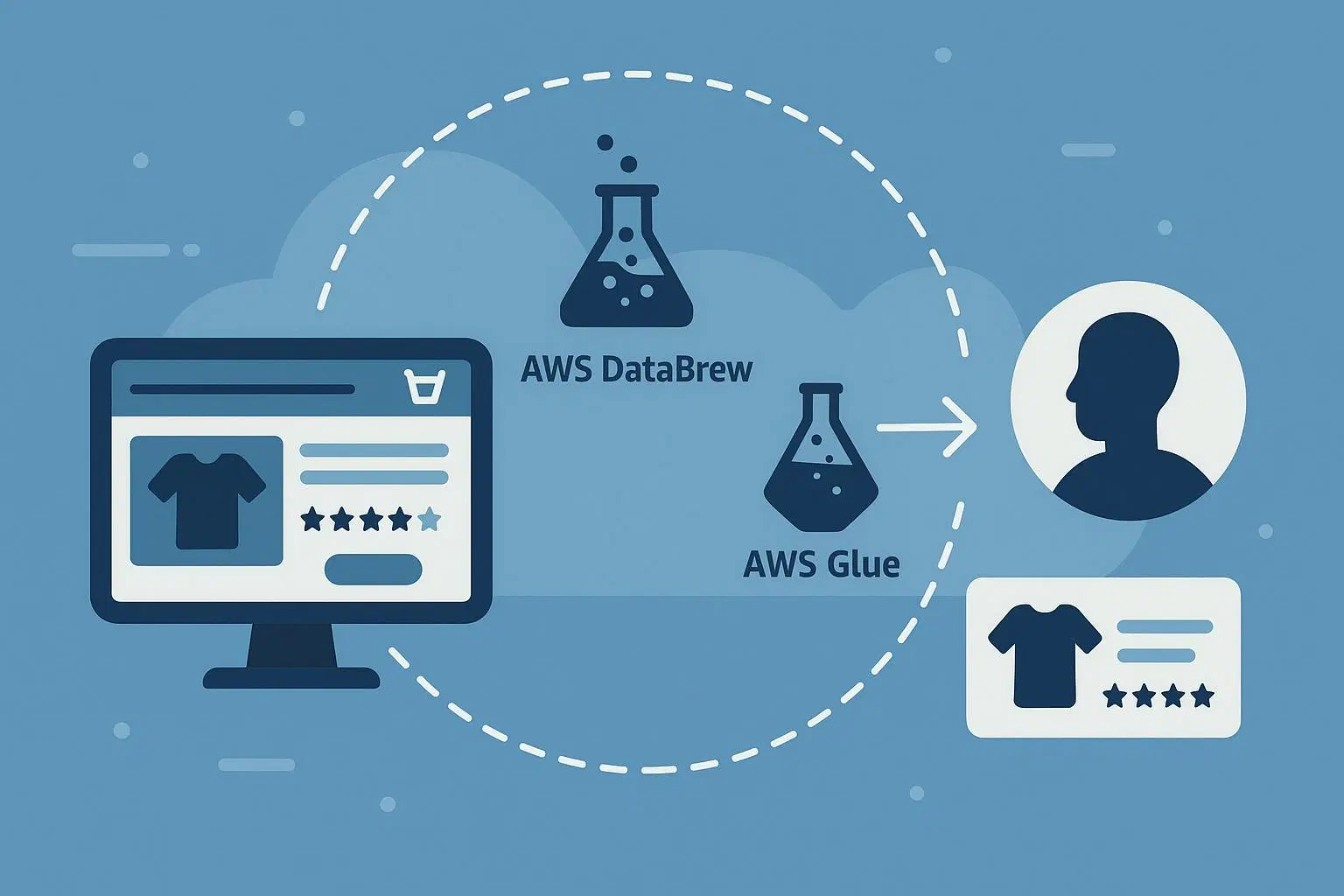





![How to Build eCommerce AI Product Recommendation System [Most Practical Guide]](https://www.intuz.com/wp-content/uploads/2026/05/How-to-Build-eCommerce-AI-Product-Recommendation-System-Most-Practical-Guide.webp)
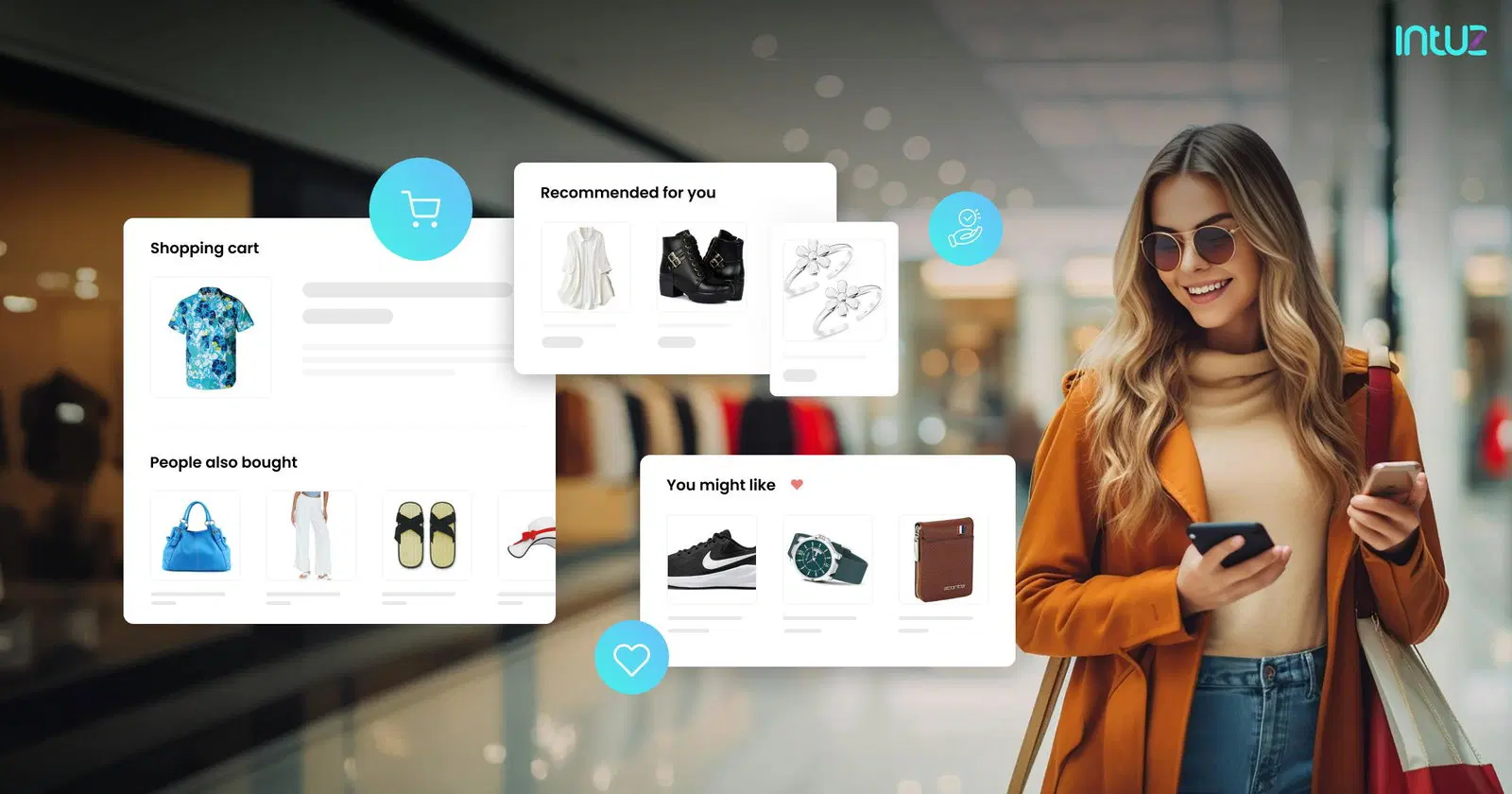
A solid AI recommendation system can turn your eCommerce store into a sales machine—serving the right product to the right shopper at the perfect moment. In this guide, we’ll walk you through the simplest, most practical way to build it from scratch. And if you ever want experts by your side, Intuz can help you design, develop, and scale smart recommendations that actually drive revenue.
Did you know 35% of Amazon’s revenue comes from its recommendation engine? This number from a McKinsey report tends to surprise many people. But it reflects something every eCommerce business is now experiencing firsthand.
For starters, our search behaviors have changed. Forget Google. ChatGPT has taken precedence. Attention spans have shrunk even more. A single static “Related Products” widget on the online store no longer interests a customer.
But AI-driven recommendation systems that update in real time based on individual purchase or browsing history do. If you’re thinking of building an engine like this, it helps to work through the process with clarity. In this blog post, we break down all the steps you need to take.
Show
- 35% of Amazon’s revenue is attributed to its AI recommendation engine, proving the direct commercial impact of smart personalization at scale.
- Building an effective system starts with defining clear business objectives and KPIs — such as increasing AOV, reducing cart abandonment, or improving product discoverability — before choosing any algorithm.
- The right algorithm depends on your catalog size, traffic volume, and use case — from collaborative filtering for repeat-visitor stores to deep learning models for enterprise-scale catalogs with rich media.
- Data quality is foundational: user behavioral data, product metadata, and contextual signals must be collected, cleaned, and structured before any meaningful model training can begin.
- Deployment isn’t the finish line — A/B testing, MCP-based integration across pricing and inventory systems, and a lightweight UI guardrail layer are all critical to production-ready accuracy.
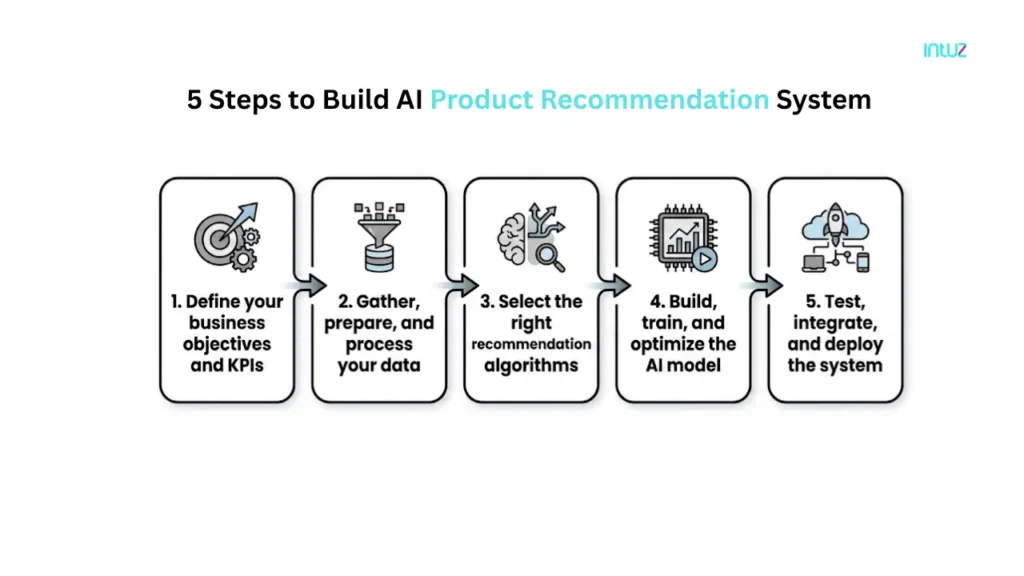
How to Build an AI Product Recommendation System [5 Steps]
1. Define your business objectives and KPIs
Before you think about data or algorithms, get clarity on what this system should improve. Every eCommerce business has different priorities, and the model you build depends entirely on the outcomes you want to influence.
For instance, you might want to increase Average Order Value (AOV) by suggesting cross-sell and upsell options. Or you may wish to minimize friction in product discovery, reduce cart abandonment, or keep customers engaged across more sessions.
Every goal calls for different signals, placements, and model behavior.
Next, to keep the strategy grounded, map your objective to a measurable KPI and pair it with a simple example. This exercise gives your design and engineering teams a shared reference point. Here’s what that can look like for you:
| Business Goal | Relevant KPIs | Practical Example |
|---|---|---|
| Increase AOV | Uplift in order value, cross-sell acceptance rate | Showing complementary items on product detail pages |
| Improve conversion rates | Conversion lift, add-to-cart rate | Displaying personalized recommendations on the homepage |
| Boost product discoverability | CTR on recommendation widgets, session depth | Suggesting niche or long-tail items in category pages |
| Reduce cart abandonment | Recovery rate, cart revisit rate | Recommending alternatives for out-of-stock items |
| Strengthen loyalty and retention | Repeat purchase rate, frequency of visits | Tailored suggestions during post-purchase journeys |
Intuz Recommends
Sit down with product, sales, marketing, customer support, and anyone who interacts with real customer behavior. Each team sees a different part of the shopping journey—abandoned carts, low-performing categories, or high-intent search patterns.A short cross-team workshop will help you identify what’s hurting the business and outline a technical scope that’s far more accurate and aligned with where you want to go.
2. Gather, prepare, and process your data
The success of your product recommendation system depends entirely on the quality of the data feeding it. When this foundation is well set up, you avoid long debugging cycles later and give your AI model the context it needs to generate helpful suggestions.
Therefore, collect data from three areas:
| Type | Definition | Examples |
|---|---|---|
| User data | Helps you understand how visitors interact with your storefront | Browsing history, clicks, searches, add-to-cart actions, purchases, wishlist activity, and ratings |
| Product data | Describes your catalog in detail | Item IDs, categories, price, color, size, material, tags, descriptions, and images |
| Contextual data | Contextual data shows when and how each interaction takes place | Time of day, device type, location, seasonality, and session behavior |
Store this information in a structured system that your team can query easily. SQL databases, NoSQL stores, and cloud warehouses like Redshift or BigQuery all work best for this purpose.
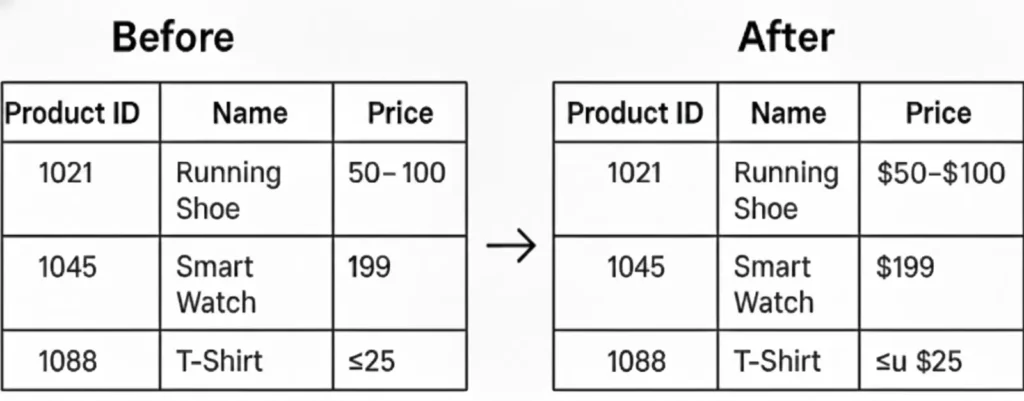
Once the data is collected, prepare it for modeling:
Remove duplicates, fix missing categories, and resolve incorrect tags
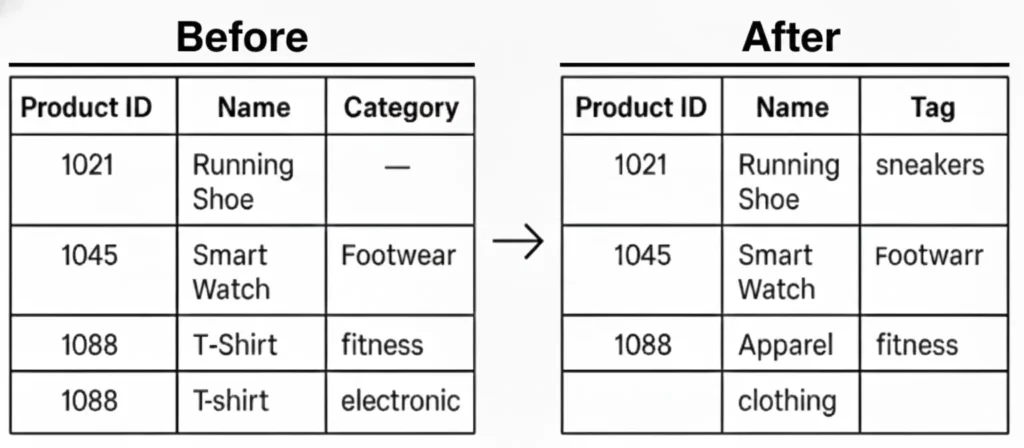
Normalize values, such as price ranges or ratings
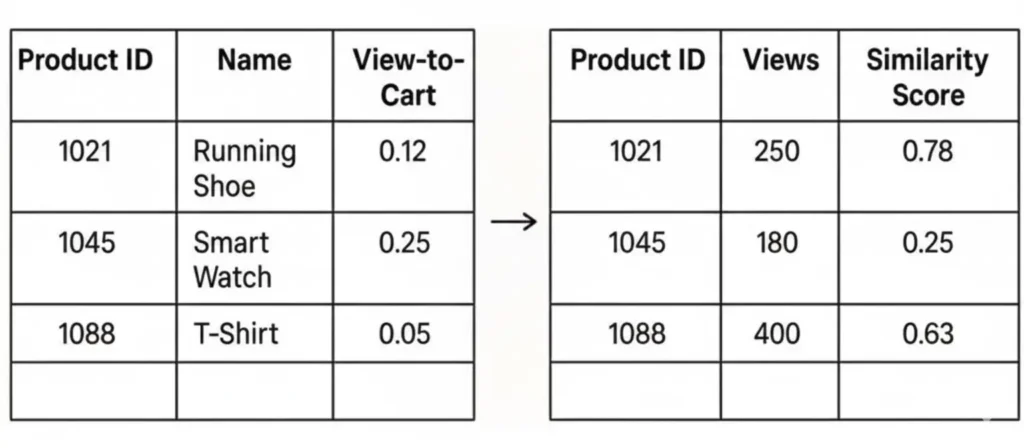
Add new indicators that improve prediction quality, such as similarity scores, text embeddings, or behavioral ratios like view-to-cart
Intuz Recommends
Tag every user and product event across your website and app with a consistent schema. For example, if a customer views a product, the event can be recorded as “product_view.” If they add the item to their cart, the event could be “add_to_cart.”These events should carry the same fields everywhere: user ID, product ID, timestamp, device, and session details.Once this clean event layer is in place, use Retrieval-Augmented Generation (RAG) to enrich each event with deeper context from unstructured sources such as reviews, product descriptions, and FAQs.
3. Select the right recommendation algorithms
Once your data is ready, you can choose the approach that shapes how your recommendation system works. The correct algorithm depends on the size of your product catalog, the volume of user activity you capture, and the type of shopping behavior you want to influence.
Here’s a quick algorithm comparison to help you make the right call:
| Algorithm Type | Description | Pros | Cons | Best Fit For |
|---|---|---|---|---|
| Collaborative Filtering | Learns from patterns in user behavior | Captures real preferences, improves with volume | Weak for new items or new users | Stores with strong traffic and repeat visitors |
| Content-Based Filtering | Recommends products with similar attributes | Is ideal for new items, uses rich catalog data | Can become narrow if product attributes are limited | Catalogs with detailed metadata |
| Hybrid Models | Combines behavioral and content signals | Balanced coverage, more stable results | More complex to build and tune | Stores wanting accuracy across all segments |
| Association Rules | Finds items often purchased together | Simple and transparent | Limited personalization | Cross-sell and bundling scenarios |
| Deep Learning Models | Uses embeddings and neural networks to learn deeper relationships | Handles large catalogs, captures subtle similarity | Requires more data and compute | Enterprise-scale catalogs with rich media or text |
| Graph-Based Models | Connects users, products, and interactions as a network | Great for complex relationships and long paths | More advanced to implement | Multi-category stores with diverse items |
Intuz Recommends
One question we get asked often is, “What to do if our eCommerce data is large-scale or complex?” For larger storefronts, you can look at two types of advanced models. Neural collaborative filtering, which uses a small neural network to learn patterns between users and products; it works well when you have a lot of interaction dataGraph-based models, where users, products, and categories are treated as connected nodes; your recommendation system learns relationships through these connections rather than just behavior logs
Learn how Intuz enabled a California-based sportswear brand to increase sales with an AI recommendation system.
We helped a leading sportswear brand in California, an AI-powered eCommerce platform, automate its critical workflows, like dynamic pricing, custom product recommendations, demand forecasting, and inventory management.
Equipped with a custom-built admin dashboard and seamless integrations with their backend systems, the company was able to enjoy the following results:d
- Faster order fulfillment
- Fewer operational errors
- Increased sales and customer satisfaction
Looking to build something similar? Explore our custom AI development services.
4. Build, train, and optimize the AI model
This phase turns your prepared data into something your recommendation system can learn from. Therefore, split your dataset.
A standard ratio is to use 80% for training and the remaining 20% for testing. This gives the AI model enough examples to learn patterns while still leaving room to evaluate its performance on unseen data.
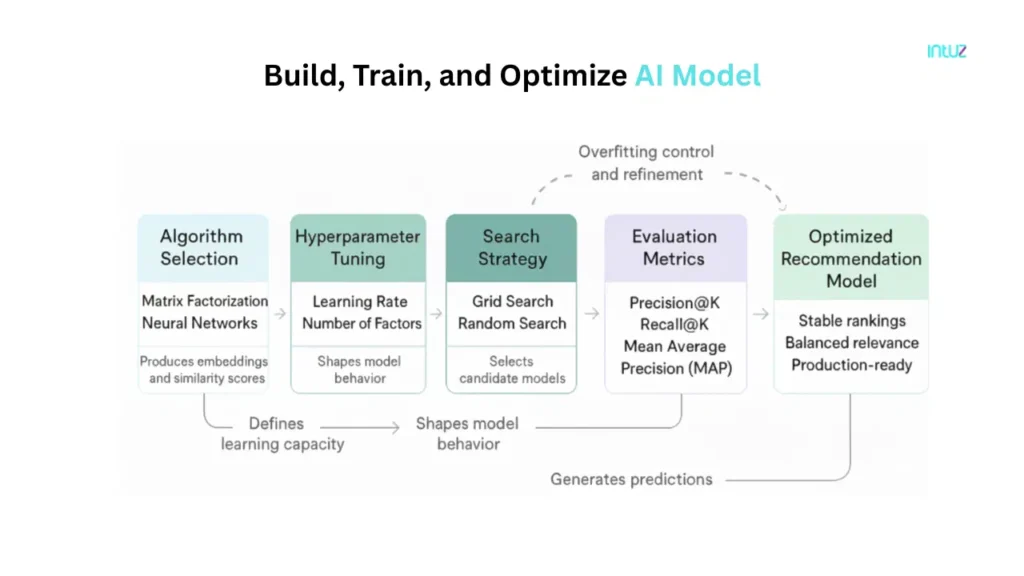
Training also depends on the algorithm you chose in the earlier step. For example, matrix factorization is suitable for collaborative filtering. Neural networks handle more complex relationships between users and products.
Whatever you select, aim to produce embeddings or scores that reflect meaningful similarity. Next, tune parameters, which are fine controls that shape how aggressively or cautiously the model learns. Examples include the number of factors, learning rate, and neighborhood size.
Grid search and random search are practical ways to explore these settings. Each adjustment helps you move toward a system that learns accurately without overfitting.
Intuz Recommends
Design your Model Context Protocol (MCP) orchestration with built-in fallback logic for cold-start scenarios before you finalize training. New users and new products won’t have enough interaction data to generate reliable embeddings.In these cases, your system should automatically shift to popularity-based, category-based, or rule-driven recommendations until sufficient behavior data is available.
5. Test, integrate, and deploy the system
Once you’re satisfied with the type of recommendations your AI model is generating, confirm how those suggestions perform in real conditions. Testing enables you to validate relevance, measure performance, and refine placement before the system reaches the customer.
Perform controlled experiments. A/B tests help you compare different versions of your recommendation strategy. You can test model variations, ranking approaches, and UI variations. Some metrics include:
- Click-through rate (CTR)
- Revenue per user
- Add-to-cart rate
Gradually, integrate the version that performs the best with your storefront, starting with the homepage, product pages, the cart, and the post-purchase flow.
What’s more, MCP acts as the communication layer between your recommendation engine, inventory service, pricing engine, and rule-based systems.
It ensures these services exchange the proper context without being tightly coupled. When the model returns a set of recommended items, MCP routes that list through inventory and pricing so downstream systems use the most recent information.
Intuz Recommends
Add a lightweight guardrail right before recommendations reach the UI. This filter checks for stock changes, pricing errors, region blocks, or compliance constraints that may have appeared after the backend services responded. It keeps the recommendations accurate at the exact moment they’re shown.
How Intuz Helps Ecommerce Businesses Build AI Recommendation Systems
One of the biggest reasons our eCommerce clients have enjoyed working with us is that we help them integrate AI into their workflows without adding unnecessary complexity.
Our expert team combines practical engineering with an outcome-driven approach. This allows you to move from strategy to implementation rather quickly and efficiently.
Here’s how Intuz supports your journey:
- We work inside your cloud environment, which keeps your customer data, catalog, and analytics stack fully under your control
- We set up clean data foundations, including event structures and product attributes that support accurate recommendations
- We collaborate in real time, sharing pull requests, decisions, and progress so you always know what’s moving forward
- We maintain strong security and compliance practices backed by encrypted devices and enterprise-grade controls
- We use open-source frameworks that are stable, adequately documented, and easy for you to maintain going forward
To get a clear roadmap for your AI product recommendation system, book a free 45-minute call with us. We’ll discuss your pain points, understand your vision, and outline potential solution paths. With Intuz, it’s always a win-win for you.
FAQs
How does an AI product recommendation system work for eCommerce?
An AI recommendation engine learns from customer interactions—views, clicks, purchases, time spent—and matches patterns to predict what each shopper is most likely to buy next. It uses ML techniques like collaborative filtering and deep learning to rank products in real time. The more behavioral and transactional data the system receives, the more precise the recommendations become.
What data is required to build an accurate recommendation engine?
To build a reliable model, you need user browsing history, cart events, past orders, product metadata, search queries, and category relationships. Additional signals like dwell time, abandoned carts, discount responsiveness, demographics, and seasonality further improve accuracy. Clean, well-structured datasets with unique identifiers and consistent schemas are essential for training models and scaling them without noise or bias.
Which machine learning models perform best for ecommerce recommendations?
Hybrid systems combining collaborative filtering and content-based ranking consistently outperform single-approach engines. Neural networks like BERT for product embeddings, matrix factorization, and sequence models (RNN/Transformers) help predict intent with high relevance. Real-time ranking algorithms, contextual bandits, and reinforcement learning optimize results continuously. The best choice depends on catalog size, traffic volume, cold-start challenges, and personalization depth needed
How long does it take to build and deploy an AI recommendation system?
A basic MVP takes 6–12 weeks: two weeks for data cleanup, four for model development and evaluation, and another two-to-four for API integration, UI testing, and rollout. Advanced features like real-time personalization, dynamic pricing, A/B testing, and multilingual recommendations extend timelines. Faster delivery is possible using cloud services like AWS Personalize or pre-trained embeddings.
What measurable impact can an AI recommendation system deliver to a store?
Well-implemented recommendation engines commonly increase conversions 10–30%, average order value 15–40%, and customer retention through repeat purchases. Cross-sell and upsell suggestions drive incremental revenue, while personalized homepages reduce bounce rates. Revenue lift depends heavily on data quality, speed of serving recommendations, UX placement, and continuous A/B testing. Growth compounds over time as models learn more from user activity.
Work with Intuz
Build Your AI Recommendation Engine
Talk to our experts and get a free project roadmap.
Let's Get Started
Share this article