


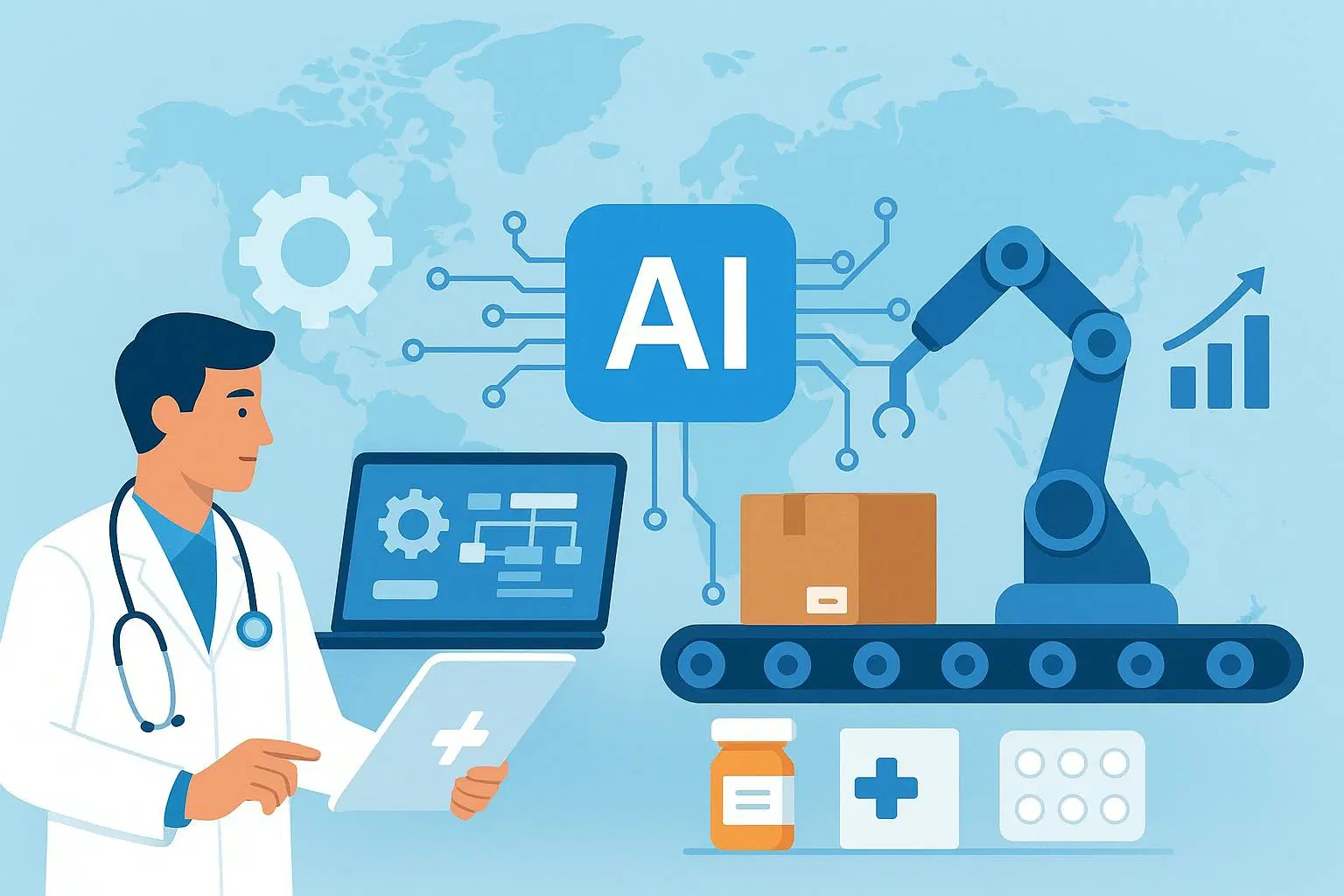
Healthcare supply chains often struggle with inefficiencies, manual errors, and rising costs. By combining AI with low-code tools, organizations can automate workflows, improve accuracy, and make smarter decisions faster. Intuz can help you build custom healthcare supply chain automation solutions that simplify operations & helps to track visibility.
Have you ever watched a surgery get delayed because a critical implant wasn’t logged in the system on time? Or seen nurses manually track inventory in spreadsheets while hundreds of SKUs expire quietly in storage?
You’d think that by now, most of these processes would be automated. Yet, in healthcare supply chains, verifying purchase orders by hand, following up with vendors often, and filing compliance reports in silos are still all too common.
So, what does it take to implement automation in a way that helps you deliver effective patient care without worrying about the basics? Are AI and low-code/no-code tools the answer to simplifying critical workflows?
We at Intuz firmly believe so. But before we get down to the brass tacks and discuss which workflows to automate and why, let’s look at the most significant challenges that healthcare organizations like yours face in managing their supply chains.
Show
- Disconnected ERP, procurement, and inventory systems force manual cross-department coordination, with fragmented records accounting for 34–40% of hospital audit preparation time.
- AI-powered forecasting tools reduced inventory holding costs by 19–24% in hospitals in 2024, while static models like SES and Fixed-Period Reorder Point fail to account for seasonal shifts and patient inflow.
- Automating supplier onboarding with low-code forms, OCR extraction, and ERP sync eliminates manual credential lapses and flags expiry dates proactively before compliance audits.
- Cold-chain breaches result in $30–35 billion in annual global losses for vaccines and biologics — IoT-enabled real-time monitoring with threshold-based alerts can prevent route deviations and temperature exposure events.
- A modular procurement and payment reconciliation workflow — connecting POs, goods receipts, and AI-based invoice matching — can trigger automatic payment authorization or flag mismatches, with every step logged in an immutable audit trail.
Key Challenges in the Healthcare Supply Chain
1. Audit and compliance processes with low data maturity
Enterprise Resource Planning (ERP), procurement, and inventory tools operate in isolation with little or no data sharing.
In the absence of real-time synchronization, even simple cross-department updates, such as supplier changes or material shortages, require manual coordination. This slows decision-making and increases the risk of mismatched records.
Fact: Disconnected healthcare systems account for approximately 34–40% of hospital audit preparation time spent on consolidating financial and clinical records. — Deloitte.pdf)
2. Manual supplier credential lifecycle management
Vendor onboarding, license checks, and renewals are conventionally handled through emails and document uploads. Because there’s no automated validation or expiry tracking, you may spend hours verifying paperwork, often discovering lapses only during inspections or audits.
Fact: Missing or incomplete supplier documentation accounts for 26% of all compliance-related audit delays at US hospitals. — GHX/AHVAP Survey
3. Static inventory and demand planning models
Most forecasting models, like Simple Exponential Smoothing (SES) and Fixed-Period Reorder Point Models, don’t adjust numbers for season trends, procedure volumes, and patient inflow. You could end up holding excess inventory in some categories while running short in others.
Fact: AI-powered forecasting tools reduced inventory holding costs by 19–24% in hospitals deploying these systems in 2024. — HIMSS/Medscape Report
4. Fragmented shipment visibility
In all probability, your logistics teams depend on carrier updates to track deliveries. High-value or temperature-sensitive items lack continuous IoT monitoring, making it hard to detect route deviations, exposure events, and delivery delays before they become costly.
Fact: Global cold-chain breaches result in $30–35 billion in annual losses for vaccines and biologics, according to WHO/partner studies. — IQVIA
4 Healthcare Supply Chain Workflows to Automate (+ Best Practices by Intuz)
1. Supplier onboarding and compliance management
Start by designing a low-code form to capture supplier details, such as IDs, licenses, and certifications. Make sure the form enforces validation rules so that incomplete or invalid data never enters your system.
Next, connect the form to an OCR and entity-extraction pipeline. Each uploaded document should automatically pass through it, identifying license numbers and issue/expiry dates. Use internal logic and external APIs to confirm license authenticity or regulatory status in real-time.
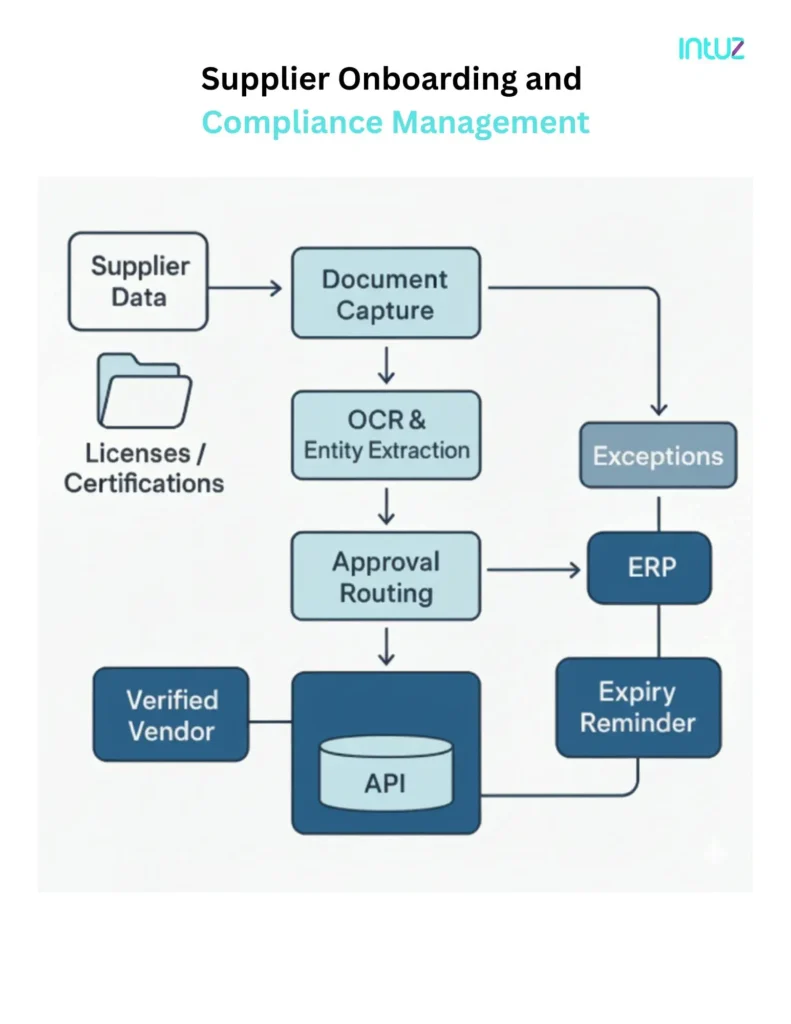
Once verified, define approval workflows that route each record based on parameters like spend limits and supplier categories. Exceptions, such as expired or unverifiable credentials, should trigger review tasks rather than halting the entire flow.
Finally, integrate the workflow with your ERP or supplier master via an API call. Every approved supplier record should sync instantly, with every action logged for audit. Add a rule to track expiry dates and send automated renewal requests before compliance lapses.
Intuz Recommends
Create a single vendor schema with defined field names (for example, Supplier_ID, License_Type, Expiry_Date). Make sure all your systems, whether ERP, compliance tracker, or document parser, use the same structure. If your OCR engine extracts “Exp Date” but your ERP expects “Expiry_Date,” your automation will fail at sync. A canonical schema fixes that early and avoids silent data mismatches.
2. Shipment visibility and cold-chain tracking
Equip each shipment of yours with an IoT sensor or smart tag that continuously monitors temperature, humidity, and location. Configure these devices to transmit data to a central platform via cellular or LoRaWAN gateways.
On the platform side, create a data parsing and standardization workflow. As telemetry data arrives, it should normalize values and update the shipment records in your logistics or ERP system every few minutes.
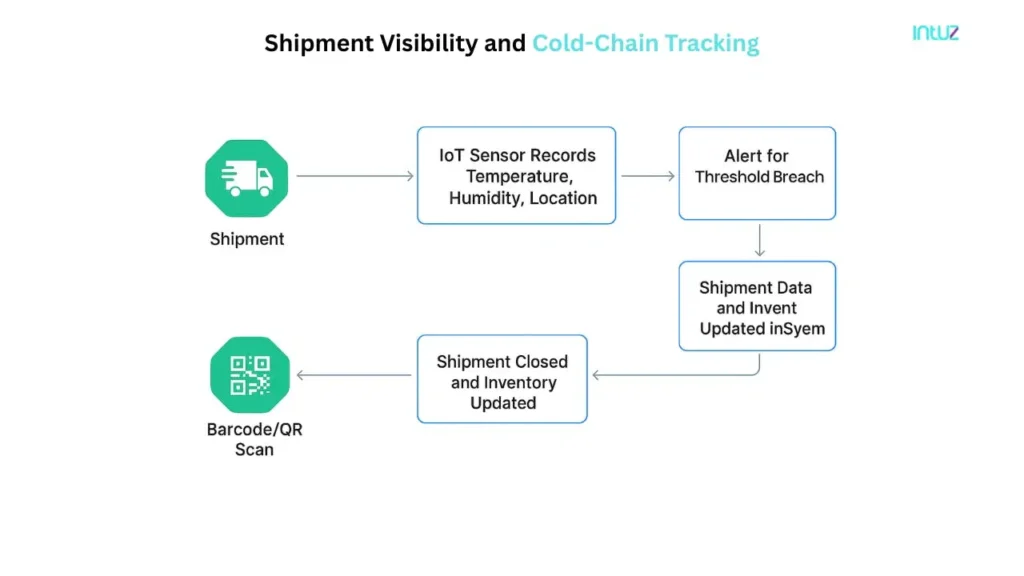
Next, ensure your workflow engine monitors this stream for threshold breaches or status changes. For example, if temperature or route data falls outside defined limits, the system must generate an alert and notify the assigned operations group through Slack, Teams, or your incident tool.
When a delivery is confirmed via barcode or QR scan, the workflow should update inventory counts, record the event timestamp, and archive the data for compliance audits. That way, you see precisely where each consignment is and what condition it’s in.
Intuz Recommends
Instead of scheduling batch jobs, publish events when specific actions occur, such as “StockBelowThreshold,” “InvoiceValidated,” or “ShipmentDelivered.” Your low-code workflows subscribe to these events. For example, when StockBelowThreshold fires, the system automatically creates a purchase request and routes it for approval. This pattern avoids constant API polling and reduces latency between detection and action.
3. Inventory forecasting and replenishment
Connect your inventory management system to data sources, like patient admission records, historical consumption records, and seasonal demand patterns.
Set up a forecasting model, typically a regression or time-series algorithm, to process this data daily or weekly. The output should help you predict consumption for each item or SKU and publish updates on a central dashboard that shows stock position against projected demand.
Next, define low-code automation rules to monitor these levels continuously. When stock drops below a defined threshold, trigger a replenishment workflow that:
- Generates a purchase request
- Routes it for approval
- Send the confirmed order to your ERP or supplier portal via an API
Ensure all updates, such as reorder, approval, and delivery, are written back to your central data layer. This creates a single, real-time source of truth for your procurement and supply teams.
As automation expands beyond inventory into procurement, compliance, and logistics, maintaining a consistent execution model becomes increasingly important. This is where the modular automation lanes we deploy for supply chain workflows help standardize integrations, approvals, and exception handling without redesigning each workflow from scratch.
Intuz Recommends
Forecasting and document extraction models drift as conditions change. Therefore, deploy a retraining schedule—for instance, every quarter, feed in the latest transaction and performance data. Keep a version log so you can trace which model generated which result. If an invoice validation model starts flagging false mismatches, you’ll know exactly when performance drift began and can roll back or retrain.
4. Procurement and payment reconciliation
Design a single transaction flow that connects purchase orders, goods receipts, and invoices. Your low-code workflow engine should validate a purchase request against budgets, cost centers, and approved vendor lists.
If it meets the rules, the system should auto-generate a purchase order and push it to your ERP. The same engine should also handle approval routing based on spend limits, project type, or departmental hierarchies.
Once goods are received, automate delivery confirmation using barcode scans or supplier integrations. When an invoice arrives, an AI-based reconciliation module should cross-check it with the PO and the goods receipt, ensuring line items, quantities, unit costs, and taxes match.
If all values align, the system triggers payment authorization automatically. If there’s a mismatch, the workflow will flag it for review and attach the relevant transaction logs. Every step is recorded in an immutable audit trail.
Intuz Recommends
When an automation fails, such as when a supplier API returns an error or a shipment sensor stops transmitting, capture the failure data immediately. Create a “FailureEvent” queue that stores context (error type, payload, system ID). Route it to your operations dashboard for triage. This keeps exceptions visible and prevents silent process breakdowns, which are otherwise hard to catch in multi-system automations.
Also Read
Agentic AI in Healthcare: A CXO’s GuideHow Intuz Helped This AI SaaS Platform Client Enhance Case Management
CasePath sought to develop a SaaS web application for companies and agencies to deliver child protection and family welfare services. Here’s what our AI solutions provider achieved for the client:
- AI‑driven case summaries to speed up reviews and decisions
- Subscription model for predictable revenue and scalable usage
- Dynamic form builder for quick process changes without new dev cycles
- Multi‑tenant architecture for secure workspaces and lower management overhead
Why Partner With Intuz for Healthcare Supply Chain Automation
Look, if deploying automation were a cakewalk, every business across all industries would do so without giving it much thought. But it’s not like that.
You need a partner who understands how to integrate AI, low-code platforms, and IoT systems into environments that are highly regulated, time-sensitive, and data-rich. That’s where Intuz adds real value.
We have experience building automation solutions that operate within your existing infrastructure, including your ERP, data lake, and access controls. That means your data never leaves your environment.
A key consideration is our platform’s integration surface across EMR, ERP, and inventory systems, which enables data to move consistently between clinical and operational workflows without introducing duplicate records or manual reconciliation. This helps ensure that automations remain reliable even as new departments, suppliers, or applications are added over time.
Every workflow we design is modular, auditable, and governed under the same security and compliance frameworks you already use.
Our teams work with you in real time, regardless of where you’re based, combining healthcare domain experience with technical depth across AI, low-code, and cloud-native architectures.
Plus, you’ll see progress early: supplier validation pipelines running in weeks, forecasting dashboards linked to your ERP by the next sprint, or live shipment telemetry integrated into your inventory system.
You also get transparency at every step. Every workflow, configuration, and decision rule is documented in your environment. You keep full ownership of the code, the data, and the outcomes.
If you’re exploring automation for your healthcare supply chain, book a free 30-minute session with our automation specialists.
We’ll map one of your existing workflows, identify automation opportunities, and show you what a measurable pilot could look like in your environment. Get in touch today!
FAQs
How does AI-driven demand forecasting reduce stockouts and waste in healthcare supply chains?
AI leverages medical records, disease trends, and seasonal data to predict supply and medication needs with high accuracy. This enables hospitals to optimize inventory, minimize stockouts, and cut waste by maintaining supplies only as needed, boosting both operational efficiency and patient care quality.
What are real-world examples of low-code automation in healthcare supply chains?
Low-code platforms are used to automate purchase orders, manage supplier data, and integrate disparate systems without custom coding. For instance, hospitals create tracking dashboards and auto-generate supplier audit reports—reducing manual labor and error rates, and accelerating process improvement.
What cost and efficiency benefits have hospitals reported after adopting supply chain automation?
Hospitals using AI-enabled supply chain automation have achieved measurable cost savings by automating routine procure-to-pay workflows, reducing manual exceptions, and reallocating staff to higher-value activities. This results in improved staff satisfaction and more resilient supply chains, especially during demand surges.
Can low-code/no-code platforms help healthcare providers respond faster to supply disruptions?
Yes, low-code/no-code solutions empower non-technical staff to quickly build apps for sourcing alternatives and rerouting supplies during disruptions. This adaptability ensures continuity of care, quicker mitigation of shortages, and more agile responses to market or public health changes.
Work with Intuz
Automate Your Supply Chain
Talk to our experts & get a free automation roadmap.
Let's Get Started
Share this article