




Discover how AI transforms manufacturing with demand prediction, product design and development, smart automation, predictive maintenance, and real-time quality control. Explore how AI can cut costs, reduce downtime, and unlock new possibilities in your manufacturing processes.
The world has changed for manufacturers. Preparation for uncertainty is now the industry norm, and businesses face various challenges such as climate change effects, geopolitical tensions, supply chain vulnerabilities, and technology breakthroughs.
An MIT study indicates that the impact of such disruption is projected to increase by 15% to 25% in the next five years, making the manufacturing industry both dynamic and competitive.
With the rise of Artificial Intelligence-driven technologies and tools like the Internet of Things (IoT), edge computing, and Machine Learning (ML), manufacturers have access to more data than ever before, enabling them to take more meaningful actions.
Research shows that the global AI in manufacturing market is poised to be valued at $20.8 billion by 2028, with the top contributing factor being AI.
Show
- The global AI in manufacturing market is projected to reach $20.8 billion by 2028 (Grand View Research)
- The five core use cases are: demand forecasting, generative product design, supply chain optimization, quality control, and predictive maintenance
- Companies like Siemens, BMW, Tesla, and Airbus are already using AI to reduce downtime by 40%+, improve defect detection, and cut component weight by 55%
- Heavy industrial manufacturers lose an average of 23 hours/month to machine failures — costing $4.3M — which AI predictive maintenance directly addresses
- AI quality control systems using computer vision outperform human inspection for detecting microscopic defects in size, shape, colour, and surface finish
What Is AI in Manufacturing?
AI in manufacturing refers to the use of machine learning, computer vision, and predictive analytics to automate and optimize industrial processes. The five most impactful applications are demand forecasting, generative product design, supply chain optimization, automated quality control, and predictive equipment maintenance — each reducing costs, downtime, or defects in measurable ways.
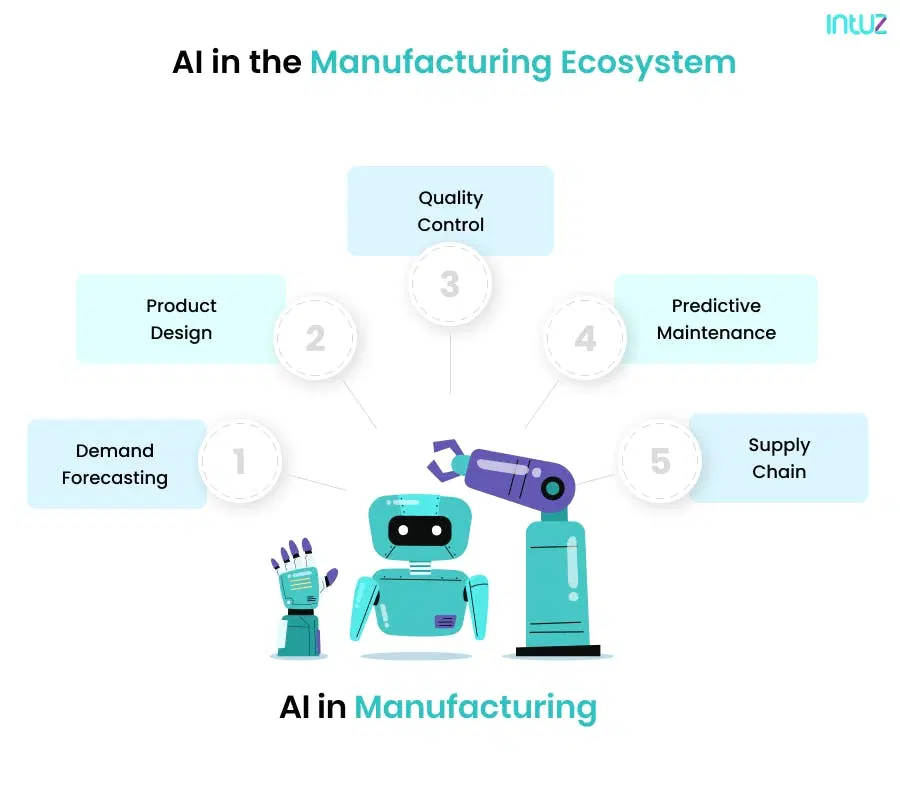
Top 5 most practical use cases of AI in manufacturing
The most practical use cases of AI in manufacturing include demand predictions, product design & development, supply chain optimizations, product quality control, and equipment predictive maintenance. Let’s understand each of them with relevant examples.
| Use Cases | Technology Used | Key Business Outcome | Real-World Example |
|---|---|---|---|
| Demand Forecasting | Machine Learning, Time-series models | Reduce overproduction & stockouts | Tesla — dynamic inventory management |
| Product Design & Development | Generative AI, Simulation tools | 55% weight reduction; faster time-to-market | Airbus — aircraft bracket redesign |
| Supply Chain Optimization | AI Analytics, Route optimization | Lower inventory costs; reliable delivery | Tesla — global supply chain |
| Quality Control & Defect Detection | Computer Vision, Deep Learning | Near-zero defect escape rate | BMW — microscopic defect detection |
| Predictive Maintenance | IoT Sensors, ML anomaly detection, Digital Twins | 40% downtime reduction; $4.3M/month savings potential | Siemens — GE Predix, IBM Maximo |
1. AI Demand forecasting for strategic decisions
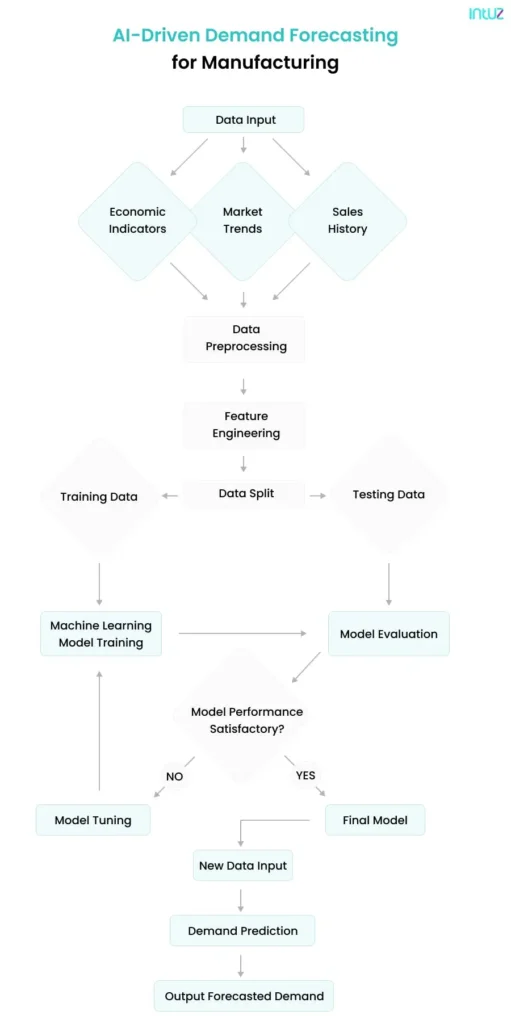
AI demand forecasting uses machine learning models trained on historical sales data, seasonal trends, and real-time market signals to predict exactly what to produce — and when — eliminating overproduction waste and costly stockouts.
In the manufacturing sector, overproducing goods ties up capital in excess inventory. On the other hand, under-production leads to stockouts and lost sales. What if there was a way to optimize production schedules and manufacture only the right quantities at the right time?
Imagine being able to predict exactly what customers want, when they want it—without the risk of overproduction or underproduction—how would that change business operations?
Analyze vast amounts of historical data, including seasonal trends, past sales, and buying patterns, with AI-driven Machine Learning algorithms to predict future demand for products with a high degree of accuracy.
The technology also incorporates external factors, such as indicators of the digital economy, market trends, and social media sentiment. This meticulous approach enables forecasting models to account for broader influences that might increase product demand.
At the same time, AI systems can process real-time data inputs, such as sudden market fluctuations, supply chain disruptions, or unexpected events, equipping manufacturers to adjust their production plans to better respond to changing demand patterns.
How to Implement AI Demand Forecasting in manufacturing
- Consolidate historical sales, inventory, and production data into a centralised data warehouse
- Integrate external data feeds: economic indicators, social sentiment, competitor pricing, weather patterns
- Select and train an ML model (LSTM, XGBoost, or Prophet are commonly used for time-series forecasting)
- Deploy the model in production with real-time data pipelines for continuous updates
- Set automated alerts for demand spikes or drops that exceed defined thresholds
- Review model accuracy monthly and retrain on new data each quarter
2. Product design and development for valuable insights
The look and feel of a product are vital aspects of manufacturing operations. Specific parameters such as material type and weight, strength requirements, and code constraints must be considered.
With Generative AI, manufacturers can explore all possible configurations, often identifying innovative structures and designs that human counterparts might not consider. This process helps in optimizing product performance and machine usage.
Food for thought: What if there was a way to uncover design possibilities never even considered before?
Once the design is generated, AI-driven simulation tools can virtually test it under various conditions, such as stress, temperature, and vibration, to understand how a product will perform in the real world.
This proactive approach eliminates the need to create physical prototypes while pushing the boundaries of traditional design thinking and reducing costs with material usage optimization. It also enables modern manufacturers to bring new products to market much faster.
3. AI-driven supply chain optimization for revenue management
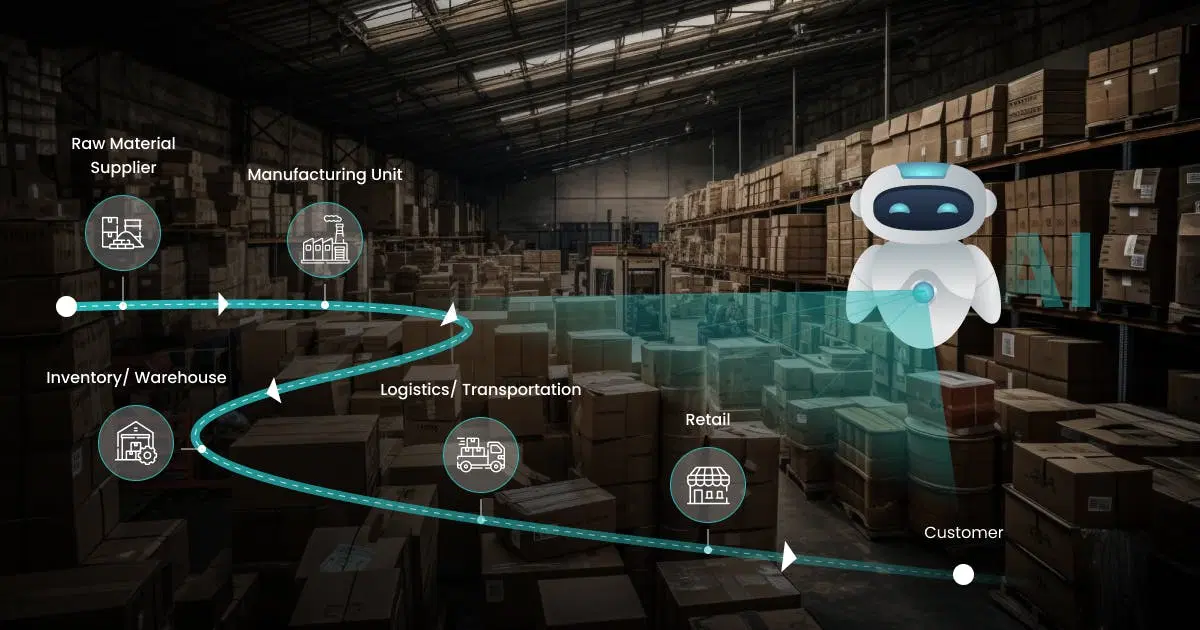
AI supply chain optimisation analyses supplier reliability, lead times, cost efficiency, and demand forecasts simultaneously — enabling manufacturers to maintain optimal inventory levels, select better suppliers, and route deliveries more efficiently than traditional ERP systems allow.
A manufacturer’s supply chain is a critical business process that influences the success or failure of customer experience. A high-performing supply chain management enables operational efficiency and responsiveness. Therefore, choosing the right supplier is crucial.
Thankfully, with AI, manufacturers can streamline the selection and evaluation of suppliers by analyzing various factors, such as cost efficiency, reliability, lead times, and past performance. They can find one that enhances supply chain sustainability goals without compromising profitability.
In addition, manufacturers can forecast demand for raw materials and components with AI-driven advanced analytics to maintain optimal inventory levels. This leads to faster production cycles, better inventory management, and more reliable delivery schedules.
Lastly, when traffic patterns, fuel cost savings, and delivery deadlines are studied closely with AI for route optimization so that products can reach retailers (and customers) on time, resulting in higher customer satisfaction levels.
| Application | How AI Helps | Business Outcome |
|---|---|---|
| Supplier selection | Scores suppliers on 20+ performance factors | Fewer disruptions, better SLAs |
| Inventory management | Predicts raw material demand with ML | 15–30% inventory cost reduction |
| Route optimisation | Analyses traffic, fuel costs, delivery windows | On-time delivery improvement |
| Risk detection | Flags geopolitical, weather, and capacity risks early | Faster contingency planning |
4. Automated Defect Detection using AI
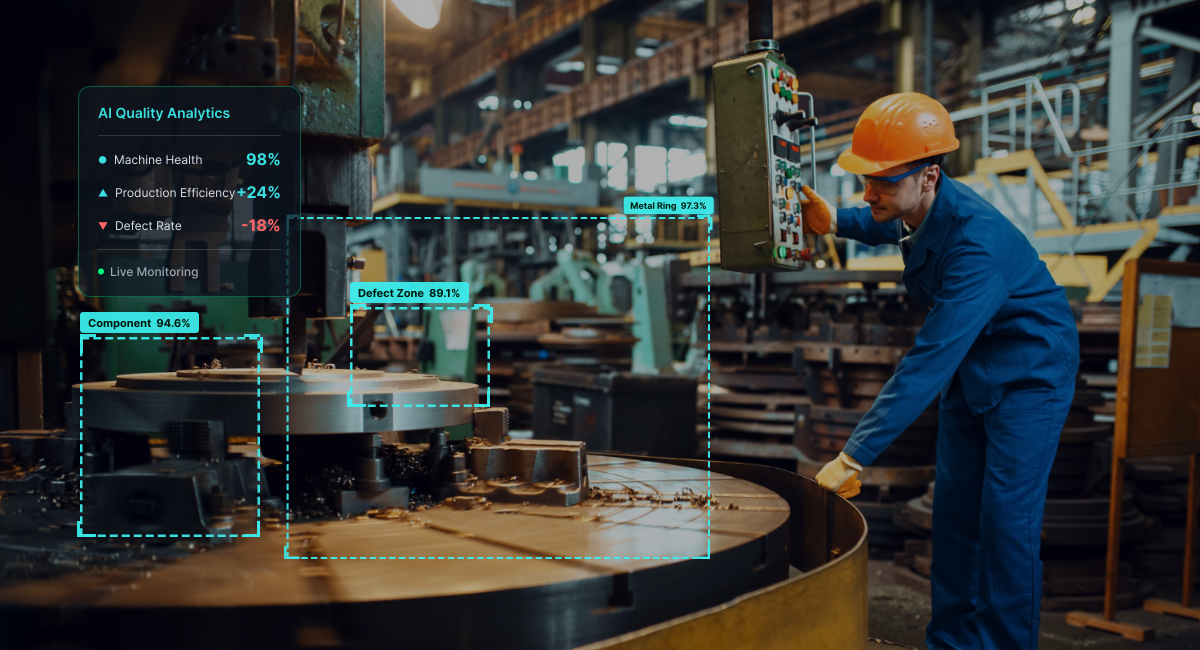
AI-powered computer vision systems inspect products at production-line speed using deep learning models trained on thousands of defect images — detecting flaws in size, shape, colour, and surface finish with accuracy that consistently surpasses human visual inspection.
So, let’s say manufacturers have used AI to make accurate demand forecasts. They’ve also designed and developed the product most efficiently and even streamlined their supply chains. But is that enough for a manufacturer to thrive? Not quite.
Product quality control and defect detection are just as important. Even if products are delivered on time, poor quality can still ruin the customer experience, decreasing customer engagement and potentially halting a manufacturer’s profits.
The good news is that AI-powered computer vision systems can inspect products on the production line at high speed, identifying defects, such as flaws in size, shape, color, or surface finish, with accuracy that far hoodwink human oversight.
These systems leverage deep learning models trained on large datasets of defective and non-defective items. AI can also be integrated with IoT sensors to continuously monitor production processes and quality control checks.
For example, sensors placed on manufacturing equipment can detect deviations in temperature, pressure, or other critical parameters in real-time, catching quality issues before they lead to significant product defects and increased carbon footprints.
End result? Improved product quality, reduced wastage, and happier customers.
Types of Defects AI Vision Systems Detect
- Surface defects: Scratches, dents, cracks, corrosion, coating irregularities
- Dimensional defects: Parts outside tolerance ranges for length, diameter, or thread pitch
- Assembly defects: Missing components, incorrect orientation, improper fastening
- Colour / cosmetic defects: Colour variation, print misalignment, label errors
- Internal defects: Voids, inclusions, and structural weaknesses detected via X-ray or ultrasound AI analysis
5. Predictive Maintenance with AI: Reducing Equipment Downtime and Failure
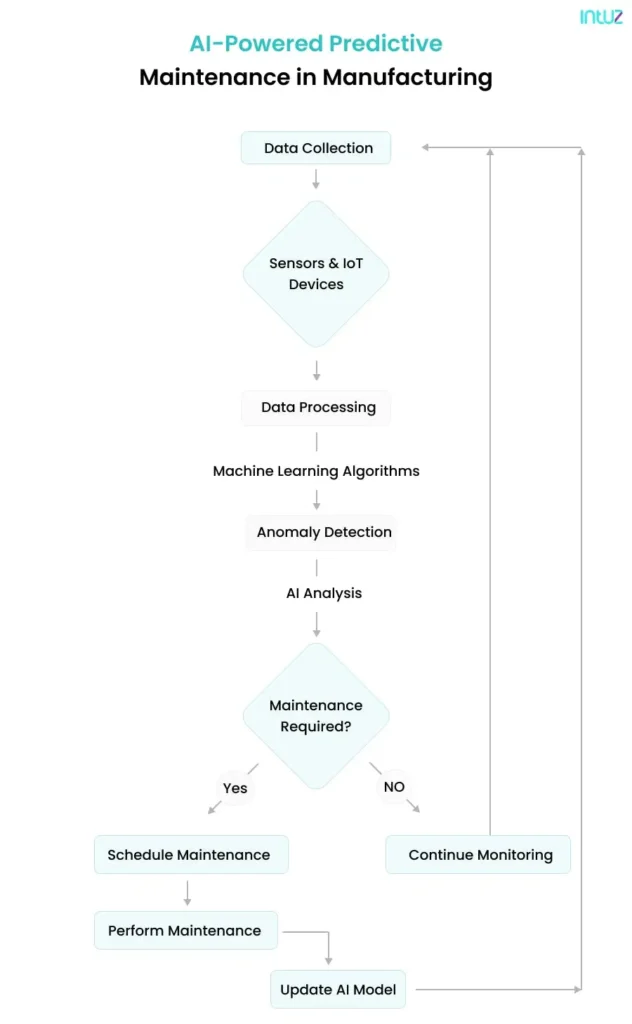
AI predictive maintenance uses IoT sensor data and machine learning to detect anomalies in equipment behaviour before failure occurs. Digital twins simulate maintenance scenarios virtually, so manufacturers can optimise intervention timing without halting production.
Mining, metals, and other heavy industrial companies lose 23 hours per month to machine failures, costing $4,312,500. This figure raises a good point—what kind of savings manufacturers could make by applying techniques, such as predictive maintenance, to reduce unplanned downtime.
Sensors embedded in equipment, for example, can collect data to monitor various parameters, such as temperature, vibration, pressure, and noise levels. ML models analyze this data to detect patterns or anomalies indicating impending equipment failures.
AI can also use digital twins to simulate different maintenance scenarios, minimizing maintenance costs without interrupting actual operations.
A digital twin is a virtual replica of physical equipment that mirrors its real-time monitoring conditions. This digital transformation helps identify the most effective maintenance actions, predict the impact of various interventions, and plan for long-term equipment performance.
Plus, when equipment isn’t maintained promptly, businesses expose their workers to safety hazards, which can cause serious injuries, legal risks, and potential shutdowns, ultimately harming the workforce and the manufacturer’s reputation.
Is the downtime cost or the risk to human worker safety worth it? With AI, there’s no need. Innovative AI-powered maintenance systems help maintenance teams counter these dangers.
For example, GE’s Predix platform, Siemens’ MindSphere, and IBM Maximo help businesses delay the need for expensive equipment replacements and ensure they operate at peak efficiency.
| Platform | Best For | Key Capabilities | Result |
|---|---|---|---|
| GE Predix | Industrial IoT & asset analytics | Edge-to-cloud sensor integration | 20–25% maintenance cost reduction |
| Siemens MindSphere | Factory automation & energy | AI-driven anomaly detection | Up to 40% downtime reduction |
| IBM Maximo | Enterprise asset management | AI work-order prioritisation | 30% longer equipment lifespan |
Explore Solutions
Streamline your manufacturing processes with AI-driven solutions!AI in manufacturing examples
Siemens
- Uses AI and machine learning to predict equipment failures before they occur
- Analyzes sensor data from industrial machinery
- Reduces unexpected downtime by up to 40%
- Estimated to save millions in maintenance and replacement costs
- Real-world implementation in gas turbine and power generation facilities
BMW
- Implements computer vision AI for automated visual inspection
- Uses deep learning algorithms to detect microscopic defects in car parts
- Reduces human error in quality assessment
- Can identify surface imperfections impossible to detect by the human eye
- Improves overall product quality and reduces manufacturing waste
Tesla
- AI-powered demand forecasting and inventory management
- Machine learning algorithms predict component requirements
- Dynamically adjusts production schedules in real-time
- Optimizes complex global supply chain operations
- Reduces inventory holding costs and improves production efficiency
Airbus
- Uses AI for advanced product design and engineering
- Generative design algorithms create optimal component designs
- Reduces material weight while maintaining structural integrity
- Example: Aircraft bracket design reduced weight by 55%.
- Improves fuel efficiency and reduces manufacturing complexity
Meet the demands of the ever-changing manufacturing industry with AI
The critical thing is manufacturers must enable an AI-driven culture. To meet this goal, they must build trust in data and AI-driven algorithms by educating the workforce about AI capabilities and values. They must also embrace its risks and limitations.
For instance, data security is a significant concern, as the vast amounts of data generated and analyzed must be protected from breaches. Additionally, workforce training ensures everyone is equipped to work alongside AI-driven systems.
A phased implementation strategy, starting with pilot projects to gradually scale AI adoption, should also be considered.
What if we told you we had the know-how to create a compelling vision of effective human-machine collaboration in manufacturing processes?
As a professional and powerful AI app development partner, Intuz can help your manufacturing business drive change with the right AI methods and technologies.
Enhance your manufacturing efficiency with our AI-powered solutions for quality control, predictive maintenance, and supply chain optimization. Achieve operational excellence with AI-driven tools. Make data-driven decisions to drive the business forward.
Book a free consultation today and receive a complimentary AI integration roadmap tailored to your needs.
FAQs
How is AI actually used on the shop floor in manufacturing?
AI is used for real-time defect detection, predictive maintenance, and production optimization. Computer vision models inspect products on assembly lines, while sensor-driven ML models predict machine failures before downtime. Manufacturers typically integrate AI with PLC/SCADA systems to enable automated decisions without disrupting existing workflows.
What is the typical cost of implementing AI in manufacturing?
Costs vary by scope: pilot projects range from $15,000–$50,000, while full-scale deployments with MES/ERP integration can exceed $150,000. Major cost drivers include data readiness, hardware (IoT sensors, cameras), and integration complexity. Using pre-built AI platforms or edge AI solutions can reduce upfront investment by 30–40%.
How long does it take to implement AI in a manufacturing plant?
A focused AI use case (like predictive maintenance) can be deployed in 6–10 weeks. End-to-end AI transformation—including data pipelines, model training, and system integration—typically takes 4–9 months. Timeline depends heavily on data availability, legacy system compatibility, and internal team readiness.
What data is required to successfully deploy AI in manufacturing?
AI models require structured machine data (temperature, vibration, pressure), historical maintenance logs, and production output data. For vision-based use cases, labeled image datasets are critical. Poor data quality is the top failure factor, so data cleaning and normalization often consume 60–70% of the project effort.
What are the biggest challenges in adopting AI in manufacturing?
The main challenges include poor data quality, lack of labeled datasets, integration with legacy systems, and resistance from operations teams. Many projects fail due to unclear ROI or lack of domain expertise. Successful implementations align AI initiatives with specific KPIs like downtime reduction or yield improvement.
How do manufacturers measure ROI from AI initiatives?
ROI is measured through reduced downtime (20–50%), improved yield (5–15%), lower maintenance costs, and labor efficiency gains. For example, predictive maintenance reduces unplanned outages, directly impacting revenue. Clear baseline metrics and controlled pilot testing are essential to accurately quantify AI impact.
Work with Intuz
Bring AI to Your Factory Floor
Get a free AI roadmap built for your plant.
Let's Get Started
Share this article