






AI-powered dynamic pricing revolutionizes eCommerce by optimizing prices in real-time, maximizing revenue and profitability. With AI algorithms analyzing market trends and customer behavior, an production-ready AI development can help businesses offer competitive prices that attract more buyers. This dynamic approach ensures products are priced right, driving increased sales and customer satisfaction. Read further our full blog to discover how AI-driven dynamic pricing strategies can boost your eCommerce revenue to new heights.
In the current age of internet savviness, customers take the time to understand a product and its retailer before closing a sale. They don’t mind browsing through many online stores and web pages to find the most suitable product for their needs.
With all the information available at their fingertips, customers also track and compare product prices. In fact, 46% cite ‘cheaper prices’ as a major reason for eCommerce shopping.
generative AI applications is, therefore, beneficial to online stores for finding ways to stay agile in setting product prices.
How, you ask? Through dynamic pricing.
Show
- AI-powered dynamic pricing — also known as surge, demand, or time-based pricing — lets e-retailers adjust product prices in real time by analyzing customer behavior, competitor costs, and inventory levels using predictive analytics.
- A five-step process (data collection, model training, testing, integration, deployment, and continuous monitoring) is required to build and deploy a Generative AI model for dynamic pricing.
- Setting up APIs to connect the AI model with backend systems — especially inventory management and payment gateways — is critical for the pricing engine to function in real time.
- Dynamic pricing gives e-retailers four key advantages: controlling profit margins, enhancing competitiveness, greater pricing flexibility, and smarter inventory management.
- Four AI-driven pricing strategies can be applied: time-based, personalized, demand-based, and competitor-based — each suited to different business scenarios and customer segments.
What is the AI-powered dynamic pricing?
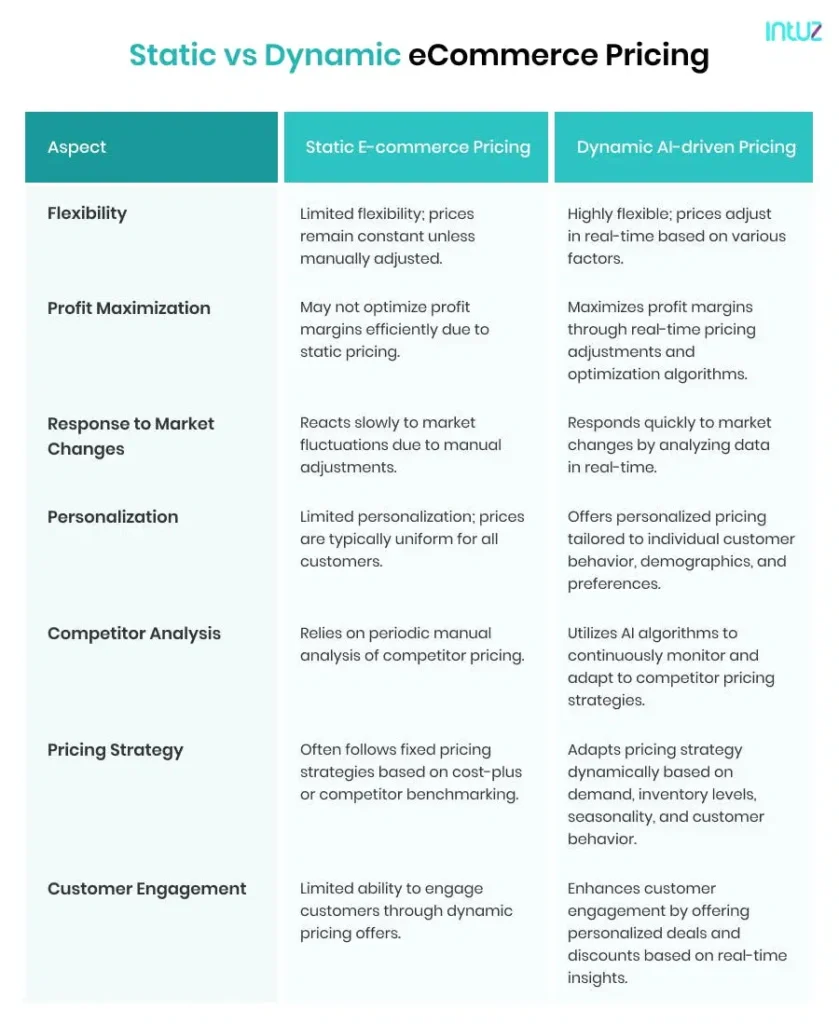
Often referred to as “surge pricing,” “demand pricing,” or “time-based pricing,” it’s a marketing tactic that allows e-retailers like yourself to adjust prices flexibly for products or services in response to market trends.
Dynamic pricing leverages AI-powered predictive analytics to analyze data, such as insights into customer behavior, competitor costing structures, and inventory levels, to make informed decisions.
For example, during winter, you could price socks, coats, cardigans, and mufflers at a higher rate due to a steep demand and gradually decrease the price as the season becomes warmer, thereby maximizing conversion.
In this blog post, we explore how Generative AI uplifts eCommerce sales through dynamic pricing. Also, learn about its benefits for online stores and discover the different AI-driven pricing strategies.
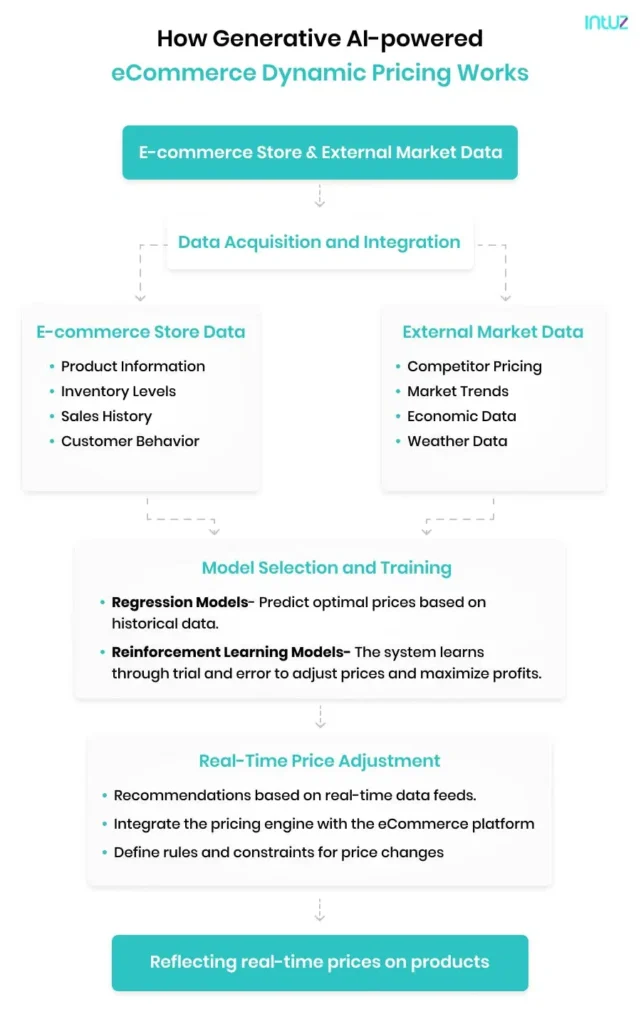
How Generative AI-powered dynamic pricing works in eCommerce
The advanced AI technology, with its ability to analyze volumes of data and predict patterns, plays a vital role in revitalizing prices for online stores. Here’s how:
1. Data collection and preparation
The first step includes building the foundation for training the AI model, which happens through the use of extensive but varied datasets encompassing:
- Historical sales
- Market condition data
- Customer demographics
- Social media sentiment analysis
- External APIs for competitor pricing
Then, implement data cleaning processes to handle missing values, anomalies, and outliers. This can be done through:
- Data formatting
- Null value handling
- Scale adjustments for number data
- Consistent category naming or labeling
Standardizing data formats enables easy comprehension, ensuring the AI model efficiently learns patterns and makes accurate predictions.
2. Generative AI model selection and training
In this phase, the AI model is fed the prepared data to learn the underlying patterns and dependencies within it to generate content. For dynamic pricing, data used for model training includes time trends, product categories, price elasticity, and seasonal effects.
Tools like Apache Kafka and Apache Hadoop are helpful for real-time data streaming and big data processing, respectively.
The performance of an AI model is strongly influenced by how quickly it learns, how much importance it gives to recent versus old information, and how it handles errors it encounters in the data sets.
Therefore, the training process involves techniques like linear regression, decision trees, and neural networks (such as recurrent neural networks for time series forecasting) to find a relationship between the input variables and the target variable.
These can be chosen depending on the complexity and nature of the dataset.
3. Testing, integration, and deployment
Next, evaluate the AI model against a set of data that it hasn’t seen before using any of the techniques mentioned above to ensure it can make accurate pricing decisions under varying market conditions.
The ‘cross-validation’ method can enhance the AI model’s predictive accuracy. Once tested, integrate it into the pricing system, where it needs to interface seamlessly with live data streams.
To make this work properly, you’ll need to set up APIs that allow the AI model to interact with your eCommerce platform’s backend systems, particularly inventory management and payment gateways.
Lastly, canary releases and blue-green deployments should be used to minimize the risk of running the AI model in real-time or near-real-time. This will ensure it can receive and process live data inputs, make pricing decisions, and update the outputs accordingly without human intervention.
4. Monitoring and continuous optimization
Once the AI model has been deployed, constantly monitor it for performance degradation, security vulnerabilities, and concept drift, which are possible owing to the rapid shifts in market dynamics or consumer behavior not present in the training data.
This phase usually comprises three types of monitoring checks:
- Reviewing model performance daily or every hour to maintain accuracy above 80%
- Evaluating distribution comparisons, numeric or categorical, on actuals, predictions, and features
- Calibrating data quality to minimize issues like change in cardinality or percent of missing values
Update the model regularly with fresh data, revising algorithms to handle new patterns in customer and market behaviors. Use real-time demand signals, such as changes in website traffic or product searches, to make immediate pricing adjustments.
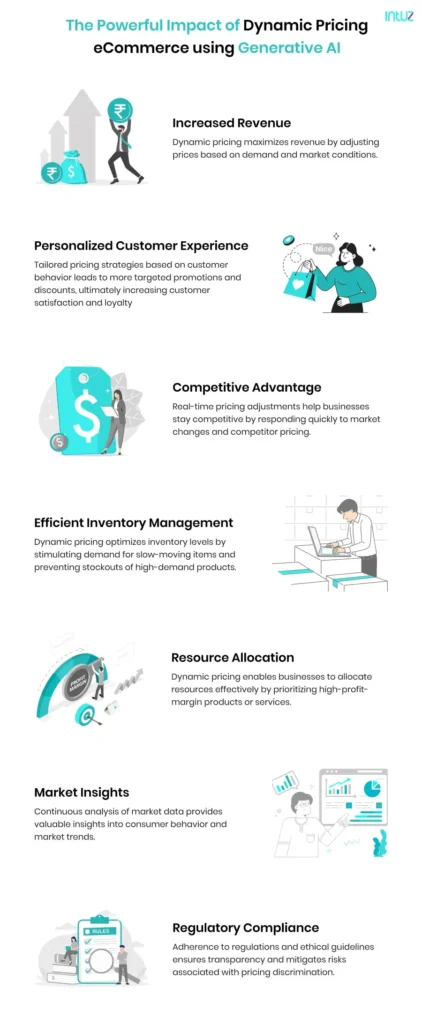
Benefits of dynamic pricing for e-retailers
The ability to automatically change pricing ensures that ROI always remains high for e-retailers and that customers shopping for the best price are attracted. Here are the top advantages dynamic pricing offers:
1. Control profit margins
Your profit margins are driven by a host of factors, such as customer demand, competition, inventory levels, and so on.
Dynamic pricing helps keep these margins at an ideal level by enabling you to raise prices during high-demand periods and reducing them when demand wanes.
A McKinsey report states that dynamic pricing can boost revenues by 5%-10% through improved customer price perception on the most competitive items.
2. Enhance competitiveness
No business likes to sell below their direct competition. Thankfully, dynamic pricing works into algorithms that allow setting optimal product prices in response to competitor pricing strategies. That way, you always have a leg up on rival businesses—regardless of the industry or season.
3. Enjoy greater flexibility
With traditional pricing, you’re locked into a specific price point, which may or may not be ideal compared to economic factors, such as supply and demand, inflation, regulatory changes, exchange rates, sales tax, and so on.
Dynamic pricing doesn’t leave room for assumption and enables you to keep charging the price apt for a particular market condition.
4. Manage inventory better
You can reduce prices through dynamic pricing to clear out excess inventory and prevent spoilage or overstock. On the other hand, charging premium pricing for scarce items can capitalize on their rarity.
For example, in the fashion sector, this strategy helps clear out seasonal merchandise to make way for launching new collections.
Types of Generative AI-driven dynamic pricing strategies
Different pricing strategies work best for different eCommerce scenarios and business requirements, including:
1. Time-based dynamic pricing
This adjusts prices according to certain time-related factors, such as the time of day, week, or season.
For example, you could offer “flash sales” during off-peak hours. Encourage customers to browse, shop, and apply special discounts from midnight to 4 AM to drive sales when online store traffic is typically lower.
2. Personalized dynamic pricing
This involves deciding prices for individual customers based on their browsing history, purchase habits, and demographic data. To predict how much a particular customer is willing to pay, you must leverage data analytics and personalize the product prices accordingly.
For example, a new visitor might see a $10 discount on the first purchase, while a frequent buyer might receive free shipping as an incentive.
3. Demand-based dynamic pricing
This allows you to alter prices in real time according to current demand levels. For instance, if the demand for air conditions increases during summer, you can raise the prices as warmer weather approaches to maximize profit per sale. This strategy also helps you manage your inventory optimally.
4. Competitor-based dynamic pricing
This is around setting prices relative to your competitors’ product pricing so you can appear more attractive to customers looking to bag the best deal on a product.
This often, however, means lowering your prices when a competitor has a sale or possibly increasing them to bridge the market gap. This strategy is beneficial during major sales events, such as Black Friday, when customers aggressively compare prices online and make a decision.
Enable smarter and faster dynamic pricing with Generative AI
With AI in the eCommerce market projected to reach a value of $14 billion by 2028, it’s safe to assume that AI-powered dynamic pricing will be one of the major aspects of the online shopping revolution.
It allows you to cater to various customer groups with custom offerings that meet specific needs and budgets. So, if you want to up the ante and boost your eCommerce sales, contact Intuz’s Generative AI experts.
We’ll discuss a suitable Generative AI strategy tailored for your business and deliver a dynamic pricing opportunity assessment for free!
Your pricing policy shouldn’t be an afterthought but an integral component of an online store.
Book a complimentary consultation with us today.
FAQs
What is AI dynamic pricing and how does it work in e-commerce?
AI dynamic pricing uses machine learning to automatically adjust product prices in real time based on demand, competitor pricing, inventory levels, and customer behavior. This ensures optimal pricing for conversions, helping eCommerce stores stay competitive and maximize profit without constant manual intervention.
How can AI-driven dynamic pricing help boost my online store’s revenue?
AI-driven pricing analyzes market trends and buyer intent to set prices that convert more sales at higher margins. It helps you avoid underpricing, reduce cart abandonment, and automatically capitalize on high-demand periods—directly improving revenue and profit per visitor.
What are the main risks or challenges of implementing AI dynamic pricing in e-commerce?
Key challenges include poor data quality, over-automation leading to erratic prices, and alienating loyal customers with frequent price changes. To avoid this, use high-quality historical data, define pricing boundaries, and regularly audit the algorithm’s output for strategic control.
How does AI dynamic pricing affect customer perception and loyalty?
Poorly managed dynamic pricing can confuse or frustrate customers. However, with transparent pricing logic and personalized offers, AI can actually enhance trust and loyalty by delivering relevant discounts or fair prices based on buyer behavior and purchase history.
What data is needed for effective AI-powered dynamic pricing in e-commerce?
You’ll need real-time competitor prices, product demand trends, historical sales data, customer behavior metrics, inventory levels, and seasonal patterns. This data feeds AI models to optimize prices for each product dynamically and profitably, aligned with business goals.


![How to Build eCommerce AI Product Recommendation System [Most Practical Guide]](https://www.intuz.com/wp-content/uploads/2026/05/How-to-Build-eCommerce-AI-Product-Recommendation-System-Most-Practical-Guide.webp)


