



Bluetooth 5.0 delivers 2x speed (2Mbps), 4x range (200m outdoors), and 8x message capacity over Bluetooth 4.0. Compare both versions across speed, range, power, and IoT compatibility — and find out which one your app needs.
Bluetooth 5.0 is faster, longer-range, and more power-efficient than Bluetooth 4.0 — making it the clear choice for modern IoT applications, mobile apps, and BLE-connected devices.
Specifically: Bluetooth 5.0 delivers 2Mbps data speeds (2x faster), an outdoor range of 200m (4x greater), and a message capacity of 255 bytes (8x more) compared to Bluetooth 4.0’s 1Mbps, 50m range, and 31-byte capacity.
If you’re building a Bluetooth-enabled mobile or IoT application, the version you target determines your device’s performance ceiling. This guide breaks down exactly where the two versions differ — and what it means for your product.
Show
- Speed Advantage: Bluetooth 5.0 transfers data at 2Mbps — exactly twice the 1Mbps maximum of Bluetooth 4.0 — sending a 251-byte packet in 1,060 microseconds vs. 2,120 microseconds on 4.0.
- 4× Greater Range: Bluetooth 5.0 supports 200m outdoors and 40m indoors, compared to Bluetooth 4.0’s 50m outdoor and 10m indoor limits, directly enabling smart home, industrial IoT, and asset tracking use cases.
- 8× Message Capacity: Bluetooth 5.0 offers 255 bytes of message capacity vs. only 31 bytes in 4.0 (of which only 17–20 bytes are usable for actual data payload).
- Backward Compatible, Not Forward: Bluetooth 5.0 is backward-compatible with 4.0, 4.1, and 4.2 devices, but when paired with a 4.0 device, it falls back to 4.0 speeds and range. Bluetooth 4.0 cannot communicate with 5.0 as the host.
- IoT & Beacon Superiority: Bluetooth 5.0’s connectionless IoT model enables beacons to broadcast richer payloads across larger areas, and it also supports dual audio streaming — two devices connected to one source simultaneously — which 4.0 cannot do.
| Feature | Bluetooth 4.0 | Bluetooth 5.0 | Improvement |
|---|---|---|---|
| Data Speed | 1 Mbps | 2 Mbps | 2× faster |
| Outdoor Range | 50 m | 200 m | 4× greater |
| Indoor Range | 10 m | 40 m | 4× greater |
| Message Capacity | 31 bytes (17–20 usable) | 255 bytes | ~8× larger |
| Max TX Power | +10 dBm | +20 dBm | Higher signal strength |
| Backward Compatibility | 4.x series only | 4.0, 4.1, 4.2 | Broader support (with limitations) |
| IoT Readiness | Limited | Purpose-built | BLE-optimized |
| Beacon Support | Basic | Advanced (connectionless IoT) | Significantly improved |
| Dual Audio | No | Yes (two devices simultaneously) | New capability |
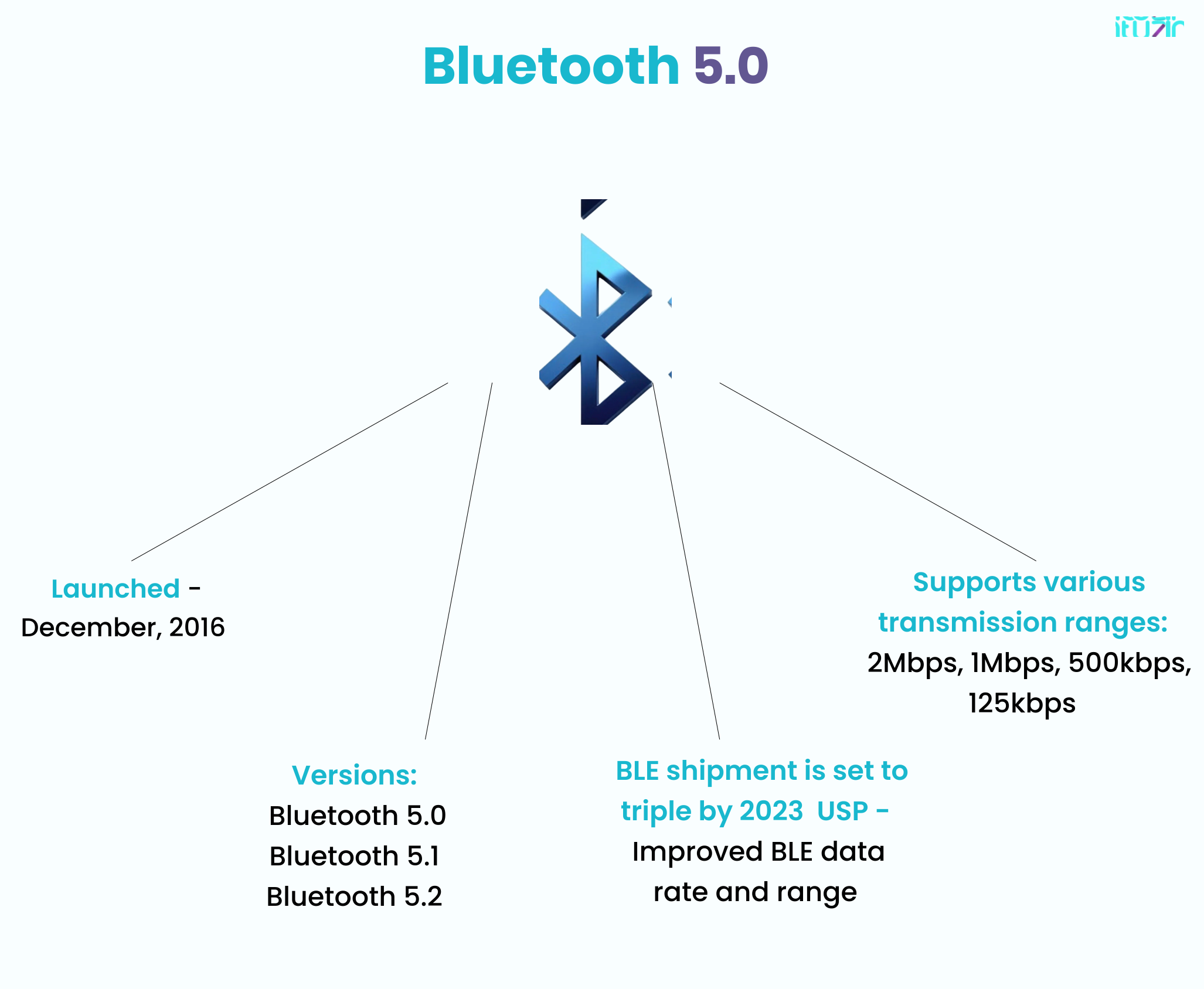
Bluetooth version 5.0 specifications at a glance
After the subsequent success of version 4.0, the market introduced Bluetooth version 5.2 on December 31, 2019. Although geared towards low-powered apps, it offers an improved BLE data rate and range – allowing devices to send even more sophisticated data to the end-users.
Unlike Bluetooth 4.0, it provides four different data rates to accommodate various transmission ranges: 2Mbps, 1Mbps, 500kps, and 125kps. That results in better call quality and significantly superior performance and functionality.
That makes it a clear successor to Bluetooth 4.0 thanks to its pro-Internet of Things upgrades and Bluetooth beacon. This article attempts to analyze Bluetooth 5.0 vs. 4.0, along with their variations in detail. But first, let us take a step back to study its history.
Bluetooth – how it all began
Bluetooth was invented by an electrical engineer Jaap Haartsen in 1994, while working for Ericsson in Sweden, as an alternative to the RS-232 cable standard for connecting PCs to computer peripherals.
Four years later, Haartsen played a crucial role in setting up the Bluetooth Special Interest Group (SIG), comprising 35,000+ member companies in various sectors such as computing, telecommunications, and consumer electronics.
Today, the body controls technology development, protects trademarks, and runs a management qualification program to ensure all manufacturers comply with their standards to sell a Bluetooth device.
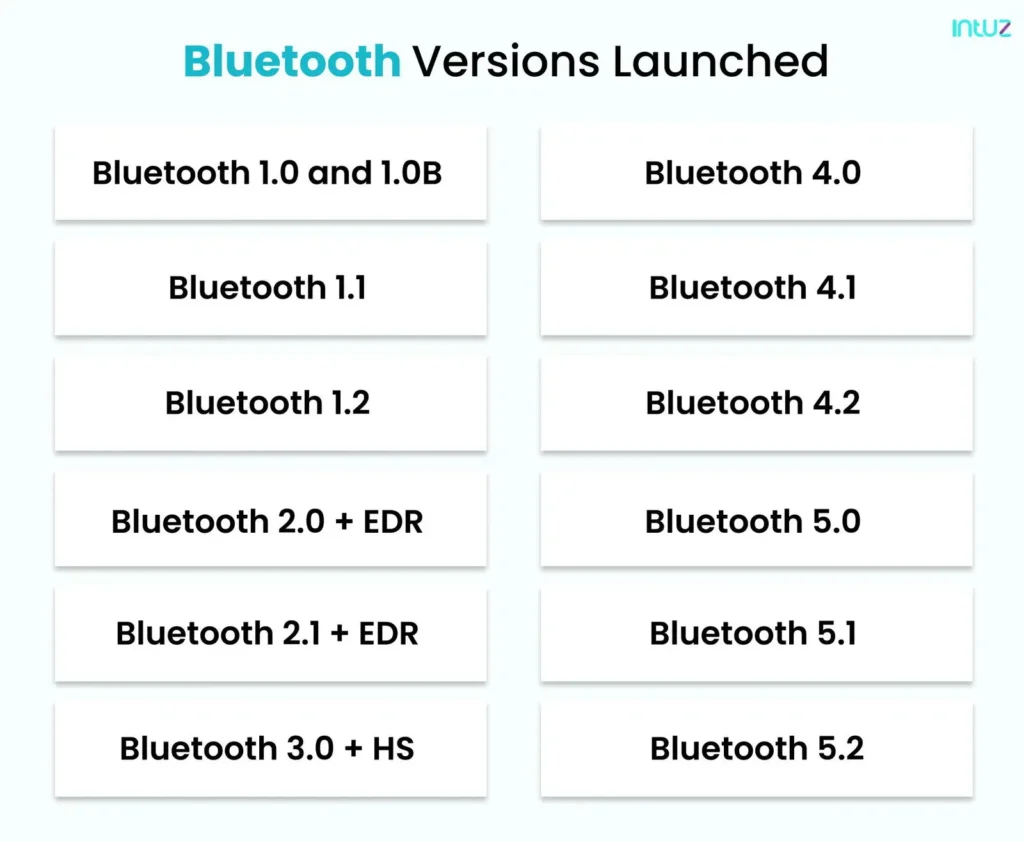
So far, Bluetooth has released 12 versions, most of which are stemming from the same series:
Bluetooth: a number game
An ABI Research states that Bluetooth beacons are expected to reach a 133% CAGR between 2016 and 2021 in retail, advertising, and personal tracking sectors. In 2020, the volume of BLE-enabled devices shipped worldwide is expected to reach 8.45 billion.
Moreover, BLE shipment is set to triple by 2023, with 1.6 billion devices shipping each year. Speaking of demographics, North America has the highest rate of Bluetooth usage at approximately 40% across devices thanks to increased use of hands-free headsets, connected watches, and other Internet of Things Development.
The technology has undoubtedly evolved from connecting PC ancillary systems into a domestic IoT connectivity solution. Let us study some compelling use cases of Bluetooth.
Bluetooth creates a buzz in the market
1. Find your airport terminal
Miami International Airport installed Bluetooth beacons to each terminal and critical areas such as restrooms and food courts. That way, travelers can download the airport app and be guided straight to their terminal from the security check-in area.
2. Skip the long queues
Since 2013, Apple Stores in the USA have been using beacons to communicate with users once they enter the facility and check-in for the Apple Store app’s service. They are sent notifications on their Apple devices regarding discounts, sales, hot favorites, and more.
3. Enjoy guided museum tours
The Brooklyn Museum of Art provides guided tours through their official app. Location-based triggers serve content as visitors walk through the museum. It is an impressive way for the museum to communicate with visitors and allows the latter to interact with the exhibits of their liking.
Bluetooth 5.0 vs. 4.0 – A detailed comparative analysis
Bluetooth 5.0 was rolled out in 2016 and designed to meet all the wireless world’s advanced privacy and security standards. It requires the latest hardware to run smoothly and is not compatible with its older versions, like Bluetooth 4.0. So, how do the two versions fare against each other? Time to analyze Bluetooth 5.0 vs. 4.0:
1. Speed
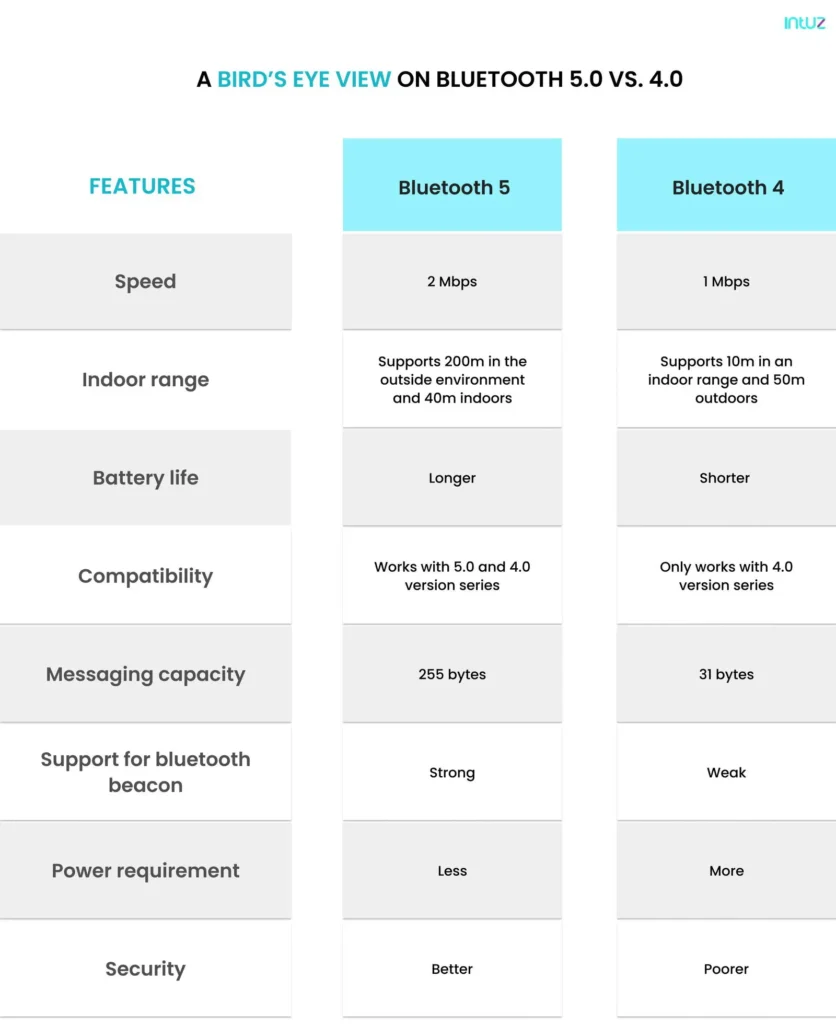
Bluetooth 5.0 transfers data at 2Mbps — exactly twice the 1Mbps maximum of Bluetooth 4.0 — making it capable of sending a 251-byte data packet in 1,060 microseconds versus 2,120 microseconds in the older version.
One of the most impressive Bluetooth version 5.0 specifications includes speed. It is twice as fast as Bluetooth 4.0. Clocking in at a decent 2Mbps, it can meet all the Internet of Things compatibility requirements.
A packet of data worth 251 bytes can actually be sent in 1060 microseconds compared to the previous version that recorded a set time frame of 2120 microseconds.
This shows that even though the data is sent faster, the packets’ distance has not been shortened or wedged. In a nutshell, Bluetooth 5.0 is certainly 1.7X faster than BLE 4.2.
2. Range
Bluetooth 5.0 supports an outdoor range of 200m and an indoor range of 40m, compared to Bluetooth 4.0’s 50m outdoor and 10m indoor limits — a 4x range improvement that directly enables smart home, industrial IoT, and asset tracking use cases.
While Bluetooth 4.0 supports 10m in an indoor range and 50m outdoors, its successor supports 200m in the outside environment and 40m indoors. That shows that Bluetooth version 5.0 specifications are far superior to any versions of Bluetooth 4.0.
Bluetooth 5 allows low-energy transmission providing data range for more range.
The advanced range means you can listen to music through your wireless headsets from your smartphone while moving around the house or garden without disrupted streaming.
3. Battery bandwidth
Bluetooth 5.0 operates at a maximum transmit power of +20 dBm versus +10 dBm in Bluetooth 4.0, yet consumes less energy per device — a design intentionally optimized for IoT devices and wearables that must operate for extended periods on battery power.
4. Compatibility
Bluetooth 5.0 is backward-compatible with Bluetooth 4.0, 4.1, and 4.2 devices — but when paired with an older device, it operates at the older version’s speed and range. Bluetooth 4.0, by contrast, cannot communicate with Bluetooth 5.0 as the host device.
You cannot just throw your smartwatch in the bin or purchase a new mobile phone only to stay in vogue! That is the issue Bluetooth version 5.0 specifications address once and for all!
Bluetooth 4.0 is only compatible with devices that were designed specifically for the version 4 series. However, it will not work with devices that have Bluetooth 5. Although that is not a problem with version 5 and is backward-compatible with all version 4 series, it will not utilize all Bluetooth version 5.0 specifications on the device.
5. Hardware support
Bluetooth 5 met the requirements for the Internet of Things thanks to its extraordinary range and increased speed. Its predecessor, on the other hand, gets a boot because of its speed and faulty range. Samsung Galaxy 8 and 8+ work well with Bluetooth 5.0.
However, to take full advantage of Bluetooth 5.0, you will need the new and improved gear. For instance, you might need a Bluetooth adapter to make a device work properly. By plugging into a USB port, you can upgrade your device with the latest version.
This is not the case with Bluetooth 4.0 – which won’t be compatible with any version series except for its own.
6. Message capacity
Bluetooth version 5.0 specifications include a large messaging capacity of 255 bytes, giving more bytes for actual data payload. However, Bluetooth 4.0 has a small message capacity of 31 bytes that only give 17-20 bytes for actual data payload.
7. Bluetooth beacon
Bluetooth 5.0’s extended range and advertising capacity make it the preferred protocol for beacon-based IoT deployments. Its connectionless IoT model enables beacons to broadcast richer payloads to more devices across larger areas — a capability Bluetooth 4.0 cannot match.
Bluetooth 5.0 offers a connectionless Internet of Things, which makes its beacons so apt! It optimizes responsiveness and ensures faster and smoother connectivity.
Which Bluetooth Version Is Right for Your IoT App?
The decision isn’t just about specifications—it depends on what your application needs to achieve.
Choose Bluetooth 5.0 if your application requires:
- Extended range → Ideal for smart buildings, warehouses, and outdoor asset tracking
- Higher data throughput → Suitable for audio streaming and real-time health monitoring
- Advanced beacon capabilities → Supports rich payloads for retail, hospitality, and navigation use cases
- Dual audio output → Enables streaming to two devices simultaneously (consumer and entertainment apps)
- Future-proof technology → Bluetooth 5.x is the actively evolving standard
Bluetooth 4.0 may be sufficient if:
- Your device ecosystem is already locked into 4.x hardware
- Your use case involves minimal data transfer (e.g., simple sensor readings)
- Budget constraints make upgrading to 5.0 hardware impractical
Recommendation for New IoT Applications
For any new IoT application, Bluetooth 5.0 should be considered the baseline.
The hardware cost difference is minimal, while the improvements in range, speed, and scalability are significant enough to impact long-term performance and flexibility.
Should you really get Bluetooth 5?
When considering the benefits of Bluetooth 5.0 over Bluetooth 4.2, the features that stand out are the faster speed and the greater range. You can get up to twice the speed (2Mbps versus 1 Mbps), four times the range (800 feet versus 200 feet), and eight times the bandwidth of your old Bluetooth. We have discussed all of this before.
It is important to remember, though, that you cannot have all of it at the same time — the devices need to choose between speed or range for any given transfer of information.
For instance, a Bluetooth tracker tag might opt for greater range, while headphones designed mainly for music playback might prefer greater speed.
Of course, these are ‘line of sight’ maximums, so anything that comes in the way of the two objects will naturally interfere with the signal.
Nonetheless, these are commendable improvements, and they also apply to BLE, so your IoT devices can benefit from better speed and range while still being power-efficient.
Another major advantage of Bluetooth 5.0 is that it simultaneously enables two devices to pair with a third device. Imagine this scenario: there are two people with their wireless headphones listening to the same music from the same smartphone or controlling the speakers in your bathroom as well as your kitchen with just one phone.
That being said, we recommend that you go for Bluetooth 5.0 only if you know that all the paired devices will be using it. For instance, your phone might support Bluetooth 5.0, but your car or your smart home device might not.
In fact, this is quite likely, as automobile manufacturers are not always super-prompt about updating their cars’ Bluetooth, and the same applies to home device makers. So, please do your research before you think of upgrading to that.
Luckily, Bluetooth 5.0 is backward-compatible with Bluetooth 4.2, so your two devices can still connect and share information the usual way, even if you cannot leverage the extra speed and range. Plus, if you are genuinely keen on making Bluetooth 5.0 a part of your life, consider verifying that any new item you buy is compatible with it.
Wrapping it up
As the Internet of Things, Android app development, and iOS app development expand, Bluetooth’s usage will continue to soar for days to come. One cannot imagine life without Bluetooth, is it not?
When Apple first introduced the headphone Jack many years ago, they embraced Bluetooth technology as the new audio connectivity standard. Since then the technology has evolved by leaps and bounds, and the article proves how!
Given what we have learned in our comparative analysis of Bluetooth 5.0 vs. 4.0, there is no doubt that Bluetooth 5 version series are much better than the previous versions.
If you need any assistance concerning Bluetooth-compatible Android app development and iOS app development, please do not hesitate to contact us.
FAQs
What is the main difference between Bluetooth 5.0 and Bluetooth 4.0?
Bluetooth 5.0 outperforms Bluetooth 4.0 across every key metric. It delivers twice the data transfer speed (2Mbps vs 1Mbps), four times the outdoor range (200m vs 50m), and eight times the advertising message capacity (255 bytes vs 31 bytes). It also supports dual audio streaming — allowing two devices to connect to a single audio source simultaneously — a capability Bluetooth 4.0 does not support. For IoT and mobile app development, these differences determine how much data your app can transfer, how far devices can be from each other, and how long batteries last per charge cycle.
Is Bluetooth 5.0 backward compatible with Bluetooth 4.0 devices?
Yes, Bluetooth 5.0 is backward compatible with Bluetooth 4.0, 4.1, and 4.2 devices. However, when a 5.0 device connects to a 4.0 device, the connection operates at 4.0’s speed and range — the 5.0 improvements are not available. Bluetooth 4.0, by contrast, is not forward-compatible: a 4.0 host device cannot leverage Bluetooth 5.0 features. For developers building apps that need to support a wide device range, designing around the lowest common denominator Bluetooth version in your target market is essential.
Which Bluetooth version should I use for an IoT app?
For any new IoT application, Bluetooth 5.0 or higher is the recommended minimum. Its 200m outdoor range covers smart building and campus deployments that Bluetooth 4.0 cannot. The 255-byte message capacity reduces data fragmentation across BLE sensors. Its connectionless beacon mode enables scalable proximity services without pairing overhead. At Intuz, our IoT development team defaults to Bluetooth 5.0 architecture for all new connected device projects — the hardware cost difference over 4.0 is minimal, while the performance improvement is significant.
How much faster is Bluetooth 5.0 vs 4.0 in real-world usage?
In BLE mode, Bluetooth 5.0 transfers data at 2Mbps — twice the 1Mbps maximum of Bluetooth 4.0. In practical terms, a 251-byte data packet takes 1,060 microseconds on Bluetooth 5.0 versus 2,120 microseconds on 4.0. This difference matters most for applications transferring continuous sensor streams, audio data, or health monitoring readings where latency affects user experience. One important constraint: on Bluetooth 5.0, devices must choose between maximum speed or maximum range for any given transfer — peak speed and peak range cannot be used simultaneously.
What is the maximum range of most Bluetooth 5 devices?
Bluetooth 5 supports a range of 200m in the outside environment and 40m indoors. It offers four different data rates to include various transmission ranges: 2Mbps, 1Mbps, 500kps, and 125kps. The range ensures better call quality and significantly superior performance and functionality than the older versions of the Bluetooth.
Can Bluetooth 5.0 improve the battery life of my IoT device?
Yes. Bluetooth 5.0 is designed to consume less energy per transmission than Bluetooth 4.0, even though it operates at higher power output (+20 dBm vs +10 dBm). The efficiency gain comes from transmitting the same data in fewer, larger packets — reducing the number of transmission cycles per event. For battery-powered IoT devices like wearables, asset trackers, and environmental sensors, the switch from 4.0 to 5.0 can meaningfully extend device uptime. Actual battery improvements depend on hardware design, duty cycle, and use case.
Does Intuz build Bluetooth 5.0-compatible iOS and Android applications?
Yes. Intuz develops custom iOS and Android applications with Bluetooth 5.0 and BLE integration across industries including healthcare, retail, logistics, and smart home. Our mobile development team handles the full stack — from BLE firmware coordination and SDK integration to the app-layer logic managing device discovery, connection state, and data handling. If you’re building a Bluetooth-connected product and need a mobile app to match, our team can scope the right architecture from day one. Contact us to discuss your project requirements.
Work with Intuz
Build a Bluetooth-Powered App
Tell us your idea. We'll build the right BLE solution for it.
Let's Get Started
Share this article