



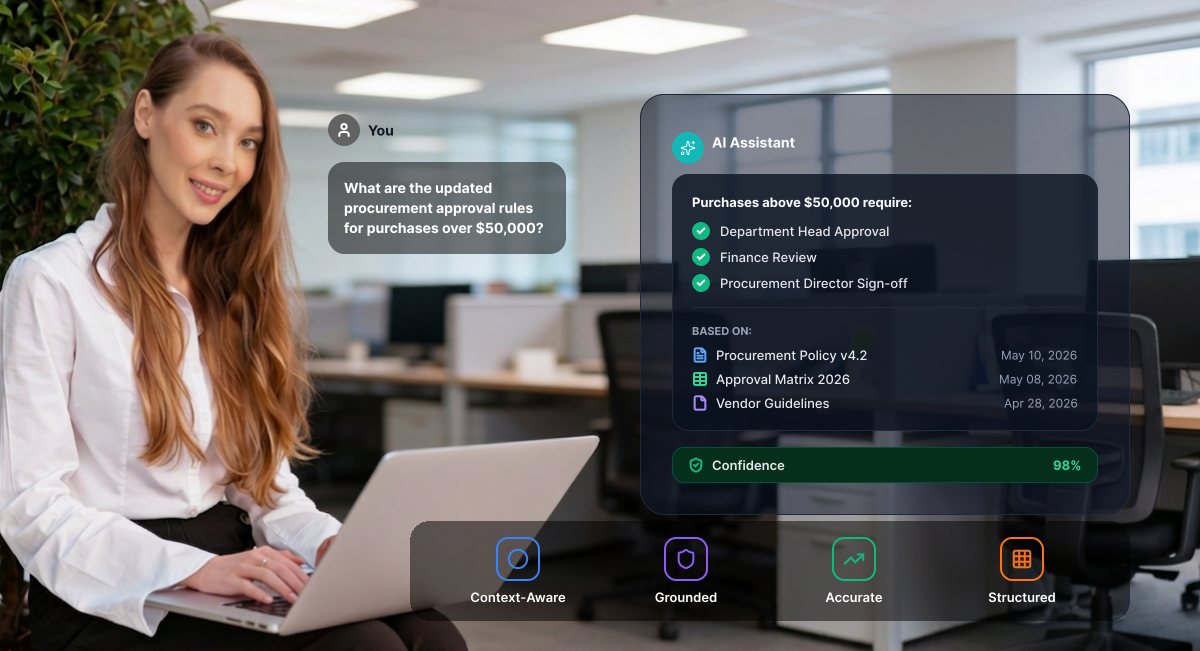
Basic RAG breaks at enterprise scale. This guide covers the eight techniques that fix it — from semantic chunking and hybrid retrieval to Self-RAG and Agentic RAG — with practical implementation steps for each.
Retrieval-Augmented Generation (RAG) enables Large Language Models (LLMs) to generate responses by drawing on internal knowledge rather than relying solely on training data. At its simplest, RAG retrieves similar document chunks and passes them to the model as context.
This works reliably only when datasets are small, consistent, and tightly controlled. However, at the enterprise level, these assumptions no longer hold.
That’s because data is fragmented across systems and versions, queries are often left unspecified, and similarity search begins returning content that’s statistically related but factually or operationally incorrect.
Large documents exceed practical context limits, while latency and operational cost become difficult to predict and control. This blog breaks down eight advanced RAG techniques that exist specifically to address these issues.
Show
- Basic RAG breaks at enterprise scale — it assumes small, consistent, tightly controlled datasets, but production data is fragmented across systems and versions, queries are underspecified, and similarity search starts returning content that is statistically related but factually or operationally wrong.
- Eight techniques close the gap: semantic chunking, hybrid retrieval, re-ranking, metadata filtering, query transformation, context compression, Self-RAG, and Agentic RAG — each targeting low retrieval precision, excessive token usage, or complex/ambiguous queries.
- The measured impact is significant — hybrid retrieval adds ~30% relevance, semantic chunking adds 15–25% recall, and cross-encoder re-ranking cuts retrieval failures by 67%.
- Verification layers stop confident-sounding errors — Corrective, Self-, and Agentic RAG validate each claim against retrieved context and re-retrieve only the unsupported portions until claims are grounded.
- A real pharma deployment combining semantic chunking, hybrid retrieval, re-ranking, and metadata filtering cut literature-review time by over 60% while delivering grounded, source-cited summaries.
Basic RAG vs Advanced RAG: What Actually Changes in Production
Even though both AI architectures rely on embeddings, a vector database, and a language model, the differences become apparent once the system faces real-world scale, user queries, and accuracy expectations. At that point, the gaps become structural.
Here’s how they differ across the areas that matter in production systems:
| System Layer | Basic RAG | Advanced RAG |
|---|---|---|
| Retrieval Strategy | Single dense vector search over all documents | Hybrid and multi-path retrieval combining dense vectors, lexical search, filters, and graphs |
| Ranking Logic | Cosine similarity decides the final order | Cross-encoders and re-rankers reassess relevance before context injection |
| Query Handling | Raw user input sent directly to retrieval | Queries are rewritten, expanded, or decomposed before search |
| Chunking Method | Fixed-length text splits | Semantic and hierarchical chunking aligned to document structure |
| Context Assembly | Top K chunks appended until token limit | Context is compressed, pruned, and prioritized before generation |
| Reasoning Depth | Single-pass retrieve and generate | Multi-hop and iterative retrieval across sources |
| Hallucination Control | Assumes retrieval alone is sufficient | Post-generation verification through corrective and self-checking loops |
| Operational Visibility | Limited insight into retrieval and failure patterns | Continuous tracking of retrieval quality, ranking drift, and token usage |
8 Advanced RAG Techniques with Implementation Notes
Advanced RAG techniques are production-grade improvements to Retrieval-Augmented Generation that solve three core problems: low retrieval precision, excessive token usage, and inability to handle complex or ambiguous queries. The eight primary techniques are: semantic chunking, hybrid retrieval, re-ranking, metadata filtering, query transformation, context compression, Self-RAG, and Agentic RAG.
| Technique | Problem It Solves | Complexity | Impact on Accuracy | Tools |
|---|---|---|---|---|
| Semantic Chunking | Broken document logic | Low–Medium | +15–25% recall | LangChain, LlamaIndex |
| Hybrid Retrieval | Exact-term + semantic mismatches | Medium | +30% relevance | Pinecone, Weaviate, BM25 |
| Re-ranking | Near-miss results in context | Medium | -67% retrieval failures | Cohere Rerank, ColBERT |
| Metadata Filtering | Operationally invalid sources | Low | High (compliance-critical) | All major vector DBs |
| Query Transformation | Query-document vocabulary gap | Low–Medium | Significant on ambiguous queries | LangChain, LlamaIndex |
| Context Compression | Token waste, distraction | Low–Medium | Reduces hallucination | LangChain ContextualCompression |
| Self-RAG | Unnecessary retrieval, unsupported claims | High | Lower hallucination rate | Custom or fine-tuned models |
| Agentic RAG | Multi-hop, multi-source reasoning | High | Highest for complex queries | LangGraph, LlamaIndex, AutoGen |
1. Hybrid retrieval
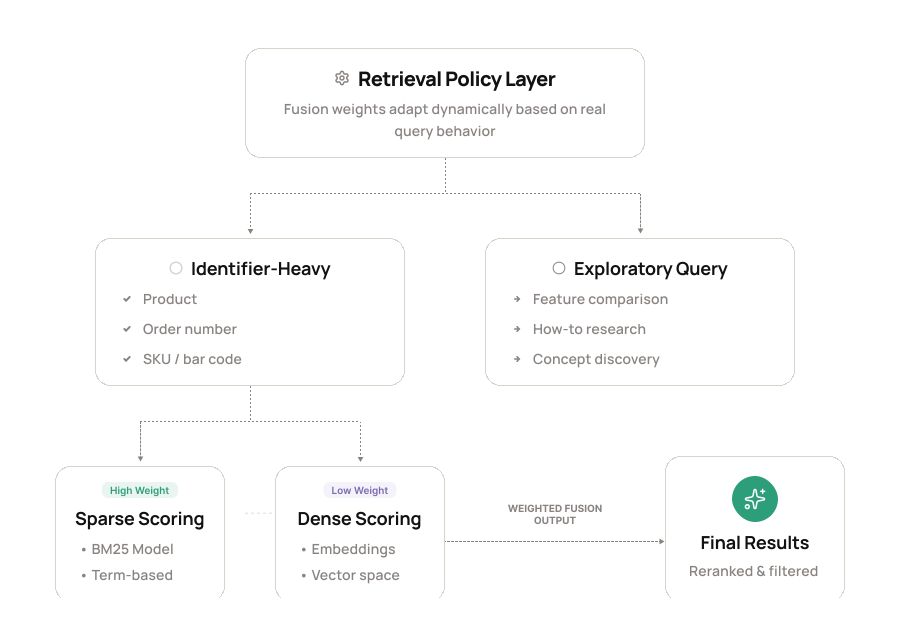
Dense vector search weakens when your queries depend on exact terms. Product IDs, ticket numbers, clause references, error codes, and version tags lose priority when relevance is computed only in the embedding space.
Hybrid retrieval fixes this by running two searches in parallel:
- One for semantic meaning using embeddings (dense)
- One for exact term matching using keyword scoring, like Best Matching 25 (sparse)
Once the results are set, return, you normalize their scores, apply a weighted fusion formula, and pass the top candidates into your re-ranking layer.
2. Semantic and hierarchical chunking
Semantic chunking is a document segmentation method that defines chunk boundaries based on detected topic transitions rather than fixed token counts. Unlike fixed-length splitting — which breaks documents at arbitrary character or token boundaries — semantic chunking preserves the logical coherence of each unit, so retrieved chunks represent complete ideas rather than fragments.
Fixed-length chunking splits documents based on token counts rather than meaning, breaking logical boundaries within contracts, specifications, policies, and technical manuals. You replace fixed N-token splitting with semantic segmentation in the RAG system.
It defines chunk boundaries based on detected topic transitions through:
- Heading structure
- Paragraph transitions
- LLM-based segmentation prompts that identify concept shifts
Each resulting chunk now represents a coherent unit of meaning.
You then add a hierarchical layer to each chunk through metadata references to:
- The parent section
- The document root
- Any higher-level grouping
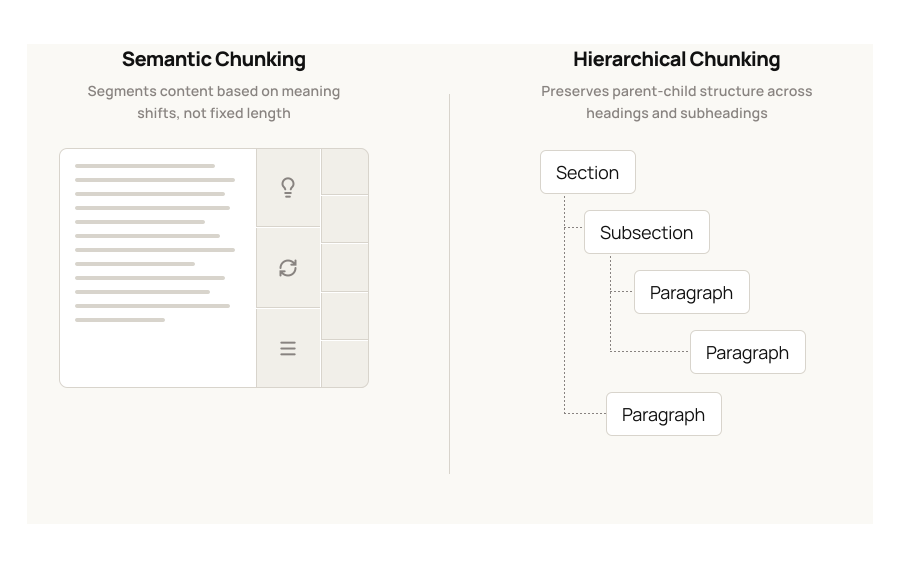
During retrieval, you’ll:
- Fetch leaf chunks for precision
- Expand parent sections only when additional context is required
If you apply recursive re-embedding, you generate embeddings for both leaf chunks and parent nodes. This allows retrieval to operate at multiple structural levels instead of a single flat index.
3. Multi-vector retrieval
You apply this technique when there’s a need to preserve fine-grained matching in long, structurally dense documents. Relevance is computed by late interaction between query and document tokens, rather than a single embedding per chunk.
At query time, you:
- Encode the query into token-level embeddings
- Compute token-to-token similarity across stored document vectors
- Aggregate the strongest matches into a final relevance score
- Rank documents using this late-interaction score
Only the highest-scoring results are then forwarded into re-ranking and context compression.
4. Query optimization
Raw user queries are rarely retrieval-ready. Many are vague, unspecified, overloaded, or written in business language that doesn’t match how your documents are structured. When you send these queries directly into retrieval, recall collapses before ranking even begins.
Query optimization helps you insert a processing layer ahead of retrieval using three strategies:
- Hypothetical document generation (HyDE): Generate a short, synthetic answer to the user’s question using the language model. Then embed that synthetic answer and use it as the retrieval query instead of the raw input.
- Controlled query expansion: Here, variants, such as synonyms, domain-specific terminology, and ontology mappings, run as parallel retrieval probes, and you merge their results before ranking.
- Query rewriting: Normalize the user’s input into a cleaner, more explicit version. Remove ambiguity, resolve shorthand, and restate the intent in retrieval-friendly terms.
5. Metadata filtering and faceted retrieval
Pure vector search treats every document as equal unless you explicitly constrain it. In enterprise datasets, that assumption fails pretty quickly, fetching you technically relevant matches from operationally invalid sources.
You prevent this by attaching structured metadata to every document at ingestion time.
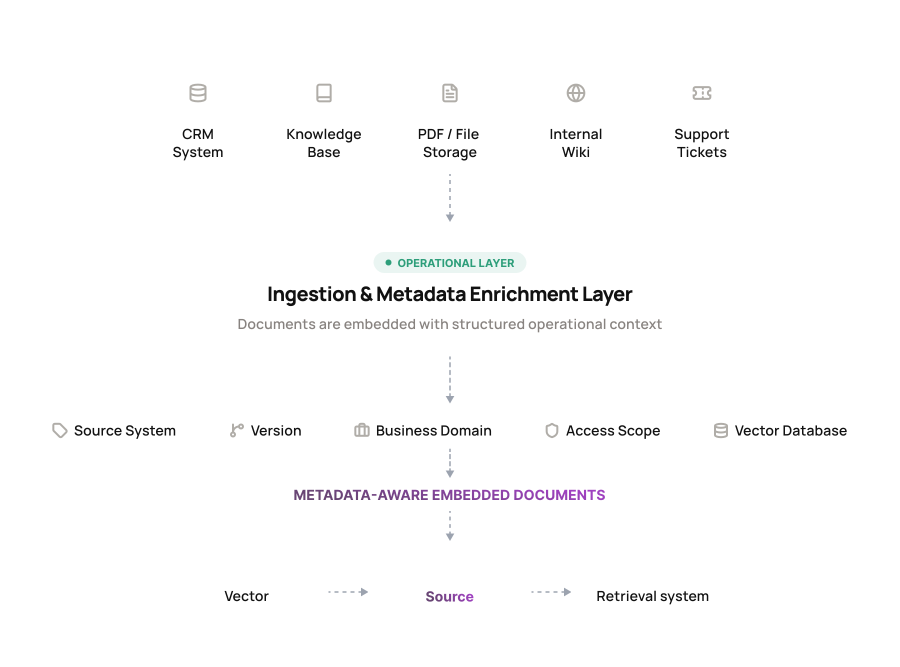
This enables you to apply deterministic filters before or during vector search, restricting retrieval to:
- Valid time ranges
- Approved document classes
- Permitted access domains
You then allow users or upstream agents to operate through facets that expose controlled dimensions such as document type, region, or policy category without expanding the entire search surface.
If your system supports hybrid filtering, you combine:
- Structured filters for rigid operational boundaries
- Vector similarity for semantic relevance
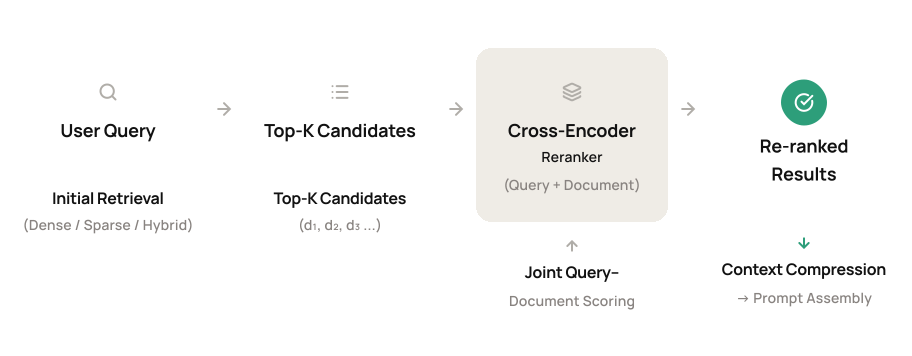
6. Cross-encoder re-ranking
Dense and hybrid retrieval methods optimize for speed and recall. However, the top results often include near-misses that appear relevant at a distance but fail under close inspection. When those near-misses enter the context window, answer quality degrades.
You correct this by placing the reranker immediately after the initial retrieval stage.
This way, you retrieve a broad top-K candidate set from dense, sparse, or hybrid search, pair each candidate with the whole query, and run the pairs through a cross-encoder model to generate direct relevance scores.
Only the re-ranked top results proceed to context compression and prompt assembly.
7. Context compression and distillation
As retrieval quality improves, the amount of context you pass to the model increases. Meaning: more documents, longer passages, and more overlap. This drives up token usage and still doesn’t guarantee precision. So how do you fix it?
By placing a compression stage between re-ranking and prompt assembly.
Start by pruning redundancy. You remove overlapping passages that restate the same facts across multiple documents. Next, you distill the remaining content:
- Pass each candidate through a compression model or LLM prompt that extracts only query-relevant statements
- Drop descriptive padding, preambles, and unrelated sections
- Preserve references, numerical values, clauses, and operational conditions
For larger document groups, apply hierarchical summarization. Summarize at the section level first, then merge those summaries into a compact final context block.
You enforce complex token budgets at this stage. Compression adapts to the available budget rather than letting context expand unchecked.
8. Corrective RAG, Self-RAG, and agentic RAG
Even with strong retrieval, ranking, and compression, generation can still drift. Models can over-generalize, mis-attribute sources, or fill gaps with fluent guesses. In enterprise systems, these failures go unnoticed because the output sounds confident.
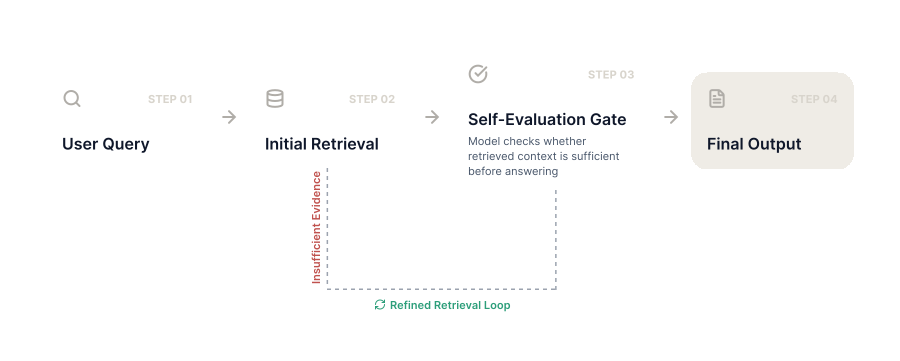
Add a verification layer after generation with corrective and self-evaluating agentic RAG systems. After the model produces an answer:
- Run a validation pass that checks whether the retrieved context supports each factual claim
- If a claim lacks support, trigger a corrective retrieval focused on that specific gap
- Regenerate only the unsupported portion using the new evidence
- Repeat this loop until all critical claims are grounded, or a termination condition is met
With Self-RAG, the model evaluates its own retrieval sufficiency before answering. It decides whether it has enough evidence to proceed or whether it must fetch more context first.
With Agentic RAG, you assign explicit roles inside this loop:
- A retrieval agent that fetches evidence
- A generation agent that drafts the answer
- A verification agent that audits all claims
Each role runs within tight bounds, so verification remains deterministic rather than exploratory.
Operational Impact Summary: Advanced RAG Techniques
| Technique | Operational Impact |
|---|---|
| Hybrid Retrieval | Preserves exact identifiers and prevents semantic search from suppressing mission-critical matches |
| Semantic and Hierarchical Chunking | Restores legal, technical, and procedural boundaries for clause-level accuracy and audit traceability |
| Multi-Vector Retrieval | Recovers localized relevance inside dense technical content where single embeddings lose signal |
| Query Optimization | Converts vague user intent into retrieval-ready queries for stable recall under real usage |
| Metadata Filtering and Facets | Enforces access control and operational validity before retrieval noise can enter the system |
| Cross-Encoder Reranking | Eliminates near-miss candidates before prompt assembly to raise final answer precision |
| Context Compression and Distillation | Forces predictive control over token usage, latency, and redundancy |
| Corrective, Self and Agentic RAG | Enforces evidence-backed generation and exposes unsupported claims before delivery |
How to Evaluate RAG Performance (RAGAS Framework)
Key metrics to track:
- Accuracy: Percentage of questions answered correctly against a ground-truth set
- Retrieval precision / recall: Standard IR metrics on the retrieved chunk set
- ROUGE / BLEU: N-gram overlap between generated and reference answers
- Faithfulness (RAGAS): Fraction of answer claims traceable to retrieved context
- Context relevance (RAGAS): Fraction of retrieved context actually relevant to the query
- End-to-end latency: Time from query to response; critical for production SLAs
How Intuz Helps Implement Advanced RAG in Production
Now that we have all the primary RAG techniques out of the way, the next step is to find a technology partner that can help you implement them. The good news is Intuz has the necessary expertise in this area.
You work with us under an outcome-first delivery model, aligning on a concrete goal at the start, such as deploying a production RAG system, reducing inference cost, or passing an internal security review.
Your RAG system is built directly inside your cloud, your repositories, and your security perimeter. Our team operates under your IAM policies and SSO.
Data never moves into external tenancies. This arrangement keeps your IP, embeddings, and retrieval pipelines fully contained inside your compliance boundary from day one.
Work is delivered from ISO 27001–audited facilities. GDPR-compliant DPAs, encrypted devices with MFA, and enterprise cyber-liability insurance are part of the engagement baseline, which shortens approval cycles and reduces the load on your internal infosec team.
You also avoid vendor lock-in at the RAG layer with us. Open-source frameworks are used by default. Proprietary logic is committed to your repository under your license. Your team can extend, maintain, or re-platform the system without dependency on closed tooling.
Real-World Implementation: Pharma Case Study
Want proof? Check out how Intuz helped a leading pharmaceutical company deploy Generative AI with RAG to turn complex research papers into clear, actionable insights.
Challenge:
A pharmaceutical company needed to extract structured clinical insights from thousands of research papers, each with dense domain-specific terminology, complex tables, and multi-section logical dependencies.
Solution:
Intuz implemented a RAG pipeline using semantic chunking (to preserve clinical reasoning units), hybrid retrieval (to match both exact drug names and semantic descriptions), and a re-ranking layer tuned on clinical document pairs. Metadata filtering constrained retrieval to peer-reviewed sources within relevant therapeutic areas.
Result:
Researchers received grounded, cited summaries with source traceability — reducing literature review time by over 60%.
Next steps?
Book a free consultation with Intuz. Walk away with a practical architecture direction and an implementation roadmap tied to your production requirements.
FAQs
What Are Advanced Indexing Techniques for RAG Retrieval?
Advanced indexing uses ANN like HNSW or FAISS for rapid retrieval from large datasets by approximating nearest neighbors, reducing computation while maintaining speed. Hierarchical indexing organizes data into sub-indexes by category for targeted retrieval, boosting relevance by 20-30% in benchmarks.
How Does Re-Ranking Improve RAG Accuracy?
Re-ranking applies cross-encoder models post-initial retrieval to score query-document pairs jointly via transformer attention, prioritizing top candidates. Studies show 67% reduction in retrieval failures when combined with contextual retrieval, as validated on Finance Bench.
What Chunking Methods Optimize RAG Performance?
Chunking splits documents into sentences, paragraphs, or fixed tokens; paragraph-level balances context and precision, improving recall by 15-25% per LangChain evals. Optimal size determined via precision-recall testing on domain data.
How to Implement Hybrid Retrieval in Advanced RAG?
Hybrid fuses sparse (BM25 for keywords) and dense (DPR embeddings for semantics), reranking via reciprocal scores. Pinecone benchmarks confirm 30% relevance gains for complex queries.
What Metrics Evaluate Advanced RAG Systems?
Key metrics: accuracy for response correctness, precision/recall for retrieval, ROUGE/BLEU for generation quality, plus latency. RAGAS framework tracks end-to-end via faithfulness and context relevance.
How does Intuz implement advanced RAG for enterprises?
Intuz builds RAG systems inside your own cloud infrastructure under an outcome-first model. Engagements align on a concrete production goal (e.g., deploy a RAG system, reduce inference cost, pass a security review), operate under your IAM and SSO policies, and are delivered from ISO 27001–audited facilities with GDPR-compliant DPAs. All code is delivered into your repository with no vendor lock-in.
What tools are used to implement advanced RAG?
LangChain and LlamaIndex for orchestration; Pinecone, Weaviate, Qdrant, and PGVector for vector storage; FAISS and HNSW for indexing; Cohere Rerank and ColBERT for re-ranking; RAGAS for evaluation; LangGraph and AutoGen for Agentic RAG.
Work with Intuz
Build RAG for Your Enterprise
Get an expert consultation of your AI retrieval pipeline.
Let's Get Started
Share this article