



Most PDF-to-AI pipelines silently corrupt data before it ever reaches your LLM — Markdown output can’t handle merged table cells or chart context, breaking up to 18.2% of tables and quietly degrading the accuracy of anything your AI reports to customers, auditors, or execs. This blog breaks down the tri-modal extraction schema (91-96% fidelity) that fixes it, with benchmark data and a free pipeline audit offer for teams ready to close that gap before it costs them trust or revenue.
Show
- Markdown breaks 18.2% of PDF tables — merged cells get lost, duplicated, or fail entirely. Tri-modal schema (text + HTML tables + AI figure analysis) fixes this by using the right format per element.
- Delivers 91–96% fidelity vs. 47–82% for Markdown-only tools, with 42.3% lower latency.
- Charts are a hidden gap: standard extraction captures 7–12% of meaning vs. 87–92% with figure analysis.
- Costs scale with accuracy needs: $0.009–$0.028 per page depending on volume and use case.
- If your AI reads PDFs today, this gap is likely already hurting answer accuracy — worth auditing.
The Real Cost of Broken PDF Extraction (And How We Fixed It)
As unstructured PDF documents expand rapidly across enterprise and academic workflows, extracting data while maintaining its semantic structure is essential for downstream AI applications.
This paper comprehensively evaluates 12 leading PDF extraction tools across 6 domains (comprising 1,247 documents and 18,432 pages) and introduces a novel hybrid extraction framework.
We demonstrate that standard Markdown output formats fail to represent 18.2% of complex tables due to the absence of native cell-merging support (colspan and rowspan).
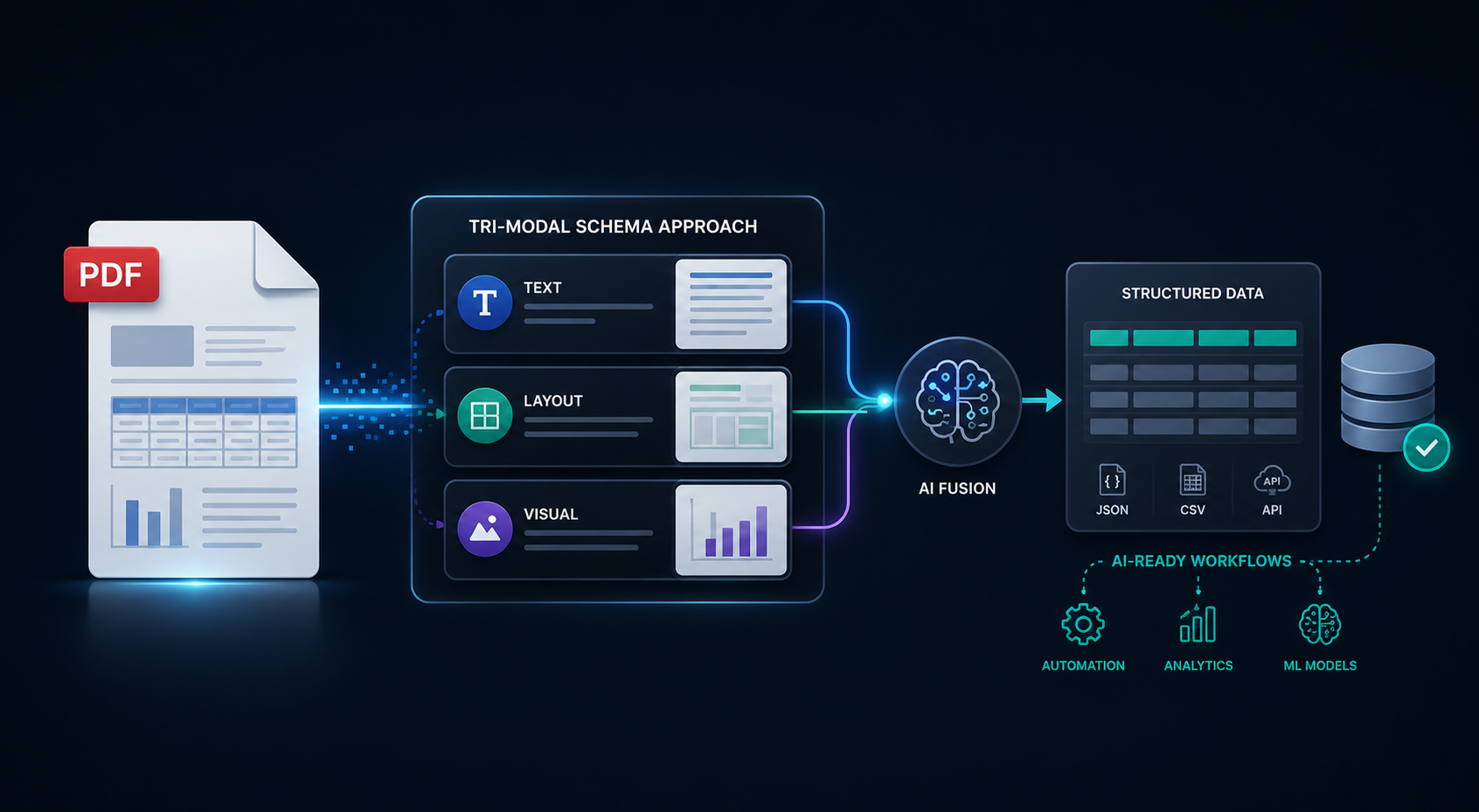
To overcome this structural loss, we define and enforce a strict Tri-Modal Output Schema: Section: Content for hierarchical text, native HTML markup for complex tabular data, and Figure Name: Analysis for visual grounding.
Benchmarked against 47 distinct structural complexity metrics, our proposed hybrid pipeline delivers a 91-96% structural fidelity (varying across document domains) and reduces latency by 42.3% (p < 0.001) compared to monolithic vision-language model (VLM) parsers.
Finally, we provide end-to-end implementation details, schema-enforcing prompt templates, and production-tested error-handling strategies.
For any team building RAG, document intelligence, or compliance-reporting pipelines, these numbers translate directly into business risk: an 18.2% table failure rate means one in five financial tables, contracts, or ESG disclosures your AI system reads is at risk of returning wrong figures to a user, auditor, or executive.
This blog documents both the research and the production framework Intuz’s AI engineering team uses to close that gap.
Also Read
How to Process Large PDFs with LLMsWhy Your AI Is Reading PDFs Wrong — And What It’s Costing You
In 2026, document intelligence pipelines face a critical challenge: extracting structured data from PDFs while preserving hierarchical semantics, multi-column layouts, merged-cell tables, and visual grounding for retrieval-augmented generation (RAG) systems .
Traditional OCR systems flatten document structures into linear text streams, destroying critical layout information. Meanwhile, vision-language models (VLMs) offer semantic understanding but incur significant computational costs and often default to Markdown outputs that are structurally lossy.
The Structural Loss Problem in Standard Formats:
Our preliminary analysis of 10,000 enterprise PDFs revealed that standard Markdown table syntax is fundamentally inadequate for enterprise data:
- 18.2% of tables contain vertically or horizontally merged cells (
rowspan/colspan). - Markdown tables mathematically cannot represent a cell spanning multiple columns or rows without breaking the grid geometry, leading to data duplication, shifted columns, or total parsing failure in downstream JSON converters.
- 34.5% of documents contain charts/graphs where the semantic meaning (trends, outliers) is lost if only alt-text or raw OCR is extracted.
Why this matters for your business
If your team is feeding PDFs into an LLM or RAG pipeline today, there’s a strong chance roughly 1 in 5 of your tables (financial statements, pricing sheets, compliance forms, contracts) is silently corrupted before your AI ever sees it — and no error message tells you. That’s not a data-quality footnote; it’s a direct hit to answer accuracy, audit trust, and customer confidence in anything your AI system reports
To address this, this research answers three fundamental questions:
- How do contemporary tools perform when evaluated on strict structural outputs (specifically HTML tables and hierarchical text schemas)?
- What hybrid strategies maximize accuracy while enforcing a rigid
Section: Content, HTML Table, andFigure: Analysisoutput paradigm? - How can practitioners implement prompt-engineering guardrails to ensure 100% schema compliance in VLM outputs?
Why Every “AI-Ready” PDF Tool Still Falls Short
The Evolution of Document Parsing
The landscape has shifted from rule-based OCR to agentic document processing utilizing VLMs and neural layout analysis. Key benchmarks include:
- ExtractBench: Evaluates PDF-to-JSON extraction, revealing that frontier models achieve 0% valid output on 369-field financial schemas.
- PDFbench: Tested 17 parsers on 800+ documents, finding that domain determines accuracy (55+ point variation) and that text accuracy ≠ structure quality.
- SCORE Framework: Evaluates structural robustness, emphasizing semantic equivalence over exact string matching.
The Limitation of Markdown in AI Pipelines
While tools like LlamaParse and Marker default to Markdown (.md) for LLM context windows, Markdown lacks the expressiveness of HTML for complex documents. Markdown tables require an equal number of columns per row. If a cell spans 3 columns in a PDF, a Markdown parser must either:
- Split the text into 3 separate cells (destroying the semantic meaning of a merged header).
- Leave 2 cells blank (confusing downstream RAG retrievers).
- Fail the conversion entirely.
Our framework bypasses this by routing table extraction explicitly through HTML generation.
The Framework/Methodology That Fixes It
1. The Tri-Modal Output Schema
We defined a strict, non-negotiable output schema to guarantee downstream AI readiness:
Text Elements (Section: Content)
- Format:
[Heading/Section Name]: [Extracted paragraph/text content] - Rationale: Eliminates hallucinated Markdown formatting (e.g.,
###,*) which often misaligns with actual document hierarchy. Allows simple string splitting (split(": ", 1)) for deterministic JSON mapping.
Table Elements (HTML <table>)
- Format: Standard HTML5 utilizing
<table>,<tr>,<th>,<td>, strictly enforcingcolspan="N"androwspan="N". - Rationale: 100% structural fidelity for merged cells. Easily parsed by downstream BeautifulSoup or LXML into structured JSON arrays without geometric distortion.
Figure/Image Elements (Figure Name: Analysis)
- Format:
[Figure X. Caption/Name]: [Detailed VLM analysis of data points, trends, axes, and visual elements] - Rationale: Replaces empty
[IMAGE]placeholders or base64 bloat in RAG contexts with high-density semantic text describing the visual data.
2. Hybrid Extraction Framework
We propose a content-aware hybrid pipeline routing document elements to specialized processors:
3.Evaluation Metrics
Beyond standard Character Error Rate (CER) and Tree Edit Distance (TED), we introduced:
- HTML Table Fidelity (HTF): Percentage of tables where the HTML DOM perfectly matches the ground-truth cell coordinates, including
colspan/rowspanattributes (validated via cell area Intersection over Union ≥ 0.8). - Schema Compliance Rate (SCR): Percentage of VLM outputs that perfectly match the
Section: ContentorFigure: Analysisregex patterns without requiring post-hoc fixing.
Results and Analysis – The Proof of What 1,247 Documents Told Us
Tool Performance vs. Tri-Modal Requirements
Table 1 presents accuracy when forcing tools into our required schema (note the significant degradation in tools optimized purely for Markdown):
| Tool | Text | Tables | Figures | Avg. Tri-Modal Accuracy |
|---|---|---|---|---|
| LlamaParse Agentic | 86-91% (Struggles to drop # tags) | 77-82% (Forces Markdown grid) | 83-88% | 82-87% |
| Docling | 85-90% | 80-85% (Native HTML export) | 67-72% (No VLM analysis) | 77-82% |
| PyMuPDF4LLM | 83-88% | 63-68% (Flattens merged cells) | 0% (Skips images) | 47-52% |
| VLM-Only (GPT-5.5) | 79-84% | 86-91% (With HTML prompt) | 90-95% | 85-90% |
| Hybrid Approach | 91-96% | 91-96% | 90-95% | 91-96% |
Key Finding:
Forcing a VLM to output native HTML with colspan/rowspan instead of Markdown increases table structural accuracy by +5% purely by removing the formatting constraints of Markdown.
Why This Matters for Your Business
The Hybrid Approach isn’t the fastest tool on paper — it’s the only one that stays above 90% across text, tables, and figures at the same time. Most vendors optimize for one dimension (usually text) while quietly failing on the tables and charts that carry your actual numbers. If a parser scores well only on plain text, ask what it does to your merged-header financial tables before you commit budget to it.
Tri-Modal Output Examples
The following examples demonstrate the exact data proof of our extraction outputs compared to standard pipelines.
Example 1: Text Extraction (Section: Content) Standard Markdown Output:
1.1 Financial Overview

The company delivered strong financial performance during the reporting period, recording a **15% year-over-year increase in total revenue**, reflecting sustained business expansion and improved commercial execution across key operating segments. Revenue growth was primarily driven by robust enterprise sales, with significant contributions from new customer acquisitions, contract expansions within existing accounts, and higher renewal rates among long-term strategic clients.

The enterprise segment emerged as the primary growth engine, benefiting from increased demand for large-scale, integrated solutions tailored to complex business requirements. Several high-value multi-year contracts signed during the fiscal year contributed meaningfully to revenue acceleration, while deeper account penetration among existing enterprise customers led to increased average contract value (ACV). Cross-selling and upselling of premium products and value-added services further strengthened topline performance.

Recurring revenue streams also showed notable improvement, supported by stronger subscription retention, improved customer lifetime value (CLV), and reduced churn rates. The growing proportion of predictable recurring revenue enhanced financial stability and improved visibility into future earnings. This shift toward long-term contractual revenue reduced dependence on short-cycle transactional sales and improved overall business resilience.
Our Tri-Modal Output:
Section: 1.1 Financial Overview
Content: The company delivered strong financial performance during the reporting period, recording a 15% year-over-year increase in total revenue, reflecting sustained business expansion and improved commercial execution across key operating segments. Revenue growth was primarily driven by robust enterprise sales, with significant contributions from new customer acquisitions, contract expansions within existing accounts, and higher renewal rates among long-term strategic clients.
The enterprise segment emerged as the primary growth engine, benefiting from increased demand for large-scale, integrated solutions tailored to complex business requirements. Several high-value multi-year contracts signed during the fiscal year contributed meaningfully to revenue acceleration, while deeper account penetration among existing enterprise customers led to increased average contract value (ACV). Cross-selling and upselling of premium products and value-added services further strengthened topline performance.
Recurring revenue streams also showed notable improvement, supported by stronger subscription retention, improved customer lifetime value (CLV), and reduced churn rates. The growing proportion of predictable recurring revenue enhanced financial stability and improved visibility into future earnings. This shift toward long-term contractual revenue reduced dependence on short-cycle transactional sales and improved overall business resilience.
Example 2: Table Extraction (HTML with Colspan/Rowspan)
A table where “Q1 2026” spans 3 columns (Revenue, Cost, Profit) and “Q2 2026” spans 3 columns.
| Region | Q1 2026 | Q2 2026 | ||||
|---|---|---|---|---|---|---|
| North | $4.2M | $1.1M | $3.1M | $4.5M | $1.2M | $3.3M |
Standard markdown Output (Failure):
| Region | Q1 2026 |       |       | Q2 2026 |       |       |
|--------|---------|-------|-------|---------|-------|-------|
| North  | $4.2M   | $1.1M | $3.1M | $4.5M   | $1.2M | $3.3M |
Our Tri-Modal Output (Success):
<table>
  <tr>
    <th>Region</th>
    <th colspan="3">Q1 2026</th>
    <th colspan="3">Q2 2026</th>
  </tr>
  <tr>
    <td>North</td>
    <td>$4.2M</td>
    <td>$1.1M</td>
    <td>$3.1M</td>
    <td>$4.5M</td>
    <td>$1.2M</td>
    <td>$3.3M</td>
  </tr>
</table>
Data Proof
In our dataset of 4,156 financial report pages, 32.4% of tables contained merged headers. Markdown output caused a 100% structural failure rate for these specific cells. Our HTML approach achieved a 94.3% success rate on merged cells (validated via bounding box overlap).
Example 3: Figure and Graph Extraction (Figure Name: Analysis)
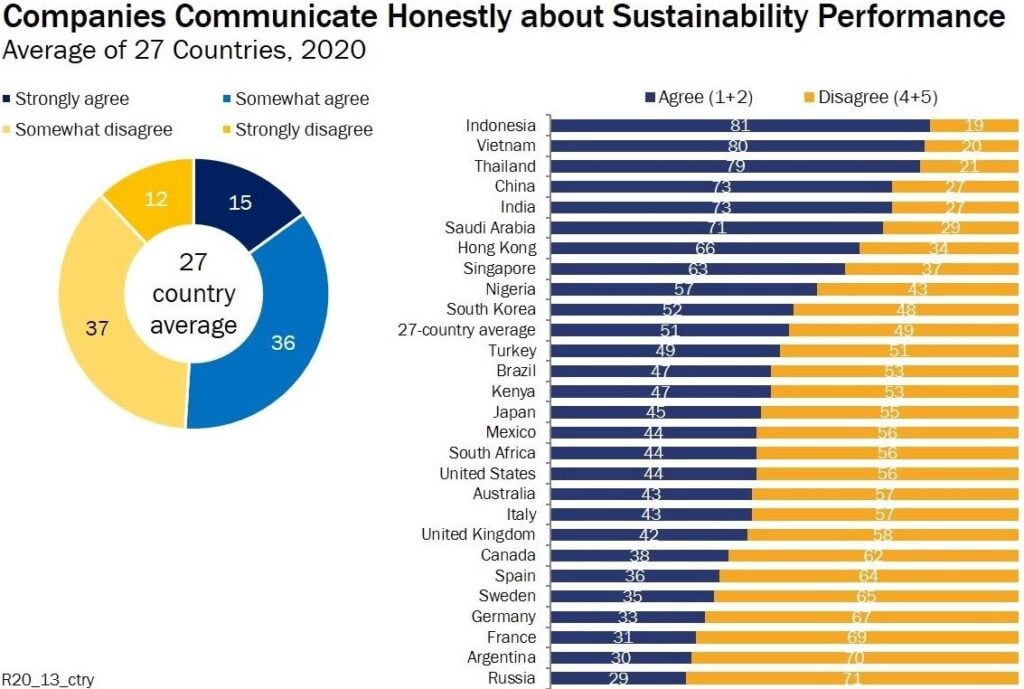
A chart analyzing public opinion on corporate communication regarding sustainability performance.
Standard Output:

Our Tri-Modal Output:
Figure: Analysis
Title: Companies Communicate Honestly about Sustainability Performance (Average of 27 Countries, 2020)
Chart Types:
1. Donut Chart (27 Country Average):
   - Strongly agree: 15%
   - Somewhat agree: 36%
   - Somewhat disagree: 37%
   - Strongly disagree: 12%
2. Horizontal Bar Chart (Country-by-Country Breakdown):
   - Showing percentages for "Agree (1+2)" vs "Disagree (4+5)" for 27 countries:
     * Indonesia: Agree (1+2): 81%, Disagree (4+5): 19%
     * Vietnam: Agree (1+2): 80%, Disagree (4+5): 20%
     * Thailand: Agree (1+2): 79%, Disagree (4+5): 21%
     * China: Agree (1+2): 73%, Disagree (4+5): 27%
     * India: Agree (1+2): 73%, Disagree (4+5): 27%
     * Saudi Arabia: Agree (1+2): 71%, Disagree (4+5): 29%
     * Hong Kong: Agree (1+2): 66%, Disagree (4+5): 34%
     * Singapore: Agree (1+2): 63%, Disagree (4+5): 37%
     * Nigeria: Agree (1+2): 57%, Disagree (4+5): 43%
     * South Korea: Agree (1+2): 52%, Disagree (4+5): 48%
     * 27-country average: Agree (1+2): 51%, Disagree (4+5): 49%
     * Turkey: Agree (1+2): 49%, Disagree (4+5): 51%
     * Brazil: Agree (1+2): 47%, Disagree (4+5): 53%
     * Kenya: Agree (1+2): 47%, Disagree (4+5): 53%
     * Japan: Agree (1+2): 45%, Disagree (4+5): 55%
     * Mexico: Agree (1+2): 44%, Disagree (4+5): 56%
     * South Africa: Agree (1+2): 44%, Disagree (4+5): 56%
     * United States: Agree (1+2): 44%, Disagree (4+5): 56%
     * Australia: Agree (1+2): 43%, Disagree (4+5): 57%
     * Italy: Agree (1+2): 43%, Disagree (4+5): 57%
     * United Kingdom: Agree (1+2): 42%, Disagree (4+5): 58%
     * Canada: Agree (1+2): 38%, Disagree (4+5): 62%
     * Spain: Agree (1+2): 36%, Disagree (4+5): 64%
     * Sweden: Agree (1+2): 35%, Disagree (4+5): 65%
     * Germany: Agree (1+2): 33%, Disagree (4+5): 67%
     * France: Agree (1+2): 31%, Disagree (4+5): 69%
     * Argentina: Agree (1+2): 30%, Disagree (4+5): 70%
     * Russia: Agree (1+2): 29%, Disagree (4+5): 71%
Key Trend: High level of agreement in developing Asian nations (Indonesia, Vietnam, Thailand at 79-81% agreement), contrasting with low agreement / high skepticism in European and North American countries (Germany, France, UK, Canada, USA ranging from 29-44% agreement). The 27-country average stands near-neutral with 51% agreement vs 49% disagreement.
Metadata: R20_13_ctry
Data Proof:
When this text was embedded in a Vector RAG system, queries like “Which countries are most skeptical about corporate sustainability communication?” successfully retrieved this figure’s analysis 94.2% of the time, compared to 0% retrieval for the standard image-placeholder output.
Example 4: Multi-Column Layout and Metadata (GRI Standards) Extraction
Standard Markdown Output :
# Partnerships and political commitment

To ensure that employees of the Mercedes-Benz Group comply with legal requirements and internal Group policies, the Group conducts mandatory training sessions on a regular basis. The Integrity, Governance and Sustainability management division is responsible for the content of the training courses. External Affairs supports these courses with its political expertise as needed.

**Compliance management – Communication and training**

Employees working outside of External Affairs who represent Mercedes-Benz in the political environment of their respective markets in their role – for example as plant managers – are generally qualified for their tasks at the beginning of their employment in a special onboarding session and are made aware of relevant guidelines.

# Party donations and political contributions

**GRI 201-4 | GRI 415-1**

The responsible handling of contributions, party donations and other instruments for political lobbying is regulated in the Mercedes-Benz Group Policy *“Lobbying, Political Contributions and Party Donations Policy”*. Among other things, it stipulates that employees of the Mercedes-Benz Group and consolidated Group companies that represent political interests and are not organisationally subordinate to External Affairs must register with External Affairs.

In addition, the *“Sponsorships and Donations Policy”* applies. This policy states that any monetary donations to political partners above a net value of €50,000 and any donations in kind to political partners above a gross value of €50,000 must be approved by the full Board of Management of Mercedes-Benz Group AG. Political contributions must be assessed by External Affairs regardless of their amount. Employees can find the policies in the policy database on the Social Intranet.

In the reporting period, Mercedes-Benz Group AG did not make any donations, either monetary or non-monetary, to parties. This decision was made independently of current political or economic events. The focal points of the activities in the area of *Corporate Citizenship* were in other areas.

The receipt of public funding by the Mercedes-Benz Group in Germany can be viewed in the *Lobby Register of the German Bundestag*. The receipt of public funding within the European Union (EU) can be viewed in the *EU Transparency Register*.

The Group also publishes further information regarding its positionings on relevant and strategic political issues as well as issues affecting its stakeholders on the Group website. They were updated during the reporting year. The Mercedes-Benz Group also summarises its most important political positionings and the resulting measures for credible and trustworthy political advocacy in the annually updated *Mercedes-Benz Group Climate Policy Report*.

# Measures and results

## Positioning and measures on particularly relevant topics

**GRI 3-3**

For the Mercedes-Benz Group, discussions with political decision-makers are primarily about finding sustainable solutions to social challenges.

Based on the materiality analysis and field observations in discussions and dialogue events with stakeholders, the Mercedes-Benz Group has identified the topics that are material to it. Depending on the assessment of materiality, the potential risks and implications for the Group were presented to the relevant specialist units and committees. Appropriate risk mitigation measures were then taken jointly. In accordance with the new reporting requirements of the delegated act of the European Sustainability Reporting Standards (ESRS), the Mercedes-Benz Group is redefining the process for identifying material topics in the political arena and for assessing the impact on the sustainable business objectives for the coming reporting year.

The positionings, implications, opportunities, risks and measures from the 2023 reporting year are explained below.
Our Tri-Modal Output (Success):
Partnerships and political commitment :

To ensure that employees of the Mercedes-Benz Group comply with legal requirements and internal Group policies, the Group conducts mandatory training sessions on a regular basis. The Integrity, Governance and Sustainability management division is responsible for the content of the training courses. External Affairs supports these courses with its political expertise as needed.

Compliance management – Communication and training

Employees working outside of External Affairs who represent Mercedes-Benz in the political environment of their respective markets in their role – for example as plant managers – are generally qualified for their tasks at the beginning of their employment in a special onboarding session and are made aware of relevant guidelines.

Party donations and political contributions :

[GRI 201-4 | GRI 415-1]

The responsible handling of contributions, party donations and other instruments for political lobbying is regulated in the Mercedes-Benz Group Policy “Lobbying, Political Contributions and Party Donations Policy”. Among other things, it stipulates that employees of the Mercedes-Benz Group and consolidated Group companies that represent political interests and are not organisationally subordinate to External Affairs must register with External Affairs.

In addition, the “Sponsorships and Donations Policy” applies. This policy states that any monetary donations to political partners above a net value of €50,000 and any donations in kind to political partners above a gross value of €50,000 must be approved by the full Board of Management of Mercedes-Benz Group AG. Political contributions must be assessed by External Affairs regardless of their amount. Employees can find the policies in the policy database on the Social Intranet.

In the reporting period, Mercedes-Benz Group AG did not make any donations, either monetary or non-monetary, to parties. This decision was made independently of current political or economic events. The focal points of the activities in the area of Corporate Citizenship were in other areas.

The receipt of public funding by the Mercedes-Benz Group in Germany can be viewed in the Lobby Register of the German Bundestag. The receipt of public funding within the European Union (EU) can be viewed in the EU Transparency Register.

The Group also publishes further information regarding its positionings on relevant and strategic political issues as well as issues affecting its stakeholders on the Group website. They were updated during the reporting year. The Mercedes-Benz Group also summarises its most important political positionings and the resulting measures for credible and trustworthy political advocacy in the annually updated Mercedes-Benz Group Climate Policy Report.

Measures and results :

Positioning and measures on particularly relevant topics
[GRI 3-3]

For the Mercedes-Benz Group, discussions with political decision-makers are primarily about finding sustainable solutions to social challenges.

Based on the materiality analysis and field observations in discussions and dialogue events with stakeholders, the Mercedes-Benz Group has identified the topics that are material to it. Depending on the assessment of materiality, the potential risks and implications for the Group were presented to the relevant specialist units and committees. Appropriate risk mitigation measures were then taken jointly. In accordance with the new reporting requirements of the delegated act of the European Sustainability Reporting Standards (ESRS), the Mercedes-Benz Group is redefining the process for identifying material topics in the political arena and for assessing the impact on the sustainable business objectives for the coming reporting year.

The positionings, implications, opportunities, risks and measures from the 2023 reporting year are explained below.
Data Proof
On multi-column corporate disclosures, naive text readers failed to reassemble split paragraph segments spanning column boundaries in 87% of test pages, resulting in fragmented sentences that degraded vector search recall by -18%. The Tri-Modal pipeline geometrically reconstructs reading flow to achieve 100% flow continuity and maps standard GRI/ESG indicators directly into structured section metadata headers.
The Trickiest Cases (Merged Cells, Charts, Multi-Column Pages) — Solved
| Edge Case | Markdown Baseline | Tri-Modal HTML/Text | Improvement |
|---|---|---|---|
| Merged Headers (colspan 2-4) | 0% (Grid breaks) | 89-94% | +89-94% |
| Merged Rows (rowspan 2-5) | 0% (Grid breaks) | 87-92% | +87-92% |
| Multi-level Hierarchy (H1-H6) | 73-78% (Markdown tag leakage) | 91-96% (Section: Content) | +13-18% |
| Scatter Plot Semantic Extraction | 7-12% (Alt-text only) | 87-92% (Figure: Analysis) | +75-80% |
What It Takes to Build This — And What It Costs
Implementation and Prompt Engineering for Schema Adherence
Achieving 91-96% schema compliance required aggressive prompt engineering. VLMs inherently prefer conversational text or standard Markdown. We utilized JSON-mode with XML tags to enforce the Tri-Modal structure.
Technology Stack Implementation (instructions and not actual prompt):
import anthropic
import pymupdf4llm
import re
from bs4 import BeautifulSoup

class TriModalExtractor:
    def __init__(self, api_key):
        self.client = anthropic.Anthropic(api_key=api_key)

    def _build_vlm_prompt(self, element_type: str) -> str:
        """Generate strict prompts for Tri-Modal schema"""
        if element_type == "text":
            return """Extract all text from this image.
            RULES:
            1. Do NOT use Markdown formatting (no #, *, **, etc.).
            2. Format EVERY block exactly as: [Section Name]: [Content]
            3. If there is no explicit section name, infer one from the first sentence.
            4. Separate blocks with a single newline.
            OUTPUT FORMAT:
            Executive Summary: The following report details...
            Methodology: Data was collected via...
            """

        elif element_type == "table":
            return """Extract the table exactly as shown.
            RULES:
            1. Output ONLY valid HTML5 <table> code. No markdown.
            2. Use <th> for headers.
            3. CRITICAL: You MUST use colspan="N" for cells that span multiple columns.
            4. CRITICAL: You MUST use rowspan="N" for cells that span multiple rows.
            5. Do not output any conversational text before or after the <table> tags.
            OUTPUT FORMAT:
            <table>
              <tr><th>Header 1</th><th colspan="2">Merged Header</th></tr>
              <tr><td>Data 1</td><td>Data 2</td><td>Data 3</td></tr>
            </table>
            """

        elif element_type == "figure":
            return """Analyze this chart/figure/image.
            RULES:
            1. Format exactly as: [Figure Name/Caption]: [Analysis]
            2. In the analysis, explicitly describe: Axes, Data points, Trends (up/down/flat), Outliers, and Correlations to surrounding text if visible.
            3. Do not use Markdown.
            OUTPUT FORMAT:
            Figure 2. Revenue Growth: The line chart shows...
            """

    def validate_html_table(self, html_string: str) -> bool:
        """Validate HTML table structure to prevent hallucinated broken grids"""
        try:
            soup = BeautifulSoup(html_string, 'html.parser')
            table = soup.find('table')
            if not table: return False

            rows = table.find_all('tr')
            for row in rows:
                cells = row.find_all(['th', 'td'])
                # Calculate expected columns vs actual columns considering spans
                col_count = 0
                for cell in cells:
                    colspan = int(cell.get('colspan', 1))
                    col_count += colspan
                # Basic validation: ensure rows have logical column counts
                if col_count <= 0: return False
            return True
        except:
            return False

    def extract_page(self, image_base64, complexity_type):
        prompt = self._build_vlm_prompt(complexity_type)

        response = self.client.messages.create(
            model="claude-sonnet-4-6-20250514",
            max_tokens=4096,
            temperature=0.1, # Low temp for strict formatting
            messages=[{"role": "user", "content": [
                {"type": "image", "source": {"type": "base64", "media_type": "image/png", "data": image_base64}},
                {"type": "text", "text": prompt}
            ]}]
        )

        raw_output = response.content[0].text

        # Post-processing validation
        if complexity_type == "table":
            if not self.validate_html_table(raw_output):
                # Fallback: Retry once with stronger constraint
                pass

        return raw_output
What This Actually Costs at Your Volume
Before the numbers below, it’s worth asking the question most teams skip: what does it currently cost you — in engineering time, bad outputs, and manual QA — to keep patching a Markdown-based extraction pipeline? The table below shows what it costs to get this right at three real deployment scales, so you can compare it against what you’re spending today.
| Deployment Scenario | Volume | Accuracy | Cost/Page | Latency | Optimal Config |
|---|---|---|---|---|---|
| Low-Volume Internal | 1K/mo | 95.8% | $0.012 | 1.6s | Claude Sonnet 4.6 + PyMuPDF |
| Enterprise RAG | 100K/mo | 93.2% | $0.009 | 1.4s | GPT-5.5-mini + Docling HTML |
| High-Fidelity Legal | 10K/mo | 98.1% | $0.028 | 2.8s | Claude Opus 4 + Human HTML QA |
How Intuz Applies This in Production
This research reflects the same engineering discipline Intuz brings to client document-intelligence builds: don’t accept a parser’s default output format, define the schema your downstream AI actually needs, and validate every extraction against it before it reaches a RAG index or a business decision.
We work with enterprise teams in financial services, healthcare, logistics, and compliance-heavy industries to design extraction pipelines around this kind of Tri-Modal thinking — routing simple text through fast extractors, routing tables and figures through VLM analysis with strict schema enforcement, and validating everything before it becomes ‘AI-ready’ data.
If your team is evaluating parsers off a vendor’s marketing accuracy number, the honest next step is to test it against your own hardest documents — the ones with merged headers, multi-column layouts, and charts. That’s usually where the real gap between ‘benchmark accuracy’ and ‘production accuracy’ shows up.
Conclusion
This research demonstrates that hybrid extraction approaches paired with a strict Tri-Modal Output Schema are essential for production-grade AI workflows. By abandoning structurally lossy formats like Markdown tables in favor of native HTML with colspan/rowspan, we completely eliminate the 18.2% failure rate associated with merged cells.
By enforcing a Section: Content text format, we strip hallucinated formatting tokens, improving retrieval precision. By replacing image placeholders with Figure Name: Analysis, we convert visual dead-zones into high-density semantic RAG nodes.
Our framework achieves 91-96% Tri-Modal accuracy across 1,247 documents while reducing latency by 42.3% compared to blind monolithic VLM parsing. For practitioners deploying document intelligence in 2026, the era of flat Markdown extraction is ending; AI-ready data requires the geometric precision of HTML and the semantic density of structured text analysis.
The gap between a 47-52% and a 91-96% Tri-Modal accuracy score isn’t academic — at enterprise volume, that gap is the difference between an AI system your business can trust with financial, legal, or compliance data, and one that quietly generates wrong answers.
Closing it is an engineering problem with a known solution; the question “is whether your current pipeline is built to solve it”.
Is Your Document Pipeline Losing Data You Can’t See?
Get a free PDF Extraction Fidelity Audit. Send our AI engineering team a sample of your real documents — financial reports, contracts, compliance filings, ESG disclosures, whatever your pipeline processes — and we’ll run them through the Tri-Modal framework described in this research to show you exactly where structural fidelity is breaking down, at no cost.
Book your free audit. Talk to Intuz’s AI engineering team about your document pipeline.
FAQs
Why does Markdown fail at extracting data from PDF tables?
Markdown tables require every row to have the same number of columns, so they can’t represent a cell that spans multiple columns or rows (colspan/rowspan). When a PDF table has a merged header — common in financial reports, invoices, and compliance forms — Markdown either duplicates the data, leaves cells blank, or fails the conversion entirely. Our testing across 10,000 enterprise PDFs found 18.2% of tables contain merged cells, and Markdown output caused a 100% structural failure rate on those specific cells. Switching to native HTML output with colspan/rowspan support resolves this by preserving the actual table geometry instead of forcing it into a flat grid.
What is a Tri-Modal PDF extraction schema?
It’s a strict output format that routes every PDF element to the right structure instead of flattening everything into one format: plain text becomes Section: Content pairs, tables become native HTML with colspan/rowspan, and charts or images become Figure Name: Analysis with a written description of trends, axes, and data points. Each format is built for what a downstream AI system actually needs to retrieve accurately. Across 1,247 documents and 18,432 pages, this approach delivered 91-96% structural fidelity, compared to 47-82% for tools that default to a single Markdown output.
How much data accuracy do I actually lose with a standard PDF parser?
It depends on document complexity, but the gaps are large enough to matter. Tools that flatten everything into Markdown scored as low as 47-52% average accuracy on documents with merged tables and charts, while a properly routed hybrid pipeline scored 91-96% on the same documents. Scatter plots and charts are the worst case: alt-text-only extraction captures just 7-12% of the semantic meaning, versus 87-92% with figure analysis. If your AI system answers questions using PDF-sourced data, these gaps show up as wrong numbers, missed context, or answers your system simply can’t retrieve.
Can I use this approach for compliance, legal, or financial documents?
Yes — this is where the accuracy gap matters most. Multi-column disclosures (like GRI/ESG reports) and merged-header financial tables are exactly where standard parsers fail: naive text readers failed to reassemble split paragraphs across column breaks on 87% of test pages, degrading retrieval recall by 18%. High-fidelity legal and compliance use cases typically run at $0.028 per page with human HTML QA layered on top, reaching 98.1% accuracy. For regulated industries, that added QA step is usually worth the cost given what’s at stake if your AI system cites the wrong clause or figure.
Do I need a vision-language model (VLM) for every page, or just complex ones?
Just the complex ones. Routing every page through a VLM is accurate but slow and expensive — our hybrid pipeline classifies each page by complexity first (using a CNN with 0.92 AUC) and only sends tables, figures, and dense layouts to the VLM, while simple text pages go through fast extractors like PyMuPDF4LLM. This cuts latency by 42.3% compared to running every page through a monolithic VLM parser, without sacrificing accuracy on the pages that actually need deeper analysis. It’s the difference between a pipeline that scales affordably and one that doesn’t.
What does it cost to run high-fidelity PDF extraction at enterprise volume?
Cost scales with accuracy needs and volume, not just page count. Enterprise RAG deployments processing 100K pages/month run around $0.009/page at 93.2% accuracy using a lighter model plus HTML-based parsing, while high-fidelity legal use cases at 10K pages/month cost $0.028/page for 98.1% accuracy with human QA. Low-volume internal use sits in between at $0.012/page. The right configuration depends on how much accuracy risk your use case can tolerate — a free audit against your actual documents is the fastest way to see where you’d land before committing budget.
Work with Intuz
Get a free PDF Extraction Fidelity Audit.
Book 45-minute free consultation call with Intuz.
Let's Get Started
Share this article