



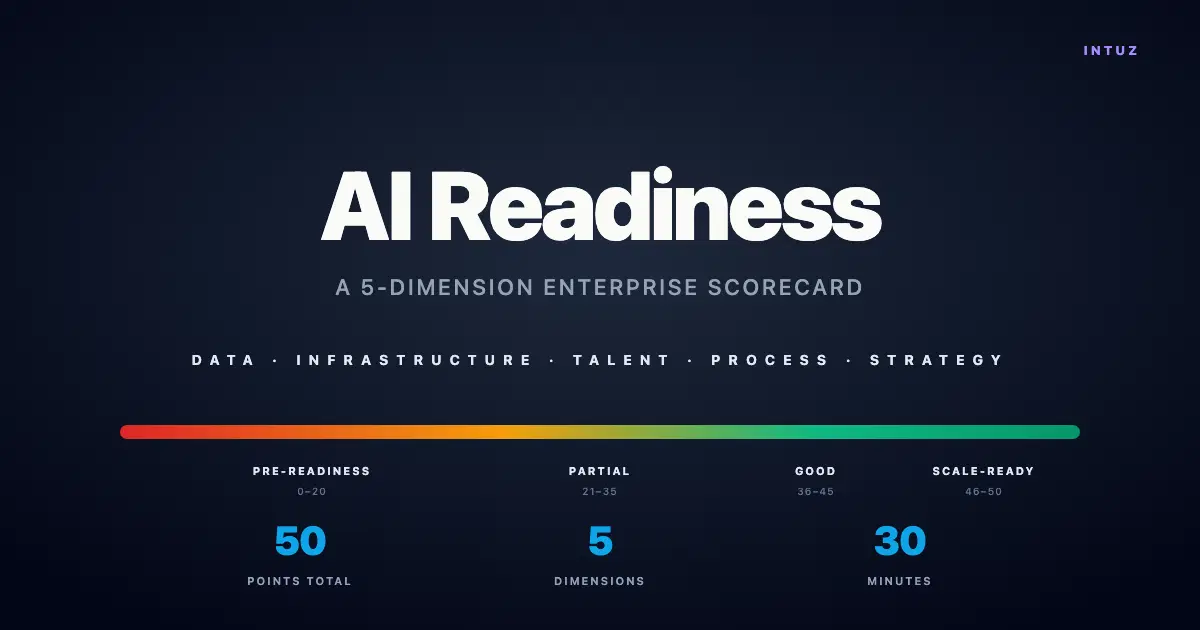
Score your data, infrastructure, talent, process, and strategy with this structured 2026 assessment guide.
Every week, another executive announces an AI initiative. Every quarter, another survey shows that 70% of enterprise AI projects fail to reach production.
The gap between launching an AI project and generating measurable business value isn’t a technology gap. It’s a readiness gap.
An AI readiness assessment scores your organization across five dimensions before you commit to a budget. It answers the one question that matters most before any AI initiative: Are you ready to ship—or do you need to fix gaps first?
Show
- An AI readiness assessment scores your organization across five dimensions — data, infrastructure, talent, process, and strategy — before you commit budget, answering whether you’re ready to ship or need to fix gaps first.
- Around 70% of enterprise AI projects fail to reach production, and the gap is a readiness gap, not a technology gap.
- Most mid-market enterprises score between 22 and 38 out of 50 on their first assessment; a score below 30 is a roadmap, not a blocker.
- The five most common mid-market gaps are: data exists but isn’t AI-accessible, the use case is too broad, no one owns the AI output, on-prem infrastructure with no upgrade path, and pilot success confused with production readiness.
- Organizations that consistently move AI from pilot to production share three traits: a named executive sponsor, a defined success metric tied to a business outcome, and at least one internal AI champion.
Score interpretation
| Score | Readiness Level | What It Means |
|---|---|---|
| 0–20 | Pre-readiness | Foundation work needed before any AI spend |
| 21–35 | Partial readiness | Pilots are viable; production needs deliberate planning |
| 36–45 | Good readiness | AI initiatives can move to production with proper support |
| 46–50 | High readiness | Scaled, multi-system AI deployment is achievable |
Most mid-market enterprises score between 22 and 38 on their first assessment. A score below 30 is a roadmap, not a blocker — it tells you exactly where to invest preparation before writing the first line of code.
Mature vs immature: what each readiness dimension looks like
| Dimension | Mature org (8+/10) | Immature org (<4/10) |
|---|---|---|
| Data | Structured, labeled, programmatically accessible via an active pipeline. | Trapped in PDFs/spreadsheets/legacy CRMs, manual extraction for every query |
| Infrastructure | Cloud-native, GPU-ready, vector DB provisioned(Pinecone/Weaviate/pgvector), staging environment. | On-prem, no GPU access, no vector DB plan, no isolated test environment |
| Talent | Internal AI champion + ML literacy + can evaluate vendor outputs. | No one understands AI well enough to scope problems or judge model quality |
| Process | Target processes documented, baseline metrics measured, feedback loops + human handoffs mapped. | Processes inconsistent or undocumented; AI would amplify the inconsistency |
| Strategic | Named exec sponsor, specific business outcome, 12+ month budget, change management ready. | “We want to use AI” with no defined outcome, no sponsor, no change-management plan |
If you can’t claim “mature” for at least 3 of the 5, your first investment is the assessment — not the model.
What is AI readiness?
AI readiness measures how prepared an organization is, technically, operationally, and culturally, to deploy and scale AI. Readiness exists on a spectrum, and different parts of your organization sit at different stages simultaneously.
The term gets conflated with “having cloud infrastructure” or “owning some data.” True AI readiness goes deeper. It’s whether your data is clean and accessible, whether your teams have the skills to work alongside AI systems, whether your processes can accommodate AI-driven decisions, and whether leadership has defined clear business outcomes for AI to serve.
An AI readiness assessment is a structured diagnostic that scores your organization across these dimensions. Companies that run a thorough assessment before development spend less time on mid-project pivots and hit production faster.
What are the 5 dimensions of enterprise AI maturity?
Most AI maturity models organize readiness around five core dimensions. Each scores independently. The combination tells you where to invest first.
1. Data readiness
Data is the fuel of AI. Before any model can be trained or deployed, the data it needs must exist, be accessible, and be clean enough to learn from.
Score yourself on:
- Structured, labeled datasets relevant to your target problem
- Data programmatically accessible (not trapped in spreadsheets or PDFs)
- Documented governance: who owns data, who can access it, and how it’s updated
- Active data pipelines vs. manual extraction per query
Low data readiness is the most common blocker we see in enterprise AI projects. Organizations with rich transactional data (e-commerce, SaaS, healthcare) typically score higher here than organizations still consolidating siloed systems.
A recent mid-market SaaS client scored 3/10 on data readiness when they engaged us. Their churn-prediction roadmap was 9 months long because the feature store had to be built from scratch — a hidden cost they hadn’t budgeted at project kickoff.
2. Infrastructure readiness
AI workloads (LLM inference, vector search, real-time prediction) have distinct infrastructure requirements that your existing cloud or on-prem environment may not meet.
Score yourself on:
- GPU-accelerated workload support for training or inference
- Vector database in place or provisionable (Pinecone, Weaviate, pgvector)
- Cloud provider supporting managed AI services (AWS, GCP, Azure)
- A staging environment where AI models can be tested before production
Organizations that have already moved to cloud-native infrastructure (containerized workloads, CI/CD pipelines) have a short path to AI deployment. Legacy on-prem environments require more lead time, sometimes 4–6 months before AI development can begin.
3. Talent and skills readiness
An AI system is only as effective as the team managing it. You don’t need an in-house ML team — but someone in your organization must understand AI well enough to define the right problem, evaluate vendor outputs, and manage the integration.
Score yourself on:
- Hands-on AI/ML experience in-house: prompt engineering, model evaluation, fine-tuning
- Engineering teams can work with provider APIs (OpenAI, Anthropic, Mistral)
- A designated AI champion or working group exists
- Leadership has completed basic AI literacy training
This is the most underdeveloped dimension in mid-market companies. Many have the data and infrastructure but lack the internal knowledge to scope what to build and how to evaluate whether it’s working.
4. Process readiness
AI augments or replaces specific decision-making processes. For that to work, processes must be documented, consistent, and sufficiently measurable for AI to improve them — not amplify their inconsistencies.
Score yourself on:
- Target processes are clearly documented
- Baseline performance is measured: error rates, processing time, cost per unit
- Feedback loops exist to capture AI errors and retrain
- Human handoff points mapped: where AI recommendations require human review
Process readiness is critical in regulated industries (healthcare, fintech, legal) where AI outputs can’t be acted on without human sign-off. A fintech client engaged us with a fraud-detection roadmap that stalled at sprint 4 because the underlying review workflow had three undocumented exceptions per region. The model couldn’t ship until the process itself was first cleaned up.
5. Strategic and cultural readiness
Technical readiness alone doesn’t predict AI success. Organizations where leadership treats AI as a technology project rather than a business transformation underinvest in change management, and projects stall at the pilot stage regardless of technical quality.
Score yourself on:
- Specific, measurable business outcomes defined (not “we want to use AI”)
- Budget and organizational will to change workflows, retrain staff, and sustain a 6–18 month integration timeline
- Executive sponsorship with authority to remove obstacles and enforce adoption
- Internal communication completed to reduce fear-driven resistance
Organizations that consistently move AI from pilot to production share three traits: a named executive sponsor, a defined success metric tied to a business outcome, and at least one internal AI champion who can translate between the development team and business stakeholders.
How do you score your organization’s AI readiness?
Use the rubric below. For each criterion, score 0 (not in place), 1 (partially in place), or 2 (fully in place). Each dimension caps at 10 points. Total cap: 50.
Data readiness (max 10)
- Relevant structured datasets exist → 0 / 1 / 2
- Data is programmatically accessible → 0 / 1 / 2
- Data governance policies documented → 0 / 1 / 2
- Active data pipeline in place → 0 / 1 / 2
- Data quality monitoring in place → 0 / 1 / 2
Infrastructure readiness (max 10)
- Cloud-native architecture in use → 0 / 1 / 2
- GPU or managed AI services accessible → 0 / 1 / 2
- Vector DB or equivalent available → 0 / 1 / 2
- Staging and testing environment exists → 0 / 1 / 2
- API-first integrations already in use → 0 / 1 / 2
Talent readiness (max 10)
- Internal AI/ML experience present → 0 / 1 / 2
- Team can work with AI APIs → 0 / 1 / 2
- AI champion or working group defined → 0 / 1 / 2
- Leadership AI literacy present → 0 / 1 / 2
- External AI partner relationship established → 0 / 1 / 2
Process readiness (max 10)
- Target processes are documented → 0 / 1 / 2
- Baseline metrics measured → 0 / 1 / 2
- Feedback loops defined → 0 / 1 / 2
- Human handoff points mapped → 0 / 1 / 2
- Change management process in place → 0 / 1 / 2
Strategic readiness (max 10)
- Specific business outcomes defined → 0 / 1 / 2
- Budget allocated for 12+ month program → 0 / 1 / 2
- Executive sponsorship confirmed → 0 / 1 / 2
- Internal communication completed → 0 / 1 / 2
- Risk and compliance review done → 0 / 1 / 2
Refer to the score-interpretation table at the top of this article for what your total means.
What are the most common AI readiness gaps in mid-market enterprises?
Across enterprise AI engagements with companies from 50 to 5,000 employees, the same five gaps recur. None is insurmountable — but knowing them in advance prevents expensive mid-project corrections.
Gap 1: Data exists, but isn’t AI-accessible
Valuable historical data trapped in PDFs, spreadsheets, or legacy systems cannot be consumed directly by AI models. Before development begins, that data needs ETL work: extraction, transformation, and loading into a format the model can read. Budget for this upfront. We see it underestimated by 2–4x in roughly 60% of engagements.
Gap 2: The use case is too broad
“We want AI to improve operations” isn’t a use case. AI works on specific, scoped tasks: classify these support tickets, extract these fields from these contracts, predict which leads convert this quarter. The broader the scope, the longer the timeline, the harder it is to define the success metric — and the more likely the project stalls.
Gap 3: No one owns the AI output
When an AI model produces a recommendation, someone must be accountable for acting on it — or overriding it when it’s wrong. Without clear ownership, AI outputs sit unused, the initiative loses executive credibility, and the budget gets reallocated. Map ownership before building, not after go-live.
Gap 4: Infrastructure is on-prem with no upgrade path
Running AI workloads on-prem without GPU access constrains model choices and inference speed. Many organizations underestimate the cloud migration lift when initiating the AI project. An infrastructure gap discovered at sprint 6 costs significantly more than one identified at the assessment stage.
Gap 5: Pilot success confused with production readiness
A proof-of-concept that works on 1,000 labeled samples may not generalize to real-world data distribution. Move from pilot to production with a documented evaluation framework (precision, recall, latency, business outcome metrics), not just executive enthusiasm after a demo.
Understanding where your enterprise AI readiness sits relative to current AI frameworks is also worth examining.
Our breakdown of the top AI agent frameworks covers leading tools and how each fits within an enterprise architecture, directly informing which gap is most constraining for Agentic AI use cases.
What comes after the AI readiness assessment?
The AI readiness assessment isn’t the destination. It’s the map. Once you have scores across the five dimensions, the path forward depends on where your lowest scores are.
If data readiness is your lowest score
Start with a data audit and pipeline build. An AI consulting company can prioritize which data sources matter for your target use case and build the infrastructure to make that data accessible before development spend begins.
If talent and strategic readiness are your gaps
Run an AI strategy workshop. Typically 2 to 4 days with your leadership team. It aligns business outcomes, defines the use case, assigns ownership, and produces a 90-day implementation roadmap. This often unlocks internal budget faster than a technical proposal alone, because it speaks the language of business outcomes rather than model architecture.
If infrastructure and process readiness are the gaps
These are typically the most resolvable with the right technical partner. Infrastructure modernization can be phased — you don’t need to migrate everything at once. Process documentation is a 2- to 3-week exercise that pays dividends in every subsequent AI project.
If strategic readiness is your weakest dimension
The most effective intervention is executive alignment, not technical work. A half-day workshop that defines the specific business outcome, success metric, and executive owner is worth more than any amount of engineering work started without such a workshop.
The organizations that move fastest from assessment to production treat the gaps as a project plan, not a barrier. Each low-scoring dimension becomes a sprint in the pre-development phase: bounded, deliverable, measurable.
How do you run an AI readiness assessment with Intuz?
Intuz works with mid-market and enterprise teams to assess AI readiness, prioritize use cases, and move from strategy to working AI systems. With 16+ years of delivery experience and 1,500+ completed projects across AI, IoT, software, and cloud, we see the full infrastructure picture, not just the AI layer in isolation.
Our AI readiness assessment engagement includes:
- A structured review across all 5 dimensions
- A scored output report with dimension-level breakdowns
- A prioritized pre-development roadmap identifying the fastest path to your first production AI deployment
If your readiness score is below 35, you’re not ready to build — you’re ready to fix gaps. Book a 30-minute readiness review with our enterprise team. We’ll walk through your scorecard and prioritize the 3 gaps blocking your path to production. This assessment is typically the first step in a broader AI consulting services engagement.
FAQs
What is an AI readiness assessment?
An AI readiness assessment is a structured diagnostic that measures how prepared an organization is — technically, operationally, and culturally — to deploy and scale AI successfully. It scores an enterprise across five dimensions: data readiness, infrastructure readiness, talent and skills, process readiness, and strategic alignment. The output is a prioritized roadmap identifying gaps before development begins, reducing costly mid-project pivots.
What is a good AI readiness score for an enterprise?
Most mid-market enterprises score between 22 and 38 out of 50 on their first AI readiness assessment. A score of 40–50 indicates strong readiness for immediate AI deployment. Scores below 30 are not a blocker — they identify exactly where to invest preparation effort. The five dimensions are scored equally, with a maximum of 10 points each.
Why do 70% of enterprise AI projects fail to reach production?
Enterprise AI projects most commonly fail due to a readiness gap, not a technology gap. The top reasons include: data that exists but isn’t AI-accessible, use cases that are too broadly defined, no designated owner for AI outputs, on-premises infrastructure with no upgrade path, and confusing a successful proof-of-concept with production readiness. Addressing these gaps before development begins is the single highest-leverage investment an organization can make.
How do you measure AI readiness in an organization?
To measure AI readiness, score your organization across five dimensions: data readiness, infrastructure readiness, talent and skills, process readiness, and strategic readiness. For each of 25 criteria, assign 0 (not in place), 1 (partially in place), or 2 (fully in place). A total score out of 50 reveals which dimension to address first before committing budget to AI development.
What should an organization do before starting an AI development project?
Before starting an AI development project, an organization should complete an AI readiness assessment across data, infrastructure, talent, process, and strategic dimensions. The three non-negotiables before development begins are: a named executive sponsor, a defined success metric tied to a measurable business outcome, and at least one internal AI champion who can translate between the technical team and business stakeholders.
How long does it take to go from AI pilot to production deployment?
Moving from an AI pilot to a full production deployment typically requires a 6–18 month timeline for enterprise organizations. A successful proof-of-concept on a small labeled dataset does not guarantee production performance. The transition requires a formal evaluation framework covering precision, recall, latency, and business outcome metrics — not just a positive executive demo. Organizations with higher AI readiness scores consistently reach production faster.
What is the most common gap in enterprise AI readiness?
The most common gap is data accessibility, not data availability. Most enterprises have valuable historical data, but it is trapped in PDFs, spreadsheets, or legacy CRMs that AI models cannot directly read. Before any model can be trained, this data requires ETL work — extraction, transformation, and loading into a machine-readable format. This step is consistently underestimated in project planning and budget.
How is the Intuz AI readiness assessment different from a generic maturity audit?
Generic AI maturity audit score frameworks; the Intuz assessment scores your specific path to production. Across 1,500+ delivery engagements, we evaluate not just whether you have a vector database — but whether yours can support your target use case at your data volume. The output is a prioritized 90-day pre-development roadmap, not a static maturity grade.
Work with Intuz
Is Your Enterprise Actually AI-Ready?
Get your 5-dimension scorecard in a free 30-min review.
Let's Get Started
Share this article
![Best 15 AI Software Development Companies in USA [2026]](https://www.intuz.com/wp-content/uploads/2026/05/Best-15-AI-Software-Development-Companies-in-USA-2026.webp)
![Best AI & Enterprise App Development Companies in USA [2026]](https://www.intuz.com/wp-content/uploads/2026/05/Best-AI-Enterprise-App-Development-Companies-in-USA-2026.webp)


