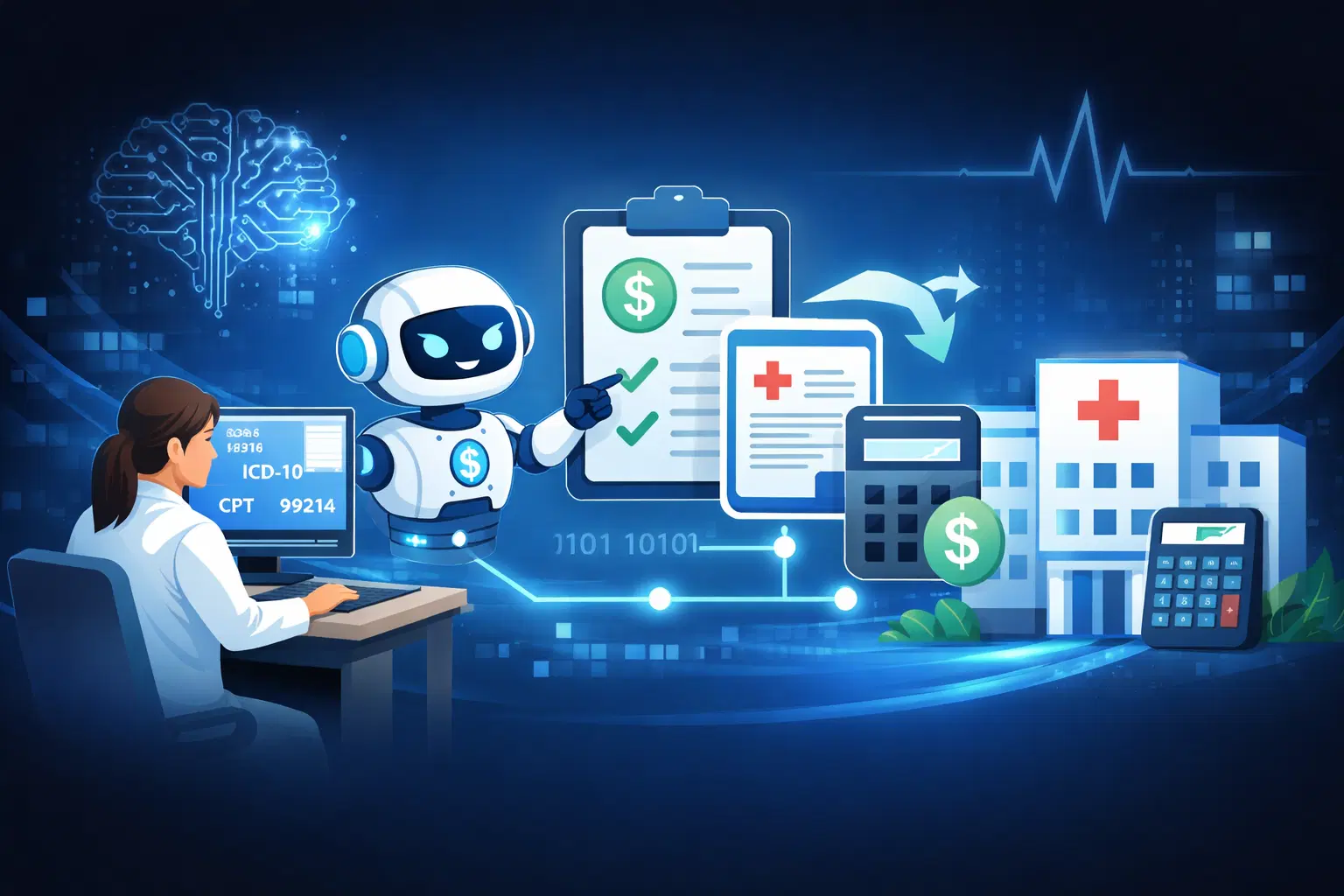
Manual charge entry is slow, error-prone, and one missed or incorrect code can directly impact revenue and compliance. AI-assisted medical coding automates charge capture with real-time accuracy, reducing denials, rework, and billing delays. Keep reading to see how healthcare organizations are using AI to streamline charge entry and protect every dollar earned.
In healthcare revenue cycle operations, delays often begin before medical claims are even submitted to insurance payers. The main reason behind this problem is manual charge entry.
Your staff spends hours reviewing clinical notes, identifying billable services, and entering charges under tight deadlines. However, as documentation becomes more detailed, coder capacity gets stretched, resulting in backlogs.
Sure, there are traditional rule-based coding tools in the picture, but they depend on pre-defined logic that doesn’t adapt well to unstructured clinical paperwork, specialty-specific variation, and frequent payer updates.
As a result, they catch obvious issues and miss contextual errors, shifting more review effort to your coders and auditors rather than minimizing it. The good news is, AI-assisted medical coding addresses this constraint by applying automated analysis earlier in the revenue cycle.
For home health agencies managing high claim volumes with distributed field staff, a Home Healthcare AI Automation Platform connects coding automation to intake, EVV, and physician order workflows — compressing the entire revenue cycle into one managed loop
And in this article, we’ll learn how this approach works in practice, where it fits within the workflows, and how healthcare companies can apply it through real use cases. But first, let’s get the basics out of the way:
Show
- Manual charge entry creates revenue-cycle delays before claims are ever submitted, and traditional rule-based coding tools miss contextual errors because they rely on pre-defined logic that doesn’t adapt to unstructured notes, specialty variation, or payer updates.
- AI-assisted medical coding analyzes clinical documentation and suggests ICD-10, CPT, and HCPCS codes before charges are entered, so coders start from a prepared, evidence-backed output instead of a blank screen.
- Human coders stay in control: the AI surfaces confidence levels and supporting documentation snippets, and coders confirm accuracy, make edits, and apply compliance judgment for edge cases.
- Validated codes flow directly into EHR, practice management, and billing systems through secure HL7/FHIR integrations, so charges are created without manual re-entry. Real-world impact spans faster charge capture, higher charts per coder, reduced undercoding and missed charges, fewer preventable denials, and audit-ready, traceable code recommendations.
What Is AI-Assisted Medical Coding and Charge Entry Automation?
Simply put, it refers to the use of AI to analyze clinical documentation, identify billable diagnoses and procedures, and suggest medical codes, such as ICD-10, CPT, and HCPCS before charges are entered into billing systems.
Human coders review AI suggestions, confirm accuracy, and make corrections when needed. The only difference is that they start with a prepared output instead of a blank screen.
Core Technologies Behind AI Medical Coding
| Technology component | Examples of technologies used | What it does in practice |
|---|---|---|
| Clinical language analysis | Clinical NLP models, large language models trained on medical text | Reads unstructured clinical documentation such as progress notes, operative reports, and emergency department notes to identify diagnoses, procedures, symptoms, and supporting clinical details |
| Medical entity extraction | Healthcare-tuned named entity recognition models | Extracts billable concepts such as conditions, procedures, devices, time elements, and anatomical references from narrative documentation |
| Code inference and mapping | ICD-10, CPT, and HCPCS inference engines with specialty logic | Maps extracted clinical concepts to appropriate codes while accounting for specialty context, exclusions, and coding conventions |
| Context resolution | Context-aware reasoning models with rule augmentation | Resolves laterality, severity, encounter type, and temporal qualifiers that affect code selection |
| Confidence and explainability layer | Scoring models with traceable evidence linking | Assigns confidence levels to code recommendations and surfaces supporting documentation snippets to guide coder review |
| Human feedback learning | Supervised learning loops driven by coder actions | Learns from coder approvals, edits, and rejections to improve future recommendations within the same specialty or workflow |
| Integration layer | Secure APIs and HL7 or FHIR connectors | Sends validated codes and charge data into EHR, practice management, and billing systems without manual re-entry |
How AI Medical Coding Assistants Automate Charge Entry and Billing Workflows
The assistants typically follow a fixed operational sequence.
Once clinical documentation is finalized, the system ingests the record directly from the source systems. Automated analysis processes the text to extract billable entities and interpret the clinical context.
As healthcare organizations expand automation across the revenue cycle, reliable EMR, fax system, and clearinghouse integrations become equally important. They ensure clinical documents, referral packets, eligibility information, and claim updates move seamlessly between systems, allowing AI-powered coding and charge entry workflows to operate without manual handoffs.
Now, based on this interpretation, ICD-10, CPT, and HCPCS code recommendations are generated along with supporting evidence and confidence indicators.
For example, if an operative note describes a laparoscopic procedure with documented complications and laterality, the assistant identifies the relevant clinical elements, applies the appropriate coding rules, and recommends codes that reflect the full scope of the encounter.
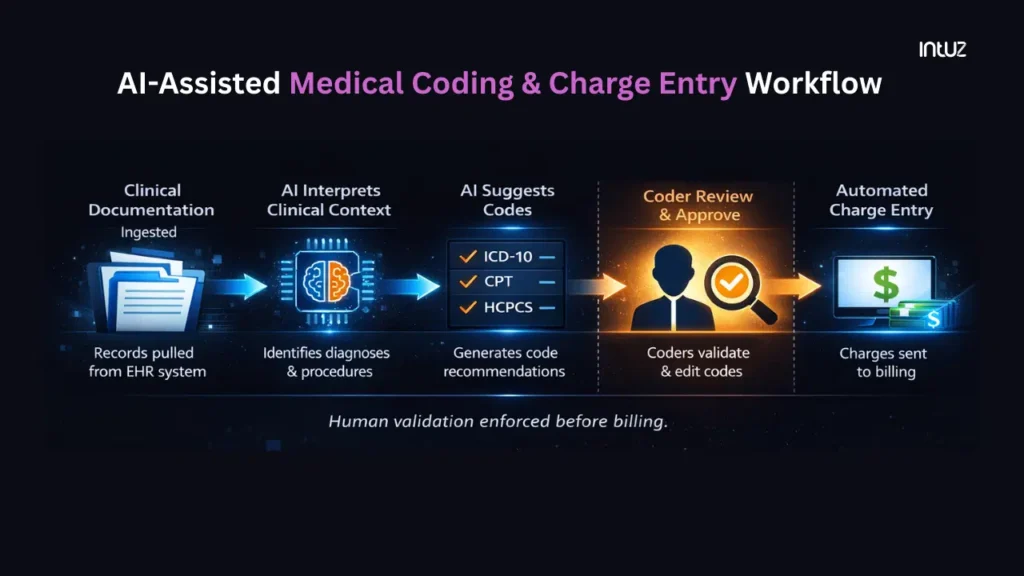
These recommendations are then presented to coders in a dedicated validation interface. They confirm accuracy, make edits where required, and apply compliance judgement for edge cases.
Once approved, validated codes are passed directly into charge entry and billing systems through system integrations. Charges are created without manual re-entry, and claims move forward according to existing billing workflows.
Practical Use Cases of AI-Powered Medical Coding Assistants
1. Capture every billable charge before claims go out
Here, you apply automated review before claims are created to confirm that documented services are fully and accurately reflected in charges. This allows undercoding, missed charges, and unsupported codes to be identified while clinical context is still available.
In Home Health AI environments, this pre-claim review layer also needs to account for EVV data, visit documentation, and physician order status — all inputs that AI can validate before charges are entered.”
For example, an operative note may document additional procedures, supplies, or extended time that are not reflected in the initial code selection.
AI-assisted review highlights these gaps during coding. Your coders can confirm whether the documentation supports additional charges or request clarification before the claim moves into billing.
2. Improve clinical documentation quality without slowing providers
AI-assisted coding supports earlier documentation feedback during the coding process. When required details for accurate coding are missing or ambiguous, the system flags these gaps while coders are still reviewing the record.
For example, a progress note may reference a diagnosis without specifying laterality or severity required for code selection.
The system highlights the missing detail during coding, allowing your coder to resolve the issue immediately instead of sending a clarification request after billing delays have already occurred.
3. Scale coding operations without hiring more medical coders
AI-assisted coding is also used to relieve coder throughput constraints. You can reduce the time your coders spend extracting information from lengthy notes and navigating code sets by presenting focused, evidence-backed code recommendations for review.
For example, in a high-volume emergency department, coders often review repetitive documentation patterns across similar encounters.
AI-assisted analysis reveals likely diagnoses and procedures directly from the note, allowing your staff to concentrate on validation rather than manual extraction. This shortens review time per chart without lowering review standards.
4. Prevent claim denials before they happen using AI insights
Denial prevention becomes more effective when driven by pattern visibility across encounters rather than isolated checks. You use AI-assisted analysis to identify recurring documentation and coding issues associated with denials before claims are submitted.
For example, if a payer frequently denies claims due to modifier misuse for a specific procedure, the system identifies this pattern across prior submissions.
That way, future encounters with similar characteristics can be flagged for closer review during coding, allowing corrections to be made before billing rather than after denial.
5. Maintain Specialty-Specific Coding Accuracy Across All Clients
Specialty and client-specific coding control allows AI-assisted systems to reflect how billing operates across different environments. You can apply models aligned to specialty workflows, facility or professional billing logic, and payer expectations.
For example, an revenue cycle management (RCM) organization managing both hospital and physician billing applies different validation rules for the same procedure depending on billing context.
The system then enforces the appropriate logic for each account, ensuring consistency without forcing coders to manually adjust workflows across clients.
Business Benefits for Healthcare Companies
| Area | What changes in practice | Measurable |
|---|---|---|
| Charge capture speed | Charges are prepared as part of coding review instead of after manual entry | Faster charge lag and earlier claim submission |
| Coding productivity | Coders review evidence-backed suggestions rather than extracting data from scratch | Higher charts per coder without increasing error rates |
| Revenue leakage control | Missed procedures, time-based services, and modifiers are flagged before billing | Reduced undercoding and missed charges |
| Denial reduction | Recurrent payer-specific issues are identified during coding | Fewer preventable denials and rework cycles |
| Documentation quality | Missing or ambiguous details are surfaced during coding review | Fewer post-bill queries and delayed clarifications |
| Operational consistency | Specialty- and client-specific rules are enforced automatically | More predictable output across teams and accounts |
| Cost containment | Throughput increases without proportional hiring | Lower cost per coded encounter |
| Audit readiness | Code recommendations include traceable evidence | Faster audits and clearer compliance defense |
Explore services
Enterprise AI Development Services Built to Deploy, Scale & LastHow Intuz Helps You Build AI-Assisted Medical Coding Solutions
If charge capture delays, rework, or preventable denials are already visible in your revenue cycle metrics, incremental fixes won’t change the trajectory. What you need is an AI-assisted medical coding as a leverage.
Intuz works with healthcare companies like yours that want this shift without disrupting existing systems or workflows. Our work starts with requirement mapping directly with your coding, billing, and operations teams to understand specialty logic, payer behavior, denial patterns, and throughput constraints.
Organizations implementing AI-driven coding and billing workflows often combine intelligent code suggestions with our charge entry and revenue cycle automation module to streamline claim creation, reduce manual errors, and accelerate downstream reimbursement without changing established clinical documentation practices.
These inputs shape the AI assistant’s workflows, review checkpoints, and validation logic from day one. Our teams then develop them trained on specialty-specific datasets.
Coding recommendations reflect clinical nuance, documentation patterns, and billing context rather than one-size-fits-all assumptions. Human-in-the-loop validation is designed intentionally, so your coders stay in control while automation handles the repetitive analysis that slows them down.
Integration is treated as a first-order concern. We connect the assistant directly to your EHR, practice management, and billing systems using secure, auditable interfaces.
Approved codes and charge data move into downstream systems without manual re-entry, without parallel workflows, and without forcing process changes onto your staff.
Every implementation follows a compliance-first architecture. We design for HIPAA requirements, PHI protection, access controls, auditability, and data isolation from the outset.
Security, governance, and operational transparency are built into the system, ensuring you don’t need to worry about it later.
This approach also extends to HIPAA-aware access controls and audit trails, ensuring every user action, coding decision, and system interaction remains traceable without adding operational complexity.
The real healthcare outcome you get is a production-ready AI coding assistant that fits your workflows, improves throughput, reduces rework, and gives you earlier control over charge capture and denial risk.
So, if you’re ready to move beyond incremental fixes and apply AI-assisted medical coding in a way that reflects real revenue cycle complexity, Intuz is the partner that builds it with you, inside your systems, under your rules.
Book a free 45-minute consultation with us to learn more.
FAQs
Can AI really replace human medical coders for charge entry?
AI doesn’t replace coders—it removes repetitive charge entry work. It automatically assigns ICD-10, CPT, and HCPCS codes from clinical notes, while human coders focus on complex cases, audits, and compliance. Most US providers use AI to augment, not eliminate, coding teams.
How accurate is AI-assisted medical coding compared to manual coding?
Modern AI-assisted coding systems achieve high accuracy when trained on specialty-specific data and payer rules. They consistently reduce missed charges and coding variations. Accuracy improves over time as the AI learns from historical claims, denials, and coder feedback within real production workflows.
Will AI-assisted coding reduce claim denials?
Yes. AI identifies missing documentation, under-coded procedures, and payer-specific risks before claims are submitted. By flagging denial-prone patterns early, healthcare organizations prevent avoidable rework, shorten reimbursement cycles, and significantly lower first-pass denial rates without slowing billing operations.
Is AI-assisted medical coding compliant with US healthcare regulations?
AI-assisted coding solutions are built to support HIPAA, CMS, and payer guidelines. They don’t make unchecked decisions—every code is traceable back to clinical documentation. This audit-ready approach improves compliance while giving organizations full control over coding rules and specialty-specific standards.
How fast can healthcare organizations see ROI from AI-assisted charge entry?
Most US healthcare organizations see ROI within months. Faster charge capture, fewer denials, reduced coder workload, and improved billing accuracy directly impact cash flow. AI scales coding operations without proportional hiring, making it especially valuable for high-volume hospitals and billing service providers.