




Manual loan processing leads to slow approvals, inconsistent eligibility checks, and high operational overhead for lending teams. This guide explains how n8n automates loan processing and eligibility workflows by connecting KYC, credit checks, and decision logic into one streamlined flow. Intuz helps lenders design, build, and scale secure n8n-based automation that reduces turnaround time, minimizes risk, and accelerates loan disbursals.
As a lending company, how long does it take for you to determine whether an applicant is even eligible for a loan? 2 weeks? 6 weeks? 3 months? Yes, it could be either of those.
From document verification and income checks to FOIR calculations and bureau pulls, there are a lot of tasks spanning teams and systems to complete. Each handoff increases turnaround time and operational costs.
But the thing is, borrowers expect fast decisions. If your approval routing logic still depends on manual validation, spreadsheet calculations, fragmented APIs, and rigid rule configurations, you’re only harming your business.
The good news is, you can convert your loan eligibility process into a fully automated workflow. How, you ask? Through n8n. In this blog, we’ll explore everything you need to know about implementing automation correctly.
Show
- n8n automates the full loan processing pipeline — from application intake via webhook to KYC, document OCR/AI validation, credit bureau orchestration, rule-based eligibility scoring, and final decision sync across LOS, CRM, and ERP systems.
- Document processing uses OCR and AI to extract structured financial data from bank statements, pay stubs, and tax returns, and flags mismatches between declared and deposited income automatically.
- Credit bureau integrations (TransUnion, Experian, Equifax) are handled natively within n8n workflows, including retry logic, rate-limit handling, and fallback provider routing — with all interactions logged for audit traceability.
- Eligibility rules are fully configurable: FOIR calculations, income thresholds, product-specific parameters, and AI risk scoring can all run within a single workflow without touching core banking systems.
- Intuz delivers n8n deployments from an ISO 27001-audited facility with GDPR-compliant DPAs, encrypted credential management, role-based access control, and outcome-first billing — reducing lender TAT from weeks to hours.
How to Automate Loan Processing & Eligibility Check Workflow with n8n
1. Automated KYC and digital application intake
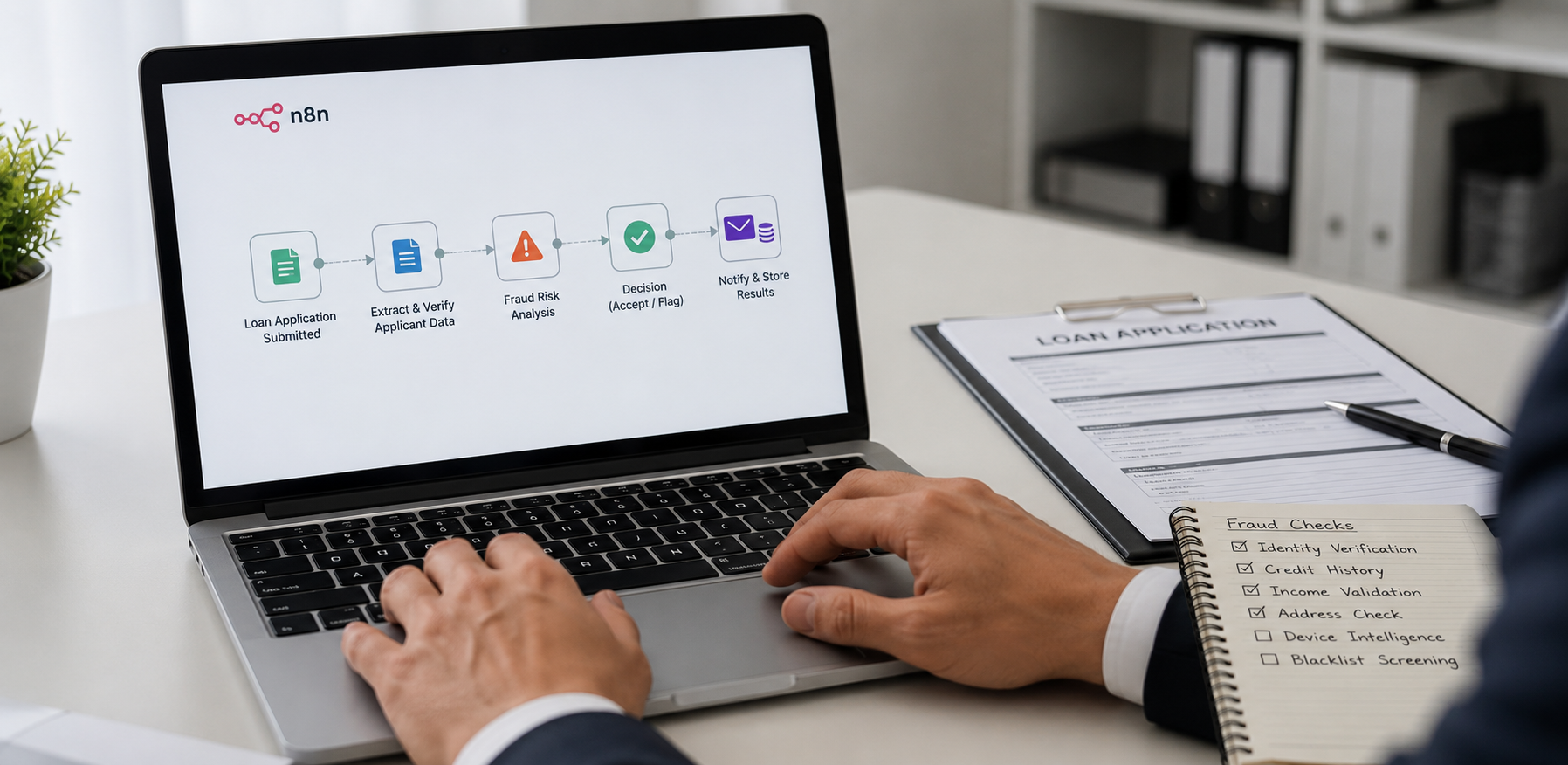
The workflow begins when an applicant submits a loan request through a web form, mobile app, partner API, or tools such as Jotform. Whether the source is an internal portal or an external integration partner, the submission hits an n8n webhook in real time.
This webhook captures the applicant data, including personal details, loan type, income information, and consent for bureau access and KYC verification. Each application is timestamped, assigned a reference ID, and stored as a structured record.
At intake, required fields and documents are checked for completeness and format accuracy. This includes verifying identification details, income information, consent flags, and supporting documents such as ID proof or bank statements.
If any required information is missing or invalid, the application is flagged and held at intake, and a request for correction can be triggered automatically.

Intuz Recommends
We recommend validating completeness at intake and rejecting incomplete submissions before document processing begins. For example, if “income_proof” or “bureau_consent” is missing, stop the workflow and request correction. You should avoid allowing incomplete applications into downstream stages. This prevents wasted bureau calls, incorrect risk scoring, and unnecessary manual review.
2. Document processing with OCR and AI validation
Once the application packet is complete, n8n routes uploaded documents to OCR and AI processing services. Bank statements, pay stubs, W-2 forms, and tax returns, and income are converted into structured records.
Fields such as monthly income, account balance trends, existing debt obligations, employer information, and transaction history are extracted and normalized.
This data is then checked against application inputs. Name mismatches between identification records and financial documents, discrepancies between declared and deposited income, and unusual transaction patterns are flagged automatically.

Files that meet validation thresholds proceed forward with the financial data attached. Documents with inconsistencies are marked for review with specific validation flags.
Intuz Recommends
OCR extraction errors are common, especially with scanned PDFs and inconsistent formatting. So, why not define minimum confidence thresholds? For instance, that would look something like this: confidence ≥ 90% → proceed automaticallyconfidence < 90% → require verification You should never use low-confidence extraction results directly in eligibility calculations.
3. Automated credit assessment and bureau orchestration
Once applicant data and financial documents are validated, n8n initiates credit bureau integrations.
API requests are sent to providers such as TransUnion, Experian, or Equifax using authenticated credentials, consent identifiers, and applicant metadata.
The response includes credit score, active loan accounts, EMI obligations, repayment behavior, and delinquency history. n8n parses and normalizes this response into a standardized format so it can be evaluated alongside internal financial data.
If a bureau request fails due to timeout or rate limits, retry logic and rate-limit handling are applied automatically. When needed, the system can route requests to a fallback provider based on predefined rules.

All interactions are logged with timestamps and response status for audit traceability.
Intuz Recommends
Repeated bureau calls increase cost and may violate bureau usage policies. Therefore, store your bureau responses with the application ID and reuse them if the application is reprocessed within a defined time window.
Explore Solutions
4. Rule-based eligibility execution and AI risk scoring
With validated applicant data, extracted financial records, and bureau responses available, n8n executes eligibility rules in a defined sequence.
Baseline criteria such as age, employment type, income thresholds, and requested loan amount are evaluated first. FOIR is calculated using income and EMI data, and product-specific parameters are applied based on the loan type.
Rule definitions are configurable and can reference centralized policy settings such as income limits, exposure caps, or product eligibility thresholds.

If an internal risk model is used, consolidated applicant data is sent to the scoring service. The returned risk score, probability of default, or decision band is evaluated alongside rule conditions.
Additional behavioral and transaction signals, such as account volatility or repayment trends, can also be included in the scoring input.
Convert OCR output into standardized numeric and date formats before eligibility checks.
Example:
| Raw | Standardized |
|---|---|
| “$5,200 CR” | 5200 |
| “Jan 1–31, 2025” | 2025-01 |
You should store normalized fields such as: “monthly_income: 5200”. This ensures your eligibility rules evaluate consistent values across all applications.
5. Automated decisioning, exception handling, and system synchronization
Once eligibility rules and risk scoring are complete, n8n determines the application outcome. Applications that meet approval criteria proceed automatically. Applications that fail defined thresholds are marked ineligible.
Cases with risk indicators such as low credit score, high FOIR, document inconsistencies, or borderline scores are routed to a manual review queue.
Underwriters receive the complete application context, including financial summaries, bureau data, rule evaluation results, and risk scores. SLA timers can be applied to review stages, with automated alerts and escalation if defined timelines are exceeded.

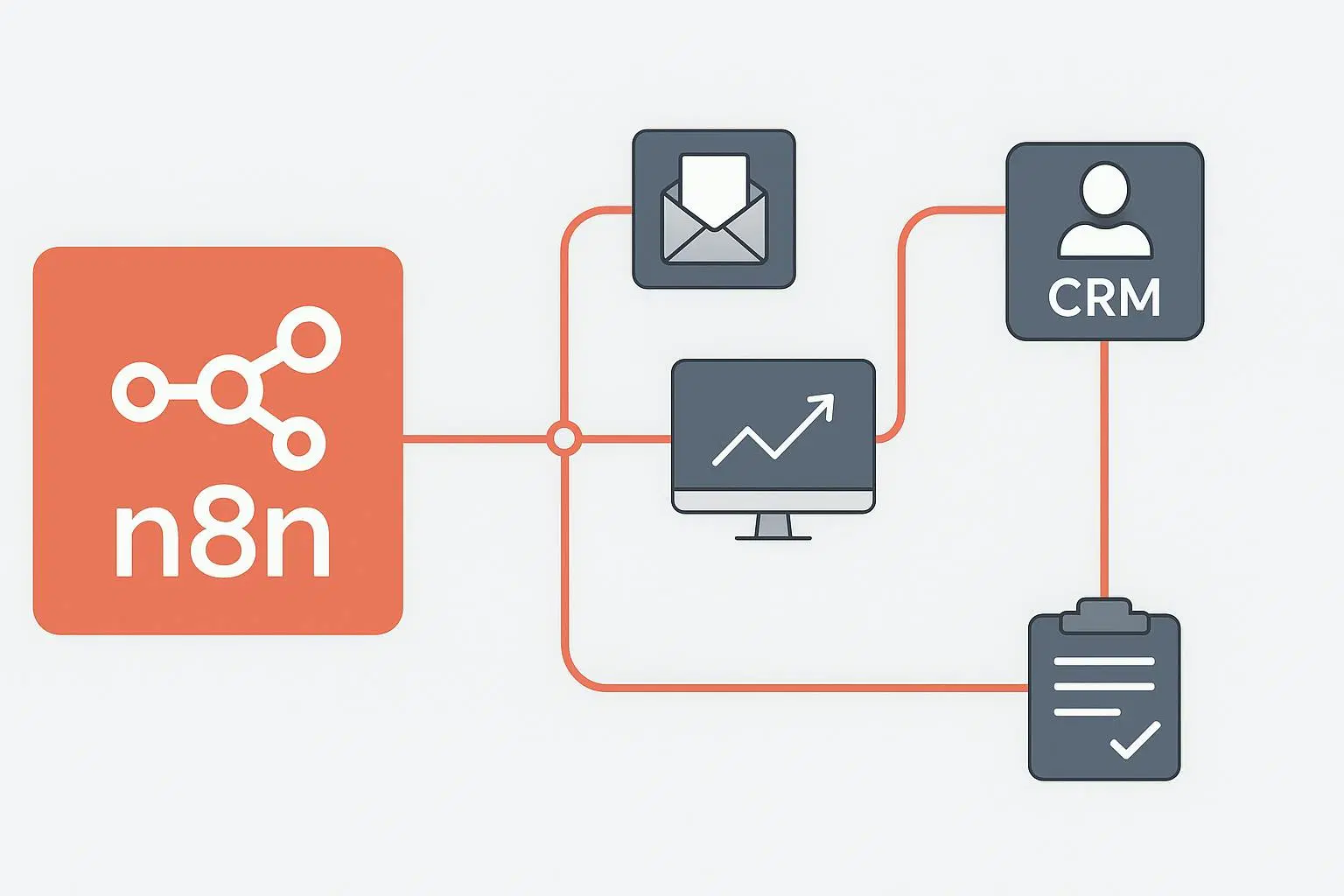
After a decision is confirmed, the outcome is synchronized across connected systems, including the Loan Origination System, CRM, ERP, and analytics platforms. Customer notifications are triggered automatically through configured communication channels.
All decision events, rule evaluations, and system updates are logged, creating a traceable audit record from intake through final disposition.
Intuz Recommends
Store the exact reason for every approval, rejection, or manual review. Structured decision reasons improve audit traceability and help analyze approval and rejection patterns.
Why Intuz Is the Right Partner for Loan Eligibility Workflow Automation Using n8n
Automating loan eligibility goes beyond “connecting APIs.” It’s about designing a governed decision system that withstands regulatory scrutiny, product changes, scale, and audit reviews. Intuz brings execution discipline to that complexity.
For starters, we serve clients from industries such as fintech, banking, and SaaS. Our teams have the know-how to build multi-step AI workflows, integrate LLM-driven risk models, and implement event-driven orchestration using platforms like n8n.
Check out our work / portfolio
Loan eligibility workflows require architectural planning, not isolated automation scripts. Our approach focuses on building decision pipelines that remain stable under volume spikes and evolving credit policy.
The best part? We don’t treat n8n as a drag-and-drop tool. We treat it as a workflow orchestration layer within a broader architecture.
Our production-ready AI development can easily handle:
- Secure self-hosted or cloud deployments of n8n
- Custom JavaScript and Python logic within workflows
- Integration with internal ML risk scoring services
- Bureau abstraction layers
- Configurable rule engines with version control
- Audit logging frameworks
Our team works inside your repositories and cloud environments under your IAM and SSO policies . You retain full control of code, infrastructure, and data. We firmly believe eligibility automation should reduce dependency on vendors, not increase it.
What’s more, Intuz delivers automation from an ISO 27001-audited facility and signs GDPR-compliant DPAs . We implement:
- Encrypted credential management
- Role-based access control
- Structured audit logging
- Consent traceability
- Version-controlled eligibility rules
For institutions operating in regulated markets, this reduces friction during SOC 2, GDPR, or internal compliance reviews—you get the drill.
Scalability is handled through controlled workflow segmentation, queue management, and infrastructure tuning. Whether you process hundreds or tens of thousands of applications daily, orchestration remains stable.
Intuz also operates on outcome-first billing. We align pricing with a clearly defined objective such as reducing eligibility turnaround time, lowering manual underwriting effort, or improving approval consistency.
From kickoff to initial deployment, onboarding is designed to begin quickly with minimal operational disruption . You gain measurable improvements without prolonged discovery cycles. Bringing automation initiatives to fruition is a breeze with us.
To find out more about how we can help your lending company, book a 45-minute free consultation with us and get a complementary n8n implementation roadmap!
FAQs
How does loan processing automation using n8n actually work?
Loan automation with n8n works by connecting all steps—application intake, KYC, credit checks, eligibility rules, approvals, and notifications—into one workflow. n8n triggers actions based on events (form submission, document upload, API response) and routes data automatically, removing manual handoffs and significantly reducing loan processing time.
Can n8n automate loan eligibility checks without changing core banking systems?
Yes. n8n sits as an orchestration layer, not a replacement. It integrates with existing core banking, LOS, or CRM systems via APIs, webhooks, or databases. Eligibility logic (income, credit score, risk rules) can be automated externally while final decisions still sync back to your core system.
What loan processing steps can be automated using n8n?
n8n can automate application capture, document validation, KYC verification, credit bureau checks, eligibility scoring, approval routing, status updates, and customer notifications. It also handles exception cases—like missing documents or low scores—by triggering follow-ups or manual review tasks automatically.
Is n8n secure enough for automating loan workflows?
Yes, when implemented correctly. n8n supports self-hosting, role-based access, encrypted credentials, and secure API handling. Financial teams often deploy n8n within private cloud or on-prem environments to meet data privacy and compliance requirements while maintaining full control over sensitive borrower data.
How does loan automation via n8n reduce approval turnaround time (TAT)?
Manual loan workflows slow down due to handoffs, data re-entry, and follow-ups. n8n eliminates these delays by running checks in parallel, auto-validating data, and instantly routing decisions. Many lenders reduce loan TAT from days to hours by automating eligibility checks and approval workflows.
Can n8n handle exceptions and manual approvals in loan processing?
Absolutely. n8n supports conditional logic and human-in-the-loop workflows. If a case fails eligibility rules or needs manual review, the workflow pauses, assigns tasks to officers, and resumes automatically after approval—ensuring automation without losing control over high-risk or edge cases.
How is n8n better than Zapier for loan workflow automation?
n8n offers deeper control, self-hosting, custom logic, and better cost efficiency for complex financial workflows. Unlike Zapier, n8n can handle multi-step eligibility rules, database operations, and secure internal integrations—making it more suitable for loan processing and regulated environments.
What is the real business impact of automating loan workflows with n8n?
Automating loan workflows reduces operational costs, minimizes human errors, improves compliance, and scales processing without adding staff. Teams process more applications with the same resources, improve customer experience with faster decisions, and gain real-time visibility into loan pipeline performance.
Work with Intuz
Automate Your Loan Workflows
Cut approval TAT with n8n — talk to our team.
Let's Get Started
Share this article
![Best AI & Enterprise App Development Companies in USA [2026]](https://www.intuz.com/wp-content/uploads/2026/05/Best-AI-Enterprise-App-Development-Companies-in-USA-2026.webp)