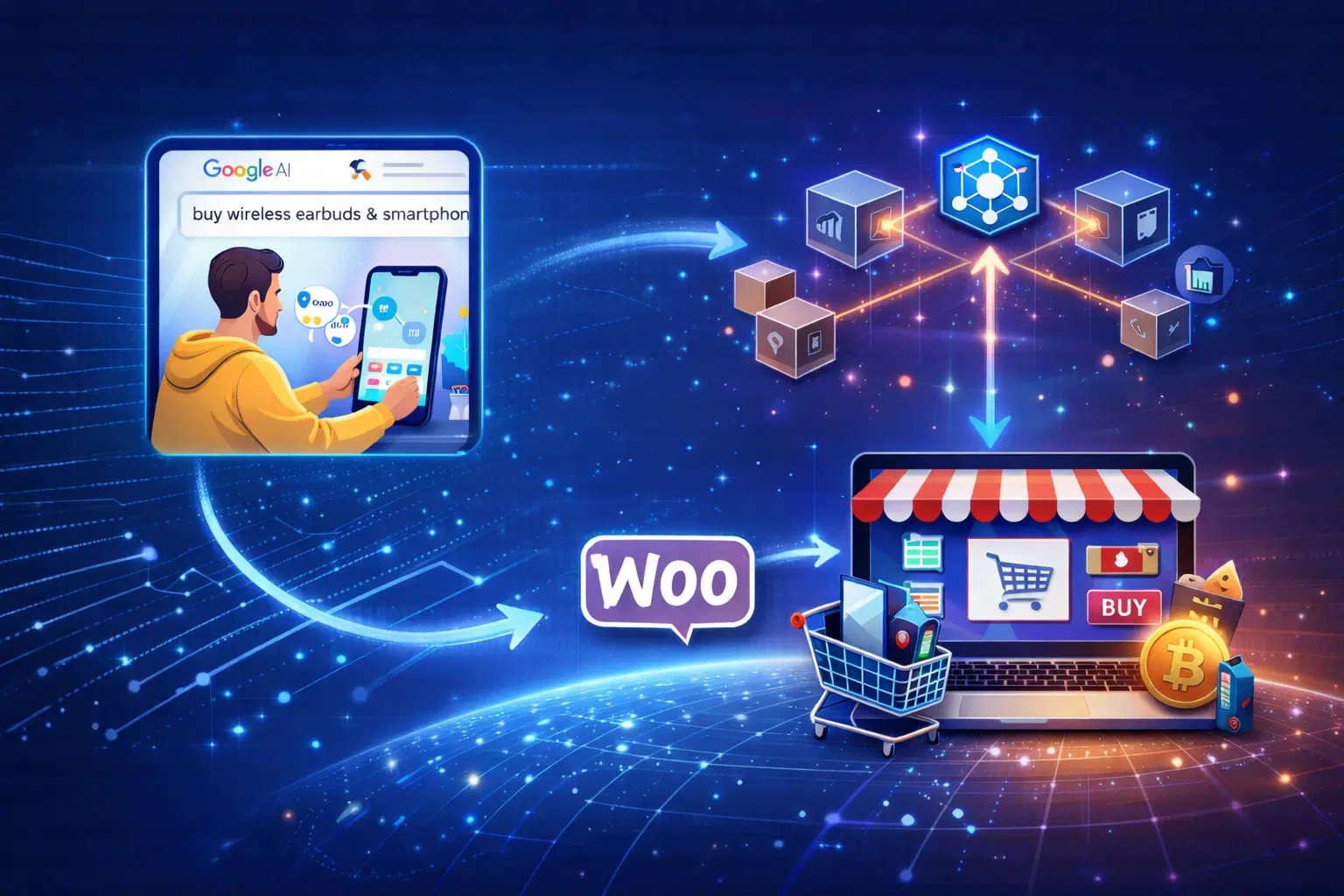





This blog explains how to implement Universal Commerce Protocol in a custom eCommerce application, covering why and when to deploy UCP, integration steps, data mapping, and real-world implementation challenges to help teams build scalable, future-ready commerce systems.
Modern eCommerce stacks comprise ERPs, accounting systems, tax engines, and CRM platforms that work in tandem to process orders, validate financial data, record customer context, and close the loop from checkout to reconciliation without any manual intervention.
In most custom apps, these connections are handled through direct APIs.
As the stack grows, logic is duplicated across integrations, and even the smallest change can create unintended side effects. Checkout reliability degrades, payment routing becomes less predictable, and adding a new system becomes progressively slower.
Universal Commerce Protocol (UCP) addresses this by standardizing how such commerce capabilities are expressed and consumed. In this blog, we’ll discuss how to implement it, independent of the underlying platform or channel.
Show
- Modern eCommerce stacks that rely on direct APIs across ERPs, CRMs, tax engines, and payment systems become increasingly fragile as they scale — UCP standardizes how commerce capabilities are expressed and consumed across all those integrations.
- UCP is worth deploying when you operate multiple channels sharing the same order/pricing/payment logic, support multi-PSP/multi-currency setups, or have automation and AI agents acting on commerce events; it’s not worth it for single-storefront, low-change-velocity, or short-lived products.
- Before implementing UCP, five technical prerequisites must be in place: API-first commerce services, event-driven state propagation, explicit domain ownership, stateless scoped authentication (OAuth2/JWT), and governed API versioning.
- The implementation follows a four-phase sequence — scoping which commerce actions UCP controls (starting with order creation and payment authorization), canonicalizing data schemas, building a dedicated adapter layer, and synchronizing state via events and tokenized payment handling.
- Production readiness requires passing a four-area gate covering contract validation, idempotency and retry rules, capability-scoped security tokens, and continuous observability — traffic is blocked until all checks pass.
When and Why to Deploy UCP in a Custom eCommerce Application
| Aspects | Internal model (UCP makes sense when) | UCP doesn’t make sense when |
|---|---|---|
| Number of channels | You have multiple channels using the same order, pricing, or payment | You have a single storefront with no concrete plans to expand |
| Commerce logic reuse | Core commerce rules must be identically reused | Logic is tightly coupled to one UI and unlikely to be reused |
| Payments | You support multiple PSPs, regions, currencies | One PSP, one region, static payment behavior |
| Order lifecycle complexity | Orders move through multiple states with retries | Orders are simple create → pay → complete flows |
| Cost of failure | Order or payment errors cause revenue loss | Occasional failures are tolerable and cheap to fix |
| Automation or AI involvement | Automation or agents act on orders, payments, etc. | All actions are initiated by humans through a single UI |
| External consumers | Partners, internal tools, or third parties need access | Commerce is used only by one application |
| Change velocity | Commerce rules change frequently and must | Rules are stable and change rarely |
| Team structure | Multiple teams touch commerce behavior | One small team owns everything end to end |
| Time horizon | You expect the platform to exist and evolve for years | The product is short-lived or experimental |
Core Technical Requirements Before Implementing UCP
| Requirement | What must be true | Why UCP depends on this |
|---|---|---|
| API-first commerce services | Products, carts, orders, and payments are exposed through stable, owned APIs rather than embedded in channel code. | UCP can only coordinate behavior it controls. If logic exists in channels, protocol guarantees can’t be enforced. |
| Event-driven state propagation | Order and payment state changes are published through webhooks or message queues as authoritative events. | UCP requires a single source of truth for lifecycle transitions. Polling and inferred state break ordering and automation safety. |
| Explicit commerce domain ownership | Catalog, pricing, checkout, orders, and fulfillment each have a single owning service enforcing rules. | UCP depends on clear responsibility boundaries. Without them, protocol rules leak and diverge across services. |
| Stateless, scoped authentication | All access uses scoped, short-lived tokens such as OAuth2 or JWT, with no session state. | UCP must support agents, partners, and async consumers safely. Stateful or broad access undermines protocol guarantees. |
| Governed API and schema versioning | APIs and event schemas are versioned with backward-compatible evolution rules. | UCP is long-lived infrastructure. Without versioning discipline, consumers break as the protocol evolves. |
How to Implement UCP in a Custom eCommerce Application
1. Decide which commerce actions UCP controls
List all supported commerce operations, such as catalog management, order creation, payment authorization, refunds, and fulfillment updates.
Determine which of these must be governed by UCP because inconsistent behavior across channels would result in revenue loss, operational errors, or trust issues. For each action, identify the system that currently executes the operation and enforces its rules.
Limit the initial scope to operations that map cleanly to standard commerce entities such as Orders, Payments, or Fulfillments. Actions that rely on channel-specific logic remain outside UCP in the initial phase.
Intuz Recommends
Typically, you’ll want to begin with order and payment flows where failures carry the highest financial risk. But still, to make this part of the process easier and objective, leverage the prioritization matrix as shown below:
| Commerce action | UCP priority | Reason |
|---|---|---|
| Order creation | Phase 1 | High revenue impact, high consistency, financial |
| Payment authorization | Phase 1 | Financial, failure is costly |
| Refund processing | Phase 1 | Financial, compliance risk |
| Fulfillment status updates | Phase 2 | Cross-channel value, low revenue risk |
| Catalog browsing | Out of scope initially | Low failure cost, read-only |
2. Standardize commerce data to UCP standards
UCP demands a single, unambiguous interpretation of commerce data across platforms like Shopify or WooCommerce. Therefore, define and enforce a single UCP identifier for each product, offer, order, and payment, regardless of internal IDs.
For example, an order exposed through UCP should look like “order_id = UCP_ORD_10293” with a status of “paid,” not an internal record like “order_pk = 928374” with a state such as “PAYMENT_RETRY_PENDING.”
Next, clarify pricing explicitly. Every price must include the currency, taxes, discounts, and the total, with these values expressed as concrete amounts.
Avoid implicit rules, such as tax-inclusive pricing or channel-specific discount logic. If pricing differs across systems, resolve those differences before exposing pricing through UCP.
A UCP price must include concrete fields such as “currency = INR,” “subtotal = 147.00,” “tax = 12.00,” “discount = 10.00,” and “total = 149.00.” Don’t expose values like “price = 149” or rely on assumptions such as tax-inclusive pricing or channel-specific discount rules.
Normalize inventory and order state in the same way. For instance, inventory should use a small set of states, such as available, reserved, and unavailable.
On the other hand, order states exposed through UCP must correspond to real stages in the order system (e.g., created, paid, cancelled) rather than inferred or transitional conditions (e.g., pending_fraud_check, awaiting_inventory_sync, retrying_payment).
Intuz Recommends
Create canonical schemas for each UCP-exposed entity, such as Orders, Payments, Products, and Inventory, and define them independently of internal database tables or service models.
| Aspect | Internal model | Canonical UCP schema |
|---|---|---|
| Order identifier | order_pk = 928374 | order_id = UCP_ORD_10293 |
| Pricing | pricing_blob = {…} | total = 149.00currency = INRtax = 12.00discount = 10.00 |
| Order state | PAYMENT_RETRY_PENDING | paid |
| Fraud handling | fraud_check_status = IN_PROGRESS | not exposed |
| Inventory coupling | inventory_sync_flag = false | not exposed |
| Timestamps | created_ts | created_at = 2026-02-01T10:42:11Z |
For example, the UCP order schema defines fields such as order_id, status, total, and created_at without referencing internal columns, joins, or workflow flags.
Publish these schemas as the UCP data contract using OpenAPI or JSON Schema, and treat them as the authoritative reference for all UCP APIs and events.
3. Implement the UCP adapter layer
After you define UCP schemas, introduce a dedicated adapter service that handles all UCP traffic. For instance, when a web app or partner sends a request to “POST /ucp/orders,” it always goes to the adapter, not directly to an internal order or checkout service.
These endpoints represent canonical commerce actions and don’t mirror internal APIs. They define the requested action and the allowed state, without exposing how those actions are implemented internally.
Internally, you organize the adapter around three logical responsibilities:
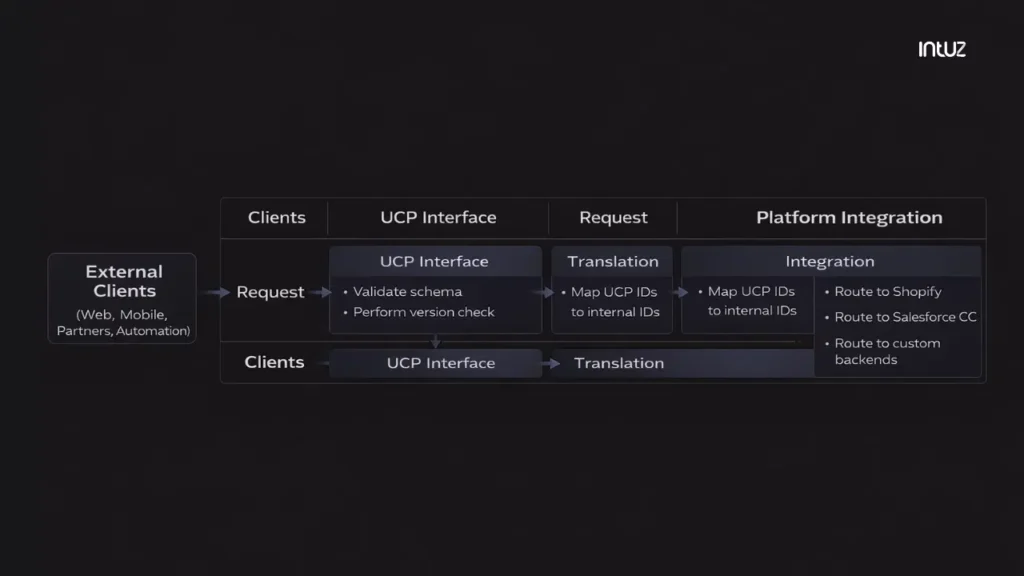
This structure remains consistent as the adapter grows, without introducing everything at once. You start with a single critical endpoint, such as “POST /ucp/orders,” and implement the full adapter flow for that path:
- Validate the request against the UCP schema
- Enforce lifecycle and idempotency rules
- Translate the request
- Call existing order and pricing services
Intuz Recommends
Once this path is stable, you can route all external order creation traffic through the adapter and remove direct access to internal commerce APIs, while leaving internal services unchanged. Then, expand incrementally by adding payments, refunds, and read endpoints, each following the same interface, translation, and enforcement model. At runtime, the adapter is responsible for translating UCP requests into internal service calls, enforcing protocol and lifecycle rules, and handling API versioning and backward compatibility.
4. Synchronize the order lifecycle and payment state using events and tokens
Once requests flow through the UCP adapter, the order and payment state no longer change in a single request.
For example, you can create an order now, authorize payment seconds later, fulfill it hours later, and refund it days after that. State evolves over time and across platforms like WooCommerce and Shopify.
Polling APIs such as “GET /orders/{id}” to infer these changes introduces delay, inconsistency, and unnecessary load. Therefore, publish an event every time a real state change occurs. For example, emit:
- “order.created” when “order_id = UCP_ORD_10293” is created
- “payment.authorized” when the payment succeeds
- “order.fulfilled” when shipment begins
- “order.refunded”when a refund completes
Ensure each event includes the same UCP identifiers and states as defined in the UCP data contract. Don’t expose internal IDs, workflow flags, or provider-specific fields.
In addition, apply lifecycle correctness before publishing events. Reject invalid transitions, such as cancelled → paid, and allow only valid transitions, such as created → paid. The event stream becomes the authoritative record of what actually happened.
For payments, adopt tokenized payment handling by integrating with payment providers such as Stripe, Adyen, or Braintree. Pass payment tokens through UCP interfaces and store only token references inside your systems.
You can also use UCP to abstract the selection of payment providers. Route transactions based on geography, payment method, or cost optimization rules defined in the adapter. Enable A/B testing or gradual rollout of new payment providers without changing client or channel integrations.
Before routing live traffic through UCP, you must pass a production readiness gate:
| Area | What you enforce |
|---|---|
| Contract validation | Schema validation at the adapter boundary, version compatibility checks, and contract tests for all UCP APIs |
| Idempotency & retries | Idempotency keys for all state-changing actions, explicit retry rules based on outcome visibility |
| Security | Capability-scoped tokens, token expiration, rate limits per capability |
| Observability | Latency per UCP capability, failures segmented by channel, rejected lifecycle transitions |
Block production traffic until all checks pass. Validation happens before internal calls. Security applies before routing. Observability runs continuously after go-live.
Why Teams Choose Intuz to Implement UCP Correctly
There’s no doubt that UCP touches the most sensitive parts of your commerce system. Orders, payments, pricing, and state transitions can’t tolerate ambiguity or rework. Execution discipline clearly matters more than architectural intent.
Intuz approaches UCP as production infrastructure. Engagements begin with a tightly scoped, high-risk surface such as order creation or payment authorization, and are delivered against concrete outcomes. This prevents UCP from expanding into an open-ended platform rewrite.
Commerce domains are modeled explicitly and early. Products, variants, offers, pricing rules, and availability constraints are treated as first-class inputs to the protocol. This is critical because weak domain modeling undermines every downstream guarantee UCP is meant to provide.
All UCP components are implemented directly in your environment. Schemas, adapter services, state machines, and event flows live in your repositories and are under your ownership. This keeps the UCP boundary part of your core commerce system.
Operational concerns are addressed during implementation. Token handling, access control, idempotency, retries, and observability are built into the adapter from day one. This is what allows UCP to hold up under real traffic.
Most importantly, you benefit from prior experience with production commerce and event-driven systems. That experience shows up in how contracts are enforced, how retries are handled, and how state drift is avoided during rollout. UCP works when protocol rules hold under real traffic.
Book a free 45-minute consultation with Intuz today.
FAQs
What is Universal Commerce Protocol (UCP) and why should custom eCommerce apps use it?
Universal Commerce Protocol (UCP) is a standardized integration layer that connects your eCommerce app with multiple commerce services like payments, inventory, shipping, and marketplaces through a unified API. US businesses adopt UCP to reduce custom integrations, speed up feature rollout, and future-proof their commerce architecture.
Does UCP replace my existing eCommerce platform or work alongside it?
UCP does not replace your eCommerce platform. It works as an abstraction layer on top of your existing system. Your custom app continues handling UI and business logic, while UCP standardizes how it communicates with external services like ERP, payment gateways, marketplaces, and fulfillment systems.
What are the main technical challenges when implementing UCP?
Common challenges include data normalization across systems, real-time event synchronization, version control of UCP schemas, and handling platform-specific edge cases. US enterprises often solve this using event-driven architecture, message queues, robust logging, and automated contract testing between UCP and downstream services.
Is Universal Commerce Protocol suitable for SMBs or only large enterprises?
UCP is increasingly adopted by US SMBs building custom or headless commerce apps. While enterprises use it for complex ecosystems, SMBs benefit from faster integrations, lower long-term maintenance costs, and easier vendor switching. A phased implementation—starting with payments or inventory—keeps costs and risk manageable.
How can Intuz help you implement Universal Commerce Protocol in a custom eCommerce application?
Intuz helps US businesses design and implement Universal Commerce Protocol using a scalable, API-first architecture. From UCP schema mapping and adapter development to event-driven workflows, security, and performance optimization, Intuz delivers production-ready implementations that reduce integration risk, speed up time-to-market, and support long-term commerce scalability.
Work with Intuz
Get Your Store AI Visibility & Conversion
Tell us what you're building — we'll map the right UCP approach.
Let's Get Started
Share this article