



Node.js is one of the most popular development environments that enables developers to run JavaScript independent from a browser. Being an open-source and cross-platform runtime environment, it has become the beloved environments of developers globally.
Node is a fast and quickly scalable environment that makes it easier to run JavaScript on the backend as well as frontend, offering a seamless development experience. At the same time, as everything is managed by a single language, the app development process is faster and more consistent.
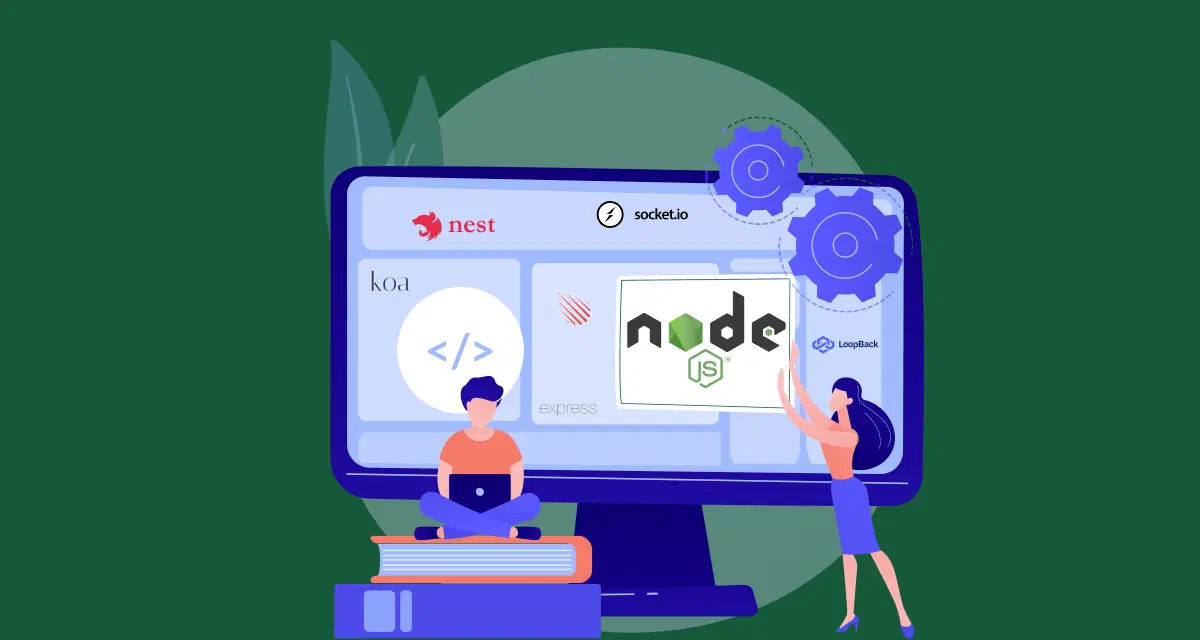
Nodejs is also popular because of the availability of several frameworks which can be used by web app developers according to the project requirements. Meant to enhance the functionality of Nodejs, these frameworks improve the flexibility, scalability, robustness, and efficiency of an app.
Show
- Node.js supports both frontend and backend with a single language (JavaScript), making the development process faster and more consistent across the full stack.
- Socket.io and Meteor lead in community popularity, with 47,000+ and 44,000+ GitHub stars respectively, making them the top choices for real-time application development.
- Framework selection depends on the use case — Express suits REST APIs and HTTP servers, Nest is built for enterprise-grade TypeScript apps, and Sails supports MVC patterns with auto-generated APIs.
- Enterprise-grade frameworks like Hapi and NestJS offer robust support for authentication, authorization, caching, and input validation, with Hapi specifically stress-tested during Walmart’s Black Friday traffic.
- Hiring a Node.js development agency is recommended when you’re not deeply familiar with JavaScript frameworks, as framework selection and configuration significantly impact scalability and delivery speed.
Top 10 Nodejs Frameworks
Here are some of the most popular Nodejs development frameworks according to Github and Nodejs community:
1. Socket.io

Socket.io is unarguably the most popular Nodejs frameworks with 47000+ stars on Github. It facilitates the real-time applications development owing to its real-time bidirectional communication capabilities.
Github Stars: 47000+
2. Meteor

With over 44000 stars on Github Meteor is a full-stack Nodejs framework that is simple, modern and is compatible with Android, iOS, web or desktop. Meteor is used for the development of connected-client reactive applications using an integration of technology, build tools and packages from Nodejs and JavaScript community.
Used majorly for creation of real-time web apps, Meteor supports data sending over the wire. With detailed documentation and ever-growing community, Meteor is used by global corporations such as IKEA, Mazda, Qualcomm, etc.
Github Stars: 44000+
3. Express

Express is also a popular framework with 44000+ Github stars. Coming with a minimalistic framework, it serves as a middleware to help developers configure routes for sending/receiving requests between database and frontend.
Coming with potent tools to handle HTTP servers, the framework is suitable for one-page websites, apps, hybrids or public HTTP APIs.
Github Stars: 44000+
4. KOA

Koa framework has also been developed by the team behind Express. Koa utilizes ES6 methods which can be used by developers to work without callback. Koa promises better control over error-handling practices and configuration.
However, as Koa doesn’t come with inbuilt middleware, the conventional middleware such as req, next, res, etc. don’t work with Koa. Koa is light and more robust than Express and has more than 26,000 stars on Github.
Github Stars: 26000+
5. Sails

Sails is an MVC framework that supports real-time applications and auto-generated REST APIs. Built on Express, Sails facilitates simplified WebSocket integration. Compatible with all major databases like MongoDB, MySQL, PostgreSQL, etc. Sails support all leading frontend technologies, too. This includes iOS, Angular, React and Android.
Github Stars: 20000+
6. Nest

Nest can be considered as a complete development kit for enterprise-grade app development. Built with TypeScript, Nest supports a wide range of libraries and uses progressive JavaScript. The framework combines elements of object-oriented programming, functional reactive programming, and functional programming.
Nest is used for creating reliable and highly scalable server-side applications. Being an out-of-the-box architecture, it can be used for creating flexible and progressive apps.
Github Stars: 18000+
7. LoopBack

LoopBack can be used to accelerate the pace of REST API development. With its user-friendly CLI wizard, developers can create dynamic models based on the schema. Coming with an API explorer, LoopBack is compatible with major REST services and leading databases including MongoDB, Oracle, PostgreSQL, and MySQL.
Github Stars: 12000+
8. Hapi
Hapi serves as a bridge between server and client-side application for data and is an ideal alternative to the Express framework. Known for its modular approach, developers can make use of Hapi to write reusable app logic.
With support for authentication, authorization, input validation and caching, Hapi is turning out more and more popular with each passing day. Its capability and scalability potential can be understood by the fact that it was developed to handle mobile traffic during the Black Friday sale at Walmart.
Github Stars: 11000+
9. AdonisJS

AdonisJS is an MVC framework that is simple to use and focuses on stability more than anything. Supporting all major operating systems, it facilitates writing code for server-side web applications. The basic premise for this framework is to simplify a developer’s ordeal associated with finalizing packages.
The expressive API is quite consistent and helps developers develop full-stack web apps as well as micro API servers.
Github Stars: 6000+
10. TotalJS
Just like its name, TotalJS is a full-scale NodeJS framework that consists of useful packages, libraries, and products for facilitating the development process. With approximately 4000 stars on Github, TotalJS can be called a rising star that promotes swift development, enhanced performance, robust scalability, and reliable stability during the development process.
Github Stars: ~4000
FAQs
Which Node.js framework is best for building a real-time application?
For real-time applications, Socket.io is the most proven choice — it has 47,000+ GitHub stars and is purpose-built for bidirectional, event-driven communication. It excels in use cases like live chat, gaming, collaborative tools, and notifications. Meteor is the second strongest option, especially if you need a full-stack framework that handles both server and client in real time. It’s used by companies like IKEA and Qualcomm. Your final choice should depend on whether you need a lightweight socket layer (Socket.io) or a complete opinionated full-stack setup (Meteor). Intuz’s Node.js team can help you evaluate the right fit based on your app’s data flow and scale requirements.
What is the difference between Express and Koa for Node.js development?
Both Express and Koa were built by the same core team, but they take different design philosophies. Express is a mature, widely adopted framework with built-in middleware and strong community support — ideal for REST APIs, single-page apps, and hybrid applications. Koa is leaner, uses ES6 async/await natively, and gives developers finer-grained control over error handling, but it ships without built-in middleware, meaning you wire everything yourself. Express suits teams who want a battle-tested default. Koa suits experienced developers who want a minimal, modular setup without legacy constraints. Both have 26,000–44,000+ GitHub stars. For most production projects, Express remains the safer starting point.
Is Node.js good for enterprise-level backend development?
Yes — and several Node.js frameworks are specifically designed for enterprise use. NestJS, built with TypeScript, combines object-oriented, functional, and reactive programming patterns, making it a strong choice for complex, scalable server-side systems. Hapi.js was battle-tested by Walmart to handle Black Friday mobile traffic and supports authentication, authorization, caching, and input validation out of the box. LoopBack accelerates REST API development with a CLI wizard and built-in API explorer. These frameworks are used in production by large-scale companies globally. For enterprise projects with compliance, security, or team-scale requirements, framework selection is critical — a Node.js development partner can help architect this correctly from day one.
What kinds of applications can you build with Node.js frameworks?
Node.js frameworks support a wide range of application types: real-time chat apps, REST APIs, microservices, full-stack web apps, mobile backends, IoT data pipelines, streaming platforms, and enterprise dashboards. Socket.io handles event-driven real-time apps; Express and Koa handle API servers; Sails handles MVC-style apps with auto-generated REST APIs; AdonisJS handles full-stack apps and micro API servers. The event-driven, non-blocking architecture of Node.js makes it particularly strong for applications with high concurrency and I/O-heavy workloads. Most types of multi-functional applications that need to scale quickly and handle simultaneous users are well-suited for Node.js.
How do I choose between Sails, NestJS, and AdonisJS for my project?
The choice comes down to architecture style and team preference. Sails is an Express-based MVC framework with automatic REST API generation and WebSocket support — great for teams familiar with Rails-style conventions. NestJS is TypeScript-first with a modular, Angular-inspired architecture and strong support for microservices and GraphQL — ideal for teams building complex, maintainable enterprise backends. AdonisJS takes a Laravel-style approach, with a stable, expressive API that works well for both full-stack apps and micro API servers. If stability and simplicity matter most, use AdonisJS. If TypeScript and modular enterprise architecture are priorities, use NestJS. If you want convention-over-configuration for REST APIs, use Sails.
Should I hire a Node.js development company instead of building in-house?
It depends on your team’s existing JavaScript depth and delivery timelines. If your in-house team has strong JavaScript expertise and experience configuring frameworks, building in-house is viable. But Node.js framework selection, configuration, and architecture decisions have significant downstream impact on app performance and scalability. Getting these wrong early is expensive to undo. A Node.js development company brings framework experience across multiple project types, reduces ramp-up time, and can deliver faster, more reliably. For B2B companies where speed-to-market and code quality are non-negotiable, outsourcing to a specialist team typically delivers better ROI than building a Node.js capability from scratch.

Share this article