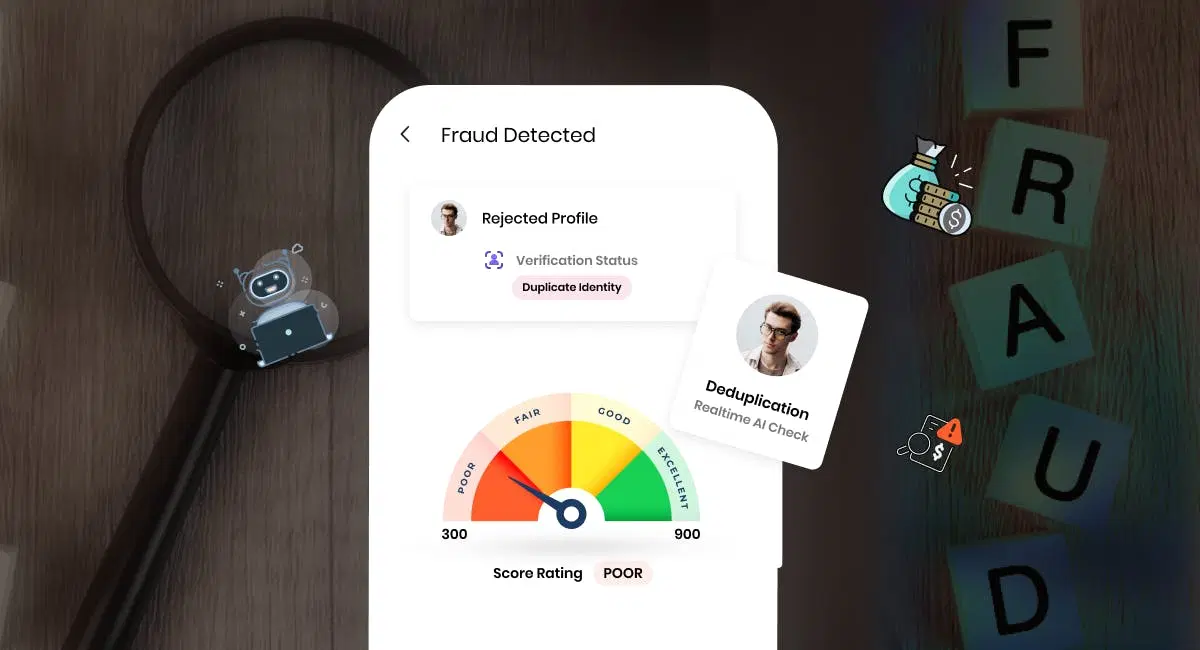





Build a real-time loan fraud detection workflow that verifies applications automatically, detects risk signals, and flags suspicious cases before approvals. Learn how to implement scalable, AI-ready automation using n8n to reduce manual reviews and prevent fraud losses. Intuz helps lenders design and deploy secure, production-ready workflow automation tailored to business and compliance needs.
If your lending workflow relies on isolated, rule-based fraud checks or point solutions, you may miss fraud that a connected system could catch.
Synthetic identities pass KYC checks because their documents appear clean. Manipulated bank statements slip through because no automated step compares income claims against behavioral signals or device history.
The fraud is there, but your current setup isn’t built to detect it. The Federal Trade Commission reported that fraud losses in the US exceeded $10 billion with financial services among the most targeted sectors.
A significant portion of that exposure comes not from unsophisticated attacks but from well-coordinated ones that exploit gaps between disconnected tools used for KYC checks, document verification, device intelligence, and credit validation.
Closing those gaps requires fraud detection that runs across every stage of the application process. And n8n provides the orchestration layer to connect these systems into a single automated workflow. In this blog, we dive deep into that.
Show
- n8n can automate the complete loan fraud detection workflow from application intake to final decision routing.
- Fraud checks combine KYC verification, document analysis, device intelligence, and credit validation in a single workflow.
- Real-time risk scoring helps automatically approve, reject, or flag suspicious applications for manual review.
- Open banking and behavioral signals improve fraud detection accuracy beyond traditional document-based verification.
- Proper audit logging, workflow versioning, and structured validation are essential for compliance and traceability.
How to Implement Loan Application Fraud Detection Workflow Using n8n
Let’s understand how a loan fraud detection workflow runs in n8n, from application intake to final decision. You’ll also learn the key implementation considerations that ensure accurate risk evaluation, reliable workflow execution, and complete audit visibility:
1. Application intake and trigger
The workflow begins the moment a loan application is submitted.
A webhook receives the application data from your loan origination system, web form, or internal API and passes it into n8n. From here, subsequent fraud checks run automatically.
No manual handoff is required, and no application enters your pipeline without going through the full detection sequence.
Intuz Recommends
In n8n, use a Function node immediately after the webhook trigger to check that required fields are present, that the SSN matches a 9-digit numeric format, that the date of birth is a valid date, and that the loan amount is a positive number. If any field fails validation, return a 400 response and stop the workflow there.
2. Identity and KYC verification
Once the application is received, n8n calls your identity verification provider to validate the applicant’s details against authoritative data sources. At this step, you’re checking whether the name, SSN, date of birth, and address are consistent with each other and with existing records.
Mismatches between these fields, SSNs issued after the stated date of birth, or identities with no established credit or address history are all signals of synthetic identity fraud. Office of Foreign Assets Control (OFAC) and watchlist screening also runs here.

Intuz Recommends
Normalize applicant data in n8n before the API call using a Set node or Function node. Specifically: trim whitespace from all string fields, convert names to title case, remove hyphens and spaces from SSN inputs, and format dates to ISO 8601 (YYYY-MM-DD). Pass the normalized values to your KYC provider, not the raw inputs.
3. Document fraud analysis
Bank statements, pay stubs, and tax documents submitted with the application are passed to a document intelligence tool.
The analysis checks for metadata inconsistencies, font irregularities, and formatting anomalies that indicate a document has been edited after it was generated.
For example, an income figure that doesn’t match the document’s formatting patterns, or a PDF whose metadata shows it was modified in a tool unrelated to its stated source, warrants further review or immediate rejection.
Intuz Recommends
Configure your web form to accept only PDF, JPG, and PNG uploads and enforce a maximum file size. In n8n, use an HTTP Request node to pass the binary file directly to your document analysis API without converting or re-exporting it first. Along with the file, include the upload timestamp and the applicant’s stated income as context.
4. Device and behavioral risk checks
n8n calls a device intelligence API to evaluate the environment from which the application was submitted.
For instance, repeated use of the same device or IP address across multiple applications, VPN or proxy usage, and session behavior that doesn’t match a typical applicant are all strong fraud indicators.
Velocity signals are particularly important here: multiple applications submitted within a short window from the same device or network suggest an automated or coordinated attack.

Intuz Recommends
Instrument every application channel, web, mobile, and LOS, with the same device fingerprinting script from your chosen provider.In n8n, store the device ID and IP address returned from each application in a database node, such as PostgreSQL, and run a query at this step to check whether the same device ID or IP address appears in more than one application within your defined time window.Set that window based on your typical application volume. For most lenders, three or more applications from the same device within 24 hours is a reliable velocity threshold to use as a starting point.
5. Credit and income validation
At this step, the applicant’s stated income is cross-referenced against credit bureau data and open banking signals.
A significant gap between reported income and credit behavior, a thin credit file with no supporting financial activity, or inconsistent income figures across submitted documents indicate potential first-party fraud or application misrepresentation.
Connecting to open banking data via a provider like Plaid gives you a real-time view of account activity that cannot be fabricated the way a document can.

Intuz Recommends
When you receive income data from Plaid or Argyle, calculate the variance between the open banking figure and the applicant’s stated income inside an n8n Function node before passing it to your scoring step.Define an acceptable variance percentage in a workflow variable rather than hardcoding it, so you can adjust it without editing the node logic. Start at 20%, review it against your first month of application outcomes, and adjust it based on your false-positive and false-negative rates.
6. Risk scoring and automated decision routing
After all checks are complete, n8n aggregates the outputs into a composite fraud risk score. Applications that fall below your defined risk threshold proceed to approval. Those that exceed it are automatically rejected or flagged for manual review, depending on your configured logic.
Every decision, along with the signals that informed it, is logged for audit and compliance purposes.

Intuz Recommends
Assign each signal a numeric weight, for example, KYC fail carries 40 points, document anomaly carries 30, high device risk carries 20, and income variance carries 10, and sum them into a score out of 100. Store the score, the individual signal values, and the workflow version number in your audit log on every execution so you have a complete record of how each decision was reached.
Tools and APIs Used in n8n Fraud Detection Workflows
Each stage of the workflow relies on external APIs for identity, document, device, and financial verification. The table below maps each tool’s role:
| Function | Tools | What These Tools Do |
|---|---|---|
| Application intake | Internal LOS APIs, Stripe Identity, Persona | Capture loan applications, identity documents, and applicant data, then send it to n8n via API or webhook |
| Identity and KYC verification | Socure, Alloy, Persona, LexisNexis Risk Solutions | Verify SSN, name, DOB, and address against credit bureaus, government records, and fraud databases |
| Document fraud detection | Sardine, Persona, Alloy, AWS Textract | Analyze bank statements and identity documents for tampering, metadata inconsistencies, and fabrication |
| Credit and income validation | Experian, Equifax, TransUnion, Plaid, Argyle, Pinwheel | Provide credit reports, validate income, and retrieve real-time banking or payroll data |
| Device and behavioral intelligence | Sift, Fingerprint, ThreatMetrix | Identify devices, detect VPN or proxy use, and flag repeated or high-risk application patterns |
| Fraud scoring and decisioning | Sardine, Alloy, Sift, custom scoring in n8n | Assign fraud risk scores and determine whether to approve, reject, or route applications for review |
| Audit logging and compliance | PostgreSQL, Snowflake, AWS CloudWatch, Datadog | Store workflow decisions, fraud signals, and execution logs for audit and monitoring |
| Manual review and escalation | Zendesk, Jira, Slack, internal fraud dashboards | Route flagged applications to fraud analysts for investigation and decision |
How Intuz Can Help You Build Loan Fraud Detection Workflows Using n8n
Look, this requires more than just connecting APIs.
It means translating risk policies into automated processes, integrating with your loan origination and compliance platform, and ensuring the system can handle real application volumes.
And you need an Enterprise AI development company that gets that.
Lucky for you, Intuz has worked with many US fintech companies and banks to design, integrate, and deploy n8n-based fraud detection workflows.
Engagements are priced as fixed-fee outcomes, so you know your exact cost before the project starts, and the incentives on both sides stay aligned with delivery. From the moment you give the go-ahead, you can expect a working first commit within five business days.
All work happens inside your own repositories and cloud environment. Intuz engineers operate under your IAM policies and SSO, and leave no residual access when the project closes. For lending businesses with SOC 2 or FCRA obligations, that matters.
We operate from an ISO 27001-audited facility, sign GDPR-compliant data processing agreements, and carry USD 2 million in cyber liability insurance, so the compliance conversation with your infosec team is straightforward.
Throughout the engagement, your team has full visibility. Intuz joins your Slack or brings you into theirs, keeps a living runbook of every architecture decision, and maintains a four-hour live overlap with US workdays for stand-ups and reviews.
You always know what has shipped and what’s in progress—isn’t that wonderful?
So, if your fraud detection requirements evolve after the initial deployment, engagements are flexible. You can start with a focused build, move to a retainer, or pause if priorities shift. There are no termination penalties, and handoffs are fully documented.
Book a free 45-minute consultation with Intuz to find out more.
FAQs
How to set up real-time loan fraud detection in n8n?
Trigger n8n webhook for loan app intake. Chain Plaid/Stripe nodes for KYC enrichment, GPT-4 AI Agent for risk scoring (0-100). IF node branches high-risk (>80) to Slack alerts; low-risk approves. Self-host on AWS for sub-second speed—catches 90% fraud instantly with zero downtime.
What data sources should be integrated into a fraud detection workflow?
A practical workflow integrates KYC providers, credit bureau APIs, device fingerprinting tools, bank statement analyzers, IP geolocation services, and internal CRM records. Combining behavioral, financial, and identity signals enables stronger fraud pattern detection compared to relying on a single verification source.
What n8n nodes detect loan app fraud red flags?
Use HTTP Request for credit bureau/KYC APIs, AI Agent for anomalies (IP velocity, geo mismatches, doc forgery). IF nodes flag thresholds like duplicate SSNs. Integrate OCR tools like Inscribe—accurately spots 40% forged IDs, synthetic identities via pattern matching in real-time workflows
How do you detect synthetic identity fraud using automation?
Synthetic identity fraud detection requires cross-checking SSN or identity data, credit history age, device consistency, and document authenticity. n8n workflows can automatically compare multiple signals, flag mismatched histories, and escalate applications showing unusual credit build patterns or repeated device reuse across applicants.
What triggers should start a fraud detection workflow in n8n?
Common triggers include new loan submissions, document uploads, applicant data edits, API submissions from partners, or suspicious login behavior. Event-based triggers ensure fraud checks begin instantly without manual intervention, helping lenders prevent fraudulent approvals before underwriting or disbursement stages begin.
How to integrate AI scoring in n8n fraud workflows?
Post-enrichment, connect OpenAI/Pinecone nodes: prompt with tx patterns, device fingerprints, scores 0-100 risk. IF routes >80 to Gmail/Slack holds or API blocks. Explainable outputs log reasoning—reduces losses 52%, false positives 37% via tuned thresholds in production fintech flows.
Is self-hosted n8n secure for loan PII/fraud data?
Yes—encrypt credentials/vars, disable execution logs, deploy on AWS EKS with VPC. Integrates Stripe Radar ML signals securely. Fintech-compliant (SOC2/AML) without cloud PII exposure; audit trails via Postgres node ensure traceability for regulators and 100% data sovereignty.
How to handle Stripe/Plaid in n8n loan fraud flows?
HTTP Request node with API keys: pull balances, tx history, account age. Cross-check app data for inconsistencies like sudden large deposits. AI flags velocity fraud (10+ inquiries/hour)—boosts detection 94%, auto-freezes suspicious accounts via callback webhooks seamlessly.
What ROI from n8n loan fraud automation?
Cuts fraud losses 84%, false positives 40%; handles 12K apps/hour at $0.01/flow. Clients hit 3-5x ROI in 3 months via instant blocks, compliance audits saved. Payback under 90 days—proven in fintech with velocity checks, AI scoring integrated.
Work with Intuz
Automate Loan Fraud Detection
Build secure AI-powered fraud detection workflows with n8n.
Let's Get Started
Share this article