


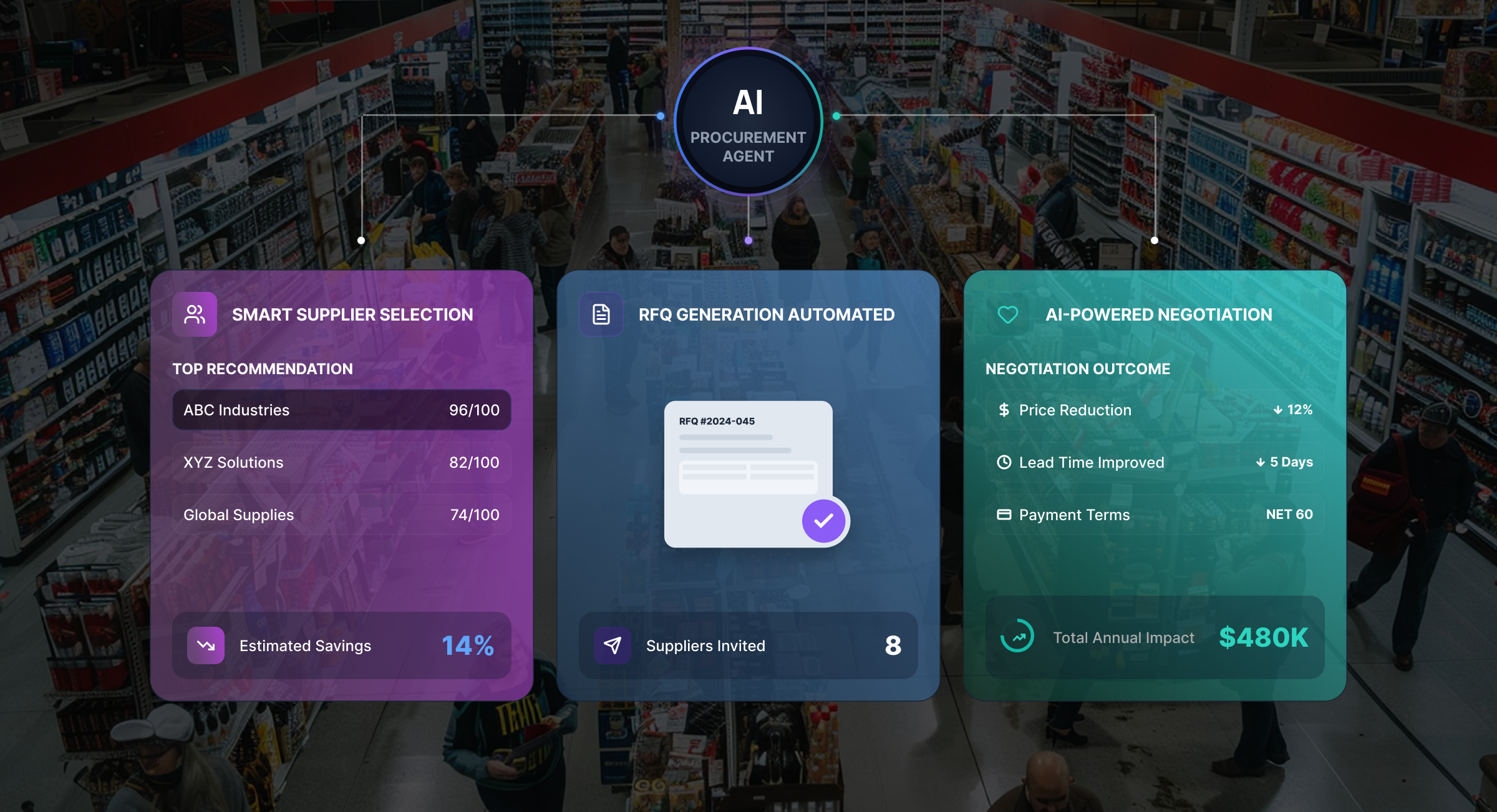
This guide covers six use cases of AI in procurement, we at Intuz have scoped and developed, along with the data they require, typical implementation timelines and costs, and the decisions involved in building or buying each capability.
Are you a procurement leader, business owner, or operations head managing more than $2 million in annual procurement spend and still losing hours to scattered data, supplier checks, contract searches, and invoice exceptions?
A budget that size hides a lot: duplicate suppliers, category spend split across three cost centers, contracts nobody can search, invoices stalled waiting for a PO match. Most teams already know where the delays are.
What they lack is a practical way to eliminate them without adding headcount. That’s the case for AI in procurement.
What Is AI in Procurement?
AI in procurement is the use of machine learning (ML), natural language processing (NLP), document intelligence, generative AI, and autonomous agents to analyze procurement data and carry out tasks across sourcing, supplier management, contracts, purchasing, and accounts payable (AP).
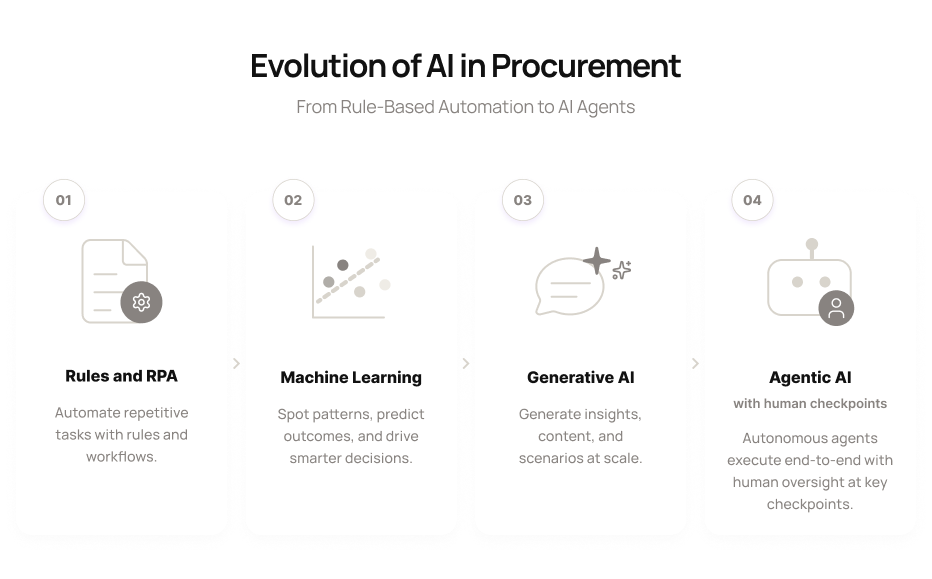
Six Practical AI Use Cases in Procurement
The following AI in procurement examples show what each system does, which inputs it needs, and where your team keeps control.
1. Reduce costs with AI-powered spend analytics
When your spend data isn’t centralized, basic reporting misses duplicate suppliers, fragmented category spend, and off-contract purchases. AI connects these sources into a single normalized spend dataset:
- ML models map purchases to a procurement taxonomy, while NLP extracts supplier names, product details, dates, and other entities.
- LLM-assisted categorization interprets less structured content, including contract language, emails, and free-text PO fields.
- Connectors for SAP Ariba, Coupa, Oracle, or your existing ERP keep the analysis linked to current purchasing data.
Once the data is normalized, you can compare spend across categories and suppliers, identify off-contract purchases, cut duplication, and point sourcing teams toward the strongest savings opportunities.
Spend analytics implementation snapshot
| Data you need | Integration effort | Intuz timeline |
| ERP data, invoices, POs, contracts, and supplier files | Medium, depending on source quality and ERP access | 4–7 weeks |
2. Generate RFQs and negotiate supplier deals
Manual RFQ preparation and supplier negotiation depend on individual buyers, dispersed documents, and repeated email exchanges. That makes the process slow and produces inconsistent requirements, limited negotiation coverage, and uneven outcomes.
Generative AI in procurement can draft the first version for you. Hand it an approved template and your engineering specification, and you get back quantities, technical requirements, delivery terms, and evaluation criteria.
From there, agentic AI in procurement can carry the process into supplier negotiation. It reviews historical prices, contract terms, benchmarks, supplier performance, and market data before acting within the boundaries your team has defined.
The supporting stack can include:
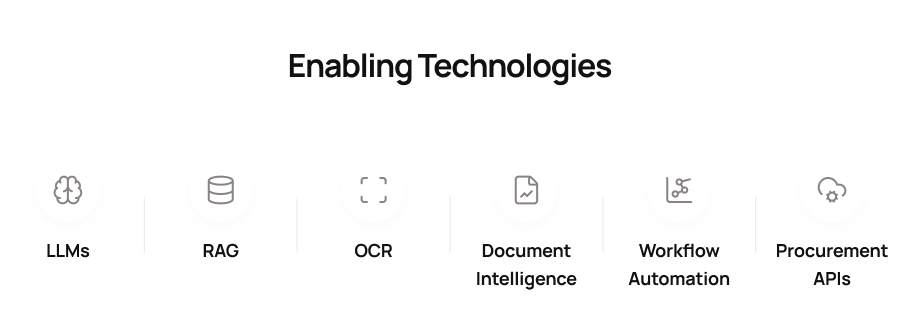
What can this change in practice? Keelvar’s 2025 sourcing report cites one automated sourcing case that reduced a request cycle from 11 days to nine minutes, saved 85% of processing time, and delivered 25% cost savings.
| Area | Before AI | After AI |
| RFQ preparation | Buyers collect and rewrite requirements manually | AI creates a review-ready first draft |
| Bid comparison | Buyers compare spreadsheets and emails | AI normalizes and scores responses |
| Negotiation coverage | Teams prioritize only high-value suppliers | Agents cover approved lower-value negotiations |
| Buyer workload | Buyers manage drafting, comparison, and follow-ups | Buyers focus on exceptions and final decisions |
| Value | Limited coverage and inconsistent outcomes | Faster cycles, broader coverage, more consistent terms |
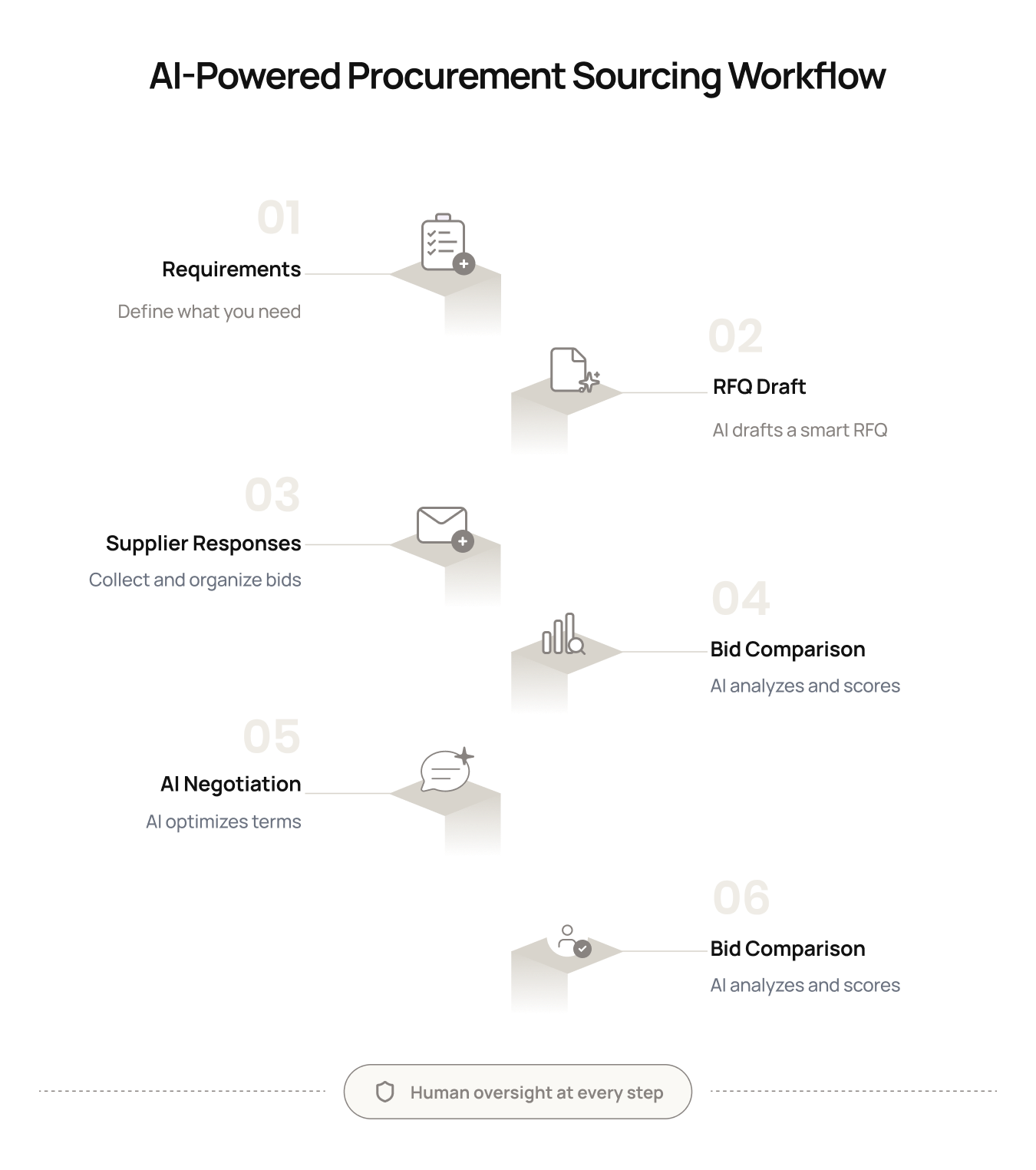
Agents work only within the boundaries you define, while your team keeps control of strategic suppliers, policy exceptions, high-value commitments, and any terms outside those boundaries, so you get faster RFQs, more consistent comparisons, and more buyer capacity without giving up oversight.
3. Discover, qualify, and monitor suppliers
You can use AI to search supplier databases, verify certifications, assess capacity and financial health, and rank candidates by price, delivery performance, ESG criteria, risk, and technical fit.
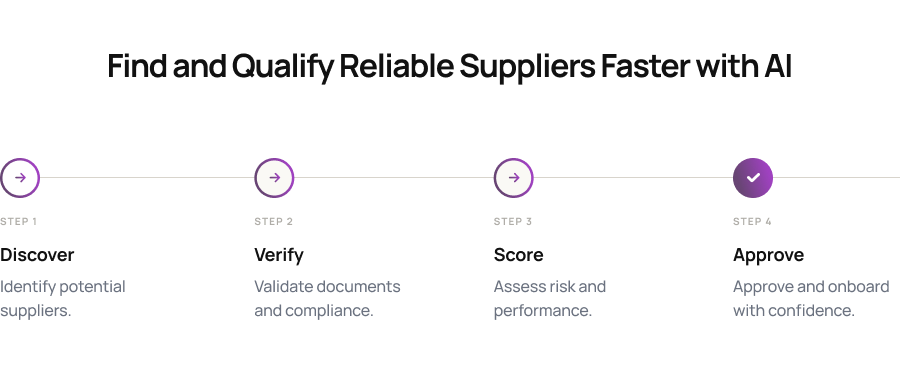
To generate reliable scores, the system needs accurate supplier data and access to your ERP or vendor master. The four-step framework below shows how qualification works:
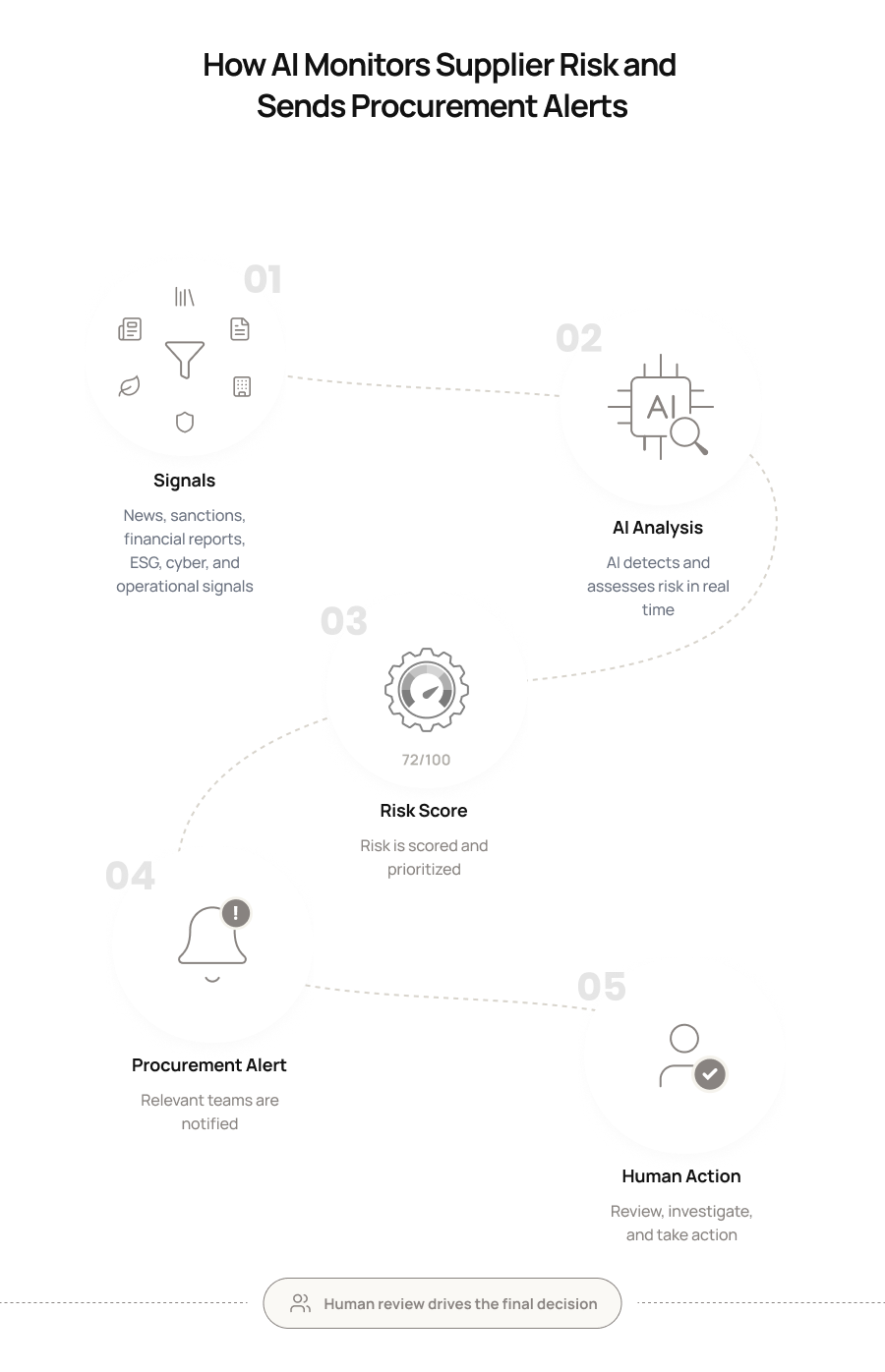
Once you approve a supplier, the same intelligence layer keeps monitoring sanctions, financial reports, cyber incidents, ESG events, operational updates, and relevant news. NLP, LLMs, knowledge graphs, and external APIs turn these signals into risk scores and alerts.
KPMG reports that 77% of procurement executives consider supply disruption a critical external challenge.
Earlier alerts give you more time to investigate, request corrective action, adjust inventory plans, or qualify an alternative before delivery suffers, which is how you reduce emergency sourcing and expedite costs.
4. Simplify contract management with AI-powered CLM
AI-powered CLM creates a searchable intelligence layer across your contract repository. OCR and document intelligence read scanned and digital agreements, while NLP and LLMs extract:
- Clauses and non-standard language
- Pricing and payment terms
- Renewal dates and notice periods
- Service levels and supplier obligations
- Compliance and reporting requirements
You can also ask questions such as, “Which supplier contracts renew next quarter?” or “Which agreements include price-escalation clauses?” and retrieve the relevant source language.
For reliable contract Q&A, we use retrieval-augmented generation, or RAG, to find the relevant clause before the model answers.
Structure-aware chunking, hybrid search, metadata filtering, and reranking help the system return a sourced response instead of relying on the model’s general knowledge. In Intuz’s internal testing, this optimized setup has achieved 90%–95% retrieval accuracy.
Having said that, your legal team still reviews non-standard clauses, high-risk terms, and exceptions before anyone takes action.
Before implementation, you need to centralize your agreements, digitize scanned PDFs, define your approved clause standards, and decide which risks require legal review.
Once you have that foundation, you can shorten contract review cycles, retrieve terms faster, catch renewals earlier, monitor obligations more consistently, and reduce missed discounts, credits, and notice deadlines.
5. Automate invoice processing and AP
You can use AI to convert incoming invoices into structured, ERP-ready data. OCR and document AI capture header and line-item details, while ML and LLMs validate supplier and tax information, code invoices, perform three-way matching, and flag anomalies.
Your AP team reviews only mismatches, missing PO references, and policy exceptions. During implementation, you need to account for different invoice formats you receive, the quality of your PO and receipt data, your matching tolerances, and your ERP posting rules.
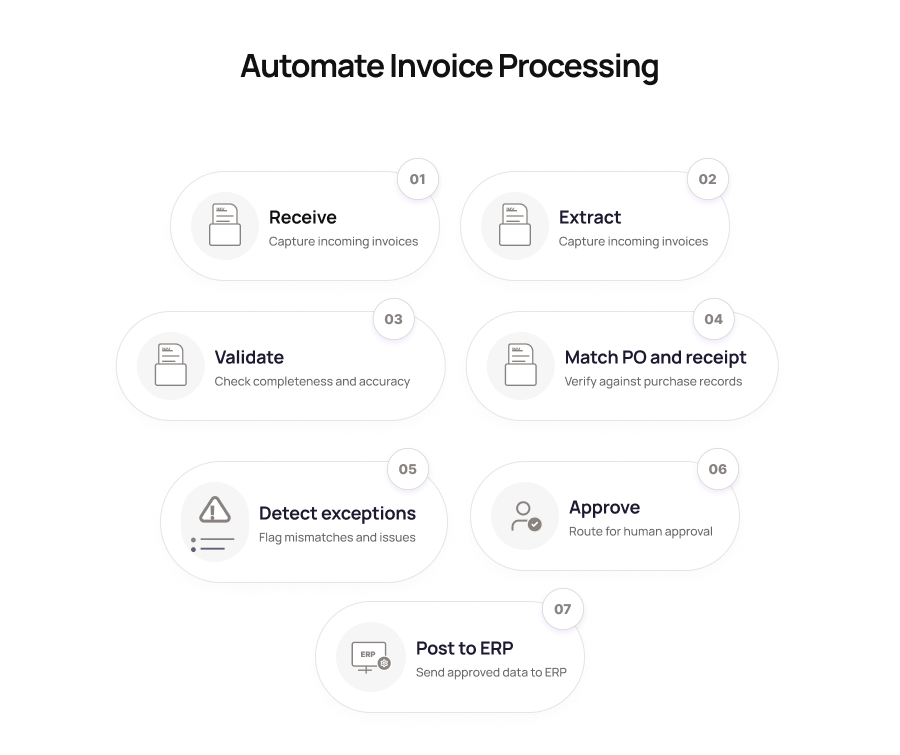
Define these early to enable the system to route genuine exceptions instead of creating another approval queue.
6. Improve demand forecasting across procurement and supply chain
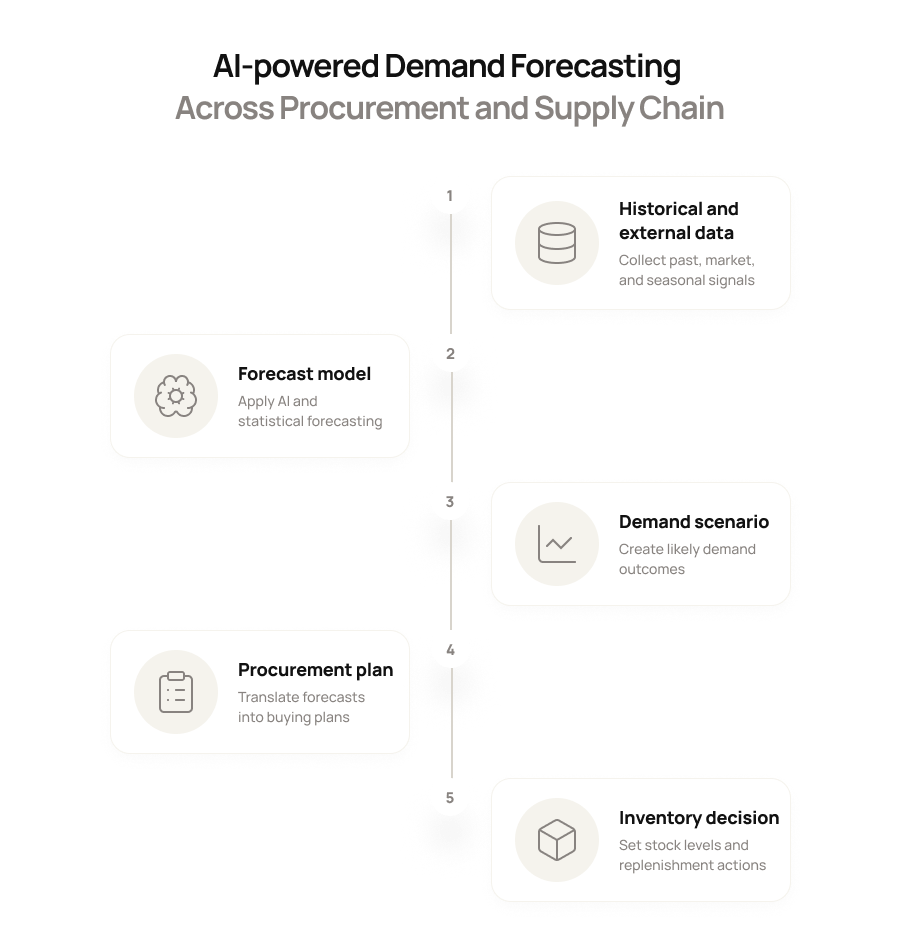
Here, the AI system combines purchasing history, sales, inventory levels, seasonality, promotions, pricing, and external signals to generate demand scenarios.
Your data volume, forecast horizon, and product behavior determine whether you use Prophet, TimesFM, Chronos, LSTMs, transformers, or another forecasting model.
AWS cites research showing that AI-based forecasting can improve forecast accuracy by 10% to 20%. In one retail implementation, Amazon Forecast improved the company’s manual forecast by an average of 10% based on WAPE, saved 16 labor hours per month, and reached deployment within eight weeks.
With more reliable forecasts, you can plan purchases earlier, reduce rush orders and stockouts, avoid excess inventory, and negotiate supplier volumes with greater confidence.
Which AI Approach Fits Which Procurement Problem?
Once you choose among the AI use cases in procurement, you need to select the right AI approach and decide whether to build or buy.
ML vs. generative AI vs. agentic AI
At Intuz, we use ML for classification, scoring, anomaly detection, and forecasting; generative AI in procurement for extraction, drafting, comparison, and Q&A; and agentic AI in procurement for connected actions governed by your approval rules.
The estimates below reflect focused implementations of our individual capabilities.
| AI use case | Main approach | Intuz timeline | Ballpark cost |
| Spend analytics | ML + GenAI | 4-7 weeks | $12K-$15K |
| Supplier negotiation | Agentic AI | 8-14 weeks | $25K-$40K |
| Supplier qualification | ML + GenAI | 8-10 weeks | $35K-$50K |
| Supplier risk monitoring | ML + GenAI | 10-12 weeks | $42K-$60K |
| RFQ generation | GenAI + RAG | 8-10 weeks | $25K-$30K |
| Contract management | GenAI + RAG | 10-12 weeks | $30K-$40K |
| Invoice and AP automation | ML + document AI | 6-8 weeks | $20K-$30K |
| Demand forecasting | Predictive ML | 8-12 weeks | $30K-$40K |
Should you build a custom AI solution or buy a procurement platform?
At Intuz, we compare custom AI development and hosted platforms across fit, timeline, cost, technology, and expected returns:
| Decision area | Custom AI solution | Hosted procurement platform |
| Best fit | Organization-specific workflows, integrations, security controls, and decision rules | Standard procurement processes and faster adoption |
| Timeline | 8-12 months | 3-6 months for integration and adoption |
| Cost | $180K-$300K for development, plus annual hosting, support, and maintenance | $50K-$150K per year, plus spend- or usage-based fees |
| Technology | Python, PyTorch, TensorFlow, Scikit-learn, TimesFM, Chronos, Prophet, LangChain, OpenAI or Anthropic APIs, open-source models, PostgreSQL, Qdrant, Redis, RabbitMQ, n8n, FastAPI, Celery, AWS SageMaker, Google Vertex AI, Docker, Kubernetes, and ERP connectors | Coupa, SAP Ariba, GEP SMART, JAGGAER, Ivalua, and Levelpath |
| Task-specific options | Components selected around your architecture | Sievo for spend analytics; DocuSign IQ or Icertis for CLM; Zip or Fairmarkit for sourcing and RFQs; Avalara or Tipalti for AP workflows |
| ROI focus | Integration depth, data control, specialized workflows, and long-term flexibility | Adoption speed, standard capabilities, subscription cost, and time to value |
What Will Shape the Future of AI in Procurement?
Progress will depend on data readiness. Agentic systems can increasingly support multistep sourcing and renewal workflows, yet progress slows when contracts remain locked in PDFs, supplier records are split across systems, and approval rules exist only in people’s heads.
Teams that make procurement data machine-readable and decision rules explicit will be better positioned to scale these systems.
At Intuz, we can engineer custom procurement AI systems around your data, integrations, workflows, and approval controls. Request a free AI assessment to identify the strongest use case and define a practical implementation path with us.
FAQs
How much does it cost to implement AI in procurement?
$12K–$60K per use case (e.g., $12K–$15K spend analytics, $42K–$60K supplier risk monitoring). Full custom build: $180K–$300K plus hosting/maintenance. Hosted platform: $50K–$150K/year plus usage fees.
How long does it take to implement AI in procurement?
Individual use cases take 4–14 weeks depending on complexity: spend analytics (4–7 weeks), invoice/AP automation (6–8 weeks), RFQ generation (8–10 weeks), supplier qualification (8–10 weeks), demand forecasting (8–12 weeks), supplier negotiation (8–14 weeks), supplier risk monitoring (10–12 weeks), and contract management (10–12 weeks). A full custom build across multiple workflows takes 8–12 months; a hosted platform takes 3–6 months for integration and adoption.
Should we build a custom AI solution or buy a procurement platform?
Build if you need organization-specific workflows, deep integrations, security controls, or custom decision rules, and you have the budget and timeline for an 8–12 month project. Buy if you need standard procurement processes and faster adoption (3–6 months) at a lower upfront cost. Buying trades long-term flexibility and data control for speed to value; building trades speed for fit.
What ROI can we expect from AI in procurement?
Returns vary by use case, but reference points from the article include: a Keelvar-cited sourcing case that cut a request cycle from 11 days to 9 minutes, saved 85% of processing time, and delivered 25% cost savings; AI-based demand forecasting improving accuracy by 10%–20% (AWS); and an Amazon Forecast retail deployment that improved forecasts by 10% (WAPE), saved 16 labor hours per month, and deployed within 8 weeks. Custom builds optimize ROI around integration depth and long-term flexibility; hosted platforms optimize ROI around adoption speed and time to value.
What data do we need before starting an AI procurement project?
It depends on the use case. Spend analytics needs ERP data, invoices, POs, contracts, and supplier files. Contract management needs a centralized, digitized repository with defined clause standards. Invoice automation needs clean PO and receipt data plus defined matching tolerances. Supplier qualification and monitoring need accurate supplier records and ERP/vendor master access. Poor data quality is the main factor that extends timelines and effort.
Will AI replace procurement buyers and analysts?
Across every use case in the article, AI handles drafting, extraction, matching, and scoring, while humans retain control of strategic suppliers, policy exceptions, high-value commitments, non-standard contract terms, and final decisions. The stated shift is in workload, from manual drafting and comparison to managing exceptions and judgment calls, not headcount reduction.
Work with Intuz
Want to Build AI-Powered Procurement Assistant?
Book 45-minute free consultation call.
Let's Get Started
Share this article