


We shipped ten automations for a logistics client in four weeks. By the end of the build, one small thing bothered us more than any bug we fixed along the way.
Each of those ten automations held a key to something real. One carried the Shopify token. One held the production database password. One had the SendGrid credentials, another the Twilio account, two more held carrier keys for Delhivery and Shiprocket. Ten small programs, each able to read live orders, send invoices, message customers, and move data across systems, all running on a single self-hosted box across eight cities of operation.
Ten was manageable. We could name every one of them and say exactly what it touched. Then we did the math that every enterprise is now doing. What happens at fifty automations? At two hundred? When they were built by four different teams over two years, and half the people who built them have already left?
That is the shadow-agent problem, and it is the real governance story of 2026.
AI agent governance is the practice of knowing which agents exist, what each one is allowed to touch, what it actually did, and how to stop it. Not the model. Not the prompt. The agent as an actor with credentials, running inside your production systems. Most teams instrument the agent’s answers and never instrument the agent’s access. That gap is where the damage lives.
The industry data points the same direction. Adoption has raced far ahead of control. Security teams are now finding agents on their networks that nobody registered, running with credentials nobody is tracking. Amazon’s director of AGI autonomy told VB Transform 2026 that reliability, not capability, is what blocks enterprise deployment, and Gartner expects more than 40% of agentic AI projects to be scrapped by 2027, most of them not because the model failed but because no one could operationalize what got shipped.
The uncomfortable part is that the failure is not exotic. It is the boring, predictable result of deploying actors with access and no system to govern them.
Why the fleet, not the agent, is the unit of governance
Almost everything written about agent safety looks at one agent. Is its output correct. Is its reasoning sound. Does it hallucinate. Those questions matter, and we have written about the answer layer before. But they are the wrong unit for governance.
The unit of governance is the fleet.
A single agent with a scoped key and an audit log is a controlled system. The same agent, copied five times by five teams, each with a slightly different credential and no shared record of who owns what, is an attack surface. Nothing about the individual agent changed. The number changed, and the number is the whole problem.
This is why the sprawl feels invisible until it is expensive. Every new agent looks like a small, local decision. A team automates one workflow, gives it the access it needs to work, and moves on. Repeat that across an organization for eighteen months and you have a population of actors with standing access to production, and no single place that knows they all exist. The organization did not decide to build that. It accumulated it.
Governance has to move up a level to match. You do not secure a fleet by making each agent slightly safer. You secure it by building the layer that sees all of them at once.
What a shadow agent actually is, and how you get one
A shadow agent is not a rogue AI. It is something far more ordinary. It is an agent that is doing exactly what it was built to do, that no central system knows about.
You get one the same three ways every time.
The first is shared credentials. A team needs an automation to write to the database, so it uses the same service account three other automations already use, because that account already has write access and asking for a new one takes a week. Now four agents share one identity, and when something goes wrong in the data, there is no way to tell which of the four did it.
The second is no owner. The engineer who built the agent moves teams or leaves the company. The agent keeps running, because it works, and working software rarely gets a second look. Six months later nobody can tell you why it exists or whether it is safe to turn off, so nobody turns it off.
The third is no retirement. The workflow the agent automated gets replaced, but the agent is never decommissioned. Its credentials stay live. It sits in the environment holding access to systems it no longer has any reason to touch, which is the exact definition of risk with none of the offsetting value.
None of these require a mistake. They require normal work, done at normal speed, with no layer designed to catch the accumulation. That is what an architecture has to fix.
The architecture: five layers that turn a population into a fleet
Here is the structure we build toward, whether a client has ten agents or a hundred. Each layer answers one question that the shadow-agent problem leaves open.
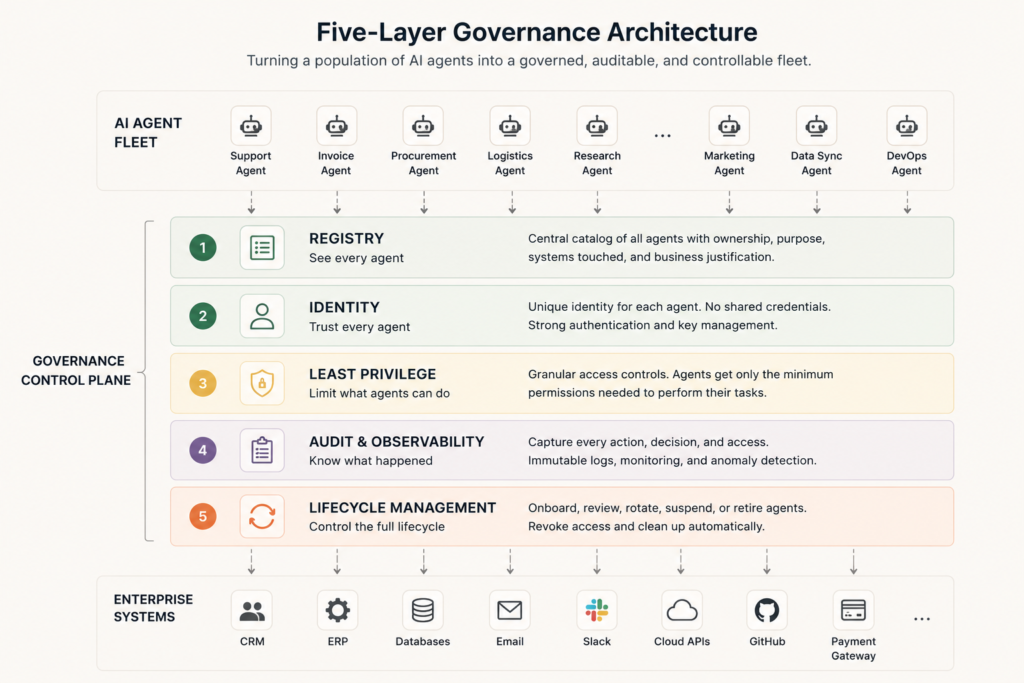
Layer 1: A registry, because you cannot govern what you cannot see
The first layer is the least glamorous and the most important. Every agent gets an entry in one place, before it reaches production, with four facts attached: what it does, who owns it, what systems it touches, and why it needs them.
On the ten-automation logistics build, this was a manifest. Every automation had a named owner and a one-line business justification, and if an automation could not answer why it needed a given credential, it did not get the credential. That sounds obvious at ten. It is the difference between a fleet and a fog at a hundred.
The registry is what converts an invisible population into a governed one. Without it, every other layer is guessing. With it, you can answer the question a board will eventually ask, which is simply: how many agents do we run, and what can they each do.
Layer 2: An identity per agent, because a shared superuser is a single point of failure
The most common shortcut in agent deployment is the shared automation account. One identity, broad access, used by everything. It is convenient on day one and indefensible by day ninety.
Each agent needs its own identity. Its own service account, its own credentials, its own scoped role. This is not bureaucracy. It is the only way an audit log means anything, because an action taken by a shared account tells you nothing about which agent took it. An action taken by a distinct identity tells you exactly who to look at when something breaks.
Distinct identity is also what makes the kill switch in Layer 5 possible. You cannot shut down one misbehaving agent if five agents share its credentials, because you would take down all five. Identity is the foundation the rest of the control surface stands on.
Layer 3: Scoped, deny-by-default access, because most agents need far less than they are given
Once an agent has its own identity, that identity should start with nothing and receive only what the workflow demands. Deny by default. Grant per tool, per system, per action.
This is the pattern we described in detail when we wrote about connecting agents to legacy systems through a governance gateway. The agent does not get direct keys to the ERP or the database. It goes through a layer that holds an explicit allowlist of what this specific agent is permitted to do, and rejects anything outside it. If a protocol like MCP is in play, that gateway is where the scoping lives, and it is worth understanding the tradeoffs between the connection standards before you pick one.
Two disciplines make this real rather than theoretical. Read-only wherever the job allows it: on an analytics agent we built that translated plain-English questions into database queries, the agent had read-only access to the database and a validation pipeline in front of it, so the worst case was a bad answer, never a bad write. And least privilege enforced at grant time, not review time, so an agent physically cannot reach a system it was never scoped for, rather than being trusted not to.
The test for this layer is blunt. Pick any agent and ask what is the worst thing it could do if its logic went wrong tomorrow. If the answer is “not much, because it cannot reach anything it should not,” the scoping works. If the answer is “we are not sure,” you have a shadow agent with a name.
Layer 4: An audit trail you can actually read, because permission is not the same as behavior
Knowing what an agent is allowed to do is not the same as knowing what it did. The fourth layer is the record.
Every consequential action an agent takes gets logged, immutably, in a form a human can read under pressure. On a healthcare document-automation build where an agent moved physician orders into an electronic medical record, every step wrote to an audit log, and anything that looked wrong raised an alert into the team’s Slack in real time. The point was not compliance theater. The point was that when a question came up about a specific order, the answer took seconds, not a forensic afternoon.
The 2026 shift in this layer is from permission-based thinking to behavior-based thinking. The dangerous agent is rarely the one doing something it is not allowed to do. It is the one doing something it is allowed to do, at the wrong time, in the wrong volume, for the wrong reason. You catch that only by watching behavior, not by trusting the permission grant you made months ago. Continuous visibility into what an agent is actually doing beats a static list of what it is theoretically allowed to do.
Layer 5: A kill switch and a retirement policy, because agents that never stop become the sprawl
The last layer is the one teams skip, and it is the one that determines whether your fleet stays a fleet or decays back into a fog.
You need to be able to stop one agent without stopping all of them. That is a direct consequence of Layer 2: distinct identities mean you can revoke one without touching the rest. Build the switch before you need it, because the moment you need it is the worst moment to discover you have to take down twenty working automations to stop one.
And you need a retirement policy. When a workflow is replaced, its agent gets decommissioned and its credentials revoked, on a schedule, by someone whose job it is to check. The shadow agents that hurt most are almost never new. They are old, forgotten, still holding live access to systems they have no reason to touch. Retirement is the layer that keeps the population from growing faster than your ability to govern it.
The five layers at a glance
For teams mapping this to their own environment, the architecture reduces to five questions, each owned by a layer:
- Registry: Do we have one place that knows every agent, its owner, and its purpose?
- Identity: Does each agent have its own credentials, or do they share?
- Scope: Does each agent start from deny-by-default and receive only what its workflow needs?
- Audit: Can we reconstruct what any agent did, in seconds, from an immutable log?
- Lifecycle: Can we stop one agent without stopping the rest, and do we actually retire the ones we no longer use?
A “no” to any of these is not a gap in a checklist. It is a named location where your next incident will come from.
Governance is a velocity layer, not a tax
The reflex is to treat all of this as overhead that slows agents down. That reflex is backwards, and getting it backwards is why most teams underinvest here until something breaks.
Governance is what lets you ship more agents, not fewer. An organization that can register a new agent, scope it, and see what it does can approve the next one in a day, because the risk is bounded by design. An organization without that layer has to argue about every new agent from scratch, because it has no way to bound the risk, so it either says no too often or says yes too fast. Both are expensive.
The teams pulling ahead in 2026 are not the ones with the most agents or the fewest rules. They are the ones who built the governance layer early enough that trust became cheap. When you can trust an agent to operate without a human watching every action, you can point it at more work. That is the entire return on this architecture. It is not safety for its own sake. It is speed you can defend.
Where to start, whether you have ten agents or a hundred
You do not build all five layers at once, and you do not need a platform to begin.
Start with the registry, because it is the cheapest layer and it makes every other decision legible. A single shared document that lists every agent, its owner, and what it touches will surface shadow agents you did not know you had within an afternoon. That inventory alone is often the highest-value hour a team spends on this.
Then close the worst identity gaps: find the shared superuser accounts and split them. Then scope the agents with the most dangerous access, working from write-access-to-production down. Audit and lifecycle come next, and by the time you reach them you already have the registry and identities that make them straightforward.
The mistake is waiting for a platform decision before doing any of it. The architecture is a sequence, not a purchase. The first three layers are process and discipline before they are tooling, and the discipline is what actually governs the fleet.
The fleet is the unit
The teams that get hurt in the next eighteen months will not be the ones whose agents gave a wrong answer. They will be the ones who lost count of how many agents they were running and what those agents could reach.
The shift is small to say and hard to do. Stop governing agents one at a time. Govern the fleet. Build the layer that sees all of them, give each one an identity and a boundary, keep a record you can read, and hold the power to switch any of them off. Do that early, while the number is still ten, and the number can grow without the risk growing with it.
If you are automating real workflows and the agent count is climbing faster than your ability to name them, that is the signal to build this layer now. What would you find if you tried to list every agent you are running today?
This piece is part of Intuz Engineering Notes, where the Intuz engineering team writes about building and shipping production AI. Intuz builds AI agents and workflow automation for enterprises, from a single task to a full business process, integrated into the systems you already run. If you are scaling past a handful of agents, start a conversation with our team.
FAQs
What is AI agent governance?
AI agent governance is the set of controls that lets an organization know which AI agents are running, what each one is permitted to access, what each one actually did, and how to stop any of them. It governs the agent as an actor with credentials in production systems, which is distinct from evaluating whether the agent’s output is correct.
What is a shadow AI agent?
A shadow AI agent is an automation or agent running in production that no central system tracks. It usually results from shared credentials, an owner who left, or a workflow that was replaced without decommissioning the agent. It is rarely malfunctioning. Its risk comes from holding live access with no oversight.
How do you give an AI agent least-privilege access?
Give each agent its own identity, start that identity with no permissions, and grant access per system and per action based on what the workflow actually requires. Enforce it through a gateway that holds an explicit allowlist and denies anything outside it, and prefer read-only access wherever the task allows.
Do small teams really need agent governance?
Yes, and starting small is cheaper. A team running ten automations can hold the whole fleet in a single registry and split identities in an afternoon. The cost of governance grows with the number of ungoverned agents, so the least expensive time to start is before the population is large.
How is agent governance different from agent observability?
Observability tells you whether an agent’s output is correct and whether the system is healthy. Governance tells you whether the agent should have access at all, whether you can prove what it did, and whether you can stop it. You need both. Observability watches the answer, governance watches the actor.
What is the first step if we suspect we have shadow agents?
Build the inventory. List every automation and agent in production with its owner and the systems it touches. That single registry surfaces the shadow agents, the shared credentials, and the retired-but-still-running agents faster than any tool, and it is the foundation every other control depends on.
Work with Intuz
Ready for Production AI?
Build AI agents with governance, security, and operational controls from day one.
Let's Get Started
Share this article
![AI Agent Workflows: Top 5 Use Cases, Examples & Implementation Guide [2026]](https://www.intuz.com/wp-content/uploads/2026/04/AI-Agent-Workflows-Top-5-Use-Cases-Examples-Implementation.webp)