





In this blog, we’ll walk through building a robust recommendation system for e-commerce platforms like Meesho, with a focus on MLOps best practices.
Modern e-commerce success relies heavily on personalized recommendations. When implemented effectively, recommendation systems can significantly boost user engagement, increase average order value, and drive sales.
Show
- Personalized recommendations are central to modern e-commerce success, and when implemented well they boost user engagement, increase average order value, and drive sales.
- The system is built for a Meesho-style platform using machine learning to predict the most relevant items for each customer based on past behavior, preferences, and interactions. MLOps practices keep the model effective over time through security, continuous monitoring, version control, and scalable infrastructure.
- The build uses an AWS-based pipeline: data flows from a Source S3 bucket through AWS Glue DataBrew (ETL) and Glue Crawler (cataloging), into Amazon Athena (queries), then Amazon SageMaker (model training/deployment), with CloudWatch for monitoring and QuickSight for visualization.
- The core workflow covers four practical stages: sourcing the Meesho dataset from Kaggle, data preprocessing (cleaning, feature engineering, normalization, encoding), data storage/management (S3 plus SQL/NoSQL, data lakes, warehousing, and real-time streaming options), and building the ML model itself.
Building Robust eCommerce Recommendation System
We’re creating a robust e-commerce recommendation system for a platform like Meesho, which helps users discover products they are likely to purchase. The recommendation system will leverage machine learning to predict the most relevant items for a customer based on their past behavior, preferences, and interactions with the platform. By implementing MLOps practices, we’ll ensure our model remains effective over time through:
- Security
- Continuous monitoring
- Version control
- Scalable infrastructure
The Problem We’re Solving
E-commerce platforms face several challenges that our recommendation system addresses:
- Information Overload: Users struggle to find relevant products among thousands of options
- Personalization at Scale: Each user has unique preferences that must be catered to
- Real-Time Requirements: Recommendations need to update based on current browsing behavior
- Evolving Preferences: User interests change over time, requiring model adaptability
Project Focus – Building Machine Learning Model
The project will focus on building a machine learning model that can accurately predict what products a user will be interested in, helping the platform increase engagement and sales.
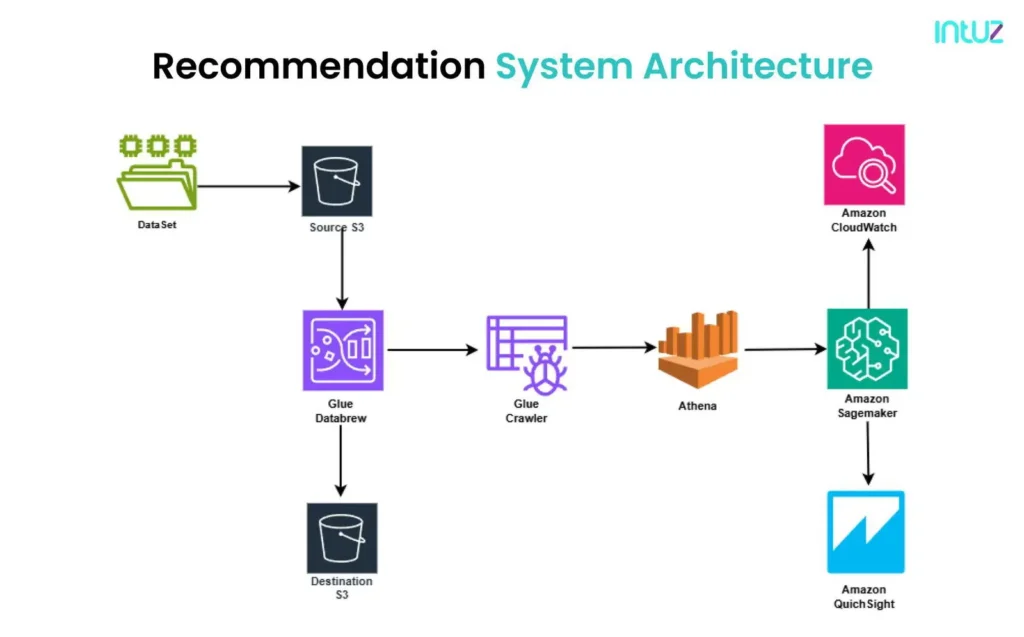
This architecture diagram illustrates an AWS-based MLOps (Machine Learning Operations) pipeline that handles data processing, storage, and machine learning workflows. Here’s a breakdown of the components and their relationships:
- Data Flow Begins: The pipeline starts with a Data Set (shown as a folder with data chips) that feeds into a Source S3 bucket for initial storage.
- ETL Process: From the Source S3 bucket, data flows to AWS Glue Databrew, which is a visual data preparation tool that helps clean and normalize data without coding.
- Data Storage: After processing in Glue Databrew, the transformed data is stored in a Destination S3 bucket.
- Data Cataloging: Simultaneously, data from Source S3 is also processed by AWS Glue Crawler, which automatically discovers and catalogs metadata from the data source.
- Data Analysis: The cataloged data moves to Amazon Athena, which allows for SQL queries against data stored in S3.
- Machine Learning: The query results from Athena flow to Amazon SageMaker, which is AWS’s fully managed machine learning service for building, training, and deploying ML models.
- Monitoring: Amazon SageMaker connects to Amazon CloudWatch for monitoring the performance of the ML models and the overall pipeline.
- Visualization: Finally, SageMaker connects to Amazon QuickSight for business intelligence and visualization of the insights generated from the ML models.
How to Build E-commerce Recommendation System with MLOps
1. Data Source For Creting Robust Recommendation System
We’re using the Meesho Recommendation System dataset from Kaggle, which contains:
- User Data: Unique user IDs Demographic information (age, gender, location)
- Product Data: Product IDs and URLs, categories and pricing information
- Interaction Data: Purchase history and user ratings
2. Data Preprocessing
Before training the model, several data preprocessing steps will be performed:
- Cleaning: Removing missing or irrelevant data.
- Feature Engineering: Creating features such as “recently viewed products” or “purchased together” to enhance recommendations.
- Normalization: Standardizing features like price to ensure they contribute equally to the model.
- Encoding: Encoding categorical data, such as product category and user demographics, for machine learning algorithms.
3. Data Storage and Management
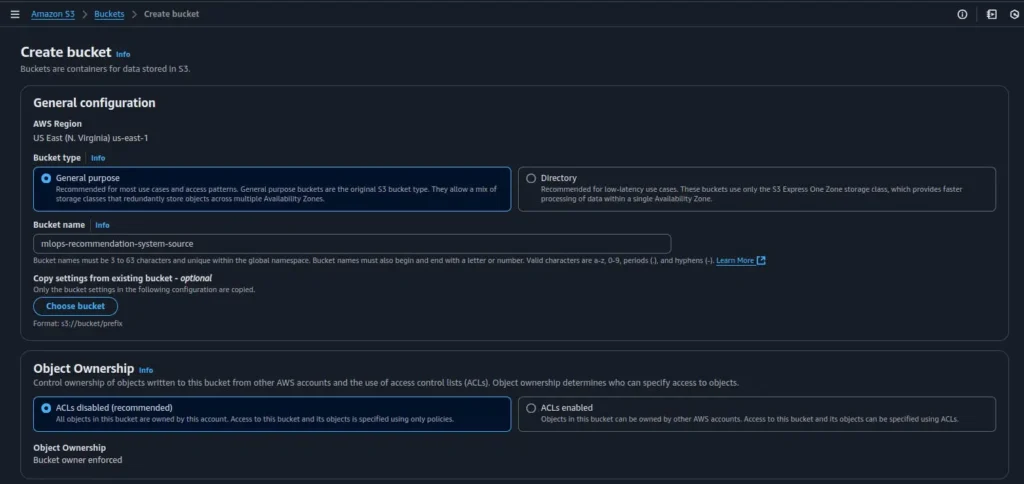
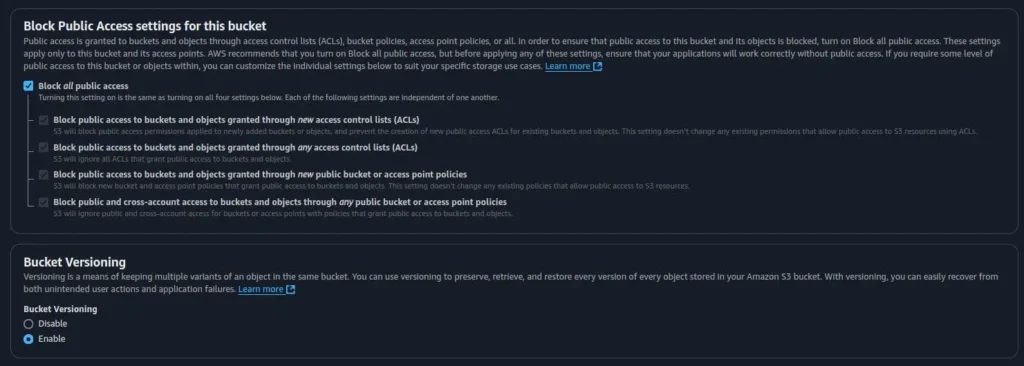
While our implementation uses AWS S3 as the primary storage solution, below are the steps which shows the process of creating S3 bucket and storing the dataset into it:
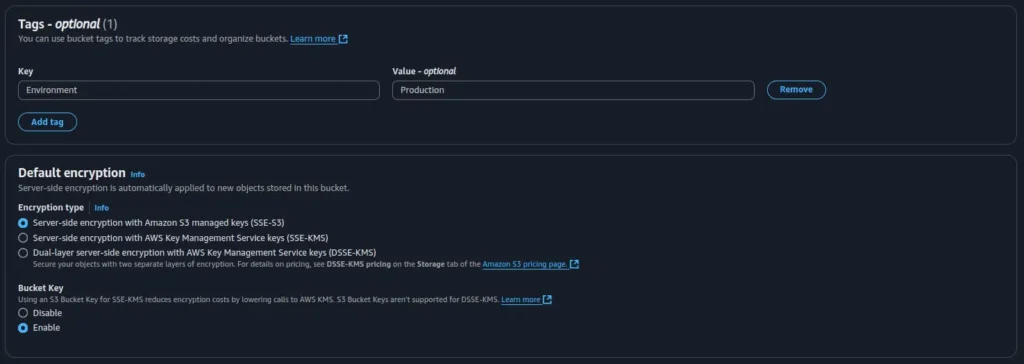
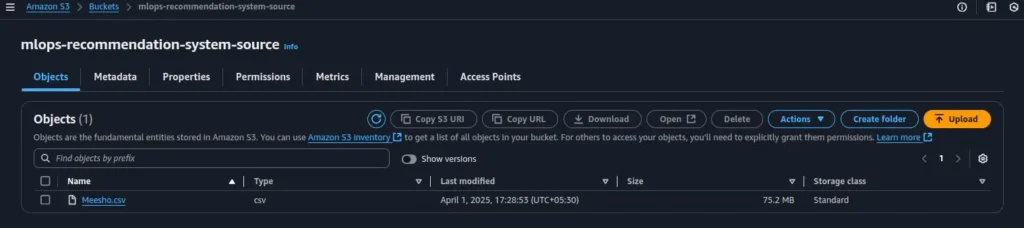
Other than AWS S3 as storage we can also use following approach for data storage:
1. Database Storage (Structured Data)
- SQL Databases (e.g., PostgreSQL): Store user data, transaction history, and product data in a relational database that can easily be queried.
- NoSQL Databases (e.g., MongoDB): Store semi-structured or unstructured data like user interactions and logs.
2. Cloud Storage (Unstructured Data):
- Amazon S3 / Google Cloud Storage: For storing large datasets, raw logs, and model files.
- Data Lakes: Store large volumes of unstructured data in a format that can be processed later.
3. Data Warehousing (Analytics):
- Amazon Redshift / Google BigQuery: For aggregating large amounts of data and running analytical queries to derive insights for model training.
4. Real-Time Data Streaming (For Real-Time Recommendations):
- Apache Kafka / AWS Kinesis: To stream user activity data (clicks, views, purchases) in real-time, ensuring that recommendations are updated as soon as new data arrives.
Conclusion
Building an effective e-commerce recommendation system requires both machine learning expertise and operational excellence. By implementing MLOps practices, we ensure our recommendation system stays current, performs reliably, and scales efficiently.
In upcoming posts, we’ll dive deeper into data cleaning process, model training techniques, monitoring best practices, versioning, and security considerations for production recommendation systems.
If you are an eCommerce company looking to boost sales with generative AI-driven personalized recommendations system,
Book Your Free 45-minute Consultation with Our Generative AI Experts Today!
FAQs
How does MLOps improve an e-commerce recommendation system?
MLOps keeps the model effective long after launch through four things: security, continuous monitoring, version control, and scalable infrastructure. User preferences shift constantly, so a recommendation model trained once will degrade — MLOps practices catch that drift and retrain before performance drops. Version control lets you roll back a bad model release; monitoring through tools like CloudWatch flags anomalies in real time; and scalable infrastructure handles traffic spikes without re-architecting. The result is a system that stays current, performs reliably, and grows with your catalog and user base. Without MLOps, teams ship a model and watch accuracy quietly erode. With it, the system improves on a schedule instead of breaking by surprise
What data do you need to build a product recommendation system?
Three categories drive accurate recommendations. User data covers unique IDs and demographics like age, gender, and location. Product data includes product IDs, URLs, categories, and pricing. Interaction data — purchase history and user ratings — is the most valuable, because it captures what people actually do rather than who they are. The build here uses the Meesho Recommendation System dataset from Kaggle, which packages all three. In practice, the richer your interaction data, the better the predictions, since behavioral signals like recently viewed or purchased together reveal intent that demographics alone miss. If you’re starting out, prioritize capturing clean interaction logs early — that’s the dataset your model will lean on hardest.
Which AWS services are used to build an ML recommendation pipeline?
This build relies on seven AWS services, each handling one stage. Amazon S3 stores raw and processed data across source and destination buckets. AWS Glue DataBrew cleans and normalizes data without code. AWS Glue Crawler discovers and catalogs metadata automatically. Amazon Athena runs SQL queries directly against S3 data. Amazon SageMaker builds, trains, and deploys the actual ML model. Amazon CloudWatch monitors model and pipeline performance. Amazon QuickSight visualizes the resulting insights for business teams. The advantage of staying within AWS is that these services integrate natively, so data moves between them with minimal glue code. For teams already on AWS, this stack keeps a recommendation system maintainable rather than stitched together.
Can a recommendation system update in real time?
Yes, with the right streaming layer. Tools like Apache Kafka or AWS Kinesis stream user activity — clicks, views, purchases — as it happens, so recommendations reflect current browsing behavior rather than yesterday’s data. This matters because e-commerce intent is fleeting: a user researching running shoes wants relevant suggestions in that session, not next week. Real-time streaming sits alongside batch storage like S3 and data warehouses, feeding fresh signals into the serving layer while historical data trains the underlying model. Not every platform needs sub-second updates, but if your conversion depends on session-level relevance, real-time data is what makes that possible. Start by identifying which events actually change a recommendation, then stream those.
Work with Intuz
Build Your AI Recommendation Engine
Boost sales with personalized product recommendations.
Let's Get Started
Share this article